Friday, 9 November 2012

Some People More than Others

This is my introductory post for this week's theme of Class, Hierarchy and Transition on the Transition Network Social Reporting Project. Mark Watson

(i)
We live in a society and culture that is shot through with class and hierarchy. We are brought up living and breathing it whether we like it or not, with our monarchies and corporate pyramids, line managers, owners, renters, professionals, masters, servants, wage-slaves, the woman who has and the woman who does.

Some people are upstairs, some people are downstairs, the ones downstairs are dreaming of what it’s like to be upstairs. And whilst most people do not find themselves literally living in Upstairs, Downstairs today, one look at our lives, our day-to-day exchanges, the way we speak and act with each other, the language we use, not to mention the huge (and growing) disparity in wealth distribution and access to resources, is enough to see how heir (and heiress) we are to millenia of inequality in civilisation. Our own government (if we can call it ours) here in the UK is testament to this, packed as it always is with privileged public schoolboys.

Some people, as Irish poet Rita Ann Higgins says*

know what it is like,
to be called a cunt in front of their children
to be short for the rent
to be short for the light...
 

and other people don't.
 
(ii)
But what has this got to do with climate change, peak fossil fuels and economic crisis? The things that individuals and communities in transition are responding to?

In a recent interview with Rob Hopkins, Kevin Anderson, deputy director of the UK Tyndall Centre for Climate Change Research, says that an adequate response to climate change and continued economic growth are mutually exclusive. Levels of energy and resource consumption need to be drastically reduced, and it's the people who earn more and therefore consume more, where these reductions need to happen most. He says that already people on lower incomes are consuming less because they have less money:
given that we face a lot of issues now with unemployment, welfare reductions etc., issues that disproportionately affect people in the middle-lower income band; it is these people that could actually benefit from a transition to a much more efficient and lower carbon economy. Andersen goes on to say that Transition’s bottom-up, community approach is pivotal in providing examples of how individuals and groups can prepare for a future with less fossil fuel energy and less consumption. They are, in effect, the pioneers.
Most people who have done "very well out of our western system, and live very carbon profligate lifestyles are going to face difficult challenges, and we should not pretend otherwise."

At present though, many of these people, including old friends of Andersen’s in the oil industry and even fellow climate change scientists "think climate change is a serious issue but are not prepared to make any changes to their lifestyles. It has raised some serious challenges for me in maintaining personal relationships..."
Until we actually embrace alternative means of finding value in our lives, I think that transition from where we are today, high-carbon, high-energy lifestyles, to ultimately lower-carbon lifestyles is going to be both difficult and unpopular. But ultimately, I do not see an alternative.
Some of those alternative means are going to have to come from letting go of the idea that some people are ‘better’ than others because of their position of birth, class, profession, what school or university they went to or because of how much money and property they own. This includes the have-nots. We have to stop aspiring to resource-hungry lifestyles. Another dream needs to happen.

(iii)
I am the current chairman of Sustainable Bungay, a grass-roots community initiative in north-east Suffolk, 15 miles from Norwich. The group started up in November 2007 (it’s our 5th birthday this month) after a Climate Change conference in the local Emmanuel church (which included speakers from the Tyndall Centre in Norwich). 

We became an ‘official’ Transition initiative in the summer of 2008, ‘unleashed’ in 2009 and we’ve been unleashed ever since. We have had minimal funding since we began. We host several events each month, and you can read more about us on our community website – in fact, I've just noticed the about us section is due for an update.

I’m not saying that no hierarchy or class exists in Sustainable Bungay. There is scarcely a place in our culture and in ourselves where these have not been ingrained, and they are sometimes expressed unconsciously.

But I’d like to talk a bit about the core group, which has been meeting together for five years now. Every month since then, bar December when we have a party, we meet at the library or the oak room at the Three Tuns pub and organise and feedback on our various events and projects.

We have a chairman, a secretary, a treasurer, a bank account and a basic constitution. 

The core group meetings are open to anybody who wants to come as are all our events. This ‘open plan’ structure has kept the group coherent, dynamic and relatively fluid. The meetings provide a space where people can report back on how the projects they’re involved with are going, ask for help or sound out ideas for new ones. 

This commitment to turning up each month over the years has been a key part of building community. The open nature of the group means that people of all different types get to meet each other, work together, even take the lead on projects: employed, unemployed, self-employed, old, young, middle-aged, with money or without, working class, upper class, middle class. What we're getting is a great deal of excellent practice in working together, one of the major skills we'll need in a downshifted future.

I grew up in a working class family of Irish immigrant and English background on a council estate in High Wycombe, in an atmosphere with Bohemian overtones and musical and artistic ability. My dad was a car mechanic and my mum cleaned offices and houses. I passed the twelve-plus and went to grammar school where I was thrown suddenly among middle-class people with much more money and status (and posher cars) than my parents had. I have known what it is like to be short of school books* and money and to be looked down on*. To wear a cheaper school uniform than others and be aware of it. And to dream of being upstairs when I was downstairs. As an adult living in various places I have also felt the exclusion of being a renter when most other people were buying their houses.

I am no longer personally so much at the behest of these things. Partly due to age, partly to having spent a great deal of time examining them and lately to involving myself in Transition with all the friendly collaborations and difficult encounters, carbon cutting and community building. I'm tougher now. Though social inequality is as rife, as iniquitous and as inexcusable as ever.

I am at present the non-hierarchical chairman of Sustainable Bungay (happily holding the position until it's time to let go for someone else's turn), and a writer on this Social Reporting project. I have been downshifting for years on very little income (could do with a bit more, actually), exploring with others ways to (re)connect with the planet, keeping our carbon down and our spirits up.

My dreams though are neither up nor down these days, more steady-state.

Photos: Temple of the Magician (all civilisations need a magician or two), Uxmal, Mexico, 1991; We Told Them the Wealth Would Trickle Down**; Downsizing at the first Sustainable Bungay Give & Take, March 2009***; Plants for Life (for everyone) poster, April 2012. Images/artwork by Mark Watson except **from the  Mendo Island Journal and *** from Sustainable Bungay
*from the poem Some People by Rita Ann Higgins (1988) in An Awful Racket (Bloodaxe Books, 2001)

Tuesday, 6 November 2012

Swimming for Adrienne

Last month my dear friend and fellow Transitioner Adrienne Campbell died. When she told me she was going into retreat to do battle with the cancer that had returned, I knew I wouldn’t see her again. So I went down to the sea and swam in the path of the sun and remembered everything we had said to each other. It was Lughnasa, around the time of her 52nd birthday. I lay in the waves and let them take my weight, feeling the currents underneath me, the wind on my face, the children laughing on the shore, the cry of the terns, the vastness of the elements, sea and sky. I’m swimming for you, I told her. Because she loved wild swimming. It was something we shared, along with a love of all wild things, bees, plants, ancestors, and of course, Transition.

I went swimming all August and all September. Mark and I would sit in the dunes and watch the sun come up. It was unusually calm most days, and always full of light. In her hometown, Adrienne came out of retreat and welcomed people into her bright room. She made a video about her dying and people from all round the world celebrated her in an extraordinary on-line testimony. By the autumn equinox the weather turned stormy and the sea became rough and very cold. I couldn’t stay in for very long. In her bed in Lewes Adrienne started to slip away. As All Souls approached, I went to the woods and sat by the pond. All around me the hornbeams dripped rainwater onto the surface, making circles that moved ever outward. Everything was silent and still. I was by myself, in the wood, and yet I was not alone.

All people come and go in your life, but some people remain deep in your heart. You remember them even when you are not close to them, in another country, far away. It’s as if they had always been there. Adrienne walked back into my life three years ago. I had recently joined Sustainable Bungay and I was in Beccles Library and watching the trailer for the documentary, In Transition:

“Oh my god, it’s Adrienne!” I cried out loud and rushed over to tell Mark. “I’m going to email her now!” We had not seen each other for twenty five years. When we were in our 20s we had been part of a group called The Women’s Dinner Party. It was formed by four of us – writers, editors all – who wanted to meet up as intelligent female beings, rather than ninnies and have meaningful conversations. We used to meet up in each other’s houses, hosting meals for about 8 or 10 and share our world-views. We had one rule: no talking about boyfriends or holidays. We worked in different fields and networks, so it was a great way to exchange knowledge. Adrienne (Katy then) was writing science stories for The Economist, I was writing style stories for Vogue and Marxism Today. She was quieter than Cat and Emma, and surprised me utterly one summer evening by giving an off-the-cuff perfect low-down on quantum mechanics. Afterwards we went outside and stood in the sun and she told me how she came originally from America. “Oh”, I said, and suddenly saw, underneath her shyness and gazelle-like beauty, a powerful spirit yearning to go home.

Adrienne surprised us all the following year by disappearing and joining a Subud community in Australia. I visited her once when she returned to the city and was staying in the squatted hippy kingdom of Frestonia. Even though it was not far from where I lived in Notting Hill, we were worlds apart. She was married with babies, living a deliberate spiritual path. I was still on the fast track. I didn’t know then that I too would leave my city life of dinner parties, boyfriends and holidays. I didn’t know either that, like her, I would, not be coming back.

When I travelled to the Transition conference in 2010 in Devon, I emerged out of the station and jumped, because there waiting for a taxi, was a familiar-looking slim figure with curly hair. It was her eldest daughter Sophia. “Mum’s really looking forward to seeing you,” she said.
 
It was mutual. When we met we didn’t stop talking; we had so much to say. Somehow we knew that we wouldn’t have much time to say it in. It would be like that for the next three years. On the phone mostly, by email, and sometimes face-to-face, at Transition convergences and the London Bee Summit. Some people you don’t know for that long, and yet you can go very very deep with them. I don’t know anyone else now (apart from Mark) with whom I can go as deep as I could with Adrienne. There were no taboos, or politeness in the way of our communication. Everything was allowed.

Everyone knows a different person in one person - that’s how it is on this earth.  I wanted to write about the Adrienne I knew, briefly in time, but deeply in spirit,, because I wanted to pay respect and honour the person who could look difficulty in the eye. Because I haven’t met anyone else in Transition who could talk from this perspective. Most people shy away from the shadows and traumas when they emerge, when the skeletons come rattling out of the closet. Adrienne advanced towards them, sun in hand, courageously.  She always listened, sister lion that she always was.
 
You miss people because when they walk into a room, or you stand beside them, only they can make you feel a certain way. I will miss Adrienne because she had a singular quality that few people possess: she made you feel as though you mattered, that everything mattered, and that kind of depth and generosity makes for a whole different relationship with the world. We spoke at length about the difficulties we had experienced in Transition: she like me had been endlessly scapegoated in her life and also by people in her initiative. She was often cast as “the difficult person”, the one who brought stuff up, the one who brought the elephant into the room, or called the company to account. When I told her about our Bungay Community Bees apiaries, she quizzed me:

“Are you feeding them? she asked.
“Yes, a little for the winter,” I replied.
“That’s not good practice,” she said.

A natural beekeeper for 20 years, a queen bee who knew how to co-ordinate the flight path and command the loyalty of all the workers and drones in her colony, she knew when something was out of alignment.

“Honey should only be used as a medicine,” she stated. “It’s a gift, not a commodity,”

So I stopped using honey carelessly to sweeten my food. She was fierce and I loved her for that. Because I knew that fierceness came from an ancestral being that I recognised – sentinel to the planet, as the red rocks of America. A being I had glimpsed many years ago.  She told me I should get a livelihood from my Transition work. I told her she was a great writer and invited her to join the Social Reporting Project. I am fierce too. That’s why we got on, We felt the same about a lot of things. About activism, about local food, about medicine, about marking the equninoxes and solstices, about duty and love and swimming upstream against the flow, getting  back to the point where we can all start again. 


Last October we had a long discussion about the earth. It was in Lewes, just after Transition Camp, where we had shared a yurt and given talks about bees and plants. “To really see what is going on you have to shift your perception,” I told her, “and communicate with the planet directly.”  “I am too much of a scientist,” she told me, and said she could not bear to think about the future that the data made so stark and inevitable.

We went down to her allotment to pick salad leaves for supper. We sat by the hive in the small forest garden she had made. I put my hand against the glass pane and felt the warmth of the bees and the scent of the fragrant wax. We sat in silence as the twilight came to the gardens and the moon rose in the sky. It felt as if we had always sat there in that vibration of everything mattering, of having its place in time, that we recognise inwardly as the heart, but rarely voice out loud.

And then, without saying anything, we got up and moved away. I saw her one more time after that, at our Social Reporting Project editorial meeting to discuss the upcoming year in the greenhouse at Finsbury Park. It was on one of the most beautiful frosty mornings I have ever seen.  She would write later about going on a locavore diet, overfishing, community solar power, growing oats, permaculture, making salt from sea water boiled on charcoal (which she had made herself), buying nothing for a year, not shopping in supermarkets (as the lead comment for the Transition Free Press), sharing a neighbourhood car, and all the projects she was justly proud of in her individual life and in her home town. She was an instigator and pioneer in all things resilient, and I’m certain many fellow Transitioners will sing her praises for all the great work she did on our behalf at the celebration ceremony in Lewes this Sunday.

But I wanted to write this personal blog today because our paths crossed in an extraordinary and significant way. She was someone who walked through people’s lives and shook them up. She could do this because she had undergone radical change herself. Sometimes this was up the wrong way, but this didn’t mean the shaking wasn’t right. Shaking is what we need to wake each other up out of our collective sleep. To get us to turn around and head upriver. That’s something we both knew was necessary in Transition, but was a continual challenge to experience and to go through with heart, especially within groups.  Denial and projection are the worst of its side-effects, and it meant a lot that we could speak of these things together, when no one else would. 

We parted mythically and suddenly on the underground at King’s Cross that day. The inspectors hauled me off the train at for an incorrect ticket. I waved goodbye, as she stood by the door in her long, reskilled coat with its wild mane collar. Then she and Mark and Caroline disappeared down the tunnel, en route to Occupy St Pauls.

“I hope she will be all right,” said Caroline,
“She’ll be fine,” laughed Adrienne.

Which, of course, I was.  


Adrienne Campbell was a founder member of Transition Town Lewes and a founder reporter on the Social Reporting Project. She also wrote a weekly blog, 100 Monkeys.

Details about Adrienne's Celebration on Sunday 11 November here 
Images: swimming in September (Mark Watson); writing with Adrienne at Transition Conference, 2010' making skeps for bees; swimming with Adrienne up  the River Dart, 2010; Adrienne and TT Lewes launch Lewes Pound (Mike Grenville); Adrienne with beautyberry, Finsbury Park, 2012 (MW)

Sunday, 4 November 2012

Transition Video Games: Anno 2070

Ever since the Transition Conference, I've been meaning to write a post about it on the Transition Norwich Blog.  Well here's one, and perhaps there will be more later!

During open space on the Saturday afternoon of the Transition Network Conference, I was a bit of a butterfly and attended several sessions which caught my interest, without settling down for too long at each.  One such session, which I was probably at for no more than 5 minutes, was Transition Games. I wanted to let the people there know about Jane McGonigal, whose TEDTalk asserts that "Gaming can make a better world" (I highly recommend watching!), but I was also interested in what they said on the subject and whether there were any computer games that they thought relevant to Transition.

I'm not much of a gamer myself, but ever since high school, I've been great friends with a guy whose hobby is computer games.  He collects classic and rare computer games and consoles, raves about the latest technology and innovations, and, of course, plays them.  Through him, I get to see pretty much all the variety of video games that exist, and play games from time to time.  I've always been disappointed at quite how many of the computer games include violence.  Many of them are centred around war, or at least defeating your enemies in one way or another.  As a pacifist, I've constantly been on the look-out for games that turn this around, and make diplomacy the enduring quality of the best player.

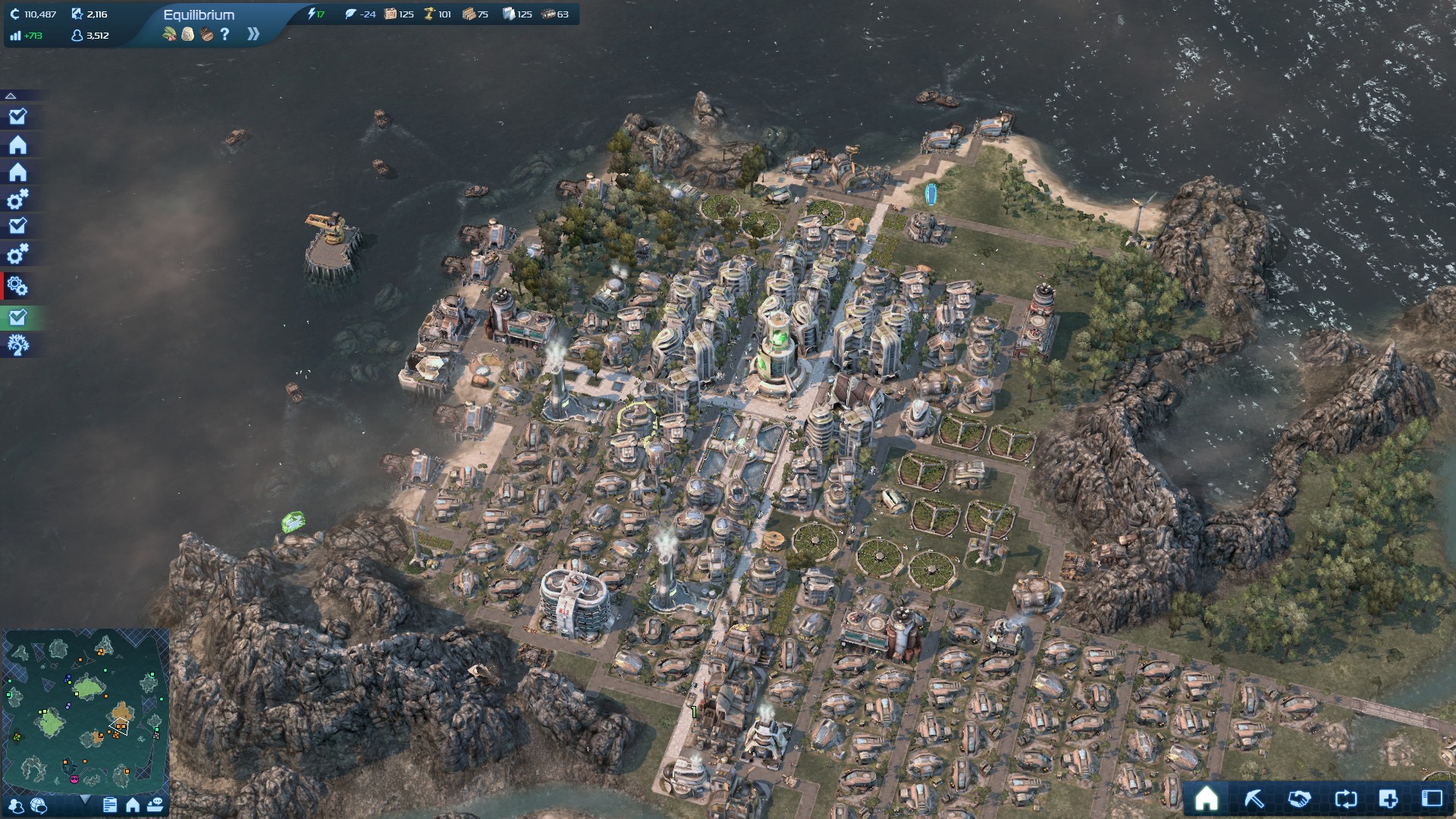
So, when at the conference someone mentioned a game called Anno 2070, I was interested to hear how it was different, and what it could teach of Transition principles.  It was a game about resources, apparently, set in 2070, when sea levels have risen as a result of global warming, and several factions are competing to make the best use of the remaining resources. One of those factions is decidedly environmental in its focus, harbouring energy from wind, improving the quality of soil and replanting forests. I was intrigued, and decided that I would see this game for myself. So I bought it, and took a look.

Anno 2070 Screenshot

The game is indeed about resources.  Each "mission" requires you to settle an island (its always an island because of the raised sea levels of the future), create a city, and then use the island's natural resources to complete an objective.  In one mission, the objective is to research the technology to save an existing city from the effects of poisoned fish, but they vary greatly.  The missions require you to mine resources, build factories, trade with other factions and (in a just a few cases) battle against factions with conflicting interests.

I was disappointed.  On several counts.

Firstly, there are two basic factions, one representing corporations that is only out for profit, and another representing environmental groups.  Apart from this not being a realistic model of a potential future political scenario, the differences are minimal, simplistic, and arbitrary.  The eco organisation still mines coal and ores, both consume huge tracts of virgin land in the building of their cities, and hydro-electric power (one of the best forms of renewable energy) is only available to the profit-motivated corporation.

Secondly, there is no real concern about the balance of resources, of the production and disposal of waste, or the effects that this has on the environment (except, again, in a rather arbitrary way).  The amount of resources on each island is plentiful, and therefore efficiency in the use of resources is not generally a concern, as long as you can process them fast enough and offset with "ecobalancing" technologies when required. It's not a game designed with education about eco-issues in mind at all, but it jumps on the bandwagon of being a game about climate change to get a few extra sales (from people like me... whoops).

Thirdly, there did end up being war in it, and although it's not the focus of the game in any way, nor is there any advantage to trying to avoid war.  In fact, it is sometimes part of the mission that you must attack some enemy facility to prevent them from causing damage to the environment.  Well, what about the damage to the environment caused by your military? That's what I want to know.

So, if you want to teach your kids about natural resources using a computer game, don't buy them Anno 2070.  Buy them Minecraft.

Minecraft Screenshot

Minecraft is an indie game (this means its produced by a small, independent software house, rather than the huge game publishing houses), where you wander around a virtual world made of one metre square blocks, moving them about and using the resources you find to build things.  Although there is an end objective (that of defeating the Ender Dragon), it's much more fun, in my opinion, to just create a virtual town with friends (it is a multiplayer game) and show off your creative talents (see the above town that my friends and I made!).

How does it teach about resources? Well, the name comes from the fact that you have to dig out materials and can then use them to craft things.  If you find iron, for example, you can smelt it, using coal or charcoal, and use it to make an axe. You can then use the axe to cut down a tree, which can then be crafted into timber to build your house, and so on.  The thing is that all these resources are limited. When you've spent ten minutes digging underground to find a seam of coal, you don't want to waste it by crafting something that you're not going to use.  And once you've mined all the resources from a particular area, they're gone for good, and you must go further and further afield to find the resources you require. Wood, on the other hand, is renewable, and as long as you remember to plant saplings to regrow trees that you chop down, you can have a continuous supply of timber, and therefore charcoal.  Resources have a real value to the player, because of their rarity, or the time and effort that it requires to get them.

OK, it's not perfect as a Transition game.  It wasn't designed as one, and it does still include enemies (monsters that appear at night), but at least you can choose your focus, and appreciate the challenges for what they are, rather than because they are imposed on you as "missions".

Still, an actual Transition game as an educational (and entertainment!) tool would be quite cool.  One that taught the challenges of resource allocation, the politics of change, the rewards of doing things differently.  Does anyone know of any existing games that fit the bill? If not, who's up for making one?!

Images: Open Space at the Transition Conference by Mike Grenville. Screenshots from Anno 2070 and Minecraft respectively.

Friday, 2 November 2012

Seasons Change

The season seems to have turned almost without me noticing, going from a rather wet summer into full autumn in a matter of days, with a few blasts of icy winter, just to remind us what's ahead.  Given that I spend most of my days sitting at a desk in an climate-controlled office, it's all too easy for the changing seasons to pass me by, especially as it seems we take our seasonal cues more from the shop windows (back to school, hallowe'en, Christmas etc) than from what's happening outside.
 
I'm keen for the girls to understand the cycle of season, and to become good observers of what's happening in the natural world.  This year, we have squirrels as well as birds eating from the bird-feeders in the garden - I don't really mind feeding the squirrels - but I'm happy to see a robin, some starlings (I think), and quite a few blue tits. We also have a fantastic ivy on the fence that is full of flowers at the moment - it really needs trimming back but I'm loath to do it before the bees have finished with the nectar.
 
But beyond these garden visitors, I'm hopeless, I have to admit, and would struggle even now to tell one bird from another, or know the difference between the now endangered ash tree and a birch.  So I try and get prepared for the seasons with these fantastic ladybird books; I can learn from them under the guise of the bedtime story!  If you get a chance to read one, do, they're fabulous and beautifully illustrated.  They're very much of a different time (late 1950s / early '60s) so there's a definite plumminess to them, but if you can get past that, there's much to recommend them.
 
Oxfam in town quite often has old ladybird books for sale - they make great Christmas presents!
 

Thursday, 1 November 2012

Common Plants, Common Room

"I'll teach a class on Herbs for Resilience," I said to Jeppe at a recent Dark Mountain conversation in Norwich.

We were talking about the 'Trade School' at The Common Room prototype day at St Laurence church on 10th November, where in exchange for a barter item' (which can be goods, produce or advice) you teach about something you know to people who want to know about it.

This sounds like a project that could help build resilience in a time of energy and financial constraints and ecological crisis. You meet people and get to swap some great skills. Most of what I've been doing in Transition over the past few years is helping people to connect with plants on all sorts of levels: as food, as medicine, as insect pollinators, as biospheric beings in their own right. Paying a different kind of attention to the plants around us.

“This is exciting,” I said. “In fact, I can do a herb class that’s part Plants for Life, part Low Carbon Cookbook. And I know just the local, wild plants to introduce to people."

I'm keeping those two plants a secret until the day, but I already have loads of ideas for future sessions on resilient herbs, based on all the Plants for Life events this year with Sustainable Bungay: making fruit leathers from hawthorn berries and apple, for example, both tasty and a tonic for the heart and circulation. Making the most of the wild plants of spring: nettle, cleavers, dandelion, to galvanise our systems into action after the winter. Making plant oils and medicinal teas.

I look forward to attending Jeppe’s class on Time skills - Navigating life in the networked society (2 - 3pm) and maybe even Vanessa’s one on practical origami (3.30 - 4.30pm). Check here for the complete timetable, a description of the sessions and teachers and to sign up for classes.

And maybe fellow TN blogger Jon might pop by during the day, as he has a plant present for me from the Eden Project!

The whole day is about “exploring a way to bring St Laurence’s church back into use as a new type of shared space”. So if you’d like this to be carried into the future, step inside, love!

It would be great to see you there! My class on Herbs for Resilience begins at 11.30am and will last around forty-five minutes.

Saturday 10th November, 9am – 4pm, St Laurence’s Church, Saint Benedict Street, Norwich NR2 4PG

Pic:  Collecting Yarrow from Herbs for Resilience - Yarrow, This Low Carbon Life, September 2010; Teaching a Medicine Plant workshop with Transition Belsize, London, May 2012

Tuesday, 30 October 2012

Low Carbon Cookbook - Cold Comfort Food

It began last week. Not just the dip in the temperature, the closing in of night, the leaves turning gold and tawny in the lanes and the proliferation of mushrooms, but the unexpected appearance of those underground veg on the table. Although there were still cosmos and California poppy flowering in the gardens, winter had put his bony leafless hand on the pot and suddenly we were all thinking Roots.

At our Dark Mountain meet-up in Norwich last week, Jeppe (just back from Denmark) served up roasted veg - parsnip, swede, carrot - and Brussel sprouts. We all tucked in heartily to spicy and warming dishes of cous cous, quinoa and Puy lentils before discussing the hands-on practical side of the movement, here exemplified by Simon Fairlie's recent blog, Growing Up Dystechnic.

Our conversation was all about time. The time it takes to cook by hand, chop and watch the stove, to grind seeds and spices, using the ancient tool of the pestle and mortar (or in my kitchen a  volcanic Mexican molcajete). How those things link you in with other times and places and peoples in a way machine-mixed or  factory-made food can never do. How crafting the materials of life, including food, runs along another groove to gimme-now 24/7 consumerism. Time is what you need when you enter the slow cook, downshift winter. The days of quick tossed salads and leaves and the sweet and hot Indian summer dishes that were the focus of our Happy Monday's Mexican Fiesta are ceding to stews and soups and warm, wholesome stuff that requires a different attention. In the Chinese Five element system we're moving from the spleen "mother" foods (think pumpkin and sweet potato ) into the realm of the "father" (lung) where the tastes are pungent, strong and dark.

We will need to have recourse to this robust simple fare because out there the weather has been dire. The worst autumn on record, declared the Farmers Weekly, as growers everywhere are struggling to get their potatoes out of the ground, roots are rotting, leaves suffering from mildew and barley struggling to come through water-logged land. Across the UK and the world  food prices are rising. Animals are being mass-slaughtered as the price of feed, after a summer of drought in the US and elsewhere, has risen prohibitively.

Here a bag of organic potatoes that cost us £8 last year is now £24. Malcolm, who has been providing us with a box of veg for nine years has almost no apples, no parsnips, small onions and smaller potatoes, says it is unlikely we will get a box in the new year.

There is one bright green light ahead however:  the brassicas may yet be all right, he tells us.

Cabbage is one of our low-carbon winter mainstays. Somewhere around now I can't get enough of those greens: kale, Brussel sprout tops, wrinkly and straight cabbages, all for putting in the stew pot or for steaming and dressed with olive oil and lemon, or tamari and sesame seeds. Or best of all making endless creative varieties of coleslaw. Here is an economical, quick to prep, slow to cook recipe that warms up every meal. Enjoy!

SWEET, SOUR AND SPICY RED CABBAGE

1 small red cabbage, roughly chopped
I cooking apple, peeled, cored and chopped
1 red chili, whole
Handful of raisins
1 tsp of juniper berries, crushed
1 tsp of mixed spice
I sprig of fresh thyme  
I bay leaf
I tbsp redcurrant jelly (or similar)
1 tbsp of honey or agave syrup (brown sugar also OK if you use sugar)
Half cup of cider vinegar
Half cup water 
Salt and black pepper to taste

Method: put cabbage and apple into an earthenware pot. Add the rest of the ingredients and stir to make sure everything is evenly coated. Slow cook for one hour in the oven. You can also cook this on top of the stove. Just bear in mind this dish, like a lot of slow-cooked meals, gets better the next day. You can adjust the seasoning before serving too depending on how sweet or sour you like your cabbage. Take out that bay leaf and chili, unless you like surprises!


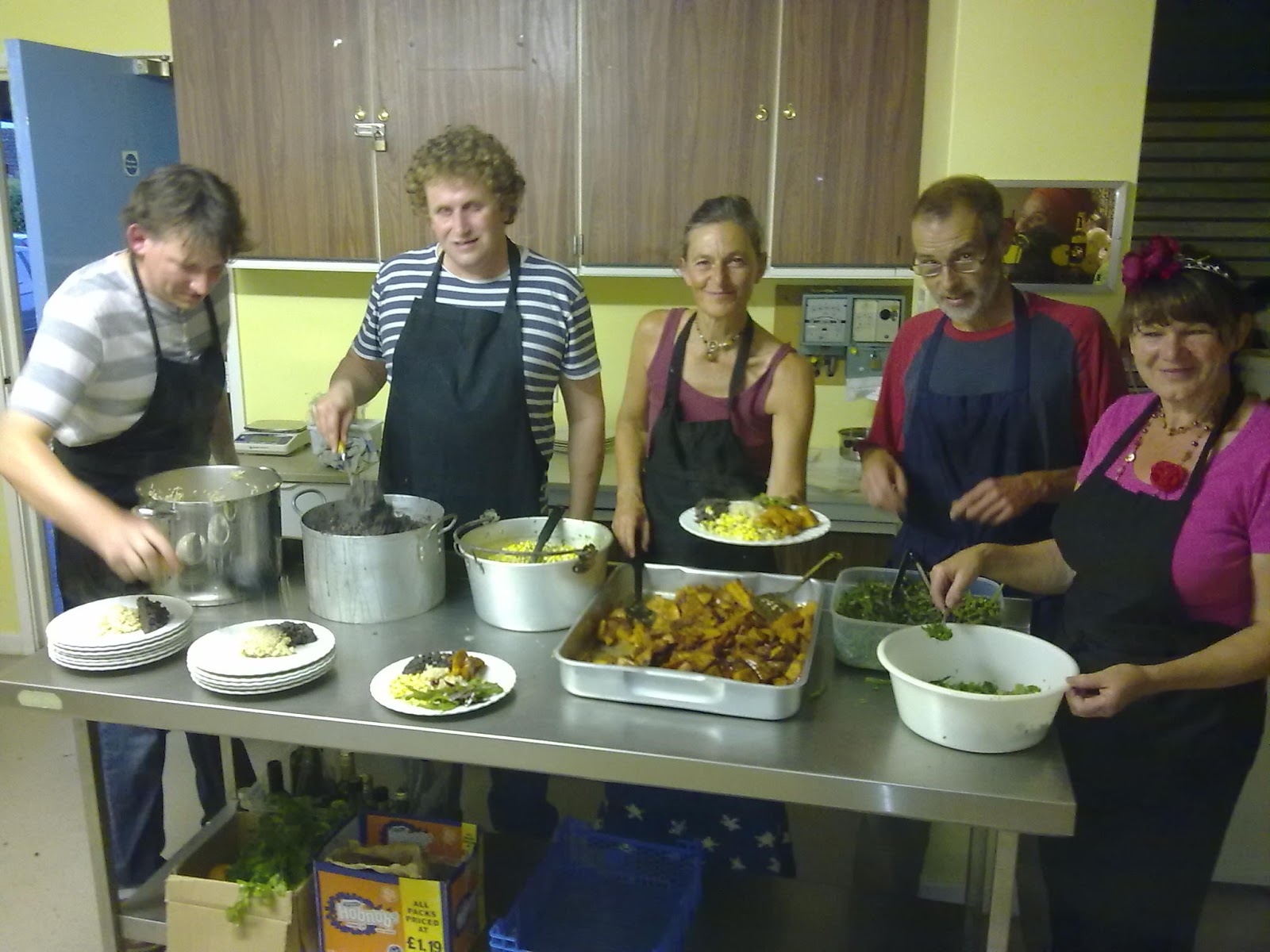
Pictures from our Happy Monday, Mexican Fiesta and Medicine Soup by Mark Watson. Bookings are now open for Sustainable Bungay's next community meal on 19 November on Winter Comfort Food.

Monday, 29 October 2012

Communications - Meeting up

This month we made two trips to the city. One to meet up with This Low Carbon Life bloggers to celebrate our third birthday at the Bicycle Cafe and the other for our monthly discussion with fellow Dark Mountaineers. At both the main topic was community convergence.

So this is a small on-the-ground post to remind ourselves that no matter how hard things become, especially economically, it's really good to meet up and share stuff and know you are not on your own. Even though our tendency is to shut down in tough times, we need to head out in the cold and the dark sometimes, and know there is a group of people talking about subjects that get scant attention in the mainstream media, or even in our ordinary daily circumstances. Projects, events, feelings, reflections we can feedback on and share. What struck me was the warmth and stability and coherence of these meetings. How we went home through the rainy back roads and wild winds smiling. How it hadn't always been like that in the city. And now it was.

At our Dark Mountain meeting Jeppe told us about Trade School and The Common Room where he and Vanessa and Mark are giving classes on the prototype day at St Lawrence's on November 10; Vanessa explained how Occupy Norwich segued into the local progressive community meet-up, Visions for Change, and the ethos behind the ex-airfield community space in Berlin. At our Bloggers meeting, Chris Hull talked about FarmShare, the restarting Transition Circle West, and the great success of the third Magdalen-Augustine Celebration, Jon talked about Norwich Community Bees (now tucked up for the winter), John about the Ceilidhs he organises at the Keir Hardie Hall, Simeon about a recent TN meeting at Inner Space and how the Economics and Livelihoods group's visioning in St Augustine's had led to the creation of The Stage Community Centre (hopefully we'll hear more about all these on the blog later on).

Since we all lead very different lives in different locations, in the city and out, it was a rare treat to meet off-line and kick back for a couple of hours without an agenda. How else do you find out first hand (from Chris Keene) about Zero-Carbon velomobiles? Or what life is like during the cuts at a regular office, or trying to find work as a graduate? Or, for that matter, as a 50-something grassroots journalist/editor.

So for me, it's always about becoming our own media. Writing for this blog, now in its fourth year, editing the new Transition newspaper, but also going out, meeting up, catching up, asking questions, listening, and in many cases, giving each other an opportunity to speak directly: Here is fellow artist and Dark Mountaineer, Kevin Hunn's video for the Norfolk Coalition Against the Cuts, shot at the Magdalen-Augustine Celebration, to encourage people to march in London the following weekend:


Top image: Chris Hull (right) and other participants in Waiting, Shifting, Shopping at Magdalen-Augustine Celebration