Showing posts with label associated movements. Show all posts

Monday, 25 February 2013

Keep Circulating in the Common Room or What Rosemary Did

I had planned on giving a pre-spring tonic Herbs for Resilience class at the second Common Room prototype day at St. Laurence's church in Norwich on Saturday. I was going to focus on plants like dandelion, cleavers and nettles to wake up our systems after winter.

Only it really wasn't 'after winter' on Saturday. It was after a week where the temperature never rose much above freezing and I'd had too many conversations with people who said they'd been feeling gloomy and low (including, unusually, myself) or who had had flus and colds that were taking an age to clear up - or both!

So on Friday I decided that the spring tonic was just going to have to wait. What we needed right now was something cheerful and warming for the End of Winter. Something that would clear our heads, lift our spirits and also keep us warm in the nippy air of St. Laurence's church!

Welcome to Rosemary! Known since forever as a herb that warms, stimulates circulation, helps clear the head and improve memory AND cheers the heart, it had to be you, bold, resinous Rosemary!

I picked some sprigs from the garden, packed up my teapot, and took some dried thyme and lavender to add to the mix along with some Norfolk honey. The class would be based around a cup of tea. 

Then on Saturday morning I sat down at home with a hot water bottle to tune in to the day and the class. The temperature was almost as low inside the house as out and I suddenly noticed my kidneys and hands were really cold. I placed the hot water bottle on my back to warm up my kidneys and carried on considering the class. Five minutes later I noticed not only was my back now warm, but so were my hands! Warming up my back and kidneys had warmed up my hands too. As my system was not just focused on keeping my organs warm, the blood was circulating further out to the extremities. 

"THIS," I thought, "is what I want to pass on to everyone at the Trade School today." Keep your internal organs warm with a hot water bottle. And make a pot of rosemary, thyme and lavender tea with a small amount of honey to help clear those old colds and cheer the spirits!


Ten people turned up for a lively class and in the way of skill and knowledge share and Common Room and Trade School, I was rewarded with friendly people and some lovely gift exchanges: a pair of hand-knitted fingerless gloves, a diary, organic fruit and veg and a jar of homemade Seville orange marmalade, all of which are already being loved, worn (fingerless gloves on as I type!), written in, cooked and eaten!

So thanks to everyone for those and for joining in so heartily. And also for sharing your own knowledge about the virtues of Rosemary, which is also an antiseptic:

"When my brother was a teenager, he had terribly smelly feet," said Sarah. "Our grandmother told him to bathe them every day in cooled rosemary tea. And that soon sorted it out!"


Notes:
(i) For more on The Common Room in Norwich check out the website. There were all sorts of interesting and co-operative/collaborative classes, talks and demonstrations going on on Saturday, besides mine: from creative action for trees and grassroots media to origami and creating complementary currencies. The whole day had a great atmosphere with many people joining in in spite of the cold. And you can see some photos from the day, too!

(ii) I teach people in groups and communities to reconnect with the living world by taking notice of the plants growing right where we are and how that helps increase well-being. Here is some of what I've been doing recently:

Common Plants, Common Room
The Plants for Life 2012 Archive (a monthly series of talks, walks and workshops I organised last year with Sustainable Bungay)
Mark in Flowers

I look forward to doing more Trade School barter sessions at the Common Room! And if you'd like me to come and give a  plant talk (always interactive and practical), or lead a walk or workshop with your group, do let me know: markintransition@hotmail.co.uk

STOP PRESS: Common Room meeting tonight Monday 25 Feb 7-9pm at the Norwich Playhouse (42-58 St Georges St, NR3 1AB) to discuss next steps and how to move forward. This is your chance to join in with setting up a new and exciting community space in Norwich! The meeting is in the Playroom (the room to the right when you come in).

Pics: Preparing the blackboard and the tea at St. Laurence's Church (in an attic-like side room); Passing the rosemary tea at the herbs for Resilience class; Lovely things people brought in exchange for the class

Monday, 28 January 2013

Snow report

Suffolk, Reydon. It came like a fox at night, stealthily, and left noisily in a rainstorm at full moon. Today I woke up and missed the soft quiet white blanket that has covered the land for the last two weeks. Life at sub-zero is a tough one in a low carbon household (5 degrees in our living room most days) and down a narrow ice-rink lane, especially when you have to travel all over the country for meetings and get a new newspaper out. But there is something very intense and creative about this weather that brings you closer to people and life. It's been full on during this time here at the depot, so there is just time for a few snapshots this week (normal service will be resumed shortly).

Hampshire, Petersfield Here I am sitting with the organising crew of this year's Dark Mountain festival, Uncivilisation 2013, We're huddled round a roaring wood fire in the Woodland Stage, which I am co-curating with the poet Susan Richardson in August. Fuelled by generous nips of island malt (Jura and Orkney) and travelling dishes (Galaway stew, Northern wild rabbit and East Anglia beans), we're cross referencing the speakers and writers, activists and workshop leaders, who will appear on the three stages amongst the beech woods. In spite of snow drifts and ice, we've converged from the four corners of Britain: from Wales, Scotland, Newcastle, Cumbria, Doncaster and London. It's seems crazy that we didn't stay home and talk on the internet. But you can't reccy a site, or work together virtually: it has to be real. Like the food and the fire.

Coming back to Suffolk, Mark picked me up at the station in a blizzard and we crawled home along the A12 in a white and whirling world. Scary, exciting, primal, unexpected . . . very uncivilised. Just how the stage should be, I thought.

Berkshire, Reading I'm travelling on the train with Lucy through the unknown birch woods and frozen ponds of Berkshire. We're on our way to Reading Museum, one of the Happy Museums you will be reading about in the upcoming Transition Free Press out this Friday.


We're off to meet Gilly Adams, one of the tutors for our 'write in' at the Arvon Foundation's creative writing centre at Lumb Bank in March. Lucy has organised for the central contributors to her book, Playing for Time to meet here and we are deciding on the the convergence's key elements. It's an adventurous task for all of us (I'm helping edit the book) as twelve artists will be sharing their community practices from all fields in the arts - from crafts to festivals to food growing projects. We're aiming to share our voices, stories and our methods and capture them on the page by the end of week.

Middlesex, Grow Heathrow Later that day in the kitchen at Grow Heathrow I'm drinking one of the best cups of tea I have had in a long time. It's a wild midsummer yarrow tea, collected by their foraging Fridays group. Rose (who also helped found Transition Tufnell Park) is showing us around the main buildings and workshops, gardens and individual houses. I visited the co-op before on a balmy September afternoon, and it's even more striking in winter how many ingenious ways the collective have found to build all the conveniences you need and power them entirely off-grid: a wood-fired shower, a straw bale, a hot tub, a kiln, compost toilets.

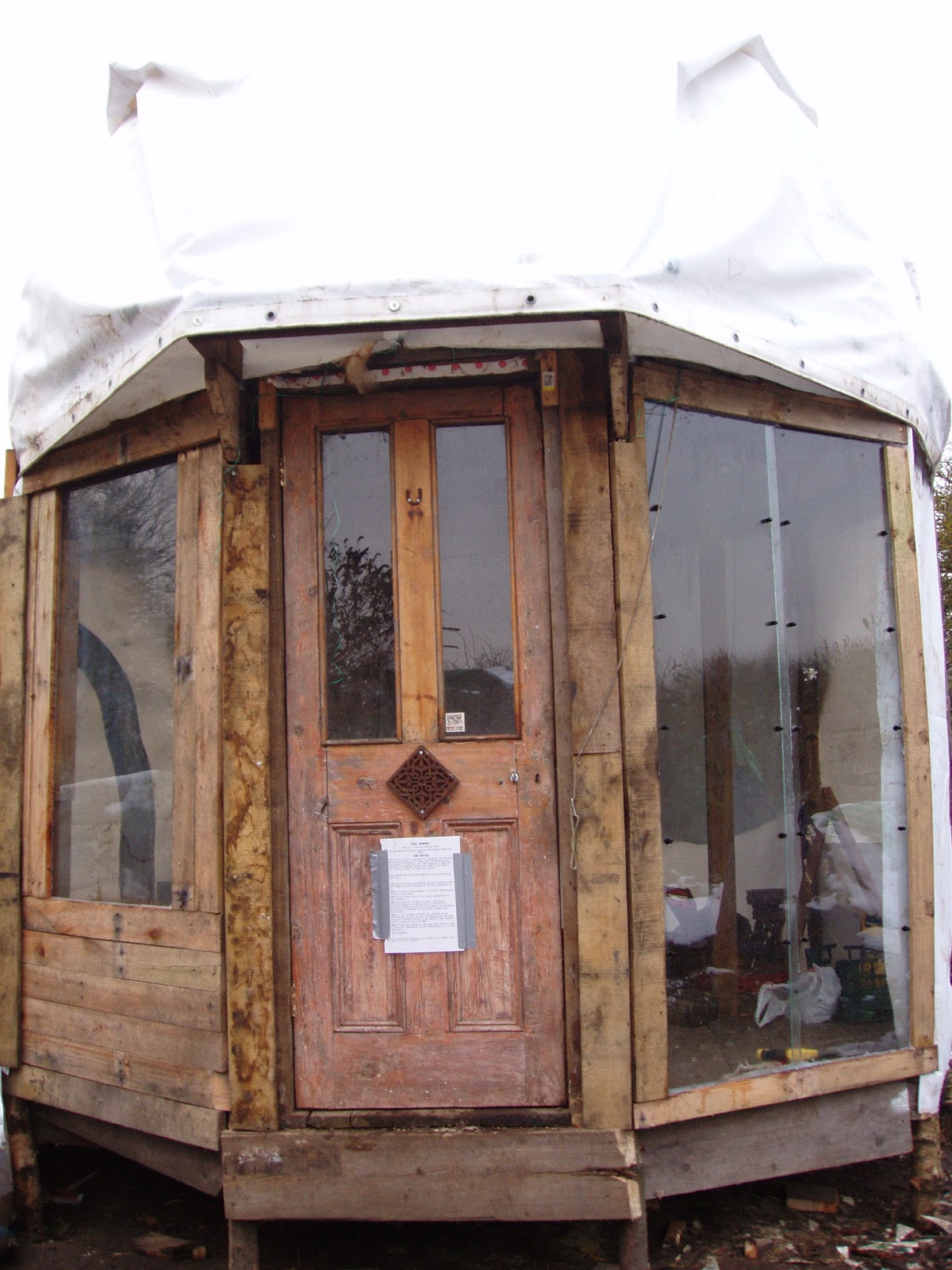
This is my favourite house with its geodesic dome built around a spinney of elder trees. Grow Heathrow are at present waiting for the verdict on their recent court case in London and we're all keeping our fingers crossed this extraordinary work of restoration and urban living won't end in their eviction.  

Suffolk, East Bergholt Back in Suffolk we're off to Bungay to edit this quarter's Sustainable Bungay newsletter ready to be distributed alongside the national paper with its suitable icy front cover. The roads are clear but it's still well below freezing and all the apple orchards and hedgerows in the Waveney Valley are covered in sparkling hoar frost. Very happy that Josiah is serving up some of his famous British bean and parsnip soup before we get down to the design board in his equally unheated house.

The next day, in spite of the threat of more snow, it's suddenly a beautiful morning and we are headed back down the A12 to meet up with 40 plus Transitioners and co-operative house dwellers from Cambridge, London and Ipswich. It's the Living Together gathering organised by the wonderful Gemma Sayers (Random Camel co-op) and Jon Halls (Lodge Farm). I'm giving a workshop on how to run new groups along creative lines called the Ideal Home Exhbition. I've never lived in a housing co-op, but I have worked cooperatively on many projects and have learned things the hard way. One of these is that selecting roles that you love and stick to are key: somehow that enables everyone else to share the best of themselves - their gifts. When we held a plenary and our four "editors" (Well-being, Practical Skills. Stuff and Resources, Social Pressure) fed back everything 25 of us had written on large sheets of paper, we found we had over 30 practical skills amongst us. That's how you know that when push comes to shove, we'll be just fine, even when it snows for days on end.

Just so long as We (and the enterprise) doesn't get stuck in Me.

View outside my window, Suffolk; woodland stage, Sustainability Centre: allotments outside Reading; Oscar's house and kale, Grow Heathrow; workshop on consensus-decision making (or how not to get stuck in Me) at Old Hall, East Bergholt; our lane.

Wednesday, 5 December 2012

coming down the dark mountain

Transition is not a stand-alone movement. In a recent interview for the Transition Free Press Shaun Chamberlin commented that one of its unsung capacities is to connect and cohere other progressive initiatives. This week is a exploration of how some of us do that

Most campaign groups have a single focus, but Transition has many (87 Ingredients and tools for starters) - food and economics, inner work and group dynamics. Instead of putting energy into confronting the business-as-usual mindset of the industrialised world, it puts it into building social and practical infrastructures for a future when that mindset begins to lose its grip on reality. Backed by a network of similar initiatives in cities and towns in the UK and elsewhere it can provide a secure base from which to proceed.

But Transition can sometimes be stodgy and small town in its approach, and lack the radical and activist dynamic to challenge the status quo and the corporate grip on our neighbourhoods. At the Transition Conference three Transition groups discussed their response to threats in their communities by taking a strategic part in local campaigns (NO to Costa, anti-fracking in Wales and Plane Stupid). When I wrote a post in 2011 called lock on it was widely held that Transition should not take part in any activism. But when the local library in Bungay (Suffolk) was threatened with closure we did not hesitate to back the campaign to make sure it stayed open. How could we not: many of our meetings and events were held there and we built the community garden in its courtyard? It was, in many ways, our home.

Sometimes you have stand by the places you love.
Occupying the town square
In Transition Norwich we have stood alongside many like-minded initiatives, from the Campaign for Climate Change to FoodCycle to Zero Carbon Britain. We've taken part in protests from Anti-GM to Norfolk Against the Cuts and published posts by campaigners across the city on our blogs. When the Occupy movement took off last year we took part in the general assemblies held at Hay Hill, where Occupy Norwich was camped for four months.

One of the highlights was a three hour discussion about climate change. Even though this is a principle driver in Transition, most of us have never made time to actually sat down and talk about it. So much of our energy goes into building the infrastructure of an initiative and maintaining it there is rarely any time to discuss these subjects at depth. Sometimes you feel constrained by politeness, by its civic and psychological language. Occupy provided that edge and that conversation : you could go to the camp at any time of day or night and go straight to the deep and urgent stuff and be surprised by the kindness of strangers.

However, I might never have slept on that pavement or gone with my hand-made rocket stove to give a talk about breaking out of the industrial food sysem, had I not been in Transition. Searching for a new narrative makes you bold and able to talk with progressive groups and food initiatives wherever you go. Often people diss Transition for not being strong enough on the environment, for not going into the poorer districts of town, as if the movement has promised to solve the crisis of capitalism with a fairy wand. Mostly however, this is a symptom of a competitive monoculture. We are programmed to reject any new ideas, the way pesticides work on crops (all visiting aliens will be eradicated!) and to allow a new "partnership" narrative to emerge, you have to let your defensiveness slide.

We’re bridge makers that's our job. We join dots and don't get derailed if people tell us the trouble with Transiton is . . . or call us hippy or usual suspects. It’s our business to find the connections between the myriad groups and projects out there and pull us into the same conversation. To really forge the future we need to work as an interconnected system: that means many different groups working in different areas, connected by a communications network. The Project and the Press are part of that network. And so is the group I want to talk about:


"If Transition is the Village then Dark Mountain is the Shaman"
Dark Mountain Project is neither a political campaign, nor a community group. In some ways it is as hard to define as Transition. Stemming out of a manifesto written by Paul Kingsnorth and Dougald Hine in 2009, it soon developed into a book, then a festival, then a movement. It is both a cultural response to a collapsing world, and a network of people who gather to make sense of that collapse.

I came to the Mountain last year as part of the Social Reporting Project and wrote a blog based on a conversation around the fire at the Uncivilisation Festival with several Transitioners:
There’s all the intensity of a Transition debate here but without the concerns of the Village, worrying about whether “the community” is going to come to your event, or understand you, or fund you. No battle with the Council, no struggle to get Other People to do stuff. No psychology or sitting around in a circle talking about your feelings. Everyone understands you.
The festival struck a chord deep within me that Transition, for all its complexity, does not reach. It speaks of rain and birds and ancestors and everything I am putting myself on the line for. Organised by writers and thinkers, unswervingly generous about each others' work, the Project forges creative relationships that are hard to find in Transition. When I was offered some press and publicity work this spring it was the first time in years anyone had given me work on the strength of my writing. I’m not an expert, I warned them. That’s OK none of us are, was the reply.

What the two networks have in common is providing a meeting place and platform for people who know that the story our parents told us about our world is not holding; that the socio-economic model we have taken for granted most of our lives is not only precarious, but is socially unjust and environmentally destructive. As a people, hemmed in by denial and illusion on all sides, that meeting place is crucial. As the manifesto states Dark Mountain does not seek solutions, it holds a space so that a different narrative can be created. Not another monoculture but an “uncivilised” culture that is diverse in its expression as an eco-system. To be part of that creative edge is what pulled me: to listen to the stories that people are telling around the fire, on the edge of the forest, in tune with each other, intellectually sharp as a scythe.

This week Dark Mountain Norwich is meeting up for our monthly discussion. We'll take food and our Transition friends from Bristol, Kristin and Sim. We'll sit down and discuss deep time and paradigm shifting around the table, and design an event we hope to hold next year. We are from many places: students from the UEA. from Austria, Denmark and Germany, Ava from Devon, who is researching Dark Mountain and Kev from Norfolk, who took the first video of Transition Norwich way back when the whole thing began in 2008.

The world comes in full circle, that's what you learn, when you connect the dots, when you come down the dark mountain. It's the circle that will make sense of everything, when the old world finds itself at the end of the line.

Captions: holding the biofuels banner with Transition Norwich at The Wave, Speakers Corner, 2009; Deepak Rughani of Biofuel Watch discussing financial systems at Norwich discuss the aftermath of Nicole Foss’s talk; The Tellling, performance inspired by Dark Moountain, Doncaster; Rise and Root frontispiece to Dark Mountain 3 by Rima Staines;


This post first appeared on the Social Reporting project as the introduction to the week on Associated Movements.

Wednesday, 15 August 2012

Why the Olympics were good but bailouts were bad

It’s easy to forget that when we spend our money, we aren’t just giving away our money, but the recipient is receiving it. It’s a passing of purchasing power from one person to another, not an expenditure, rather like the law of conservation of energy.

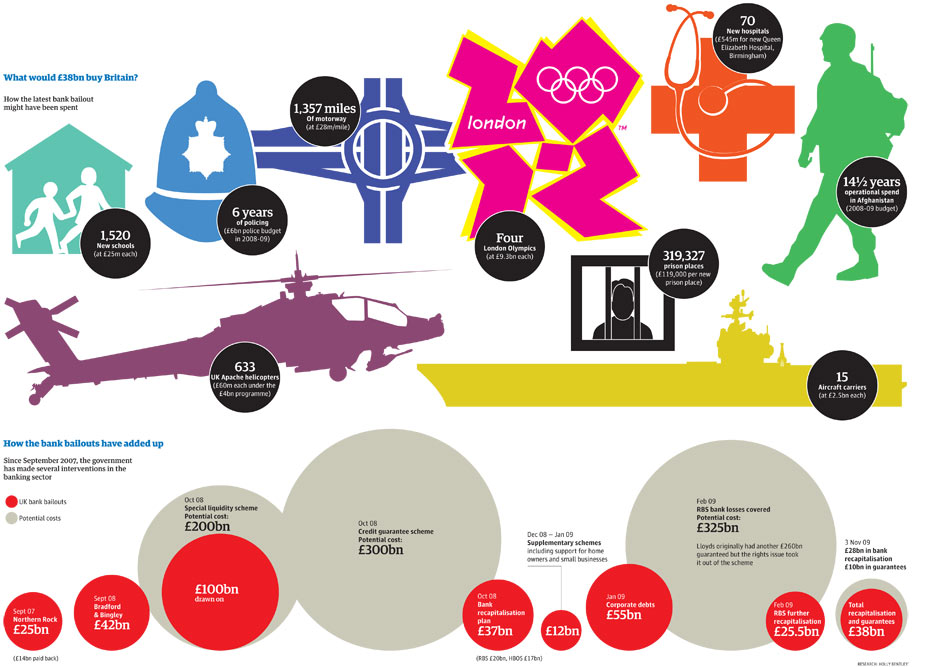
So when I saw the following edited billboard from the London 2012 Games posted at Make Wealth History, I started to question the other side of the equation.

 Your Games

Our initial reaction when you see that £9 billion has been spent by UK taxpayers to bring about the games is probably one of disgust. And rightly so – we never voted to have the Olympics; the Olympics supports London far more than the interests of the rest of the UK; and we are forced to pay for something whether or not we support it, or gain any benefit from it.  Altogether, that means that the decision to spend UK taxpayers’ money on the games is controversial.

But once you get past the selfish view of economics that we take as individuals, and instead look at the economics of the country and our society as a whole, this money was well spent. I’ll tell you why: Think for a moment about what costs the Olympics have had to face.  The costs that come to my mind are the design, engineering and building of Olympic venues and huge numbers of event staff to pay for their various services, from security to ball-boy. With very few exceptions, that money got delivered straight back into the UK economy as wages.

And will the government get back any of that? Of course! Their employees will pay income tax and the businesses that ride on the Olympic wave will pay their rates and taxes (in part thanks to our friends at 38 degrees).

So let’s compare that to bank bailouts.

What we could do with the bank bailouts

In this graphic from the Guardian, you can see equivalents to the £38 bn figure for bank recapitalisation in 2009, but this figure has since risen to £123 bn, according to this article, again from the Guardian, so rather than four we could have actually bought more than 13 Olympic games for the current bank bailout money!

But that’s not really the point, because the more significant thing is where this money goes. As we have all seen during recent years, the money that banks were given by the government did not go towards supporting our productive economy in loans to companies and entrepreneurs, and it did not go towards the wages of vulnerable low income families.  Banks selfishly continued to pay out huge sums in salaries, bonuses and make huge profits, ensuring that any benefit that came of the bailout remained firmly under the control of bankers, so that they could continue speculating on property and gambling with the world’s economy, whilst leaving the productive economy to fend for itself.

To be honest, I’m not at all surprised that bankers would take this kind of action.  If I were in their shoes, I may well have done the same (such is man’s fallibility), but what this does indicate, I feel, is that our economic system isn’t really designed to help society as a whole to develop and prosper.  It is designed as a game, where the winner takes all, and those who are unable to participate – through not knowing the rules, or not having the right friends, or not having enough cash in the bank already – must beg for the mercy of those who do.

Did we have a choice to bailout the banks?

Some people would argue that the government had practically no choice in bailing out the banks, because to have let them fail would have been catastrophic to our economy.  Those who take the opposite corner usually do so with the neat little phrase “bail out the people, not the banks”. The argument goes that the government should let banks fail, whilst guaranteeing the personal liabilities that the bank holds.  Who knows whether such action would have consumed as much money as bailouts, or have made pension funds fall flat on their faces and left millions of vulnerable pensioners without?

But what we can see is that the recipients of money from the Olympics were more diverse and more deserving than the banks, and created a more pleasing result for the millions of people who watched the Olympics, in London and around the world.

Disclaimer: I’m not an economist, and therefore may not be able to defend claims that I make in this article, so if you know more about this issue than I do, please correct me in the comments below!

Images: Billboard from Make Wealth History website; infographic from Guardian website.

Saturday, 11 February 2012

Seeing Things Differently #1

The #1 in the title of this post is there because being in Transition has made me see differently in so many ways. This post is about one of them.

I could tell you transition has made me more tolerant and that would be true. But it wouldn't convey the sense of what this actually means. Just being tolerant is okay, probably better than being intolerant in general, but it's a bit passive. "I accept people for who they are" seems like a nice-person type of thing to say, but the world is full of nice-person-type cliches. Cliches don't change the world.

There may be a better word than tolerance for what I'm about to describe, but it'll do for now.

If you look straight-on at what Transition is responding to as movement, it's nothing less than the collapse of our present industrial civilisation, built on peaking oil and other finite and diminishing fossil fuels, coupled with increasing climate insecurity, severely strained planetary life systems, and economic and social chaos.

In short, the collapse of the world as we've known it.

Building community resilience requires us to take the reality of these events seriously. This is more likely after an end-of-suburbia-moment when you've seen the 'terror of the situation'. The split-second when you realise you're living in life at the end of empire and that the world is not what your parents, friends, teachers, business-as-usual governments, global corporations or the BBC are saying it is - nor what you have been agreeing it is:
A civilisation relies upon a set of unconscious agreements as to what constitutes meaning and can be allowed into discourse. When faced with information that falls outside these parameters, cultures and individuals alike forget or neglect, or actively suppress, the ill-fitting data. Yet the repressed elements return to haunt us eventually...*
Maybe instead of tolerance, I really mean patience, or allowing enough time and space to see myself and others in a different light. So we can come to different agreements together, as valuable co-participants in life with work to get on with at a critical time.

We can't do this if we're going around seeing each other just as same old, same old nice person/nasty person, winners/losers who happen to agree or disagree with ME or be an ally or enemy to MY particular worldview or lifestyle. Particularly when that lifestyle has reached its best-before date.

Seeing ourselves and others differently is a task that takes persistent effort. All of us have been raised in and conditioned by the same system with its competitiveness, jealous rivalries and power struggles in a culture that says some people are better than others because of class, looks, education or financial status.

That's why tolerance or patience, or allowing time and space so the more co-operative aspects of ourselves and each other can emerge and our skills be recognised and valued is a practice really, an active rather than a passive thing.

And where better to practice it than with those fellows in transition who already acknowledge the situation?

Then we can really be the change we wish to see in the world.

For it is important that awake people be awake...
the darkness around us is deep.**


Later: As synchronicity would have it, the themes here find echoes in a great piece about Occupy Norwich on the One World Column today by Vanessa Buth.

* from 2012 by Daniel Pinchbeck, p.41 (2007, Piatkus Books)
** from A Ritual to Read to Each Other in Stories That Could Be True: New and Collected Poems by William Stafford,
p.52 (1977, New York: Harper and Row)

Pics: Woodbridge station arches looking through the window; Honesty, Darkness and Sunlight (both MW, January 2012)

Tuesday, 10 January 2012

Economics and Livelihoods - Transition's response to Occupy's concerns?

Over my Christmas/New Year holiday, whilst I was without internet in the depths of Normandy, I finally managed to finish reading Prosperity Without Growth, the seminal book by Tim Jackson subtitled "Economics for a Finite Planet". His analysis of our current economic problem is in-depth but still logical and understandable to the reader. Every single chapter adds new understanding to the issues, meaning that my copy has practically every other line highlighted and notes scribbled in the margins every few pages.

It was with little surprise that I found that the themes discussed at Occupy Norwich's "What's Occupy About?" meeting last Saturday (which will be continued next Saturday at the same time of 12 o'clock at the Occupy camp, Hay Hill) chimed with so many points I had read only a few days before. The fact that a book which is essentially about economics also covered issues of environmental degradation, fractured society and political dysfunction (which are also the broad theme areas of Occupy Norwich's meeting) just goes to show how inextricably these issues are interlinked.

Even many of those with no involvement or even a hostile attitude to the Occupy movement still have the same societal concerns, if the first few responses to Occupy Norwich's survey (which I urge you and all your friends to partake in) is anything to go by.

Where there is disagreement (which in some cases is really quite extreme) it is within the appropriate responses and solutions to such problems. Even within Occupy Norwich's monetary reform working group, there are highly differing attitudes to a graduated move to full-reserve banking, gold as a medium of exchange, local currencies and the elimination of money altogether.

Notes from the What's Occupy About session. The four central coloured squares are the theme areas, specifics surrounding them, colour-coded.
At the "What's Occupy About" meeting, this presence of disagreement led to discussion on what the movement's role is within this complex and ever-changing discourse. The conclusion, at least as far as I am concerned, was that Occupy is there to initiate discussion, inspire idea generation, inform and educate, but not to be a solution in and of itself, a role carried instead by individuals, organisations and campaigns that may arise out of, but not directly be a part of, Occupy.

Transition Norwich, I feel, is one such "solution organisation". Ok, Transition's actions are always in flux and depend largely on who has time and energy to push forward any particular project, but nonetheless, Transition is about actions. Transition Norwich has already implemented positive responses in all the projects that have been set up in the last three years, but there is still lots more we could do!

Images: Prosperity Without Growth, my copy; Occupy A Few Minutes; notes from What's Occupy About typed up by Robert Vincent.

Friday, 9 December 2011

Who wants to talk about economics?

The first post that I wrote on this blog, for the relaunch of the Economics and Livelihoods group back in May this year, was entitled "Do we control money, or does money control us?" and I wondered whether the provocative theme would ring true with many people, or whether economics is a subject which people shy away from when at all possible.

Little did I know that there would be the worldwide Occupy Movement on this very theme, starting with protests on Wall St, New York, but spreading to thousands of cities across the world, including our beloved Norwich.

Occupy Norwich's Capitalism/Monetary Reform working group, which formed after a great talk from Dr Rupert Read on monetary reform, has continued to discuss the issues in detail, and I've found it very rewarding to attend their meetings and learn so much about the nature of money, whilst we also look for a monetary system which would satisfy society's needs.

There is a great cross-section of religious and political ideologies and backgrounds amongst those who have been attending the meetings, but one thing is clear to all of us - the present system is broken, and needs to change. So far the discussion has mostly revolved around what money is and is for, and what the deficiencies of the current system are which require a rethink, but we hope to establish in later meetings what action we can take to change things, whether it be campaigning for national monetary reform, or for promoting local currencies which use an alternative monetary model.


What money is for: a medium of exchange, a way of measuring and comparing value, and a store of wealth (and debt, but I'll come to that in a moment). Looking at each of these functions, we tried to establish how our current system is deficient.

Firstly, as a medium exchange, the scarcity of it - although value can be created anywhere, money is not always available in the same place to be exchanged for that value. Although other means of exchange could be (and sometimes are) used, there is only one system that is recognised by law - legal tender - that has been imposed on us by the government, causing a monopoly of money creation with banks. We don't have a choice about whether we use it or not (because it is the only currency recognised by law to be valid for meeting financial obligations) and therefore we are forced to abide by its rules.

As a method of comparing value, our currency is insufficient, because its value is fluid, and is artificially adjusted by those with the power to set prices that do not match their real value (by limiting markets and gaining monopolies, for example, and speculative investing).

As a store of wealth, our currency is deficient for the same reason - its value changes, and in fact continuously diminishes, as is evident through inflation. This only covers the average value of that money, of course. When money is created as debt, as it is in the loans made from banks, the money is a store of debt, rather than wealth, and because it must be paid back at interest rates that are far beyond inflation, the value diminishes quicker, meaning that families with poor credit ratings are paying far more than what something is worth for the same goods.

When exploring some of these deficiencies, we realised that we had to distinguish between money and value. Value is subjective, and always will be, but because of our need to trade, there are some common values which make up the prices we historically see things traded at - one is the production value - how much time and effort it took to obtain or create that value; another is utility value - the nutrients that a food gives you, for example, or the pleasure that a good book brings; and these combine to form an historic value - the value which we really see in a product or service.

I could go on about the things we discussed. Many of them are typed up here on facebook and on the Occupy Norwich forum.

However, the discussion is far from over, and we're still meeting regularly at the Haymarket each Wednesday evening at 7pm to try and find out more, so please join us!

Images: Occupy Norwich protester with "Who has taken our money?" placard; a monetary reform meeting in progress, where our Muslim friends are talking about the concept and dangers of usury; A selection of books in the Occupy Norwich library, including The Future of Money, which discusses the possibilities of complimentary currencies as a solution to our economic problems. Courtesy of Ann Nicholls.

Thursday, 1 December 2011

Occupying the Conversation

Wednesday 30th November, Lowestoft I've just got back from the High Noon Rally and public sector workers' strike march up Lowestoft High Street and the meeting afterwards where I sat with Kate and Rita and Charlotte in the packed United Reform Church, listening to people speak about the effects of the government’s austerity measures on their lives, pensions, families and future prospects.

Teachers, therapists, cooks, retired gardeners and trade unions representatives all spoke about how the government (and the system) was ennabling more than ever the richest to rob the poorest, pushing mercilessly for privatisation, for fewer and fewer workers’ rights or job security and longer hours for less pay. For YEARS to come. How it considers ordinary people as being of no value whatsoever. Like the starlings Jon wrote about on Monday.

A woman who had worked as a public gardener for thirty years told how her annual pension of £2,500 was officially considered ‘gold-plated’. Another who had been a teacher for twenty years said she loved her work, it was all she had ever wanted to do, but the prospect of having to wait until she was 68 to retire made her feel like she was being squeezed of all her life force and there would be nothing left by then. And how that marred the love she felt for her job.

“It’s as if [the people running the system] want you to die so they don’t have to pay you any pension,” said someone from the floor. Everyone cheered.

One primary schoolteacher had left a well-paid media job in London to come and teach in Suffolk after he discovered that all the money he was paying into his private pension would bring him almost nothing when he retired.

“I keep hearing this one word,” he said. “It just keeps speaking to me - solidarity. Now more than ever we need to stick together. We can’t afford not to. Solidarity.”

The atmosphere of the march and the meeting in the church was alive, attentive and engaged. People were listening to each other. I wondered whether I should “stand up to speak” something about Transition or Occupy, mention fossil fuel depletion and energy constraints and the preparations we are making in our local initiatives in the face of these along with climate change and economic instability. After all, Transition is where most of my attention has been focussed for the past four years.

But I felt a bit tongue-tied (even though I hadn’t said anything), and there didn’t seem to be an opening. I thought, well I’ll write about the rally tomorrow and bring in the links with Transition and Occupy then. Better go and get on with that Transition Norwich bulletin. So I tapped fellow Sustainable Bungay transitioner Kate on the shoulder and mouthed “Got to go, see you soon…”

At that moment a woman stood up and brought Occupy into the meeting. I sat back down. She’d been to OccupyLSX and Occupy Norwich. It was really important to consider this movement, she said, because its presence in all these cities of the world brings constant attention to the vast economic and social inequality which exists and is exacerbated by the present gormengahst of the global financial system. Because of Occupy more and more people are seeing what they didn’t see before. And as Arundhati Roy once said talking about the social and environmental ravages of dambuilding in India, once you’ve seen it you can’t unsee it.

And take care not to just side with the mainstream media when they talk about finding drug needles and the presence of alcohol at the London Occupy site, the speaker reminded us. This is the middle of London. Every day food is provided free and there are tents to sleep in. Of course you’re going to get homeless people, maybe even people on drugs. That’s what’s going on in our society. “I’ve been there a couple of times and I’ve noticed that the homeless are included. Maybe included for the first time in a long time. Not everybody here may agree with the protesters but it is a non-violent movement, with a lot of young people concerned about a future with few prospects. Just like we are here."

The people in the room cheered again and the retired gardener with the ‘gold-plated’ pension stood up and exhorted everyone to make sure their trades union leaders supported Occupy.

This was the cue for Kate and me. We put our hands up. Kate went first, introducing both of us and Sustainable Bungay and a few core Transition concepts around building community resilience. This is the woman who a few years ago at one of our core group meetings stood up and delivered a two minute talk on Peak Oil and Climate Change with no props and you just got it. It was also Kate who stood up at a climate conference in Bungay in 2007 and exhorted the people in the room to get together to come up with some solutions. That was the beginning of Sustainable Bungay. So she had to speak first! And it made me feel far less nervous about standing up to speak.

I said one of the most important things about Occupy was how it opened up and held a space for conversations to happen which aren’t normally granted any space at all, certainly not in the mainstream public discourse.

And what could be more mainstream than the vast and growing social inequality wrought by a small elite via an oppressive machine-like system that ultimately has no one’s best interests at heart? This is a time when our very humanity is at stake. We need to be talking with each other.

Pete then said how at OccupyLSX he had witnessed an intense conversation start up amongst a group of besuited city workers visiting the site. They were talking about it, too.

I‘ve visited OccupyNorwich a few times now and experienced this openness, both in listening to what other people have to say about our human situation and in being listened to myself. And I've encountered warmth and intelligence each time.

As I left the rally for the library yesterday a young woman at the door offered me a ticket for the Murphy's Lore gig later in the evening. I'd have loved to, I said, I really like Murphys Lore. But I have to write an article and help prepare a bulletin. Help keep the spaces open for those conversations...

Pics: High Noon Rally in Lowestoft yesterday; Marching up the High Street; Occupy Norwich general assembly; It's the private sector too; You don't have to be a Socialist Worker to read the Socialist Worker, Kate and I at the public sector strike meeting

Wednesday, 23 November 2011

I'm not a blogger...!


... I just happen to blog!

That is, in my opinion, one of the wonderful things about This Low Carbon Life and blogs in general. These aren't corrupted journalists seeking whatever bit of news will bring in the most cash. These are ordinary people, and what those ordinary people want to talk about. Naturally, at the moment, Transition issues and the economics behind them are on everyone's minds, so many blogs reflect this.

But before I introduce my chosen blog, I'm going to give you a brief insight into how I normally get my news.

I don't usually get any newspapers, nor do I watch much TV. However, I spend large portions of my time on the internet, and specifically on Facebook, for better or for worse, but the better, I think, being the fact that hundreds of people recommend articles and videos. Discussion about politics, current affairs and even religion is not the taboo on Facebook that you might find it in your local pub, and, amongst my Facebook friends at least, these deep philosophical questions are often welcomed.

So, on Facebook I recommend you join groups that share your values, and therefore get the news that you want when its members post links, and then discuss through comments. Don't forget to post links for other people too! Transition Norwich has its own group on there, so does FarmShare, and I also follow the Occupy Norwich group, which provides me with much reading on wealth inequality.

And on the subject of wealth inequality, I come to my recommended blog, "Make Wealth History", which has the tagline "Because the earth can't afford our lifestyle".

This blog is the work of Jeremy Williams, who I very briefly met at "Small Is... Festival" last year. It includes articles on overfishing, monetary policy, resource depletion, climate change as well as book reviews and his weekly feature "What We Learned This Week", which gives links to other interesting resources.

He's got Transition Towns as one of the "Solutions" listed at the top of the site, and writes articles about us from time to time, which is nice!

The latest "What we learned this week" feature:

What we learned this week
Posted on November 19, 2011 by
0

  • I saw a map of all the Occupy protests the other day, and my favourite has to be the bold one-man effort of Occupy Paisley.