Showing posts with label Transition Patterns. Show all posts

Thursday, 6 September 2012

From Word of Mouth to Printed Press

Before, you could go to the local paper to find out about how the frijoles were doing, the jitomates, what was going on in the town market. It was first and foremost about Querétaro, reflecting the place, the people. Now you have to search hard to find anything relevant to the city. Look, all the first pages are taken up with news from elsewhere that has no relevance here... (Founder, local newspaper, Querétaro, Mexico, 1985, personal communication)*

I have remembered these words for twenty seven years, from the time I was a student in Mexico writing a dissertation on the local press in the city of Querétaro. I no longer recall the late founder's name. But what has remained clear in my mind is his frustration at seeing the newspaper change from one that did talk about how the beans and tomatoes were doing, to one full of syndicated articles from abroad with no bearing on local people and conditions in this city of 400,000 people.

'Becoming the Media' (Tool #13 in the Transition Companion) in Transition does mean we're aware of what's at play in the wider world, particularly as the global industrial system is now even more global than it was in 1985 (Querétaro today has over one million people and is host to many large corporations).

It also means that on the Transition websites, blogs, Twitter accounts and other social media we use to showcase our initiatives, we do show and talk about what we're doing 'on the ground', where we are, as Transition individuals and groups. And how we're experiencing the journey. That we make sure we talk about the beans and the tomatoes.

It also means communicating in more direct ways. And not just with online media.

(i) Talking With Your Neighbours

“I’ll definitely read this,” said Irene. “Who is Jay Tompt, though? I don’t think I’ve heard that name before.”

I had taken Irene, who lives down the lane, a note with the details of a recent piece by Jay on this blog called Postcard from the Edge of Democracy about the failure of Totnes town council and the South Hams District Council in Devon to keep ‘large corporate coffee chain’ Costa out of Totnes. The same story has repeated itself here in Southwold, Suffolk with both town and district councils.

“Jay writes on the Transition Social Reporting project,” I told her. “Check it out. It’s full of great stuff about Transition by a dozen or so regular bloggers plus guests reporting on their local initiatives and beyond. And look out for that comment by Keith Parkins on Jay’s post, too. You'll rarely find an article so clear in the mainstream media."

(ii) Last Night, Green Drinks, Sustainable Bungay

I’m sitting with sixteen other people in the Green Dragon pub in Bungay. This is the first in a new season of Green Drinks, and the theme is So What is Transition? Sustainable Bungay will be five years old in November, and so we go round the table and speak about where we are and how we see ourselves proceeding over the next few years.

We talk about our core group with its monthly meetings which happen no matter what and are open to anyone to join in with. How this has kept the momentum going and us coherent over the years, especially since as an initiative we run many projects and events, from the monthly Happy Mondays at the Community Kitchen to the twice-yearly Give and Take Days to Bungay Community Bees, Plants for Life and Sewing Sundays.

We talk about how working together on these projects over time has created an atmosphere where we want to work together on projects over time. A sense of commitment to the initiative and each other. Everybody would like to see this maintained in the future. And that the group continue to be open, flexible and organic.

We talked about the printed quarterly newsletter, and how again, we produce it come what may as a collective effort. Here is a place where anyone can read about what’s happening in the initiative, find out how to join in and contact the person looking after a particular project. It’s a bit like the core group, open and inclusive with everything you need to know in it in one place, keeping a certain coherence going.

And reaching people other media cannot reach. It’s great for those who don’t have internet access so can’t use our website. Dawn, who comes to Sewing Sundays run by Eloise, doesn’t have a computer and is a great fan of the newsletter. And although she participates in few other Sustainable Bungay activities, she goes into the town and tells all her friends about the group and the ideas behind Transition. And she loved the Transition Free Press!

(iii) Keep Talking About It

So the Transition Conference 2012 approaches (the first one I’ll have been to) and after over three years of helping to set up and maintain Transition communications in the form of blogs, websites and newsletters, I prepare to join fellow social reporters at Battersea Arts Centre at the end of next week. We shall be blogging and tweeting and reporting about our experiences there, so do stay tuned. I’ve come to thoroughly enjoy tweeting about the initiatives I'm in after swearing at first NEVER to have ANYTHING to do with something SO TACKY!!! It’s actually a great way to let others know what’s going on.

And as we celebrate the publication of the Transition Free Press and talk with people, I’ll also be remembering that print and word of mouth can refresh parts other media cannot reach.

* Frijoles: Any of the beans used in Mexican cooking (e.g. pinto or black) and grown in Mexico. Jitomates: Mexican word for tomatoes

Pic: Josiah, Iris and me working on the SB website, 2010, from The Transition Companion (Charlotte Du Cann); Sustainable Bungay Newsletter, Autumn edition, 2010 (SB); reading the Transition Free Press Preview Edition, June 2012

Wednesday, 25 January 2012

Changing the social logic through design

In Prosperity Without Growth, the seminal book by Tim Jackson, he concludes that our social logic must change:
The social logic that locks people into materialistic consumerism as the basis for participating in the life of society is extremely powerful, but detrimental ecologically and psychologically. An essential pre-requisite for a lasting prosperity is to free people from this damaging dynamic and provide opportunities for sustainable and fulfilling lives.
He goes on to give some recommendations that focus on this task, which I will describe here, and then use patterns from A Pattern Language (which I blogged about in Monday's post) to describe ways in which those can be "designed out" of our built environment.

Working Time Policy

This is not the first time I have talked about a shorter working week on this blog. In that article, I highlight the benefits that would come about due to reduced stress levels and more time to care for ourselves and family, but there's another benefit that is more economic in nature, to quote Tim Jackson again:
In an economy in which labour productivity still increases but output is capped (for instance for ecological reasons), the only way to maintain macro-economic stability and protect people's livelihoods is by sharing out the available work.
Although I believe that such policy will never really work until we have an economic system that does not rely on continual economic growth, there are a few patterns that will help:
  • Work Community (pattern 41) - "Build or encourage the formation of work communities - each one a collection of smaller clusters of workplaces which have their own courtyards, gathered round a common square or common courtyard which contains shops and lunch counters." - This sense of community, I feel, would mean that working times could be much more flexible, would build potential for synergy between members, which would mean that more intense but highly productive work could be done whilst people are together in their work communities, at the same time as freeing them to be truly away from work when they are not there.
  • Self-governing Workshops and Offices (80) - "No one enjoys his work if he is a cog in a machine." - When you step back and question why you turn up to work 35 hours or more a week, it can seem on the face of it absurd, but the real reason is that "the man" requires you to do so. You would work 20 hours if you could, because it would be so beneficial for you, your family, and for society in general, but it is not currently allowed for within our social structure. But when do we "design" self-governing workshops? When we start new enterprises, develop community projects, form teams within companies. And if we form them as self-governing entities, they will be much more satisfying places to work.
  • Also: Small work groups (148), Flexible Office Space (146), Local Sports (72), The Family (75)
Tackling Systemic Inequality

"Systemic income inequalities increase anxiety, undermine social capital and expose lower income households to higher morbidity and lower life satisfaction," says Tim Jackson.

For this, I point back to the Self-governing Workshops and Offices above. Those who have a say in how their enterprise is run rarely make decisions that would reward those who do no work, whilst cutting pay and jobs for those who earn so little, and need the money so much more. But on top of that, I will also mention these patterns:

Having out-buildings that could be used to run an engineering business from was a factor in my father's choice of home
  • Home Workshop (157) - "Change the zoning laws to encourage modest, quiet work operations to locate in neighbourhoods." - Part of the reason for systemic inequality is the lack of power people have to make their own livings from home or in their local neighbourhoods. When looking for a job, I was expected (by the jobcentre) to consider travelling up to 90 miles to a workplace, but who knows what enterprise there is the potential for in our local community if there were just the resources available to do so. Why is it almost impossible to find houses which have workshops included, or where the front room could be converted into a local shop?
  • Also: Small Services without Red Tape (81), Office Connections (82)
Measuring Capabilities and Flourishing

Tim Jackson: "The suggestion that prosperity is not adequately captured by conventional measures of economic output or consumption leaves open the need to define an appropriate measurement framework for a lasting prosperity."

At first I struggled to think which of these patterns really cover this, but then I realised that lots of them are appropriate! Since flourishing is subjective in nature, the patterns which measure our prosperity best are those which attract people to them, and form happy spaces, I therefore bring your attention to the following patterns:
  • Activity Pockets (124) - "Surround public gathering places with pockets of activity - small, partly enclosed areas at the edges, which jut forward into the open space between the paths, and contain activities which make it natural for people to pause and get involved." - We sometimes don't spend time in public spaces, not because we don't want to be out and about, but because we don't feel comfortable being exposed. The measure of good public space is how much it is used, but it will only be used if people feel comfortable using it, no matter whether its with a small group of select friends, or a city-wide Carnival (pattern 58). This pattern is also closely related to Courtyards which Live (pattern 115).
  • Sleeping in Public (94) - "It is a mark of success in a park, public lobby or a porch, when people can come there and fall asleep." - Sounds like my kind of park, and my kind of success! On this note, perhaps any kind of doing less could be considered success?
  • Beer Hall (90) - "Where can people sing, and drink, and shout and drink, and let go of their sorrows?" - If a community has not got places like this, then it's probably a failure, but they do exist. Many of our smaller villages' last pubs have closed and many new housing estates are given no such provision. Norwich, I feel, is quite lucky in that there are so many such places, or at least in places to drink. But it would be nice if Norwich had more places to sing and shout, don't you think?
Strengthening Social Capital

Tim Jackson: "Understanding that prosperity consists in part in our capabilities to participate in the life of society demands that attention is paid to the underlying human and social resources required for this task."

Immediately, two patterns come to mind:

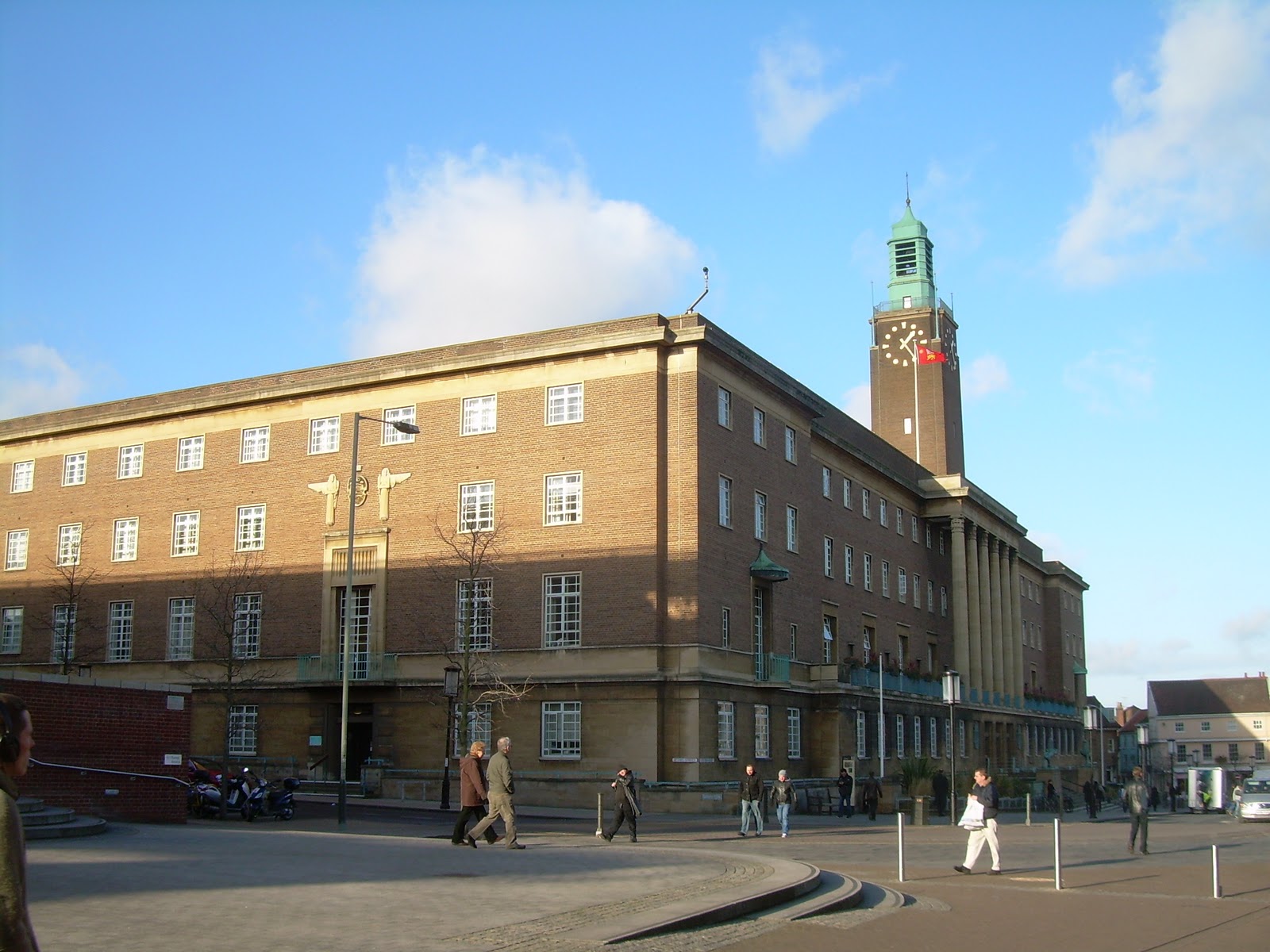
Norwich City Hall, which is too centralised and closed to be the basis for truly participatory local democracy
  • Local Town Hall (44) - "To make the political control of local functions real, establish a small town hall for each community of 7000, and even for each neighbourhood; locate it near the busiest intersection in the community. Give the building three parts: an arena for public discussion, public services around the arena, and space to rent out to ad hoc community projects." - Sounds idealistic, right? But when you look at what we do have, you do start to wonder why government is so centralised. Occupy Norwich have agreed by consensus that "The House of Commons does not represent the will or interests of the common people, rather the wealthy". Isn't an important part of claiming back our participation in the life of society to ensure that our government is at the appropriate scale for the activities that they undertake. And that society as a whole (rather than just the wealthy) has a representative say in how things are done? Simply building places to represent this would help. I hope that Beyond Green (who I mention in yesterday's post) design into their plans provision for local democracy, because without the provisions, such "democracy" will just end up as plutocracy, thinly veiled.
  • Necklace of Community Projects (45) - "The local town hall will not be an honest part of the community which lives around it, unless it is itself surrounded by all kinds of small community activities and projects, generated by the people for themselves." - I love this image, and it follows on naturally from the previous pattern. Being involved in society is not just about democratic participation, but also in trial services, research, public consultation and community activities.
Further patterns which are also relevant: Common Land (67), Local Sports (72), Dancing in the Street (63), Self-Governing Workshops and Offices (80), Master and Apprentices (83), Shopfront Schools (85), University as a Marketplace (43) and many more.

Dismantling the Culture of Consumerism

This is the biggie, when it comes to Transition, I feel, because even with all the other social logic changed, if we continue to speak to each other primarily through the language of consumer goods, then there will be no hope of ecological balance. Tim Jackson says this:
Consumerism has developed partly as a means of protecting consumption-driven economic growth. But it promotes unproductive status competition and has damaging psychological and social impacts on people's lives.
The idea of patterns to combat consumerism, then, are those that give us an alternative, non-material language to express our identity and culture:

  • Connected Play (68) - "Lay out common land, paths, gardens, and bridges so that groups of at least 65 households are connected by a swath of land that does not cross traffic. Establish this land as the connected play spaces for the children in these households." - It seems to me that a huge amount of our economic consumption is demanded by kids who have been confined to their cramped homes by the child-unfriendly nature of the public space outside their homes. But I have seen other places where, by providing rear gardens that link up with each other and even open out into countryside, children can freely be children without demanding the kind of material entertainment that they have been accustomed to in recent years.
Lower Goat Lane, Norwich
  • Street Cafe (88) - "The street cafe provides a unique setting, special to cities: a place where people can sit lazily, legitimately, be on view, and watch the world go by." - Who suggested to the world at large that "retail therapy" could ever be a legitimate and truly lasting aide to human well-being? Certainly not me. Unless the "retail" is a warming drink and a slice of homemade cake, and one can sit, perhaps with a friend, contemplating life, love, or whatever it is that makes you feel at peace with the world...
  • ...which for many people may be religion or spiritual nourishment, requiring their Sacred Sites (24) - "People cannot maintain their spiritual roots and their connections to the past if the physical world they live in does not also sustain these roots." - One worrying thing about consumerism is that, for the generation that has grown up within the last twenty to thirty years, it is the only world we know. It is the only model of society that is presented to us by TV, glossy mags and even by our schools (arts subjects have been consistently under-supported for many many years now). Consumerism has become akin to a religion, but one that is damaging to society, the environment and even, often to our own psychological well-being. Therefore churches, meditation centres, parks, memorials, graveyards... these are all essential sites in providing spaces where other values are put higher than individualistic materialism.
  • And further to these, we could also call upon the patterns Identifiable Neighbourhood (14), Dancing on the Street (63), A Room of One's Own (141), Network of Learning (18) and various others to back up the idea of places challenging the sovereignty of materialism, but, if you've got this far, you've probably got the gist by now!
This last recommendation of Tim's could, I know, form the basis for many more thoughts and posts, but this post is becoming long enough as it is!

Images: 21 hours publication by nef; all others are scenes of Norfolk and Norwich by Simeon Jackson.

Monday, 22 August 2011

Welcome to book week!

This week we'll be talking about books. We then also decided to hold a book swap on Saturday 24 September 3pm at Nectar cafe, 16 Onley Street, NR2 2EB. We'll also start an Official Bookcrossing Zone, so from then on you can come and take and bring books there. For free, there aren't even penalties for returning your books late.

To provide the context for what I'm reading at the moment (4.), let me go back a few years, when I found a feminist book in a second hand bookshop: Gyn/Ecology (no, it doesn't actually talk about ecology, which somewhat blunts the pun, but it's a powerful book anyway). In it, Mary Daly laments the lack of historical sense amongst feminist students of literature, and recommends some classics that span 3 centuries.

1. Some reflections upon marriage, Mary Astell (1700)
2. A vindication of the rights of woman, Mary Wollstonecraft (1792)
3. A room of one's own, Virginia Woolf (1929)
4. The second sex, Simone de Beauvoir (1949)
5. The feminine mystique, Betty Friedan (1963)
I thought the sixth book that she recommends isn't as good as the others, which I mostly blame on the fact that not enough time had passed to distinguish what was presumably at the cutting edge at the time, but that has now lost much of its expressive power. (Sisterhood is powerful, various (1970)) I would therefore recommend:
6. Gyn/Ecology: metaethics of radical feminism, Mary Daly (1975)

In 1995 the women's conference in Beijing calculated that it would take until the year 2745 for women's emancipation to be completed. Reading these books that span 275 years, and that must have been part of the basis for this calculation, really brought home to me what we've let ourselves in for, in transition as well, as I've argued when talking of rebalancing the carbon cycle, and also what I was thinking of when I proposed a new pattern: the Moral yardstick.

P.S. Bonus track for anyone who reads Dutch: Er is een land waar vrouwen willen wonen, Joke Smit (1984)

Wednesday, 15 December 2010

Thinking Like A Creator - Transition and A Pattern Language

I first came across A Pattern Language with Adam. He and his boyfriend were reconstructing an adobe house with their own hands in the cattle-blasted valley outside town, and we were walking around the "garden", talking about the plants they could sow back into this red earth where only creosote now grew. They wanted to turn it back into the native grassland that used to wave golden in fall, mile upon mile, right down into Mexico. Adam was reconstructing his life. He had to give up his work as a graphic designer in New York because he had developed an allergy to almost all chemicals. He had become so sensitive that you couldn’t wear any kind of artificial scent around him.

The house was small and deserted in that great space. The empty swimming pool was full of frogs and leaves and the dead cottonwood by the porch had two great horned owlets inside. It had the kind of dilapidation and promise that made you feel you could start again. Right here, right now. He lent us the book. “It’s brilliant,” he said.

Christopher Alexander’s masterwork of environmental design, written with several other architects and academics over eight years, lays out a practical and imaginal map for human dwellings and settlements. When you open the pages it brings that same excitement I felt that day in the desert. It’s a peculiarly European response to North America (Alexander is Austrian, educated in England, worked in Berkeley, California). A sudden release from an old cluttered history into a new unexplored world. The feeling you can start all over again with the best of everything you left behind.

The book contains 253 patterns that go from planning large conurbations to making natural doors and windows. It sets out problems of design and then solves them with the elegance of a mathematician and the eye of an artist. Each pattern cross-references and interlocks with others, and as you work your way across the rooms and gardens, the squares and park benches, coffee shops and workshops you feel a delight in what planners call the “built environment”. Each pattern brings a sense of discovery: Different Chairs. Farmhouse Kitchen. Quiet Backs. You look at houses and streets differently afterwards. As if they matter.

A Pattern Language is the inspiration behind the Transition Patterns (or Ingredients) now being compiled by Rob Hopkins, as the baseline for starting up and developing initiatives in the way the 12 Steps did previously. It follows the same layout: presenting 63 Patterns that move from the small (the individual in Transition) to the large (the initiative working with government) and cross-referencing them in six sections. But in its content the similarity starts to part ways.

Transition does not have eight years to compile a beautifully-made book, published by an academic publishers (OUP), selling for £25 a copy. It does not have the benefit of a cultural past to lean on. All those lovely old facades and piazzas. Those black and white photographic gems by Kertesz and Cartier Bresson. Alexander’s book is alluring to both professional and lay readers because it presents places and situations we want to linger in: arbours and arcades. Places of desire.

Transition Ingredients come out of necessity. Crucially the patterns are not physical. They are verbs or qualities rather than nouns. Standing Up to Speak, Becoming the Media, Personal Resilience. Running Successful Meetings. You engage in them, rather than possess them or receive them as a passer-by. It's difficult to convey in images and words the real value and beauty of what happens inside when we come together to create the future. When we communicate. The pictures of Transitioners doing our thing in assembly halls across the world do not appear like the stuff of dreams. So the feeling on encountering this workbook-in-progress is very different. You feel you have to make some effort to get to grips with it. And like everyone else in this time of downshift, you’re not sure you want to do that right now.

Except of course we don’t have that kind of choice. “We are a culture shifting from well-having to well-being” as the voice-over reminds us in The Eleventh Hour, and moving our minds out of a consumer framework is part of that shift. Thinking like a creator means you have to consider everything as you forge a new way forward. You have to flesh out the blueprint, reconfigure yourself and your neighbourhood and make a record as you give everything a go. You can’t buy Transition, or sit in the audience and make a critique, you have to do it. It’s an active thing. A responsibility thing.

And when I say you I’m using the vocative case. I mean me too. I’m finding it mightily hard to write comments to the Patterns that have been going up now almost one a day for the last few weeks on the Transition Network. But tomorrow I’m going to give it a go. Give some examples of what we’ve been doing in Norwich and Bungay in these last two years. Starting up this co-creative community blog for one. Planting a few seeds in the scorched earth. A few ideas to inspire an exhausted world. Starting over again with the best things we have in our hands.

A Pattern Language in Pattern No.128 Indoor Sunlight; sunrise on the east coast from Personal Resilience, August; Mark and Josiah Being the Media, kitchen table, May.

Saturday, 21 August 2010

Personal (Inner Resilience) - Review of the Week

When I first suggested this topic week on Personal or Inner Resilience, I was concerned there would be little interest in speaking about inner matters. But this weeks’s posts have proved me quite wrong. And I have a feeling there’s a lot more where they came from.

Jon and Charlotte both talked in different ways about practising self-discipline and cultivating a warrior attitude. A great lethargy began to come over me when I first read them... Discipline?!? Speaking up in the face of denial!?! Pass the chocolate! But I caught it before it put me to sleep, and used the irritation I felt at the thought of having to actually do something different about it to get me up again. Thank you both.

Another beauty of the posts this week for me has been that I’m not just reading them and saying, ‘Next.’ They are really thought-provoking. Gary and Andy both ask how we are going to be able to get along with each other? What happens when we have Transition in common but little else?

The fact is that most of us born in ‘rich’ countries have, over the past fifty years at least, had access to enormous amounts of fossil-fuels to drive a lifestyle which says ‘you can have it all, and even if you haven’t got it at the moment, you can get it’. This personal and collective fantasy is not resilient in the face of either the geo-physical restraints which peak resources and climate change are placing upon us, or the continuing economic crisis.

This is what we have in common and real awareness of it could lead us to drop our habitual hostility, antagonism and blind competition, and get up and do something different.

So whilst no one is an island and we can’t save the planet on our own (‘it’ll take at least three of us’, as permaculture cofounder, Bill Mollison, says), there are inner moves and changes that no one else can do for us.

I can’t get Charlotte or Jon to pull me up from my phlegmatic lethargy, I have to get up myself (although encouraging words from Andy this week have had very benficial effects!). I have to decide whether the day will be crappy or whether to take a warrior approach to what life presents. Whether to speak up in the face of oppression, or to keep silent. Whether I’m going to listen to an unkind and critical inner voice which tells me ‘it’s all gone horribly wrong and there’s nothing you or anyone can do about it’ or tell it to ‘shut up, you’ve had more than your fair share of my airtime’.

And start going down a kinder path.

Deep wave relaxation east coast style; shingle structures; peacock and buddleia - all August 2010

Monday, 16 August 2010

Personal (Inner) Resilience - An Introduction

Welcome to our week on personal/inner resilience on the TN Blog. As in the previous topic weeks a different person will be writing each day, so do keep coming back!

Resilience is a key concept in Transition, taken from ecology. It means the capacity of natural systems to withstand shocks and changes without falling apart. We’ve discussed in Transition Circles and Carbon Conversations, for example, how unresilient the global industrialised food system is in the face of peak oil and climate change.

Personal, or inner, resilience is spoken about a lot less. It’s far easier to talk about what’s out there than what’s in here.

So I’m beginning by taking a personal look at the four elements Rob Hopkins suggests form a starting point for considering Personal Resilience (Pattern 1.5), based on the new way of explaining Transition as a Pattern Language:

Humour For me humour means keeping light-hearted in the face of darkness and difficulties. So I first have to acknowledge those difficulties are really there and resist the temptation to laugh about, dismiss or go above what I need to be looking at. There’s nothing so unfunny as making light of serious matters. When I catch myself doing it, I get really crestfallen. I also think self-amusement is a better term than humour, as it’s less woolly and has more self-responsibility in it. Taking myself too seriously definitely decreases the personal resilience factor.

Creative Exploration For me this blog is creative exploration linked with inner resilience. Each time I come to write a post, it forces me to engage in the subject in a way I wouldn’t ordinarily do. Which brings awareness to things that otherwise remain implicit. I’m paying attention to what I’m writing and bearing in mind that people will be reading it. Through it I’ve found increased confidence in all kinds of ways, including when I'm speaking with people about Transition.

Relaxation I do not meet many deeply relaxed people. I rarely feel deeply relaxed myself. I also distrust blissing out and absenting from my body and the moment, though it’s tempting to do so. Relax…and escape.

I was in conversation with a fellow transitioner on Saturday who told me he so micromanaged his worklife (which sometimes involves a 70 hour week), it was spilling over into everything, even his dreams! He said laconically that micromanagement ran in both his and his partner’s families, and early signs of it were appearing in his toddlers. He seemed relaxed but he was probably just exhausted.

For me relaxation is being fully engaged, awake and present to what I’m doing and what’s going on. My shoulders are not up around my neck and I’m not uptight. I’m not micromanaging the moment but I am in it. Being a control freak (and we’re all control freaks now) and relaxation are incompatible partners. And we’re going to need far less of the former and more of the latter to build personal and collective resilience. All right now, everybody take a deep breath…how are those shoulders? (Mine have just dropped about six inches…)

Optimistic Thinking Do you remember how in the old days people were described as predominantly of one humour or another? There were four main ones: choleric, sanguine, melancholic and phlegmatic. Well, optimistic thinking to my mind definitely belongs to the sanguine temperament. The main temperament of Transition is pretty sanguine too, with its emphasis on the positive. So what do you do if like me you’re a bit more on the phlegmatic side (perhaps with superficially sanguine personality characterisitcs and choleric/melancholic side notes)? Oh dear, should this be in the humour aka self-amusement paragraph? Perhaps I’m not best placed to talk about this one. Optimistic thinking, anyone?

Relaxation - Sunrise over the East Coast Aug 1 2010

Wednesday, 11 August 2010

Running Successful Meetings - Pattern 2.4

Today I wanted to write a post about one of the 63 Patterns. I was planning to write about Critical Thinking (1.2) . But then I put my hands on the keys at sunrise this morning and this is what came out. As Erik said in his post on permaculture and growing veg: what you do is not always what you plan.

At first in Transition you go to a lot of meetings. Meetings are Transition for a while. You learn quickly about facilitation and go-rounds, about plenaries and agendas. You discover the joy of being able to share the richness of your experience, of being listened to. Sitting in a circle in the first days of the Heart and Soul group in 2008 it felt everything was possible. That the butterfly that was talked about in so many of the books we were reading at the time was forming itself in the room. We’re the imaginal buds, we said and laughed.

Later you discover the joy of sharing food and visiting each other’s houses. However you can’t help but notice how some people are eloquent and committed and some seem just there for the ride and are not interested in change, or doing any inner or outer work. Sometimes some of that talking gets on your nerves. Sometime you get on people’s nerves. There’s a tension between consensus and control. Between the people who want Transition to be part of the conventional world, and those who feel we should be starting over. After a while you think maybe this group thing isn’t the best way to get on. Shouldn’t we be doing something together?

Sometimes those meetings we all went to worked beautifully, and sometimes they really didn’t. People clashed. There were unbearable tensions, “atmospheres” someone called then. That’s a good word. It conveys the feeling-tone that came out as ancient power struggles enacted themselves in the room. As loud voices and strong wills quelled projects and good intentions. That dinobrain at work ensuring that the world would not change. People left. I left. The elephant remained in the room.

There was a poem I always felt like quoting, but never got round to it. It’s called A Ritual To Read To Each Other by the American poet, William Stafford:

If you don’t know the kind of person I am
And I don’t know the kind of person you are
A pattern that others made may prevail in the world
and following the wrong god home we may miss our star

We have to know what kind of people we are lest we get lost in the dark. And that’s a hard thing to do in a group. Especially one that is based on a new idea, rather than a traditional kinship. It feels like Transition could hold us with its great sense of possibility, the way it opens everything up. And it does for a while. Just as the “technologies” of open space and the friendly sharing of food in each other’s houses kept us meeting. But those feelings of cameraderie are not strong or deep enough for the shifts we need to make. We need to bust out of individualistic thinking and not be dependent on each other for emotional support. It’s easy to be superficial in a group for the sake of fellowship, to go along with what everyone else is saying so as not to be excluded and cast as the “difficult person”. To conform to prevailing patterns that fit the old meeting rooms we sit in. What’s not easy is to find a medium in which our common destiny is realised.

We can meet and get through the agenda. We can design community events and discuss what kind of legal structure we should adopt. But to really establish these 63 Patterns without being ousted by those kept in place by an old antagonistic mindset, we need to meet as people-in-Transition. We need to think together, as opposed to sounding off as isolated units in a group.

Last week Gary came over and we sat in the entrance of the tent and discussed Transition and conflict for five hours. It was a successful meeting. There were no clashes or tensions. We felt expanded and not constricted in each other's company. You could say it was because our difficulites were the same and we had the same feeling for Transition (as well as being an occassional blogger and founder of Transition Diss, Gary is a trustee of the Network). Because we shared similar territories, originating from big cities (New York and London) and had spent our lives working in communications. Or loved dancing, or because our conversation happened by the sea, in a garden outdoors.

But mostly I think it’s because we put our heads together and looked at the situation from a big perspective. We were awake to the fragility of the moment. We are all part of an intelligence, Gary was saying, that is moving from competition towards co-operation.There’s a lot of space in that idea. That’s a neo-cortex conversation if you engage in it. Most of all it’s realising that for meetings to run successfully, we first need to meet.

Imagine if twelve people could think co-operatively, or a whole community. Or the world.

Meetings in Transition: first Transition East meeting in 2008, Downham Market; Transition Circle - Strangers group talking about Resilience, June 2010; meeting tonm Harper at Frank's Bar to discuss bee and sunflower class, March; working party building the Bungay Library Community Garden, July; Bungay Comnunity Bees in communication by Mike Southern; A Ritual to Read to Each Other by William Stafford. from Stories that could be True: New and Collected Poems (Harper and Row, 1977)

Friday, 30 July 2010

Pausing for Reflection (Pattern 4.15)


The challenge of Pattern 4.15 Pausing for Reflection/'How Am I Doing?', Rob Hopkins writes, is to be aware of possible burnout due to being swept along from "exciting idea to exciting idea" and getting caught up in the great maelstrom of possibilities that Transition offers, whilst neglecting other areas of our lives. One solution he suggests is that once every six months or so, we stop to reflect on how life is going, and look at the balance between what we are contributing to Transition and the rest of our lives.

You go to meetings in the beginning and are thoroughly energised by the ideas and possibilities. This is definitely what I experienced. All the potential for coming to terms with finite planetary energy resources on a community level seemed infinite! The promise of us all getting together and getting on down to help restore some sanity and balance to ourselves, our world and the planet was very exciting indeed.

At the Transition East Regional Gathering in Downham Market in March 2009, I remember just how intensely impassioned I felt about it all. And I wasn't alone. But after that meeting I felt tired and drained in a way that didn't feel quite right. You can see what I mean by this photograph that Josiah took of me that day.

There’s a Spanish saying, "del dicho al hecho hay mucho trecho", which translates literally as 'from the said to the done there's a great gap.' My feeling now is that the talking about all the exciting possibilities is tiring in itself. That talking and theories often get in the way of what we actually need to be doing in this Transition time, all the practical things for preparing to live together with less available energy, a different climate and for many of us, less money.

So I find myself more and more drawn towards doing. Not in the sense of busy busy busy lovely to see you must have lunch can’t stop so many community projects on the go darling, but wholeheartedly engaging in what it means to be in transition in reality.

In the days of post-Unleashing Transition Norwich at the early Heart and Soul meetings, we would each bring something of meaning from our lives, a photograph say, or a poem, for the check-in at the beginning. Then we would speak from it. I've spent most of my adult life engaged in inner work and transformation, so I would bring Mexican tin butterflies of various sizes and speak about the transformation from caterpillar to butterfly and how the old immune system of the caterpillar in its death throes rises up and attacks the newly forming imago. Then something extraordinary happens as 'imaginal buds' start communicating with each other and the butterfly forms, eventually emerging as the comma, cabbage white, peacock or scarlet admiral that dances around the buddleia at this time of year.

So how am I doing now is really how are we doing now? Because the butterfly only happens when we need to join. And communication and working together is the only way I know about to help this happen.

So, shortly I shall upload this post to the blog from the studio our neighbours Philip and Irene let us use for all our Transition work. We have a conversation now, the two households, which has become deeper, more relaxed and more neighbourly since our involvement with Transition, even though we’d already been friendly for some years, and they wouldn't consider themselves transitioners in the slightest. Then I'll be off to help shift five tons of topsoil for the Bungay Community Garden at the library. I'll talk about that tomorrow.


Blogging in Philip's studio; At the first Transition East Regional Gathering, March 2009 (by Josiah Meldrum); Comma Butterfly on Buddleia in the Garden

Sunday, 11 July 2010

Don't wait until you have a design, just start (a proposal for a new pattern).

Today I am celebrating growing all my vegetables and fruit for a full year.
That was one reason for reflection, the other one was that I attended the Introduction to Permaculture course yesterday that Brenna taught at Grow Our Own allotments.
It made me notice that in permaculture two things are used that I think are contradictory: on the one hand an attempt to emulate ecosystems, on the other hand a focus on teleological design.
Ecosystems don't get designed to a master plan, they take form as nature asks in each instance: does this new piece (organism, metabolite, etc.) fit?
(This last sentence is not quite agnostic enough to my liking, but I can't find a better way of expressing that I see no evidence for a teleological universe.)
I reflected on this, because I think a focus on a master plan can slow us down unacceptably.*
It presupposes that we have made all the relevant observations, reflected on them, and that this told us which choices to make.
Let me give you an example.
In 2001 I decided I wanted a sustainable ecological footprint.
I had no idea how I was going to achieve that, and in the meantime I've lived in 4 different countries, so if I had waited to get settled enough to buy a house with a quarter acre garden within cycling distance of work, I wouldn't have achieved this goal in 2009.
So I was very glad when Rob Hopkins suggested that the 12 steps of forming a transition town were too prescriptive, and that instead we can identify these patterns that form part of the language, the song, that allows us to sing our world into existence.
It fits.
Part of what I'm suggesting above is described in patterns 2.6 Visioning, and 2.5 Measurement.
But I would suggest that there is a missing pattern.
When I suggested in April that measuring quality of life could be a guide in decision making, I was criticised for the implication that quality of life could be measured.
I partly agree that, as Robert Pirsig pointed out, we immediately recognise quality (of any kind), and that we can only try to rationalise or quantify that after the fact, and sometimes we can't.
But I think even so it's useful to be very specific and so I will propose a new pattern: the Moral yardstick, and while recognizing the danger in this as noted above, I still think our need to choose between alternate visions is such that a specific yardstick is still desirable and that it is even possible to formulate one: will it take us towards a world in which the difference between the richest and the poorest human being is less than a factor 10?

* The world is changing fast.
We're changing slowly.
Hmmm.....
embercombe

Saturday, 10 July 2010

Becoming the Media - Pattern 4.3

“The problem is The Media,” said the man in the audience.
“But there are the articles if you look for them,” another responded. “You just have to search on the web.”

“The problem is not so much the media”, I added, “But the fact we give it attention and therefore power. You’re waiting for Them to change and notice you, instead of concentrating on the fact we are communicating right now.”

We were in the Chaucer Club in Bungay after Nick’s economics lecture, and in the Transition way were holding a free-form discussion between thirty people. It’s not the ordinary kind of thing that happens in the Chaucer Club on a Wednesday. And yet it felt like the most ordinary thing in the world.

For years, like a thousand other writers, I struggled to get published by The Media. We love how you write but we don’t love what you write about, was the general consensus. The market didn’t want to know about dreams or plants or neighbourhood food exchange, or East Anglia, or the fact that life is not quite how it is officially described. A stack of manuscripts grew under my bed. Still I kept writing. Because, well, when you’re a writer that’s what you do. And meanwhile wherever I found myself I helped out with communications: drafting letters, press releases, events programmes, website copy, posters, flyers, leaflets.

And then last year I discovered blogging. Suddenly I didn’t have to wait for publishers to read the synopsis, for editors to reply to my emails, for my agent to make that call. I could just type words into a box, upload any number of lovely photographs and press a button. Whoosh! There it was. For the whole world to see if it chose. And I wasn’t alone: I was in a community of communicators who wanted to express what they were experiencing, part of a crew on a joint creative project.

Writing needs publication. It’s an out there, read-all-about-it communication thing. One-way conversations, undelivered messages, songs sung in an empty room just don’t enter the fabric of the world.

Transition is about showing other ways of doing things in a world that is seemingly controlled by marketing and a highly manipulative press. This world is undergoing a radical process of change, however it’s officially “run” by a status quo determined to keep everything fixed (i.e. in its favour). Transition creates its own independent media because the conventional media that shapes our general perception of How Things Are is deliberately selective. It focuses on highly negative events that drain our emotions and induce powerlessness, whilst distracting us from reality with the comings and goings of “stars” and an illusory and oil-dependant life-style.

What you focus on expands, as the old adage goes.

So it’s important we make our own media because no one else is covering what we do or see. There may be local reports about Transition events or projects (covered by a separate pattern) but rarely people from the inside writing about Transition itself. People talking about what it is to go through this shift, people giving value to small ordinary things, sharing their storehouses of knowledge and experience, putting their attention, not on the rich or famous, or the disasters and dramas of history but the things that hold people together, the things that matter: like plants and dreams and neighbourhood food exchange and East Anglia.

Most of all when you make your own media you find all about you people with great gifts and talents, with vision and intelligence, who would never be noticed or published by The Media. These blogs give us our voices, and in turn we give those sounds and images back to the world. On This Low Carbon Life there are journalists, editors, designers, artists, scientists, people who are expert in computers, communication systems, sustainable food systems. That’s just one small community blog in Norwich. Imagine if you gave voice and value to the people in every community in the land what kind of world we would see . . .

Making our own media: bees busy at work last week in one of the Bungay Community Beehives; writing on the kitchen table, Arizona; Elena and John at the TN Seedling Swap, Andy's pots, Kerry's ragrug; Helen and Kerry reskilling; Mark and Josiah (and Iris) in the Transition kitchen.