Showing posts with label peak oil. Show all posts

Sunday, 4 March 2012

Peak Oil: Seven Years on the Plateau

Hard to believe that the transition movement is seven years old. I remember a peak oil meeting in 2005 where we arranged ourselves in a line according to when we thought the year of peak oil was. Not that I’ve ever seen the point of worrying about the actual year of peak - knowing that it’s coming is what matters. So there we stood in a line from ‘it’s already happened’ to a more optimistic 2015. That’s 3 years from now.

oil tankers refuelling at sea2005 was also the year of the Hirsch report, which was created by request for the US Department of Energy. Hirsch considered three scenarios for implementing the necessary actions to deal with peak oil and found that initiating a mitigation crash program 20 years before world oil peaked offers the possibility of avoiding a global liquid fuel shortfall, while doing so 10 years before helps considerably but still leaves a liquid fuel shortfall roughly a decade after peak. Sadly, as this is the approach we seem to be taking, waiting until global oil production peaks before taking serious action leaves the world with a significant liquid fuel deficit for more than two decades.

The term ‘peak oil’, as I’m sure most Transitioners know, refers to the year in which the global production rate of conventional oil reaches a peak. ‘Peaking’ occurs for all non-renewable resources (as well as for renewable ones which are being extracted faster than they can be replenished) and means that the rate of production cannot increase; it does not mean that production will suddenly stop, because there will still be large reserves remaining. It’s easy to dismiss ‘peak oil’ as a distraction because we have billions of barrels left in these reserves, but it doesn’t matter how much oil is in the ground, it’s getting it to market that counts.
No one actually wants oil, or any other form of energy. It’s the services provided by that energy that matter: the miles travelled, the crops harvested or the synthetic materials manufactured. So flow rate is key because oil is energy and energy is the ability to do work. Imagine you won a competition and were given a bank account with £1million in it. But now imagine that there’s a catch: you can only withdraw £10/day from that reserve. It’s not the size of the reserve that matter - it’s your access to it.

Goldilocks oil

Oil is classified as ‘conventional’ and ‘non-conventional.’ Conventional oil, also known as crude oil, is typically the highest quality oil, which flows with comparative ease, and is the least expensive to produce. However, of all the world’s oil, conventional only makes up about one-third (see Fig. 1:). Non-conventional oils are not as readily processed as conventional oil partly because our infrastructure is not geared up for them, hence production often requires a great deal of capital investment. And they require way more energy input to process, meaning you’ve already spent a larger proportion of the energy you produce and have less to do other work with.


Fig. 1: Non conventional resources are twice as large as conventional ones

Yet despite the fact that non-conventional oils have much lower energy yields and are more polluting than conventional oil, we’re turning to them as an energy source because, as far as infrastructure goes, they are largely like conventional oil. Now without boring your socks off, it’s important to know that conventional oil is the stuff we’ve been exploiting for the last 150 years. It provided the vast majority of the energy used to create Western civilisation and was a wonderful alternative to coal, especially for transport. You might like to think of it as Goldilocks oil - it’s not too dense, not too light, it’s just right. It’s ‘just right’ because we built the appropriate infrastructure to deal with it. We live in a liquid fuel world but those with little understanding of energy returns can’t grasp that it’s not how many barrels produced, but the ‘net energy return’ that counts.

“But surely peak oil isn’t being ignored?” the doubters will ask. Well, if it isn’t, someone’s doing a hell of a good job in hiding the evidence from us! According to such august bodies as the International Energy Agency (IEA) and the Energy Information Administration (EIA), global output of conventional oil has been stagnant since 2005 (Fig. 2). More worrying than that, if all liquid fuels are considered, which includes heavy oils, tar sands and biofuels, the plateau remains (Fig 3).

Fig. 2: IEA data shows conventional oil output to have reached a plateau


Fig. 3: IEA and EIA data shows all liquid fuel output to have reached a plateau

Seven years on the plateau

While there’s no doubt that the term ‘peak oil’ is more widely understood today, the meaning to society is not. Not only have atmospheric CO2 levels continued to rise, despite way more concern over climate change, we have now turned to tar sands and fracking for shale gas, and there are continuing disagreements over who has mineral rights over the Arctic shelf, so that once that pesky ice goes we can get drilling.

Seven years on and this is ‘our’ answer to peak oil and Hirsch’s warnings go unheeded. Just last week (26 Jan 2012), James Murray and David King had an article published in Nature arguing that the impact of dwindling oil supplies on the economy is a potentially more persuasive argument for lowering global emissions than climate change. But if oil production can’t grow, the implication is that the economy can’t grow either. This is such a frightening prospect that many still refuse to consider it.

It’s easy to become depressed, demoralised, demotivated as one realises that we won’t choose to change. But change we will as change will be imposed by nature. It’s not information we are short of - it’s understanding. I’m not sure why we continue to destroy the environment on which we all depend but it’s not because we (as a species) don’t know any better. I think it’s that we don’t want to know. It’s ironic that the optimism of the Transition movement, which is seen widely among humans, is the same optimism which seems to enable us to blinker out unpleasantries, like the impossibility of endless economic growth or the need to radically change the way we do things.

I have noticed in recent years that many transition initiatives seem to be more focused on ‘cutting carbon’ but we must not forget the driving purpose of the Transition Movement - to withstand and overcome the dual challenges of climate change and peak oil. The plateau won’t go on forever - life with less energy is inevitable. It is better to plan for it than to be taken by surprise. Mandy Meikle

Mandy Meikle lives near Edinburgh and has been speaking on peak oil issues since 2004. She believes that humanity’s future lies not in technology but psychology. Mandy writes an occasional blog as The Cheery Pessimist and gives talks on energy issues. A "Transitioner-without-initiative", she is working to set up a Community Development Trust in her locality.

Photo of oil rigs from article on North Sea Oil, DECC, Climate Change by Chris Verno (Genghiskhanviet /Creative Commons)

Wednesday, 21 December 2011

What Moulds, Breaking Down?

Last week I made this beetroot ink. I meant to take a picture of the actual beetroot which was becoming soft and beginning to decompose from the outside. But I didn't so this is the ink itself, which comes out a light purple-red on paper, as you can see on the label:


Now I know this week is a photoblog of winter and decay, but as I was "Cleaning the Downstairs Toilet Window Frame of Mould for the Landlords Inspection" yesterday, some thoughts I'd had for ages and been unable to express started to cohere. So I hope you don't mind John if this post is a decayed mix of photo and poem! The text above in bold is the working title.


I wipe black mold from the window frame
Oil-painted white,
I think of all the plastics.
How will it biodegrade?
Will it 'bio' degrade?
In the end.

We don't know what the planet has in store.
For us. For these things. For us.
How they will go
In the end.

What microbes, what subtle processes,
What break-ups-and-downs,
What surprise detoxifications,
What decompositions

I don't like to say these things
In our marketed world
In our money-mind-dominated world
In our arbitrary world of no consequence

I don't want to offer space for any more excuses
for the comments:
'that's all right then, the planet will come up with
something
to get rid of us, bye-bye humans
ha-ha
just pass me the deeds to those tar sands
as big as ten countries
and let the show go on, and the lights,
and let the land and the people and the plants
go detoxify themselves!'

we don't know what the planet has in store,
what unwritten and undreamt-of-yet procedures
what creativities,
what subtle and invisible armies,
what moulds, breaking down

even if we did
it would be no excuse.


Mark Watson Dec 20 2011


Pics: Beetroot Ink, December 2011, Mould on Window Frame by Mark Watson

Wednesday, 23 November 2011

I'm not a blogger...!


... I just happen to blog!

That is, in my opinion, one of the wonderful things about This Low Carbon Life and blogs in general. These aren't corrupted journalists seeking whatever bit of news will bring in the most cash. These are ordinary people, and what those ordinary people want to talk about. Naturally, at the moment, Transition issues and the economics behind them are on everyone's minds, so many blogs reflect this.

But before I introduce my chosen blog, I'm going to give you a brief insight into how I normally get my news.

I don't usually get any newspapers, nor do I watch much TV. However, I spend large portions of my time on the internet, and specifically on Facebook, for better or for worse, but the better, I think, being the fact that hundreds of people recommend articles and videos. Discussion about politics, current affairs and even religion is not the taboo on Facebook that you might find it in your local pub, and, amongst my Facebook friends at least, these deep philosophical questions are often welcomed.

So, on Facebook I recommend you join groups that share your values, and therefore get the news that you want when its members post links, and then discuss through comments. Don't forget to post links for other people too! Transition Norwich has its own group on there, so does FarmShare, and I also follow the Occupy Norwich group, which provides me with much reading on wealth inequality.

And on the subject of wealth inequality, I come to my recommended blog, "Make Wealth History", which has the tagline "Because the earth can't afford our lifestyle".

This blog is the work of Jeremy Williams, who I very briefly met at "Small Is... Festival" last year. It includes articles on overfishing, monetary policy, resource depletion, climate change as well as book reviews and his weekly feature "What We Learned This Week", which gives links to other interesting resources.

He's got Transition Towns as one of the "Solutions" listed at the top of the site, and writes articles about us from time to time, which is nice!

The latest "What we learned this week" feature:

What we learned this week
Posted on November 19, 2011 by
0

  • I saw a map of all the Occupy protests the other day, and my favourite has to be the bold one-man effort of Occupy Paisley.

Tuesday, 30 August 2011

A Different Kind of Tea Party

Summer came to an end yesterday with a surprise... a visit from fellow TN blogger John (Heaser) and his wife Rebecca. They turned up on our doorstep after a sea walk in Southwold, armed with a huge bag of homegrown carrots, beetroot, romanesco courgette and cucumber.

I picked fresh peppermint and spearmint from the garden for tea and we sat in the tent porch talking about plants and vegetables – everything from runner beans through to sunflowers, the ten types of potatoes John is growing this year and the ‘ricola’ peppermint I gave to Rebecca for her herb patch. This type is grown for Swiss chocolate and smells like After Eights.

This year we have grown more vegetables than normal - runner beans and tomatoes in amongst the herbs and flowers, potatoes at the edge of the compost heap (currently home to a large family of grass snakes), cucumbers, courgettes and aubergines. But the garden is still mostly unmown and left to its own wild devices for the benefit of birds, lizards, bumblebees and the friendly snakes.

John gave me a vital piece of advice for potato growing. And though it will be obvious to people who have been growing them for years, it may not be to novices (like myself). So I’d like to share it:

Potato leaves love sunlight BUT the tubers need to be protected from direct sun and so need at least an inch and a half of soil over them. This keeps them under the ground and stops them from going green (green on potatoes indicates a high level of solanine, which is poisonous to humans). Yesterday I had found a few good-sized potatoes exposed to the surface. But there wasn’t a lot left of them after I’d cut the green away.

Then the conversation turned to another kind of blight - imminent economic collapse, which had been a key subject of discussion both at the Uncivilisation Festival Charlotte had gone to, and the recent off-grid Sunrise festival. John said he’s glad to have 30 years’ experience of growing food at home to provide at least some basic necessities in the face of future adversity.

But what of the general awareness of anything being other than ‘business as usual’? Last week I had gone to Southwold for tea with a friend from London. She was glad to be on holiday she told me because her next door neighbours have spent the past nine months having building work done on their house and the noise is unbearable. And EVERY one of the houses around her has had major building work in the past few years. And the conversation among the other Londoners present was the same conversation I would have heard before I left two decades ago. Money, house values, children’s education. Nowhere in this seemingly financially secure company was there talk of collapse or the sense that life was going to be any different than it had always been.

As I walked home in the pouring rain I wondered: Is this because most of us are not aware of the storm brewing, or don’t want to look out of the window, or that it’s a taboo subject? Not the kind of surprising talk you have over tea?

There is an excellent interview on Transition Voice by Lindsay Curren with Dmitry Orlov, peak oil commentator and author of Reinventing Collapse: The Soviet Example and American Prospects. The interview is long but well worth the effort to read. In it he talks about collapse American style, where for most people in the ‘polite society’ of ‘how are you?’ ‘Fine’, collapse is ‘not even on the radar’. I don’t think that’s just America.

What kind of teatime conversations are you having?

Pics: John, Rebecca, Charlotte and me at the tent with mint tea; John's homegrown vegetables; ricola peppermint - all by Mark Watson

Tuesday, 26 July 2011

Danger ahead

Strandhill in Sligo is a fantastic place - the tides make it unsuitable for swimming, but the surf is great!  Being on the far west coast of Ireland, it doesn't get dark at night until long after ten o'clock in the summertime, and the pubs have great music.  There's pretty good ice cream too.

The dunes are beautiful too - you can clime the one on the left of the photo and when you get to the top, it drops away into almost a hidden valley, with a tidal estuary that is full of waders when the tide is out.  This year for the first time, though, part of the sand cliff had fallen away, eroded, I guess by a combination of bad weather, high tides, and the constant footfall of tourist and local alike.  It made me think of an article by George Monbiot on creating an underground national park for fossil fuel reserves, to be left undisturbed in perpetuity.

So much of our natural world is being eroded away by our physical or ecological footprint, there must surely come a time when we need to say stop - no more traffic until the resource has recovered.  For the sand dunes, that might be five or ten years, for oil reserves, it could be thousands.

Worth thinking about seriously, though.

Pic: Strandhill dunes (JC)

Wednesday, 11 May 2011

On Gasland and Feeling

As I write just after sunrise this morning, I can hear birdsong of all kinds and a woodpecker drilling on a pole. A large wasp came in, carefully investigated the frame of the open window, flew slowly out again. The day is bright and the sky is mostly clear. The rain I wrote about on Monday returned with a few drops on the next night but that’s been it for now. The farmers have been watering the fields with those huge versions of sprinklers for several weeks.

Yesterday I got a message from 38 Degrees about the government’s proposals to remove the ‘red tape’ around environmental protection laws (read dismantle the laws protecting the environment) and reduce the UK’s carbon emissions targets. I read the piece by George Monbiot. I will write a letter to my local MP, as I did to protest the recent national forest sell-off plans.

And now I do want to mention what I did on my birthday, even though it was last week. I went to see Gasland with Charlotte at Cinema City. The event was organised by a young post-graduate from UEA and the auditorium was full of students, although from Transition Norwich I only recognised ourselves and Christine. We sat together for the film and the discussion afterwards with a panel of hydro-geologists and environmental experts.

Gasland documents the practice (and effects) of ‘hydraulic fracturing’ for ‘natural’ gas, or gas fracking, which in less than a decade has put thousands of wells all over the United States. Josh Fox decided to make the film after a company wrote asking him for fracking rights on his land in the Catskills. He got into his car and travelled the country to find out what was happening to the people who had sold rights on their land or lived near others who had.

It shows how gas and chemicals from the fracking process pollute the groundwater and poison the land. And how people (and animals) living in the area suffer or die as a result. There were shots of people setting light to the water coming out of their taps. One man said his water turned black overnight. Other people reported frequent severe headaches and worse - cancer and brain lesions.

Up until now in the UK, according to one of the panelists, gas fracking has happened out at sea but not inland. But it's due to start near Blackpool this summer. And what if those environmental laws get dismantled? Just as the US Clean Water Act was?

I think Gasland should be seen by everyone, certainly by anyone in a Transition initiative (see Rob Hopkins' review). Not just because it is interestingly shot, utterly engaging and completely topical. But because it has feeling. The filmmaker has real feeling for his home in the Catskills, the trees, the streams, the birds, the natural world, his fellow banjo players, the people he interviews. For what’s at stake. The kind of feeling we’re all going to need to have any real hope of restoring some kind of balance to our world, already fracked in so many ways.

This feeling was absent from the perfectly rational and well-presented panel discussion after the film. We heard about geological facts, profits and how in the UK our environmental regulations were tougher than in the US (although that was last week!). We were relieved that Norfolk (and I imagine Suffolk too?) was not earmarked for fracking.

I remarked on the curious flatness of the post-film discussion to Charlotte and Christine, who’d both felt it too. It reminded me of Ian McGilchrist’s book The Master and his Emissary*, which talks about how the left (smaller) hemisphere of our brains, the part that deals with facts, figures and stats, has put itself in charge of life, and usurped the right hemisphere’s rightful place, which is in contact with all life and the realm of feeling, and is really the ‘master’. And how this situation has become endemic to and expressed throughout the whole of Western culture with our obsession with numbers and quantification at the expense of the living planet and our own hearts.

One of the best things about being in Transition is the context it provides in which the bigger picture of diminishing fossil fuel reserves, carbon emissions, climate instability and the global economy can be brought to the table and given proper attention. With all our feelings on board. We can admit, as happened in our Low Carbon Cookbook meeting last month, that we don’t really know what the future will hold. Space and time for these discussions are invaluable in a left-hemisphere ruled world where 'getting it all done' and 'busy busy busy' are the norm. Where feeling is left out of the picture in favour of stats and ticking boxes.

And this is why I will go to a film like Gasland on my birthday. Because of the things it includes that are usually left out.

Pics: Josh Fox in the stream outside his house, among Wyoming wells, both from Gasland

*Click here for the PDF of the Introduction

Friday, 22 April 2011

Transport - Where Are We Going?

What immediately comes to mind when I think of “Transport” are cars. And buses. Mostly because at the moment I don’t own one of the former and so rely on the latter. And in rural Suffolk where I live, the number of the latter seems to be shrinking by the month.

Then I think lorries, trains, boats and planes. Bicycles. Horses. But the theme of transport goes beyond just the forms. It’s about more than whether I personally own a car or have access to a decent public transport system.

Mass transportation of goods (and people) is key to the present globalised industrial economy. Those goods whether they be food, clothes, computers, white goods or cars, already have embedded within their manufacture the use of vast amounts of oil. And that’s before you get to the fuel in the tank (see Rob Hopkins’ recent post on the energy in a litre of petrol).

If we look at the predominant aspirations and narratives of our present culture, they are still predicated on the cheap abundant oil supply we’ve enjoyed for the past fifty years. We can all have a car, own a house, fly anywhere in the world for holidays or special occasions… or dream of it for the future. In theory we can have it all. The recent economic difficulties have yet made hardly a dent in this narrative.

We know all this, you might think. We’re transitioners. But just because we are aware of something doesn't mean everyone is, even other transitioners. I still have conversations where people say that Peak Oil is a hype and that we’re not running out of oil, there’s plenty left. That’s where I need to be on the ball about, yes, there might be half of what we’ve used so far left but where is it? What Peruvian rainforest, Arctic tundra or Canadian boreal forest does it lie under? How easy is it to extract? What’s the Energy Return on Energy Invested (EROEI)? What are the environmental and political considerations? Who is being dispossessed of their ancestral lands? What about Deep Sea Drilling? Take a look at Naomi Klein’s extraordinary and lucid TEDS talk on oil and risk.

The fact is that once you start looking at Transport you’re soon looking at the culture as a whole. One car, one person and an i-pod. “We’ve had so much, we’ve become selfish. We don’t really want to share any more. And we’re not really looking at what’s coming.” And that’s from the woman who runs the (very successful) Voluntary Help Centre in Southwold.

One of the best things about being in Transition is the context it provides in which the bigger picture of diminishing fossil fuel reserves, carbon emissions, climate instability and the global economy can be brought to the table and discussed. We can begin in these conversations to forge a different and perhaps more satisfying future. And sometimes we admit, as happened in our latest Low Carbon Cookbook meeting, that we don’t really know what the future will hold.

Back to Transport. Transition Norwich has hosted many conversations about transport in the past few years, here on This Low Carbon Life, in the Transition Circles and as part of Carbon Conversations. A Transport group did form after the Unleashing in 2008 and although currently dormant, acted for a time as an umbrella for campaigners wanting to improve public transport in Norwich city centre and prevent the Northern Distributor Road from going ahead. There are several expert cyclists on the blog team some of whom have led weeks on Cycling, reported on Otesha and been active cycle path campaigners. There are posts about inconvenient carless living, giving up the sexy sports car and its identifications, the trials of rural public transport (as well as its delights) and getting from A to B in Norwich traffic. And our week on Flying last March emerged from a fiery group email debate… whew hot topic!!!

And what about in the broader Transition movement? Have a look at this superb article by Mike Freedman, published yesterday on Transition Voice, Inconvenient Truths about the Coming Transition (see part 3 on Transportation).

Some initiatives have transport-related activities up and running. Transition Town Brixton just received funding for their local cycle delivery service. And Transition Ilkley are part of a chip fat biodiesel project that has been going three years.

I'll sign off today with a mention of Sustainable Bungay's Biodiesel project, which has been taking shape over recent months. No one has gone anywhere yet with the diesel we've made, but it's early days and we're refining (sic) our methods!

And before I forget, Happy Earth Day!

Pics: One Man (with partner) and a Car, Arizona 2001; Making Biodiesel, Suffolk February 2011

Monday, 18 April 2011

Back to Basics

In the beginning there were the issues of climate change and peak oil and how these affected different parts of our lives, from the energy we use and the products and food we consume, to the waste we produce and the way we get around. Then the economic downturn was added to the list of issues and Transition Norwich got creative and developed many amazing projects. We have come so far and achieved so much, but to fully appreciate this we thought we should look back and remind ourselves of where we started.

So this week on the blog we will be revisiting the issues we are facing and having a sneaky peek at what solutions Transition Norwich and other initiatives have found.

Photos: bikes and wind turbines (Sam White), alcohol and preserves and Sri Lankan vegetables

Wednesday, 30 March 2011

My Struggle to Make Sense of the Financial Crisis in the Era of Peak Oil

Peak Oil, I get. I’ve been in Transition for three years and had my end of suburbia moment(s). I understand that fossil fuels are limited and non-renewable. That as the world’s oil fields diminish, demand exceeds production, and the remaining crude oil is harder and more expensive to extract, the enery return on energy invested (EROEI) drops to a fraction of what it was when oil was plentiful. No more cheap petrol. Oil prices soar. And along with them the price of everything else in our industrialised, oil-dependent global economy – including food.

The same with Climate Change, the anthropogenic variety. Creating a vast artificial industrial complex all over the planet which demands huge amounts of energy, destroys most of the rainforests and other complex eco-systems and burns billions of tons of fossil fuels every year with its attendant carbon emissions and expecting it not to affect the climate just makes no sense.

These two ‘drivers’ informed the beginnings of the Transition movement six years ago – a challenge to people and communities to respond to Peak Oil and Climate Change and start preparing for a (liveable, maybe even preferable) energy-leaner future without the whole world falling apart. When the financial crisis hit with the credit crunch in 2008 the economic downturn became the third driver.

Then last year Nicole Foss (Stoneleigh of The Automatic Earth) presented her talk Making Sense of the Financial Crisis in the Era of Peak Oil at the Transition Conference. It changed the whole course of the event. Suddenly Transition was seriously looking at economics and finance – money.

Money is where a vast amount of our attention and energy is invested (sic) and informs most of our decisions and choices, whether we have it or not. For the majority of us on a very basic level it’s the means by which we have a roof over our heads and put food on the table in the current economic system.

But it’s also where a lot of our aspirations, fears, fantasies and desires get caught up, “When I’m rich and famous, I’ll have a big house (and servants!!!…)” Yes, I wanted it too! This has been the case since money was invented but it’s been exacerbated by the creation of trillions of dollars of virtual wealth over the past thirty years. In addition, enough people have become more wealthy or comfortable in that time for others to feel they have the chance to follow.

But all this virtual wealth has been fuelled by cheap plentiful energy. This is where the connection with peak oil comes in. There will not be enough available energy for the modern Western resource-intensive lifestyle to continue. There won’t be enough real wealth to support it. The gap between rich and poor is already widening, bringing into sharp focus questions about social equality and the sharing of available resources.

So any conversation about the future has to include a discussion about money. Stoneleigh alluded to this on Friday night in Norwich. “It’s important to understand the way the global economy works,” she said several times. How markets work. How we are entering a time of deflation after a 30 year financial bubble. How housing (in the UK) has now become worth 8 times our incomes and yet the price of real things that matter like tools and bread are cheap and almost without value. How this will change as houses lose their value and the prices of real necessities like bread and milk go up. How when people can no longer afford the repayments on their mortgages, if one person sells their house in a neighbourhood cheaply, the prices of all the houses in that neighbourhood are affected. Meanwhile personal and global debt is enormous (the UK has the second highest debt-GDP ratio in the world after Japan).

This suggests the need for a good, hard look at what our values are. These are the conversations that need to take place. In the Stranger’s Circle meeting last year when we talked about "Stuff", each of us produced an item of value to us - all of them tools to do with either communication or making or mending things.

Social and communications skills were high on Stoneleigh’s list for what we’ll need in the times ahead, along with food growing and the ability to make things. We’ll also need to find inexpensive ways of entertaining ourselves.

I’ve been grappling with all these things since the talk, alone and in conversations with Charlotte and Nick. They’re hard to understand and hard to talk about, almost like breaking a taboo or a spell. It's like trying to catch a magician out in a sleight of hand. Or chasing shadows. Money is so entrenched in our perception of value.

But when relationships between people are given value, then you can start to share things. Some of those things cost little or no money.

Like joining in a Give and Take day, or listening to a storyteller in Bungay Library or going on a bee and flower mapping walk with Netta through Beccles and listening to the bees roar in the goat willow.

A follow-up discussion of Nicole Foss's talk will take place at Aladdin's Cafe on Magdalen Street, 12th April at 6.00pm. Everyone welcome.

Pics: Not Chasing Shadows with Netta and Charlotte in Beccles; Goat Willow with Bumblebee

Tuesday, 29 March 2011

Doing Things Differently, Together

"What we found doing this, among people in many countries, in city, suburb and countryside is this - that as long as it is part of a story, changing your life radically is wholly possible. You can endure anything - as long as it is part of a story of heroism and transformation."*

“So did you ask your question?” I said to Nick over a mug of tea and a shared plate of chips in the Buttercross Tearooms in Bungay on Saturday.

I’d had to leave the Nicole Foss talk Making Sense of the Financial Crisis in the Era of Peak Oil before question time the previous night to catch the train home.

“Oh yeah,” he said. “I asked about who all the debt is owed to (the banks) and how is it ever going to be paid off if people have no money. Will governments do anything?”

Stoneleigh’s advice was not to wait around for top-down government because they will do little or nothing. Grass roots, bottom up was the way to go.

She emphasised that in a time of severe financial and energy contraction the last thing we need to do is close down and become engulfed in the (mass) psychology of contraction, thinking just about ourselves and our immediate circles, or panicking. We need to be able to rely on each other. This is a time to be building relationships of trust. ‘If you don’t have an extended family, make one,’ said Stoneleigh, echoing the closing words of the film that got me into Transition in the first place three years ago: “Find your people.”**

These years in Transition have really opened me up. I talk with many people I may not even have met otherwise. About things which don’t get expressed anywhere else with the same understanding or attention. I’m not alone in this.

In the early days it was common at Transition meetings to hear things like, “I can talk about climate change and peak oil here without feeling like the weirdo. I’m not the only one saying we need to do things differently.”

I hear that less now. More and more of us are starting to do things differently, together.

Quotes:
* Sharon Astyk on the Energy Bulletin
** What A Way To Go - Life At The End Of Empire


Pic: Nicole Foss (Stoneleigh) in Norwich last Friday

Monday, 28 March 2011

A Welcome Message

I’m starting off my three day slot this week with pictures from some of the events in Transition Norwich and Sustainable Bungay which we’ve held over the past ten days. I’ll speak about the events themselves in more detail in the following posts.

First I want to say something about Welcome. One vital component for a successful Transition event (or group) is that people are made welcome. This includes everyone from the people in the group themselves to the people coming in the door.

Some people have a knack for communications, or for organising events and making sure everything goes smoothly behind the scenes, or understanding how systems work, building websites, designing newsletters and leaflets, chairing meetings, speaking about peak oil and climate change. I have a knack for making people feel welcome and I never considered it at all important until I got involved in Transition.

But it can make a real difference. If you’re coming to hear Nicole Foss’ aka Stoneleigh of The Automatic Earth) talk about Making Sense of the Financial Crisis in the Era of Peak Oil and all the tough deep challenges it implies for the future, you're more likely to be receptive if you're relaxed and have been made to feel at home. Particularly if you don't know anything about Transition. I know how I feel when I'm greeted warmly at an event and the difference when there's no one at home (or on the door).

Key to the success of any Transition group or project is an awareness of each others' qualities and skills. If you start with your own it’s far easier to be generous about other people's. Then everyone can get on with what they’re good at. Wanting to do what someone else is doing, have what someone else has got, or having unrealistic (and often grand) ideas about ourselves and what we could be doing stops good things happening.

As Nicole Foss stated in her presentation on Friday (a great talk with over a hundred people - organised by Christine and Charlotte, chaired by Tully), Business as Usual in a world with diminishing fossil fuel reserves and spiralling debt is not an option. This means finding ways to make the inevitable process of downshifting something worth wholeheartedly engaging in, rather than a descent into a grim twilight zone of contraction and competition.

That's easy to write. But it takes effort and practice to get used to a more communal way of living after all these years of fossil-fuelled individualism. To work together in a harmonious way. That's what the essence of Transition is about for me. And the more people on board the merrier. So welcome...


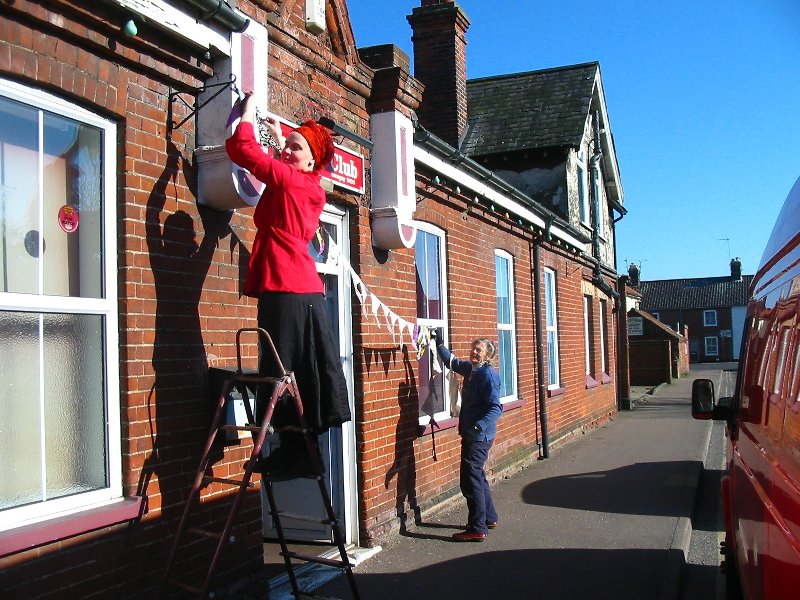
Pics: Eloise and Daphne hang the welcome bunting at Sustainable Bungay's Spring 2011 Give and Take day; Molly welcomes people to Transition Norwich's Stoneleigh presentation last Friday; Nick and the cat making themselves at home at Save Bungay Library's Telling Tales event on Saturday

Saturday, 26 February 2011

More Oil - Troubled Waters?

I had my Peak Oil moment some years ago, by which I mean a sudden all-at-once awareness of how utterly embedded I am in, and part of, a culture wholly dependent on fossil fuels for its existence and maintenance. And the shock of realising it hadn’t always been like this, and wasn’t always going to be like this.

I started taking notice of things I’d previously ignored. How is our economy set up and run? What does anthropogenically related climate change actually mean? How is the food I am eating produced? I joined Sustainable Bungay and Transition Norwich and have been looking at these questions and a million others in a thousand meetings with people who were asking them too. I worked out my personal carbon footprint for transport, home energy and food and reduced it. I morphed from vegetarian to freegan. I joined this blog and began writing about it.

It’s been an odd week. I borrowed a friend’s car yesterday to do a food shopping trip and take six months’ worth of bottles to the bottle bank. I’ve recently been going everywhere by foot, cycle, bus or train, so I hadn’t been in a petrol station forecourt for about six weeks or seen the prices (about £1.30 a litre). The Daily Express (no I don’t read it, it was on display at the garage) warned that petrol would be £8 a gallon in the near future and only the rich would be able to afford to drive cars. Meanwhile Libya becomes the latest country in the Middle East to explode in unrest. I had a feeling of deja-vu. And then became aware that the oil (and other crises) we've been talking about and preparing for in transition were actually happening now, not in some near or distant future.

And here at home the shock doctrine government spending cuts start being felt in so many areas. Suffolk County Council are planning to close several waste disposal tips, including the ones at Beccles and Southwold. Practically speaking this would mean a round trip of twenty to thirty miles to Lowestoft if you live in Bungay or Southwold and need a dump. And with petrol prices... Who will be on hand to prevent flytipping on the land?

But we have started to raise our voices. The proposed cuts to the libraries have been met with fierce opposition and community engagement in many places. Sustainable Bungay have organised a World Book Night read-in next Thursday. But even here in Southwold, there are stirrings. The Labour Party’s Save The Library poster can now be seen in many windows (and not all of them red, I'm sure).

Meanwhile back to oil. In November 2009 I wrote on this blog about the ship-to-ship oil transfers off the coast between Lowestoft and Southwold. The government recently voted to allow this to continue (the only place in Britain it is permitted). The Southwold and District Chamber of Trade and The Southwold and Reydon Society pressurised the government into reopening public consultation. This gives us until 10th March to write letters to Westminster. And shows that public pressure does have an effect.

Stop Press: See Mark Crutchley's latest article for the One World Column: The End Of The Oil Age

Pic: Ship to Ship Transfer off Southwold Nov 2009 by Mark Watson

Friday, 25 February 2011

Peak Oil! Peak Oil! - Oil! Oil! Oil!

Today I had planned to write about the Suffolk Agricultural Association’s Regional Conference on Climate Change and Food Security, which I attended last Friday at Trinity Park in Ipswich. But I’m finding it difficult.

There were probably 150 people at the conference, made up of farmers, lawyers, county councillors, politicians and transitioners. Although agriculture is not my subject, I am getting used to the flexibility that being in transition is requiring of me, so when I was invited to go and write about the conference I accepted immediately.

Professor Ian Crute of the Agriculture and Horticulture Development Board was clear and informative about climate change, although he ended his talk in what I thought was a very odd way. He showed us two pictures, one a detail of the Amazon rainforest before being cleared for agribusiness, and one after. He then said there was an argument for the second picture (a typical crop field which could be part of an industrial farm anywhere) being ‘better’ than the first. But didn’t tell us why.

The Agriculture Manager from Waitrose showed us how the company were going to increase their profits from £5 billion in the last year to £8 billion by 2016.

Then there was the unabashed and rampant display of pro-GM and biotech marketing by two speakers from the Conservative party.

But these are not the reasons I find it hard to write about the conference. I think it’s because the realities of Peak Oil were almost entirely absent from the proceedings. Representatives of several Transition groups in the region ( some of whom manage farms themselves) raised the subject.

The Waitrose man was unable to answer questions on oil price volatility, and how that would affect the supermarkets, it wasn’t his area. Other speakers just didn’t seem to hear the questions about Peak Resources. At least when (Lady) Caroline Cranbrook, who has worked closely with East Anglia Food Link, spoke out about phosphates already having peaked and asked “Is there a national larder in case of sudden food scarcity? ” she received the one direct reply I heard in the whole conference.

“No,” said chairmen John Gummer (former Secretary of State for the Environment), “is the simple answer to that question.”

Which means the just-in-time lorries serving the supermarkets are our only larder.

The conference was very much focused on the 'big picture' (the how will we feed the 9 billion people in the world by 2050? scenario), although one speaker, Lucy Wyatt, did tell us about her small mixed-farm, where she has set up an oilseed rape bio-fuel plant, providing her with electricity, and fuel for the farm machinery.

But there was no spokesperson for organic production and no representative of one of the community, small-scale projects that are happening all over Suffolk and East Anglia, like the Oak Tree Low Carbon Farm CSA, Joanne Brannan (Transition Ipswich) has set up. John Taylor, Suffolk's Climate Change officer, did ask about the small scale projects, but the question was not properly addressed.

And although I'm only a member of the mere hoi polloi, I'm inclined to say that a conference about climate change and food security that avoids the questions of Peak Fossil Fuels and small scale food projects is not really a conference about climate change and food security.

Well, I really didn't think I had anything to say about the conference, but there you are.

Just two more things for today. One is if you haven't read "The Long Emergency: Surviving the Converging Catastrophes of the Twenty-first Century" by James Howard Kunstler, and you want a solid, readable, intelligent book which brings climate change, peak resources (especially oil) and the follies of economic globalism together in a coherent manner, then this is the book for you. Don't let his occasional coarseness put you off, it's just his manner.

Secondly, The Waveney Greenpeace Winter Fair is taking place in Southwold tomorrow - 11am - 11.30pm. Donations in the day and £5 in the evening. It's usually fun with good food and stalls. Maybe see you there.

Pic: Sprouts and Clover at Oak Tree Low Carbon Farm by Richard Mudhar

Thursday, 24 February 2011

Biodiesel - A First Reaction

Last October I wrote about my meeting with a waste vegetable oil man in Beccles, and talked about the beginnings of our Biodiesel group in Sustainable Bungay. This is an update based on a December visit to a man who makes biodiesel at home and our own first attempts at a reaction last Saturday.

But first, why am I part of a Transition Biodiesel group, when I don't even have a car at the moment? Well, for several reasons, not least the social benefits of being part of a community group that's making something useful together. But equally, at a time when oil prices are soaring through the roof and with political instability in so many oil producing countries, plus the realities of Peak Oil, it just makes sense to engage in a project that focuses my mind and gets me thinking in a really practical way about these things.

And you can use biodiesel for other purposes - oil lamps for instance. (Though there are obvious drawbacks with used chip fat - unless you're into things like scratch and sniff!).

(i)
On a very cold December day Josiah, Kris and I took a trip down to Aldeburgh to see Colin, a retired chemical engineer who has been making biodiesel at home now for three or four years. Colin welcomed us with a mug of tea and showed us around his set up, explaining the process - from collecting waste vegetable oils from food outlets through cleaning the dirty vegetable oil, reacting the clean oil with lye, separating the crude biodiesel and glycerol and washing the crude biodiesel with water to produce the final vehicle-worthy product you can see in the photos.

Throughout the visit Colin answered our questions on everything from handling lye (the caustic which is vital for the trans-esterification reaction which converts the vegetable oil to biodiesel and glycerol) to the disposal or recycling of the waste glycerol. He advised anyone making biodiesel for the first time not to rush into producing enormous amounts.
“The thing is to start small, doing the reactions with some glass or plastic bottles,” he said. “Then as you get used to handling the liquids, you can increase the amount.” This came as a great relief as I had been eyeing that caustic lye with some trepidation.

The legal limit for home biodiesel production is 2,500 litres per year, tax-free. This is what Sustainable Bungay’s Biosdiesel group will aim at initially. For the project to get underway properly we would have to wait for wamer weather. Colin meanwhile invited us to come round the next time he does a ‘reaction’.

(ii)
Last Saturday, 19th February a dozen of us turned up at Kris and Eloise's to have a look at the set up in their garage and to make our first three litres of biodiesel. We crowded into the living room where Kris introduced the project and we discussed everything from logistics to legalities before descending on the kitchen for Eloise’s delicious soup and homebaked bread, David’s tasty flapjacks (his first ever!), Elinor's ginger cake (no comment required!) and Brenna's polenta, lemon and orange cake, also a first. I ate three slices of that!

Then we cleared all the food and utensils out of the way to do the reaction. Great care was needed (and taken) pouring the lye/methanol first into a glass measuring jug and then into plastic bottles with vegetable oil. As it was our first time (and the weather had not yet warmed up), we used clean vegetable oil, which does not go hard as lard in the winter.

Kris wore protective goggles and everyone handling the mixtures wore gloves. David and Josiah took photos. We kept the windows open to avoid suffocation by noxious fumes. My nervousness about caustic liquids was allayed both by the presence of Mike, a chemical engineer, and the fact that Kris was so calm.

We had to keep the temperature of the mixture at below 50 degrees for the reaction to take place safely (methanol is volatile and can produce an easily ignited vapour at higher temperatures), so the bottles were placed in a pan on the stove for about an hour. Meanwhile we went to look at the reaction vessel.

I had to leave shortly afterwards but here below is the result of our first biodiesel-making session.

Pics: Pouring the Oil (notice no gloves here!); Colin's Biodiesel; Pouring the Lye/Methanol mix (serious glove time!); Still in the Garage; First Bottle of Biodiesel - Photos by Josiah Meldrum, David Poston and Mark Watson

Monday, 7 February 2011

Starting Somewhere

I’ve had some really interesting conversations over the last week or so, inspired, no doubt, in part by the ongoing “austerity measures” that are really starting to to be felt by the ordinary person in the street.  The conversations run along the line of “I really want to do something but I don’t know where to start”.

There’s a feeling that it’s all too much for people – they don’t know what to do and feel paralysed.  Classic shock syndrome.

I don’t pretend to know all the answers, far from it.  But, for those guys, and you know who you are, here is my personal top ten of where to start.

1. Pay attention – to paraphrase Donald Rumsfeld, it’s very difficult to know what you don’t know.  So you have to get out there and find out what’s really going on in the world.  Read the news (real news, not the slop that passes for news on much of the TV and the tabloids), read magazines, blogs and books.  Norwich library has hundreds of books on various subjects, and some great “dummy guide to” style books.  It’ll take a bit of effort, but once you learn about some of the things happening in the world – happening in your name - you will Get Angry.

2. Get Angry – research suggests that people will only make a change in their lives once they reach a certain point of anger and frustration.  That point is different for different people, but we all have it.  To actually want to do something, you’ll need to get angry. One of my favourite cartoons of last year reminded me that so much is interlinked – peak oil, climate change, economics, social justice, respect for people and planet.  So whichever subject floats your anger-boat, you’ll be in good company.  But anger can be very unfocussed, so it’s important to Arm Yourself.

3. Arm Yourself – with facts (not guns, obviously).  There are lots of people out there who will tell you that a) you’re wrong, or b) that you’re just a dreamer and it won’t make any difference.  Prove them wrong.  Learn some facts about climate change, about economics, whatever.  The more you learn, the more you’ll want to learn.  And also, make sure you learn the counter-arguments.  Learn the rhetoric of the other side of the argument; some arguments you’ll never win, but you may give the other person something to think about.  The important thing is to Get Involved in the debate.

4. Get involved – this should be an easy one in the sense that the country is buzzing with debate around the economy at the moment and the government’s various proposals of how to deal with it, from tax reform to selling off the forests, to restructuring the NHS.  People will want to know your opinion, so let them know.  Not just colleagues and friends, but also your MPs, councillors etc.  Make sure these last two know what you want from them, regardless of the party they represent.  Remember, they don’t represent a party, they represent you.  Make sure they remember that too.

5. Build Resilience – one of the challenges to getting started is feeling that you’re just one insignificant person facing a sea of indifference at best, strong resistance at worst.  But you’re not alone; look around you, there are hundreds of groups, thousands of people all wanting to make a difference; make things better for the many, not just for the few.  Transition Norwich is one such group, and there are many more, big and small.  Working with others will remind you that you’re not alone, and that together, people can work wonders.  If you don’t believe me, think of the suffragist movement, the trade union movement, the fall of the Berlin Wall; look at what’s happening in Cairo at the moment.  Think about the growth of Fairtrade or the Transition movement. Working together will build your personal resilience and inspire you. So, be inspired, and then take action.  If you’re not ready yet to jump right in, you could dip a toe in the water and Start with the Small Things.

6. Start with the Small Things – magazines and Sunday supplements are full of articles on the “ten things” that will save the planet, save the environment etc.  I’m fairly sceptical of these top tens, because they all tend to be pretty similar in subject and in scale.  Changing your lightbulbs to energy-saving ones and lagging the loft are all small things, and to my mind, lack ambition.  But hey, we’ve all got to start somewhere, and let’s start with the easy wins.  Have a look at your house and lifestyle and see what you can change. The plus side is that a lot of these Sunday supplement suggestions will also save you money, so you’ll get a warm fuzzy feeling from your bank statement as well as your conscience.  And, hopefully, as with learning to walk, once you’ve taken your first tottering steps, you’ll soon want to learn to run.

But before we embark on the big changes, it’s worth pausing to take a Look Behind the Curtain.

7. Look behind the Curtain – the world is a complex place, and what seems clear cause and effect isn’t always the case.  There are hundreds of examples, but one of my favourites is that of the Somali pirates.  Quick caveat – I’m not condoning piracy or the violence that goes with it.  Obviously…  However, there’s a view that the rise in piracy off the coast of east Africa was directly related to the overfishing and subsequent depletion of our own fish stocks.  Once we’d fished out the North Sea, then the North Atlantic, we in Europe sought new fishing grounds to keep the supermarket ice-counters full.  The industrial fleets moved into the Indian Ocean, and displaced the traditional fishing lifecycles of the people already living there.  So, skilled sailors with boats suddenly had no jobs, no income, and no way of supporting or feeding their families.  Next thing, Saga cruises are being held up by pirates. That’s a simplistic assessment of the situation, but the kind of scenario that you see when you look behind the curtain of the traditional media explanations.  There are many, many similar stories.

So if that kind of thing really hacks you off, maybe it’s time to start doing the Big Things.

8. Do the Big Things – you know the kinds of things I’m talking about – the things we discuss a lot on this blog.  Flying, shopping local, buying organic, making things, reusing things, changing your personal financial model, cutting down on consumption, challenging the economic growth model.  These are the things that can frighten people, but they’re actually the things that really mean something.  They can require personal sacrifice, or sometimes they just feel like they require personal sacrifice.  Once you make a change, you might wonder why you hadn’t done it before.

9. Live like you M
ean It – we had a laugh at work on Friday as I said I wouldn’t get a bacon bap for breakfast unless I knew where the bacon had come from.  I was kind of joking as I’d already had my breakfast, but there was a serious point too.  I do have a personal code that guides the decisions I make.  I don’t always make the right choices; other things get in the way and I have to compromise – that’s life.  But I try and I think we have to keep trying. I want to leave the world a little better than it was when I entered it; leave a legacy for my children and grandchildren that I can be proud of.  I won’t Give Up.

10. Enjoy Yourself and Don’t Give Up – my children constantly remind me that you can’t take yourself – and life –too seriously.  The challenges facing us are great, but working towards solutions can be a lot of fun – that’s one thing that Transition Norwich has taught me.  There’s a great bunch of people working towards a better, more equitable future, so join in.  Don’t give up, and have some fun on the way.

*****

So there it is – a very personal view.  What do people think?  What have I missed?  What would be in your top ten, or even top three?  Leave a comment and let us know.


Pic from www.businesszone.co.uk

Saturday, 15 August 2009

This Low Carbon Life

Monday Oats From Garboldisham

Thinking about starting a blog today. I wanted to keep a log of everything that happens in this year of TN2, when a bunch of us decided to cut our carbon footprint by half. I wanted to write about the people I’m embarking on this journey with and the small surprising things that happen as we exchange news of our lives. At the last meeting we listed what small steps we had already made and Mark said: every morning he ate porridge made from oats from Garboldisham which is a mill just outside Diss. Later he got all the bills out over the living room floor and made the astounding discovery that our oil bill has decreased by 75% from 2003. What did we do in those blissful days before we knew about peak oil and the economic downturn? Were we eating the stuff?

Actually we were looking at plants. Wild plants, food plants, medicine plants. One thing I learned from looking at plants and plant medicine all those years. It’s the small changes that really affect the body and mind. So long as you pay attention to them.

Josiah once told me oats are the food of the future because they are native, hardy, don’t need pesticides and are very nutritious. Oats are a good medicine too. Excellent for calming you down, cutting anxiety so you see clearly what lies ahead.

It’s August and I’ve decided to take things easy myself! I’m having a zero-carbon holiday and have just put my tent up in the garden under the greengage tree. At night I lie in the dark listening to the seawind flapping in the rigging. It reminds me of being on a boat. The moon rises red from above the black trees, Jupiter shines like a beacon between the clouds. On the distance there are huge ships casting an ominous orange glare over the dark ocean. They’ve been there for months. Must be at least nineteen of them. Must find out what they are.


Wednesday Swimming in the Sea

Found out what those ships were talking to an ex-oil tanker/rig worker outside the Sailor’s Reading Rooms in Southwold. He said they were empty oil tankers and they were anchored there because it was cheaper than being in harbour. Then Josiah wrote in the log that actually the ships were not empty at all: Sole Bay is one of tthe only places in the world where you can legally (sic) transfer oil ship-to-ship and many of them were just waiting for the oil prices to rise. I don’t know which is more of an omen, full oil tankers or empty oil tankers on the horizon. I’m going swimming most days at the moment. It’s calm and the town beach is full of holiday makers. It’s odd but when you are in the sea with everyone, riding the waves like seals, sleek heads bobbing, you feel at home with your kind in a way that is quite difficult when you’re on dry land.


One week later Andy came down with his nephews and put a mighty-sized three man tent in the garden. Here I am with Ollie about to embark on a swimming-in-the-rough-sea lesson. First rule of resilience: enter the waves boldly, come what may!

Christine wrote about strip washing today in the TN2 log. Funny, when you are living in a tent you don’t feel like washing. You’ re not so prissy. You can pee in the compost, walk barefoot in the dew, eat plums without washing them, let the salt stay in your hair. You feel closer to things and yourself. Went down to the wood today and saw all the late summer flowers – skullcap, fleabane, angelica. On my way back I filled my pockets with yellow plums and hazelnuts and picked a punnet of wild cherries. It seems as if everyone is mapping the fruit trees of the neighbourhood at the moment in England – unwanted apples and pears in the back yards of Hackney, Sheffield and Beccles. We’re learning the art of gleaning, paying attention to the small things. When you’re focussed on the small things that’s when the beauty of life strikes you – the surprising sharpness of wild raspberries on your tongue.

What’s the pay-off? you might ask as we all face this low-carbon future without being able to escape in aeroplanes, without tropical fruit, without hot power showers. I’m discovering it this week: living on the earth is the pay-off. Swimming in the sea and feeling its energy and light enter your bones, feeling at home with your fellows as you run down the beach resiliently, come what may.