Sunday, 4 November 2012
Transition Video Games: Anno 2070
During open space on the Saturday afternoon of the Transition Network Conference, I was a bit of a butterfly and attended several sessions which caught my interest, without settling down for too long at each. One such session, which I was probably at for no more than 5 minutes, was Transition Games. I wanted to let the people there know about Jane McGonigal, whose TEDTalk asserts that "Gaming can make a better world" (I highly recommend watching!), but I was also interested in what they said on the subject and whether there were any computer games that they thought relevant to Transition.
I'm not much of a gamer myself, but ever since high school, I've been great friends with a guy whose hobby is computer games. He collects classic and rare computer games and consoles, raves about the latest technology and innovations, and, of course, plays them. Through him, I get to see pretty much all the variety of video games that exist, and play games from time to time. I've always been disappointed at quite how many of the computer games include violence. Many of them are centred around war, or at least defeating your enemies in one way or another. As a pacifist, I've constantly been on the look-out for games that turn this around, and make diplomacy the enduring quality of the best player.
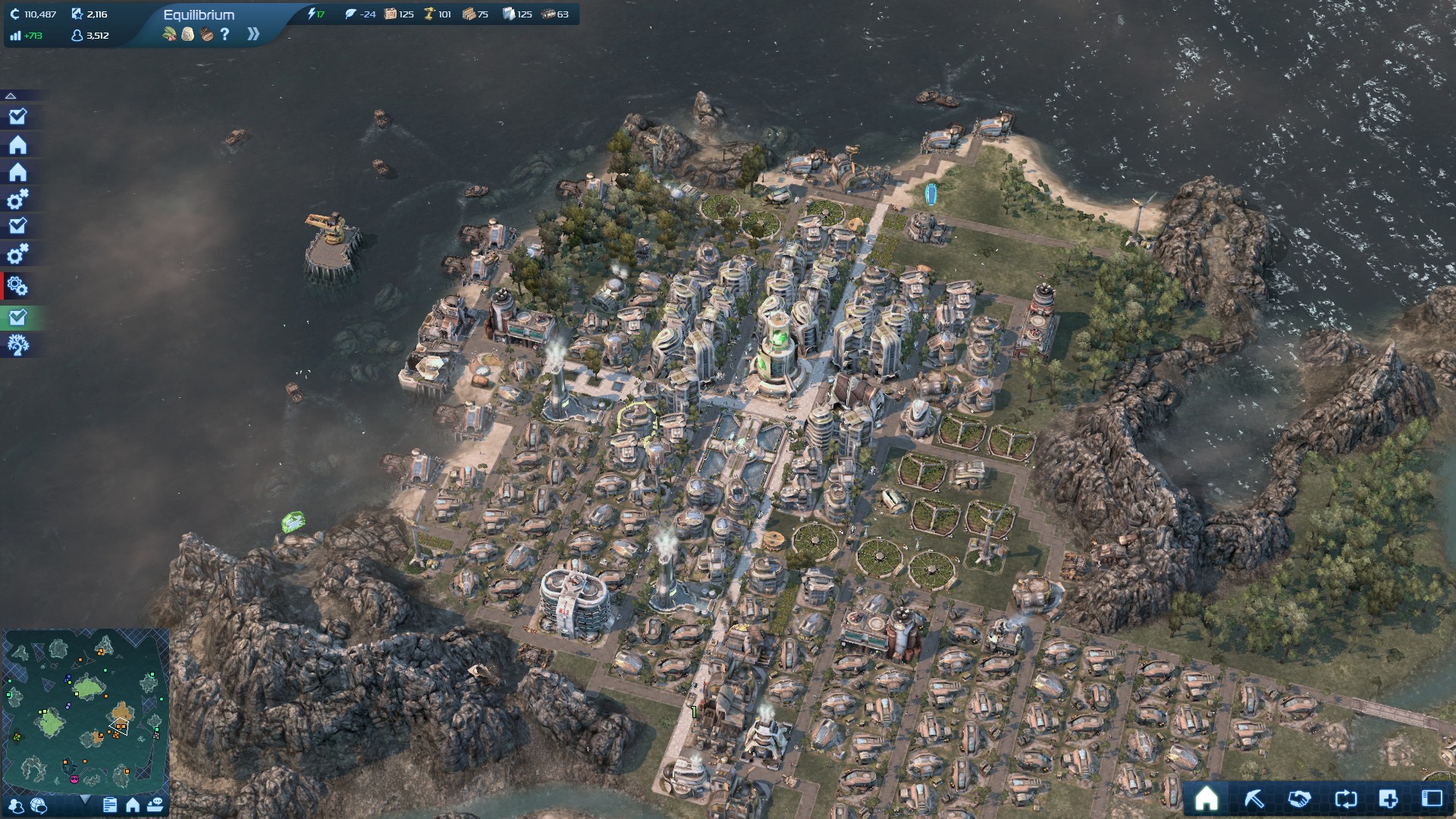
So, when at the conference someone mentioned a game called Anno 2070, I was interested to hear how it was different, and what it could teach of Transition principles. It was a game about resources, apparently, set in 2070, when sea levels have risen as a result of global warming, and several factions are competing to make the best use of the remaining resources. One of those factions is decidedly environmental in its focus, harbouring energy from wind, improving the quality of soil and replanting forests. I was intrigued, and decided that I would see this game for myself. So I bought it, and took a look.
The game is indeed about resources. Each "mission" requires you to settle an island (its always an island because of the raised sea levels of the future), create a city, and then use the island's natural resources to complete an objective. In one mission, the objective is to research the technology to save an existing city from the effects of poisoned fish, but they vary greatly. The missions require you to mine resources, build factories, trade with other factions and (in a just a few cases) battle against factions with conflicting interests.
I was disappointed. On several counts.
Firstly, there are two basic factions, one representing corporations that is only out for profit, and another representing environmental groups. Apart from this not being a realistic model of a potential future political scenario, the differences are minimal, simplistic, and arbitrary. The eco organisation still mines coal and ores, both consume huge tracts of virgin land in the building of their cities, and hydro-electric power (one of the best forms of renewable energy) is only available to the profit-motivated corporation.
Secondly, there is no real concern about the balance of resources, of the production and disposal of waste, or the effects that this has on the environment (except, again, in a rather arbitrary way). The amount of resources on each island is plentiful, and therefore efficiency in the use of resources is not generally a concern, as long as you can process them fast enough and offset with "ecobalancing" technologies when required. It's not a game designed with education about eco-issues in mind at all, but it jumps on the bandwagon of being a game about climate change to get a few extra sales (from people like me... whoops).
Thirdly, there did end up being war in it, and although it's not the focus of the game in any way, nor is there any advantage to trying to avoid war. In fact, it is sometimes part of the mission that you must attack some enemy facility to prevent them from causing damage to the environment. Well, what about the damage to the environment caused by your military? That's what I want to know.
So, if you want to teach your kids about natural resources using a computer game, don't buy them Anno 2070. Buy them Minecraft.
Minecraft is an indie game (this means its produced by a small, independent software house, rather than the huge game publishing houses), where you wander around a virtual world made of one metre square blocks, moving them about and using the resources you find to build things. Although there is an end objective (that of defeating the Ender Dragon), it's much more fun, in my opinion, to just create a virtual town with friends (it is a multiplayer game) and show off your creative talents (see the above town that my friends and I made!).
How does it teach about resources? Well, the name comes from the fact that you have to dig out materials and can then use them to craft things. If you find iron, for example, you can smelt it, using coal or charcoal, and use it to make an axe. You can then use the axe to cut down a tree, which can then be crafted into timber to build your house, and so on. The thing is that all these resources are limited. When you've spent ten minutes digging underground to find a seam of coal, you don't want to waste it by crafting something that you're not going to use. And once you've mined all the resources from a particular area, they're gone for good, and you must go further and further afield to find the resources you require. Wood, on the other hand, is renewable, and as long as you remember to plant saplings to regrow trees that you chop down, you can have a continuous supply of timber, and therefore charcoal. Resources have a real value to the player, because of their rarity, or the time and effort that it requires to get them.
OK, it's not perfect as a Transition game. It wasn't designed as one, and it does still include enemies (monsters that appear at night), but at least you can choose your focus, and appreciate the challenges for what they are, rather than because they are imposed on you as "missions".
Still, an actual Transition game as an educational (and entertainment!) tool would be quite cool. One that taught the challenges of resource allocation, the politics of change, the rewards of doing things differently. Does anyone know of any existing games that fit the bill? If not, who's up for making one?!
Images: Open Space at the Transition Conference by Mike Grenville. Screenshots from Anno 2070 and Minecraft respectively.
Tuesday, 25 September 2012
The Lavender Hill Mob
What's the word, I ask the morning, that I should take to the conference?
Open, the day replies mildly, as the horizon stretches in all directions and the clouds move with the wind ever westwards.
Afterwards I cycle down the sleepy high street, towards the farmer's market, where Brian has four kinds of home-grown chilli waiting for our next Happy Mondays Community Kitchen meal - a Mexican fiesta. I sing as I go up the hill:
Porque cantando se alegran cielito lindo los corazones
Because, sweet sky, singing gladdens the heart.
key one: finding the key
"You can have it like this," she said and wrapped me in a big black cloak. "Or you can have it like this" and she opened the cloak and there in front of me were the shiny faces of my friends, laughing. It felt as though that decision was the simplest and the most profound thing I could make in my life. It felt as if it could turn the destiny of the whole planet around.
"I'll have it like this," I declared.
"Bring it on," she said.
Battersea, London, 2012 He is feeling and I am thinking. We are enacting a drama in a workshop on creating happy and healthy human cultures. Sophie Banks is asking us to express the extremes of opposite states and then to let them go.
"What did you experience?" he asked me afterwards. They are the same, I replied. I looked at you and I saw me. Thinking and feeling make the same shape. They are either closed down, or they are open.
The opposites are not feeling or thinking, or male or female, or action and reflection, but the state in which we operate. When we rush around the room, heads down, closed, defensive, self-obsessed, we live in a restrictive world where time is running out; when we slow down, get in pace with our hearts and the natural rhythms of the earth, looking at each other, related, connected, open, we find ourselves in another world. We are open to possibility, we are open to change.
That was a small key moment at the Transition Network UK confererence 2012 on Lavender Hill. And it gnawed at my heart all weekend, like a little mouse.
key two: set and setting
Two years ago at Seale Hayne it was the Stoneleigh Lecture which rocked the halls and woke everyone up to the economic crisis; last year in Liverpool it was the tale about los indignados, told to us by Transition Barcelona, which presaged the global Occupy movement a couple of months later. Here in Battersea I'm missing the kickback time and outdoor spaces afforded by both those residential events. This year the main conference is almost a day shorter, and we do not breakfast or have supper together. I'm aware however that it has a different set and setting, where instead of feeling like an outsider, I feel completely at home.
By the composting toilet I sat down and wept
key three: layers
I'm looking for the story in amongst the noticeboards and conversations, the shafts of sunlight filtering through the coloured glass roof. The title of the conference however is not about narrative, a fluid and linear sequence in time. It's about a vertical shape contructed in space. We are building resilience in extraordinary times - a resilience, I'm discovering, that is constructed in layers. Strips of meaning laid on top of one another.In Sophy's workshop we begin with a traditional milling exercise: walking around the room slowly and deliberately, looking each other in the eye, then fast as if we were late for a meeting. Eyes down, locked into ourselves, pushing everyone out of the way. Then she outlines a Native American teaching about coming from upright or deteriorating mind. This is a teaching from the Six Nations confederacy, which gives us a blueprint of how to shift from a warmongering mindset to one of inter-tribal co-operation. Layer three comes from psychological work with trauma, where it's recognised that in extreme circumstances human beings split into two parts - an outer part that deals with survival (gotta do, gotta get on) and an Other inner part, which holds the traumatic experience and all the feelings it engendered.
The first part is always in control, and the second lurks underfoot, threatening to upset the apple cart at all turns. In order to avoid re-experiencing the initial trauma the controller projects all the dark and dangerous stuff onto other people. That's the black sheep in our families, our disloyal friend, whole sections of society in the down-there place, those "difficult" people in our Transition initiatives.
Me and you.
Layer four is our challenge: how do we move from Dominator Culture towards Partnership Culture? How do we take the good things from our deeply felt experiences and our smart, outgoing, pioneering selves, and join those fragments together?
key four: the talking shop
Teen and I teamed up in the Communications corner. We were the first shop to open (No 19), and Teen was one of the torch bearers who ran down the High Street to declare it open. The Talking Shop was a media hub and literary cafe downstairs, wth an office for the Transition Free Press upstairs.
"We'll be too busy to do food," advised Teen as my plans for the cafe extended wildly. As it happened however we found ourselves next to a Community Kitchen and we soon knocked a door through our adjoining walls, so we could share custom. Sorted swiftly, with a minimal shop front, Teen went out to have a cigarette and I went to the media hub (real one), to send my menu notes for Monday's Mexican fiesta. When I returned the High Street was in full swing and I walked around the cardboard town, talking to people, asking questions, listening to their set-up tales. For a moment it was like being a kid again at the seaside, building sandcastles and spaceships that take you all the way into the future.
"Would you like an ale?" asked a familiar voice.
"Do you have cider?" I asked. "I can't drink beer."
"Oh, yes," Rob replied, and handed me a cup. I laughed as I peered inside and found it was empty. For moment I thought it was real. I had forgotten the joy of imaginary games. It's not often you get the chance to let go and be in play with 300 people. I loved the inventive things everyone was doing with all that newspaper and bamboo sticks, all those joyful exchanges of which I was a part. But inside I was troubled too.
"Gisse job," I said to Fiona from REConomy, standing next door at the Town's Job Centre.
"This is for people with skills," she explained.
"Communications is a skill," I replied. "We're setting up a media hub and a local newspaper."
"You need to go to the Bank," she said.
I went back to mind the shop. Communications is a skill, but in the imaginary and the real job centre there is no paid work for communicators. There were only two of us in the room who were doing the job. We were skilled journalists, social reporters, and already had a national Transition paper for sale. "Comms" in the conference was represented by the workshop on Spiral Dynamics given by Nick Osborne, but there was no formal focus on our relationship with the media, or indeed becoming the media. Even though the mainstream and alternative press have a key role in shaping the mindset of the collective there was no place for those of us telling the story of our extraordinary times.
This post has taken a long time to be published. Partly because my fellow reporters have already written so clearly and comprehensively about the event. But partly because something happened there I didn't really want to look at. I wanted to write how wonderful the conference was. Because it was. There was a high octane buzz and an ace feeling afterwards that we were a network of people throughout the world, working towards a future that had nobility, meaning and heart. But there was this other feeling I found as I stood at The Talking Shop I couldn't ignore - a feeling of redundancy.
I am not a builder. I am a storyteller who makes meaning in time. I go where the story takes me. I go where I am welcomed and where I am valued. It's not an individual decision, it's a group decision.
In my Transition initiatives I organise community blogs, press releases, newsletters, bulletins, speakers and sometimes am that speaker myself. I am the one who asks awkward questions in meetings, keeps a record, relates the bigger picture - from the Network to climate change - that frames all our small local moves. For the past five years I have written hundreds of blogs in praise of everything I see and experience in this extraordinary movement. I have found the words - all the words, the bitter, the joyful and the true. I have given them freely. In one initiative, I am excluded, in the other I am welcomed. Communications is understood as vital to our resilience and has helped keep us together where the other has fallen apart. It's not because I am a wonderful and important individual, it's because I'm working with a crew that knows the work of communications is vital if we want to create a partnership culture. Communication is what brings those fragmented parts of ourselves and our world back together. A key that opens the door.
Because, sweet sky, singing gladdens the heart.
Because, dear readers, I sat down by the rivers of Babylon and wept.
Pictures: words and people from the project In Your Own Skin, showcased at the Cabaret and being crowd-funded this month (Katheryne Trenshaw),; mosiac bee on the floor of the Battersea Arts Centre (Laura Whitehead); writing up a blog at the media hub (LW); communications board at the High Street group process (LW); our sunflower-shaped neighbourhood (Mark Watson); Martin from Asda with the pre-processed carboard (Ruth Ben-Tovim); newly minted Bristol Pounds, our Transition Free Press front story, launched on 19 September.
Monday, 24 September 2012
things fall apart the centre cannot hold - communications and resilience at #tnconf2012
We reached the ice a couple of days ago and it's incredible, although in a far worse state than the scientists thought it would be, or satellite pictures show. Yesterday we were at 83 degrees North (420 miles from the North Pole) and we didn't see any large ice floes, everything was a lot smaller and thinner than we expected."Comms" in Transition is often understood as a persuasion tool: we have marketing and "communication skills" so we make people join our initiative, downshift, wake up to the effects of melting ice on our small lives. But editorial is not in the persuasion business, it is in the reality business. As the corporate media distracts everyone with parliamentary debates, game shows and celebrity parades, it is our work as communicators to report what we see happening all around us, to frame our community moves within the bigger picture. We are in search of a narrative, as individuals, as Transitioners, as planetary beings at this moment in time. What we value is a media that reflects what is going on from the ground -the gritty, the beautiful, the profound and intelligent. But most of all, the true.
This morning, a bit further west, it was mostly slush in the water - we're seeing more now but it feels like it's melting before our eyes.Right now it's the lowest sea ice surface extent ever recorded - just below 3.5 million sq. km. Trying not to be depressed though - it's still amazing and beautiful. We have seen some polar bears though - yesterday a mother and her cub were pretty close to the ship, jumping between ice floes - wonderful!
Building resilience in extraordinary times is a buzzy headline, but what does it mean as far as our communications at this conference are concerned? The principle definition of resilience is the ability of eco-systems to hold together when the whole is challenged. Our challenge as Transitioners is to hold the core within ourselves and our communities, and not to fragment. Eco-systems do this by being connected, by a web of communication exchange and feedback. When threatened what matters most is that the fire of a body, what keeps it alive, is preserved, in the same way the bees in a colony cluster around the queen to keep her warm as winter sets in.
What keeps people together is the spirit of the enterprise, its heart. That's something we share together, what we hold in common. Look at it as a story we tell each other around a fire. What is the narrative we are creating? What really matters when the chips are down, and the world is falling apart, and it feels as though everyone around us is sleepwalking? In extraordinary times, when the wild fires are raging and harvests are failing, can we tell another story that wll feel like the warmth of a fire? And who among us is going to tell it?
crew one: social reporters at large
For this weekend's conference six of our reporters (that's Ann, Caroline, Charlotte, Jay, Kerry and Mark) will be setting sail within the crowd, with our ears alert and our eyes sharp, our pencils at the ready. If you find us do tell us your story and let us know any feedback or suggestions about the blog. In the next two days we'll be writing short reports from the different events and workshops, and the following week we will be reflecting on our experiences at both the main conference and all of the four sister strands (including International Hubs on Monday). You are welcome to contribute guest blogs at the media hub (we'll have two computers there at the ready).
Oh, and we'll be communicating and networking like mad. For me, the best part of the conference is meeting and speaking with everyone in real time and space. That starts with the reporters themselves, who normally only communicate via computer or telephone. And we're all very happy to welcome back our producer, Ed Mitchell, who is returning to Transition comms from his year's voyage out. Come and find us.
launch of the transition free press
Tonight we'll also be launching our new national paper the Transition Free Press. We published our preview edition in June and since then have been distributing our 2000 print run in different regions of the UK and at summer gatherings from Permaculture convergences to Sunrise and Uncivilisation festivals. There will be a copy for everyone at the Conference, so if you haven't already seen a copy do take one home. It is our intention to publish four editions through 2013, beginning this winter, and in order to fund this venture, including printing, payment for editors and contributors - we need your help and contributions, and most of all your loyal readership.Becoming the Media is one of the principal tools in the Connecting chapter in The Transition Companion. This includes YouTubes, social media, blogs and Twitter feeds. But nothing has impact like the printed page. Newspapers publish many stories on line but only certain ones make it into the paper "proper". Physical print, like everything else built in material form, has a strength and a baraka like nothing else. We are aware as communicators that the print holds knowledge and goes places that computers can never go - no matter how swanky the tech.
Moreover the discipline of writing news stories requires a totally different attention than writing blogs or emails. It demands far more work and time and dedication. It requires skilled designers and editors. For us, the paper is a bridge that crosses boundaries, it connects all the different strands that make up an alternative vision for the planet from anti-fracking campaigns to land rights movements to food co-ops, it connects initiatives around the country and around the world, and communicates and celebrates what we do. It is a tool that is integral to the core we are holding, and lets people who might never have heard about Transition know that it is not all business-as-usual out there.
At the conference we are looking for 35 initiatives to sign up as distributors for our paper - that's all of us in the room and in Transition. Having dedicated people around the country is what will make this enterprise possible. We will have a map of Britain up behind our stall in the Octagonal Hall and distrbution forms, so do come up and talk with us and ask questions about what this might entail. We will also have a flat plan for future issues and we're looking for contributors and any stories or ideas you might have for the different sections fo the paper. On Saturday we will be running an open editorial meeting during the Open Space session (4.15-6pm). All are welcome.
The TFP crew will all be at the launch party: that's me (ed), Alexis Rowell (news ed), Mike Grenville (production and distribution), Tamzin Pinkerton (food); Mark Watson (subeditor); Trucie Mitchell and Mihnea Damian (designers), as well as many of our wonderful contributors. We're really looking forward to meeting you and declaring this paper an "official" voice of Transition. We're starting at 7pm for 7.15 and will be toasting and launching our vessel at 7.30pm in the Main Hall. See you there!
Images: Sara Ayech and the Arctic Sunrise on the Arctic sea ice (look out for Sara's story next week!); Charlotte from interview with Rob Hopkins, Transition Culture; map of Britain we hope to cover with map pins indicating distribution points for the Transition Free Press.
Tuesday, 18 September 2012
Synchronised (or was that Synchronicitous) Sweeping at the Transition Conference 2012
It is 9pm. I am typing this on fellow social reporter Jo Homan's (Transition Finsbury Park) laptop at her flat, where we have been staying for this Transition Conference weekend. Charlotte is preparing some pasta and Jo is about to return from forest gardening in Devon.
Ann (Transition Bro Dyfi) and Kerry (Transient Transitioners) have also been staying here, as well as Josiah (Sustainable Bungay) on Friday night, but they've gone home now and it is almost strangely quiet with just the two of us after such an intense, full-on, extraordinary weekend of meetings, conversations, laughter, cabaret, singing, dancing, collaborative compost toilet poems, Well-being walks in Tooting, the Transition Free Press launch, creating a Transition Town Anywhere and synchronicitously synchronised sweeping!
This is the first time I've been able to sit down and type anything, it comes just after the Conference has finished and I'll need a bit of time to decompress and let it all fall into place. So I'm really glad I put myself down to write a blogpost called Transition Network Conference - The Week After, coming next Saturday.
Jo's just walked through the door, so time to say hi and have a bite to eat, but I will just say that this was the first conference I'd been to since I entered Transition over four years ago. And it was amazing. More to follow. Mark Watson
Synchronised Sweeping, Dancing and Twirling in a Synchronicitous Way at the Transition Network Conference 2012 (by Charlotte Du Cann)
Thursday, 6 September 2012
From Word of Mouth to Printed Press
Before, you could go to the local paper to find out about how the frijoles were doing, the jitomates, what was going on in the town market. It was first and foremost about Querétaro, reflecting the place, the people. Now you have to search hard to find anything relevant to the city. Look, all the first pages are taken up with news from elsewhere that has no relevance here... (Founder, local newspaper, Querétaro, Mexico, 1985, personal communication)*
'Becoming the Media' (Tool #13 in the Transition Companion) in Transition does mean we're aware of what's at play in the wider world, particularly as the global industrial system is now even more global than it was in 1985 (Querétaro today has over one million people and is host to many large corporations).
It also means that on the Transition websites, blogs, Twitter accounts and other social media we use to showcase our initiatives, we do show and talk about what we're doing 'on the ground', where we are, as Transition individuals and groups. And how we're experiencing the journey. That we make sure we talk about the beans and the tomatoes.
It also means communicating in more direct ways. And not just with online media.
(i) Talking With Your Neighbours
“I’ll definitely read this,” said Irene. “Who is Jay Tompt, though? I don’t think I’ve heard that name before.”
I had taken Irene, who lives down the lane, a note with the details of a recent piece by Jay on this blog called Postcard from the Edge of Democracy about the failure of Totnes town council and the South Hams District Council in Devon to keep ‘large corporate coffee chain’ Costa out of Totnes. The same story has repeated itself here in Southwold, Suffolk with both town and district councils.
“Jay writes on the Transition Social Reporting project,” I told her. “Check it out. It’s full of great stuff about Transition by a dozen or so regular bloggers plus guests reporting on their local initiatives and beyond. And look out for that comment by Keith Parkins on Jay’s post, too. You'll rarely find an article so clear in the mainstream media."
(ii) Last Night, Green Drinks, Sustainable Bungay
I’m sitting with sixteen other people in the Green Dragon pub in Bungay. This is the first in a new season of Green Drinks, and the theme is So What is Transition? Sustainable Bungay will be five years old in November, and so we go round the table and speak about where we are and how we see ourselves proceeding over the next few years.
We talk about our core group with its monthly meetings which happen no matter what and are open to anyone to join in with. How this has kept the momentum going and us coherent over the years, especially since as an initiative we run many projects and events, from the monthly Happy Mondays at the Community Kitchen to the twice-yearly Give and Take Days to Bungay Community Bees, Plants for Life and Sewing Sundays.
We talk about how working together on these projects over time has created an atmosphere where we want to work together on projects over time. A sense of commitment to the initiative and each other. Everybody would like to see this maintained in the future. And that the group continue to be open, flexible and organic.
We talked about the printed quarterly newsletter, and how again, we produce it come what may as a collective effort. Here is a place where anyone can read about what’s happening in the initiative, find out how to join in and contact the person looking after a particular project. It’s a bit like the core group, open and inclusive with everything you need to know in it in one place, keeping a certain coherence going.
And reaching people other media cannot reach. It’s great for those who don’t have internet access so can’t use our website. Dawn, who comes to Sewing Sundays run by Eloise, doesn’t have a computer and is a great fan of the newsletter. And although she participates in few other Sustainable Bungay activities, she goes into the town and tells all her friends about the group and the ideas behind Transition. And she loved the Transition Free Press!
(iii) Keep Talking About It
So the Transition Conference 2012 approaches (the first one I’ll have been to) and after over three years of helping to set up and maintain Transition communications in the form of blogs, websites and newsletters, I prepare to join fellow social reporters at Battersea Arts Centre at the end of next week. We shall be blogging and tweeting and reporting about our experiences there, so do stay tuned. I’ve come to thoroughly enjoy tweeting about the initiatives I'm in after swearing at first NEVER to have ANYTHING to do with something SO TACKY!!! It’s actually a great way to let others know what’s going on.
And as we celebrate the publication of the Transition Free Press and talk with people, I’ll also be remembering that print and word of mouth can refresh parts other media cannot reach.
* Frijoles: Any of the beans used in Mexican cooking (e.g. pinto or black) and grown in Mexico. Jitomates: Mexican word for tomatoes
Pic: Josiah, Iris and me working on the SB website, 2010, from The Transition Companion (Charlotte Du Cann); Sustainable Bungay Newsletter, Autumn edition, 2010 (SB); reading the Transition Free Press Preview Edition, June 2012
Thursday, 14 July 2011
A Happy Ending - Tails of the Unexpected
It was Steph’s idea to dress up as storytellers. Come on, she said, we can wear hats.
I didn’t want to wear a hat. I look stupid in hats. So I made a tail, a fantastic tail (a tale in its own right as someone said) because no one, of course, looks stupid in a tail.
I wandered around in the mellow conference evenings, asking you what was the most unexpected thing for you in this gathering so far. (“Besides seeing a woman wearing a tail?” you said.) You told me their stories, and wrote them down and pinned them onto the tail which fairly bristled by the end of each evening. These are the stories I heard, the tales of the unexpected, your tales.
You told me unexpected tales of nature. Shivering in the chilly English rain on Friday, then soaking up the hot sunshine as you sunbathed on Saturday. Finding a surprising wild space in Childwell Park just a short walk away. Discovering a beautiful allotment site while out on a hungover early morning run. Meeting a fox who looked into your eyes and told you “You are also a fox! I will now go hunting. Please relax. I will be right back.” When she came, you said, the world was a better place.
You told me tales of unexpected food. One of you found your morning porridge surprising. Another was surprised at being able to have a cooked breakfast. Someone else was surprised by such an incredible lunch selection of couscous, cousous and more couscous.......
You told me tales of the unexpected kindness of the Liverpudlians. Walking through the city looking for a park, and meeting a driver who reversed especially so they could get out of their car and tell you the way. Or arriving in the city from Brazil and a lovely lady you’d never met before paid your bus fare because you didn’t have any money......
You also told me some tales of unexpected sorrow. You were sad that getting to the campus by public transport was so difficult. You were sad that there was, in essence, so little diversity here. Sad too that there were so few young people.....
There were tales of unexpected emotion too. Bursting into tears in the chapel during the walking exercise on Sunday morning; crying quietly into your dinner as the Flash Mob sang their hearts out. Thinking we grown ups were so clever doing all this Transition stuff, until we stood, wet cheeked and humbled as we heard and saw the kids at the Open Mic session......
But there was one tale that you told me over and over again, a tale of an unexpected new world, a tale in which you saw and relished that so many people had travelled here from beyond the UK, that there were LOADS of you! And that the whole dynamic of the Transition movement is changing because of this. Chrissie Godfrey
Collecting our labels from the storyteller's blanket at the end of the conference (with Simeon, Kerry and Rob Hopkins); weaving a collective chain at the Big Group Process (photos by Charlotte Du Cann)
Wednesday, 13 July 2011
Social Enterprise is the way forward
After the conference, I feel a lot different. I see now that there is another option, and look forward to pursuing it.
Then the Scaling Up fishbowl session became a continuation of this conversation for me, and highlighted the importance of creating business models that regenerate their local communities rather than just draw from them (either in time or money). There was a lot of talk about creating livelihoods, rather than "jobs", and making transition a collaborative effort by partnering with the council, schools, established community groups and local businesses.
On Sunday afternoon there was a long workshop which gave me more insight into how this can be done, and came back to some of the great projects which have already happened. One great example was Eldonian Group Ltd from Liverpool, a community owned company whose subsidiaries have become immensely successful businesses, whilst regenerating the local area and providing clean local energy. They reinvest all of their profits in new regeneration projects, not being afraid to try something new, but making sure they are economically sustainable too.If you want to become part of this conversation in Norwich, join our Economics and Livelihoods googlegroup. It's a discussion group, so we'd all love to hear your take on the role of Social Enterprise in local communities. You'll also get the latest updates on Economics and Livelihoods Theme meetings in Norwich.
Images and videos: The Economics, Business and Social Enterprise session at Transition Network Conference 2011; An emerging social enterprise in Finsbury Park, London put up their sign; Jonathan Melhuish speaks about 9carrots.org.
Tuesday, 12 July 2011
Being the Anchor (Pausing for Reflection on the Transition Conference)
One thing I learned from plants, I said to Dan as we headed home to Suffolk and resumed our discussion about roadside herbs, is that whatever you experience in the company of the plant that is the medicine. What makes the medicine is the looking back on that experience afterwards, the dialogue you hold about it and the story you then tell the world.So after the whirlwind three days in Liverpool what is that story? I wanted to experience everything - the 90 minute workshops, the three hour workshops, the open mike session, talking with the friends I’ve made in Transition who I can’t see everyday - and like everyone else I couldn’t. I missed the Tree Walk, the singing Flash Mob in the canteen, the roving storytellers, the incredible bookshop in the foyer. I had a job to do: I was disseminating all the publicity and media and comms work we do in Transition. I took part in all the main events of the conference to keep pace and then I returned to the Media Action Station, liaised with Ed (web coordination), Mike (photographer), Chris (audio), David (video) and all the conference bloggers who swung by.
When I stopped running and accepted my small role in the whole pattern, that’s when everything started to make sense.
To be an anchor as a communications person means you are in the midst of the action. You report back to the studio and that dialogue makes the broadcast. Being an anchor in a medicine sense has another function: it means you are prepared to put yourself in the eye of the storm and allow that change to take place within you. You are grounding yourself wherever you are, finding your bearings, and bringing the knowledge of what you know into action. Harmonising all those different voices. And that is not an easy position. It demands all your attention, all your feelings, all your time.
We were here to enjoy ourselves, to network, to celebrate, to engage in discussions and explorations. But we were also here to work. And the work of the future means we have to break out of the repeating patterns of the past and live life urgently and for real and not as we have been taught as a theory in our heads.
The conference was a metaphor for Transition, the kinds of pressures we have to withstand, the break-out moves we have to make. Held in Hope University (an ex-Catholic teaching college) the modern buildings kept us in their scholastic corridors and meeting rooms. We spilled out onto the lawns at midnight like noisy students and experienced a certain pressure that in many ways felt like a final exam. You might not know (unless you made that journey) that you were actually in Liverpool. It was hard to find home, said Jo and Inez at the final plenary in the chapel. Or feel close to the earth. Even Jay Griffiths' eloquent talk about wildness felt strangely academic.
We were people in a fishbowl with ideas, responses, theories, we had exercises and workshops and games that enabled us to come together and design a future of energy descent. Beyond the glass windows and the air conditioning lay the real world. What brought it into the room were the messages that came from the outside, particularly those political stories from Transition Heathrow and from Transition Barcelona who on Sunday night showed us videos of the extraordinary uprisings that have been taking place in the main square. How thousands of people in response to the financial and political crises of the times have come together and started to discuss a different way of doing things. Earth care, people care, fairshare.
This is the story of our times: the people who have been working for years persistently, in activism, in Transition, in permaculture and medicine, who suddenly when the moment comes, bring those principles into action. In the city squares of the world the people are gathering to design a future that they want. A democracy that is not dictated from above. One that comes out of neighbourhood, community ownership, sharing of resources, consensus decision making, participation, communication. One that is immediately local, but connects with people everywhere on the planet in the same situation. It self-organises because the people who hold those principles in place put themselves in anchor positions. They hold the change. This is not leadership or control, nor is it random and chaotic. It’s another function entirely.
Last year Nicole Foss in her talk said there will be people in the future who you might not have noticed before, because in the industrialised, push-and-shove, hierarchical culture we inhabit, they are given no value or are taken for granted. But in a time of turbulence their presence becomes known. They are the anchor people who stabilise, who connect, who include, who cohere, who make sense in a time when everything seems to be falling apart. Who bring lightness and possibility in a a time which appears heavy and dark. Who, because they know what to do, so does everyone else.
(click play and press cc for English subtitles)
When the police forced the people out of the Plaza Catalunya the spirit of what had taken place went into 23 neighbourhoods in the city and fired everyone into discussions and community-based actions. People got together to prevent the police evicting their neighbours (thousands of homes have been repossessed by the banks). Groups went into the countryside and took the news of what was happening which had not been reported by the mass media. They are walking now through Spain, going from village to village telling the story.
We met in Liverpool and now we’re returning to our villages and towns and neighbourhoods, telling the story of how things could be different in our words and actions. There are many stories that emerged out of the conference and I hope to relate all of them over the coming months. Today this was the one I chose to tell. Because Transition happens for real when we go out and join in the square with our fellows. When we put our feet on the earth and make ourselves at home. That's not a given, it's a task for everyone who longs for change. I could finally relax at the conference about not experiencing everything because as people came by and told me their experiences they became mine too. Transition is not an individualist story: it's a composite one, many stories told by many people.
Time to stand up and speak. Time to become our own media.
Group photo at Hope University; interview with Ben Branwyn by David Wilcox; interview with Mike Grenville by Ed Mitchell; Video about Plaza Catalunya from Duncan Crowley's blog (Barcelona en Transicio)
Monday, 11 July 2011
Key Messages from the Edge
What's the story of the conference? Hard to see when you're in the midst of the action. Last year Stoneleigh's talk on the financial crisis burst upon the scene and shocked us into looking at the future as a unified group. This year the strands are many and subtle and require time for unpicking, remembering, letting rise to the surface. So I'll sketch out some themes and fill them out tomorrow. One common response to a weekend of full on networking and activities and celebrations was the need for key core messages so here are a few:A WILLINGNESS TO ACCEPT CHALLENGES The Big Group Process took two hours yesterday in the chapel and food court. Walk if this question means something to you, called out Jo. Stay where you are if not. Have you experienced conflict in your imitative? Everyone was walking . . . and laughing ruefully. Walk if this has brought rewards. We kept walking . . .
WHAT KIND OF CULTURE DO YOU WANT TO CREATE? Question posed by Nick Osborne (Glastonbury) talking about the invisible beliefs and structures that shape our conversations in groups. How much are we prepared to go beyond the superficial. The courageous people who bring the debate into a deeper and more authentic space. Here is an interview with David on a workshop he held later on Group Dynamics:
COMMUNICATIONS Jamming about editorial with many groups. Showing our community blog on a workshop about websites. Meeting (and recruiting) social reporters and guest editors. Discussing communications strategy for the network. Resources for initiatives. Collating key messages particularly to do with the economic recession. What we want to say. What we need to say at this point in time.ENGAGING YOUNGER PEOPLE Another hot topic was the dynamic between self-organisation and control and how younger people break the crystallised structures of older generations. Is Transition getting too set in its ways was the question asked by one of the Social Reporting crew, Caroline Jackson (Lancaster) in her conference blog, Move Over.
This was the first conference that included children. Samadi will be the youngest blogger on the block when the Social Reporting pilot kicks off in September (and a great drummer too). Here he is discussing websites with Ed on Saturday.
Hasta la vista!
Poster by Transition Barcelona; Rob Hopkins by Mike Grenville; interview by David Wilcox; Cartoon to demonstate the communcations strategy by Chris Wells; Samadi and Ed
Sunday, 10 July 2011
Let it grow where it wants to grow
Saturday, 9 July 2011
Leaving for Liverpool
En route. We left around 11. Dan (Transition Ipswich) picked me up in our rain-drenched lane and we talked medicine plants non-stop (he’s a herbalist) as we wound down small Suffolk lanes until we got to Diss to collect Gary and then more windy Norfolk lanes until we found the last member of the Transition East road crew, Simeon (Norwich). And then we hit the A11. It was serious motorway driving after that. It’s a long way to Liverpool, across flat and industrialised country, potato fields and wheat, windowless distribution centres and coal-fired power stations.
We talked Transition - economics, politics, community farms - as the towns and flowers flashed past, Cambridge, Crewe, Birmingham Derby. Rosebay willowherb, soapwort, Himalayan balsam, great mullein. The M6 got snarled up. Transport tweets went flying as.the Transition Network bus got held up outside Wolverhampton and we got stuck at Stoke. " If we don’t make it by 7 you’ll be punished," said Dan. "What with?" I asked. "The Archers," he replied "And a gin and tonic". A150, M6, M62 and finally Hope University.
The gin was delicious. Lemon, no ice,
Full-on meetings began immediately. Here’s Mike Grenville (Forest Row) discussing one of today’s fishbowl sessions on Activism with Adrienne Campbell (Lewes) and Ian Westmoreland (Heathrow).Off camera I’m discussing the two workshops I’m helping run on Communications and the Media this morning with Chris Wells (Kensal to Kilburn) and Social Reporting with Ed and David Wilcox. We're also inviting people in the bar to interview each other on video and then uploading on the Transition network site.
What are you expecting from the conference? Haven’t asked myself that question yet. One thing I do know it’s a busy day ahead. I’ll keep you posted from our Media Action Station between sessions. . . .but first breakfast!
Later. Can you believe it it's now 7pm and I'm off in search of supper. Not stopped or had any time to blog AT ALL: theme group preparation, meeting, mapping, singing, interviewing, workshops, fishbowl (on financial instability), lunch, meeting Kerry, 5 Rhythms dancing. Am at the Station opposite Ed uploading videos, next to Chris and Paul working out a media strategy. We're all off to find some supper . . .
11.30pm The bar is in uproar as the band play their last song (especially from the Portuguese delegation). Outside my window everyone is still sitting on the lawn discussing the day's events. Jay Griffiths who gave a talk on the Politics of Kindness, the Transition film crew, the storytellers, the conference organisers, people from initiatives all round the world. Transition Barcelona are telling everyone about the Indignados of Spain. If there is a different mood this conference it is undoubtedly to do with politics and finance and finding a language in which to discuss these things among ourselves and those we meet.
Walking to the Chinese take-away down the street with Helen (Matlock) we discussed social enterprises and living on the edge and how her initiative's CSA has been paying for her organisational skills in food and wood. "It's not time for playing anymore," said Mike. "It's got to work."
Meanwhile the singers outside my window are singing through the night:
Hey Jude don't be afraid, Take a sad song and make it better . . . well, we are in Liverpool.
-500x111.jpg)