Showing posts with label Reconnection with Nature. Show all posts

Monday, 27 May 2013

Give and Grow, Walk and Be Well

Give&Grow and Well-Being Walk May 2013 06 Beans and Peas to Give and GrowSustainable Bungay's 4th annual Give and Grow event last Sunday (20th May) at the Bungay Community Library garden held a particular significance this year in the light of the recently passed EU "Plant Reproductive Material Law" aiming to regulate and restrict the sale, exchange or growth of all plants unless officially registered.

This would have impacted severely upon our freedom to (legally) "Give and Grow" in the manner of even our humble SB events, had the law not been mitigated in the final hour due to pressure from growers, gardeners and lovers of plants and freedom from all over Europe. See The Real Seed Catalogue's page for more information and why we need to keep an eye on this law (and take a look at their great vegetable seed list, too).

Our 2nd Well-Being walk took place after the Give and Grow with a group of six adults and three children setting off through town and the annual Bungay Garden Street Market, where we were joined by Sofia, recently moved to Norwich where she is studying midwifery. So here is a story in mostly pictures and some words of both the Give and Grow and the Well-being walk:

Give&Grow and Well-Being Walk May 2013 01 Lesley
Lesley Hartley, who is curating this year's Edible Bed in the centre of the library garden. Note the crimson flowered broad bean to Lesley's left. After a slow post-cold-winter start, the garden is beginning to respond to Lesley's hard work.

Give&Grow and Well-Being Walk May 2013 02 Lesley and Mark
Plant Medicine 2012 meets Edible Bed 2013. Mark and Lesley trying not to hide behind flowering brussels. What was that about Brussels, seeds and plants..? Keep giving and growing!

Give&Grow and Well-Being Walk May 2013 03 Brussels, Sign, Van
Brussels, A-Board and the big old red Post Office van, which Eloise has picked up all the large Give and Take day furniture and garden donations in over the last three years and used to deliver items to people after the events. As well as couriering display boards for Bee group events and other talks and workshops.

Give&Grow and Well-Being Walk May 2013 03A Nick, Mark & Lesley
 Nick shows Mark how to construct a make-shift seed envelope. This turned out to be a double (flowered?) version.

Give&Grow and Well-Being Walk May 2013 04 Richard planting Primroses
Richard demonstrates how to divide primrose roots and replant them. Primroses respond well to root division and the best time to start is just as the flowers are going over. Here Richard explains that even a small section of root like the one in his hands will resprout, though a misting table is best for roots this size.

Give&Grow and Well-Being Walk May 2013 08 Richard planting Primroses 2
 A new tray of primroses.

Give&Grow and Well-Being Walk May 2013 05 Double-flowered feverfew
Double-flowered feverfew growing out of the cracks and just about to come into flower. Feverfew leaves are a well-known herbal remedy for migraine. I'd never heard of anyone who'd actually used it till last year. A lady from Beccles came to a Plants for Life session and told us she swore by feverfew and used it any time she felt the beginnings of a migraine lurking. "Do you put it in bread," I asked. I'd read countless times that bread helped it to be easier on the stomach. "Oh no, I just eat a couple of leaves raw. Always works!"

Give&Grow and Well-Being Walk May 2013 07 Tony Reading TFP
You can't go to a Give and Grow event anywhere these days without coming across someone reading the Transition Free Press! Tony in  deep concentration.

Give&Grow and Well-Being Walk May 2013 09 Charlotte and Tony
And isn't that the TFP's editor sitting there with Tony? What a coincidence!

Give&Grow and Well-Being Walk May 2013 10 Paul and Rob and TFP in Pocket
Goodness me! Is that ANOTHER copy of Transition Free Press sticking out of Paul's pocket?

Give&Grow and Well Being Walk May 2013 11 Straw Bale Culture by Lesley
Straw bale culture. Cucumber. nasturtiums and giant pumpkin planted by Lesley for EastFeast at the Street Garden Market.

We've now left the library and the Give and Grow and started our well-being walk. No one was in any rush to leave the courtyard garden though, it was so relaxing.

We mapped out the route between us deciding to go via the market to the bridge at the bottom of Earsham Street and then down Castle Lane which skirts round the castle ruins. A favourite walk for several people, some found the castle ruins romantic, some liked visiting the wildflowers and others found it an  enjoyable route for walking the children to school.

Give&Grow and Well Being Walk May 2013 12 EastFeast at the Market
A brief stop at the East Feast stall (love that hat, Dano!), to play a board game with the children, and then on to  Orchard End Herbs: "I know you," I said to a young woman there. "You came to my Trade School class on rosemary and circulation at the Common Room in Norwich a few months back. Would you like to join us on our well-being walk?" "That'd be great," said Sofia. "And I'd like to bring some friends to Happy Mondays tomorrow. How do I book?" "You need to talk to Josiah," I said. "And he's coming on the walk, too."

Give&Grow and Well Being Walk May 2013 13 Looking Over the Bridge
Leaving the market (and the Punch and Judy show) and heading down to Earsham Street bridge and the River Waveney. This is one of Sally's favourite places to visit.

Give&Grow and Well Being Walk May 2013 14 Bridge Over the River
Waterweeds in the Waveney.

Give&Grow and Well Being Walk May 2013 15 Occupying the Street
Reuben leads us purposefully to Castle Lane.

Give&Grow and Well Being Walk May 2013 16 Down to the River
Take Me To The River, but don't drop me in the water... at least not until August when we combine our annual picnic with a swim.

Give&Grow and Well Being Walk May 2013 18 Edge of Flowers
Back lanes full of wildflowers and garden escapes, from cow parsley and Babington's poppy to shining cranesbill and grape hyacinth. One of Bungay's delights.

Give&Grow and Well-Being Walk May 2013 17 Sitting on the Bench
Sitting (and climbing) on the bench, before heading back to Sally's for a cup of tea. The whole walk was very relaxed and took about an hour and a quarter. To find out when our next Wellbeing walk is, check out the Sustainable Bungay Calendar - all welcome!

Images (all by Mark Watson): Beans, peas and seeds; Lesley and the Edible Bed; Mark and Lesley behind the flowering broccoli - medicine plant bed 2012 meets edible plant bed 2013; brussels, board and red van; making seed envelopes; Richard demonstrates primrose division 1 & 2; double-flowered feverfew growing through the concrete; Tony gets the lowdown with Transition Free Press; And again with TFP's editor Charlotte; Give and Grow and sit down for a chat; straw bale culture; garden street market with Dano; Earsham Street Bridge; waterweeds; follow the leader;  down by the Waveney; plants along the wayside; on the bench

First published 27th May 2013 on Sustainable Bungay's website

Tuesday, 23 April 2013

doing the spring shift

There it goes again. Booooooooom! 4am, April 20. Bang on time. The bittern is back in the marshes. Gotta be spring out there, right? And yes, finally it is: bursting out of its cherry-plum celandine and alexander seams. I've been tracking it since we went to the woods down at Dunwich in March. First the honeysuckle, then the foxglove, then the odd blue veronica winking along the curb. We checked out wild daffodils on the tumulus and goat willow at East Hill and they were finally in their splendour. I saw my first bumblebee and first butterfly (tortoiseshell) and sat barefoot on the doorstep, prepping veg, face in the sun.

You think it means nothing a shift of season, but after this long, dark and bitter winter Spring feels like a reprieve. We're warm for the first time in months and a feeling of lightness and happiness is flooding the house. At our first Sustainable Bungay wellbeing walk a crew of us walked around Bungay on the first really great sunny day of the year, mapping the streets and green spaces. We met at the community garden and everyone shared their favourite places, the edges of carparks and rivers, the commons, certain streets, trees and  houses.

We set off to visit the now community-owned, Falcon Meadow and  the wonky colourful Bridge Street, once the main thoroughfare and site of the Halloween pumpkin festival. We exchanged our experiences and memories, knowledge about birds, trees, history, delighted at the texture of place - brick, flint, faded wood - the river, alleyways, benches, footpaths, the pattern language of our town and finally ended up at Bungay Tea Rooms, everyone's favourite cafe, where we sat in the garden with tea and chips.

The sun shone gloriously. We felt good. Not just in ourselves, but with each other. Life was harder for all of us, but treasuring the day and this town we share made it seem all right. We mapped out the walks we are going to do this summer too, including swimming down the river Waveney and holding our annual picnic by the shore. And then Mark and I did a manita de gata (cat's paw) tidy of the community garden and delighted in all the green shoots of the herbs and plants that made it through the dark and cold.

Right now in the garden under the budding greengage tree, the coldwater champion of England and fearless Transitioner, Lucy Neal, has established her caravan. We have begun work on the book, Playing for Time and each week over the summer she is coming to stay for three days and we are hammering out the Work in the tiny crucible. Here I am sorting out the hexagonal sections that make up the centre of the book: contributions from the artists, writers and practitioners who gathered at Lumb Bank. Lucy recently wrote about our experiences on the Arts Council blog here:

http://blog.artscouncil.org.uk/blog/arts-council-england-blog/playing-time 

This week we are looking at each of those sections, starting with one that matters more than anything . .

Images: honeysuckle and foxglove in Dunwich Wood, March; arts, culture and wellbeing walk en route to Falcon Meadow, April; in Lucy's caravan; message to Mark at the wild daffodil tumulus!

Monday, 25 February 2013

Keep Circulating in the Common Room or What Rosemary Did

I had planned on giving a pre-spring tonic Herbs for Resilience class at the second Common Room prototype day at St. Laurence's church in Norwich on Saturday. I was going to focus on plants like dandelion, cleavers and nettles to wake up our systems after winter.

Only it really wasn't 'after winter' on Saturday. It was after a week where the temperature never rose much above freezing and I'd had too many conversations with people who said they'd been feeling gloomy and low (including, unusually, myself) or who had had flus and colds that were taking an age to clear up - or both!

So on Friday I decided that the spring tonic was just going to have to wait. What we needed right now was something cheerful and warming for the End of Winter. Something that would clear our heads, lift our spirits and also keep us warm in the nippy air of St. Laurence's church!

Welcome to Rosemary! Known since forever as a herb that warms, stimulates circulation, helps clear the head and improve memory AND cheers the heart, it had to be you, bold, resinous Rosemary!

I picked some sprigs from the garden, packed up my teapot, and took some dried thyme and lavender to add to the mix along with some Norfolk honey. The class would be based around a cup of tea. 

Then on Saturday morning I sat down at home with a hot water bottle to tune in to the day and the class. The temperature was almost as low inside the house as out and I suddenly noticed my kidneys and hands were really cold. I placed the hot water bottle on my back to warm up my kidneys and carried on considering the class. Five minutes later I noticed not only was my back now warm, but so were my hands! Warming up my back and kidneys had warmed up my hands too. As my system was not just focused on keeping my organs warm, the blood was circulating further out to the extremities. 

"THIS," I thought, "is what I want to pass on to everyone at the Trade School today." Keep your internal organs warm with a hot water bottle. And make a pot of rosemary, thyme and lavender tea with a small amount of honey to help clear those old colds and cheer the spirits!


Ten people turned up for a lively class and in the way of skill and knowledge share and Common Room and Trade School, I was rewarded with friendly people and some lovely gift exchanges: a pair of hand-knitted fingerless gloves, a diary, organic fruit and veg and a jar of homemade Seville orange marmalade, all of which are already being loved, worn (fingerless gloves on as I type!), written in, cooked and eaten!

So thanks to everyone for those and for joining in so heartily. And also for sharing your own knowledge about the virtues of Rosemary, which is also an antiseptic:

"When my brother was a teenager, he had terribly smelly feet," said Sarah. "Our grandmother told him to bathe them every day in cooled rosemary tea. And that soon sorted it out!"


Notes:
(i) For more on The Common Room in Norwich check out the website. There were all sorts of interesting and co-operative/collaborative classes, talks and demonstrations going on on Saturday, besides mine: from creative action for trees and grassroots media to origami and creating complementary currencies. The whole day had a great atmosphere with many people joining in in spite of the cold. And you can see some photos from the day, too!

(ii) I teach people in groups and communities to reconnect with the living world by taking notice of the plants growing right where we are and how that helps increase well-being. Here is some of what I've been doing recently:

Common Plants, Common Room
The Plants for Life 2012 Archive (a monthly series of talks, walks and workshops I organised last year with Sustainable Bungay)
Mark in Flowers

I look forward to doing more Trade School barter sessions at the Common Room! And if you'd like me to come and give a  plant talk (always interactive and practical), or lead a walk or workshop with your group, do let me know: markintransition@hotmail.co.uk

STOP PRESS: Common Room meeting tonight Monday 25 Feb 7-9pm at the Norwich Playhouse (42-58 St Georges St, NR3 1AB) to discuss next steps and how to move forward. This is your chance to join in with setting up a new and exciting community space in Norwich! The meeting is in the Playroom (the room to the right when you come in).

Pics: Preparing the blackboard and the tea at St. Laurence's Church (in an attic-like side room); Passing the rosemary tea at the herbs for Resilience class; Lovely things people brought in exchange for the class

Saturday, 17 November 2012

Trees in Transition

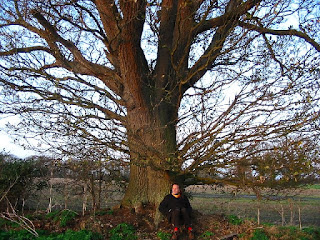
There is an oak I go to visit. Sometimes I just go there and sit under its huge spreading crown, and look over the fields and we keep each other company. Sometimes I visit when I feel fractious or discombobulated, or when a certain restlessness happens. I always greet the tree. Then I sit down and wait. At some point even on still days a breeze will rustle through the branches and echo in the nearby poplars. Within ten or fifteen minutes, I feel grounded and calm. Sometimes a conundrum or question I have is resolved. This is the effect of the tree.

I think a radical overhaul in our relationship with and approach to 'nature' is long overdue. All culture and civilisation is built on and over the earth's living systems and not the other way around. The earth is primary and we are secondary, as Thomas Berry put it.

In our present civilisation trees, like everything and everyone else, are primarily considered in terms of resources, how useful or profitable they might be. Or as property to be managed, cut down or controlled. Or we might see them in ecological terms, how they store carbon and provide oxygen. Our relationship with them is often abstract.

But what about approaching trees in their own right, seeing them as a part of the biosphere along with ourselves and other forms of life? Connecting and communicating with them?

Trees are always at home, wherever they are. Even though often we are not. Wherever I've spent time trees have shaped and informed my experience, whether growing up amongst beechwoods in Buckinghamshire, spending a season in an old miner's cottage under a huge cottonwood in the high desert of Arizona or the decade I've now lived in Suffolk. Much of this is due to the quality of being-at-homeness that trees possess.

In the face of all our human restlessness and running around, trees seem to be saying, hold on, slow down, wait (at least) a minute, stay awhile, take root, connect with where you are, with the planet, with life. Come home.

And Transition challenges us to get local, to start coming home.

(ii) Trees in Transition

I'd never really considered consciously until this week just how much trees inform transition. All the abundance projects, mapping neighbourhood fruit trees and planting walnuts, foraging and gleaning apples, plums, berries. Learning how to plant and prune.

In the thousand plus posts since 2009 on the Transition Norwich blog, This Low Carbon Life, the most popular label is Reconnection with Nature. We have hosted tree weeks with posts on The Gift of a Tree, Fruitful Trees and A Swinger of Birches and we've run a week on Deep Nature. In Sustainable Bungay's Introduction to Permaculture course in January 2010, which kickstarted the building of the Library Community Garden, I met Paul Jackson, a tree surgeon and nature lover, who helped save some threatened poplar trees in the village where I live. Paul also fashioned oak planks into seating for the central plant bed and planted fruit trees in the garden.

At a recent Green Drinks, Rob Parfitt, from the village of St. James, spoke about the orchard planted over the past few years by a group of villagers. Along with the varieties of apples and pears there are also quince, medlar and cobnut trees.

In the following conversation a feeling arose that what was now being done for pleasure by people in their spare time might well be a vital part of the resilience of the village in coming times. It was a kind of skilling up, learning to work together on the land and with the trees.

My own relationship with trees has expanded since becoming involved with transition. Previously I ordered wood for the stove from a nearby woodsman, stacked it in the woodpile and when it ran out, gave him another call. Later I would forage for wood around the neighbourhood lanes. Earlier this year I felled a dead elm at the bottom of the garden. There were three trunks, each between twenty five and thirty feet high. The first two I sawed myself with a bowsaw by hand (and if anyone copies the way I did it I accept absolutely no responsibility for any of the consequences). As I sawed through the wood my body entered a kind of merging with the action and the tree. It was total attention of the kind Kerry mentioned in her post on Wednesday. I had never felled a tree before but the two trunks came down in exactly the right place. I was sweating and exhilirated.

When it came to the third and biggest trunk the next day, it wasn't happening. I approached the tree three times and each time I became suddenly exhausted and could hardly lift the saw. I looked at the trunk. It was not that much thicker than the others. But my body was telling me something. I rang Nick from Sustainable Bungay and asked if he'd give me a hand. We finished the job together a couple of weeks later with a two handed saw.

So we had firewood from the  bottom of the garden which was great. And there was beauty too in felling the tree by hand, a tree we had lived with, walked past and seen from the window for years until elm disease took it, where the birds had perched and sung and rested. We could honour its presence and passing. And it was joyful too, working with Nick.

(iii) Taking Notice

This post would not be complete without mentioning the current plight of another of the hallmark trees of Britain and Northern Europe, the Ash, in the form of dieback disease. Government failure in the last two administrations to ban imports of live ash seedlings into the UK despite warnings that our ash populations could be seriously threatened, led to an article by George Monbiot in the Guardian calling the relevant environment secretaries to account. My hope now is that no rash eradication programmes are set in place before the trees have a chance to build resistance to the disease over time.

Ash disease, like those of elm and horse chestnut, calls all of us to account. We need to start looking at trees and the earth's other living beings in a different light and stop treating them and the land as simply property, resource or something that makes a nice view or blocks it. Or that we can cut down, uproot or trash as we see fit, without regard or negotiation.

These are the beings that provide us with timber for our dwellings and furniture, heat for our fires, shelter, shade, food and medicine. They are home to any number of birds, mammals, insects. Some of them give us grounding and answers in a restless, stressful time. They give so much to us and life. It's time to take notice of them. Mark Watson


Photos: Under the Oak, Winter Solstice 2011*; In the desert shade of the Cottonwood, Arizona 1996*; St James Village Orchard map by Rob Parfitt*; Felling the Elm with Nick, 2012*; Teaching Medicine Plants under the Silver Birch with Transition Belsize, May 2012** by *Mark Watson and Charlotte Du Cann, **Sarah Nicholl

Thursday, 25 October 2012

Winemaking - 'For Medicinal Purposes'

For Sustainable Bungay's 10th Plants for Life event last Sunday, Winemaking - For Medicinal Purposes, Nick Watts invited a dozen of us to his house for a practical demonstration of how to make fruit wine, in this case (sic) from raspberries.

Nick’s front room was filled with people (including Sophie and Nick from Transition Norwich's Low Carbon Cookbook group),  funnels, demi-john’s with deep red liquid and when you opened the door of any one of the cupboards you would discover a large container filled with a fermenting fluid. One demi-john contains enough for 6 bottles of wine at 750cl per bottle. Nick calculated he had about 80 bottles of wine fermenting at the moment.

First we took a look at some of the medicinal qualities of  raspberries. I’d been aware of the raspberry leaf  as a uterine tonic during pregnancy and childbirth and have used it along with yarrow to make a salve for piles. But for me raspberry fruits were always a delicious sign of high to late summer, picked fresh or bought from a roadside stall, and eaten long before they made it home to be turned into anything else culinary, let alone medicinal.

Raspberries, in fact, are incredibly rich in anti-oxidants and vitamin C. Eating them can help boost a poor appetite and they are useful in arthritis. See Hedgerow Medicine, by Julie Bruton-Seal and Matthew Seal,  for an excellent chapter on the many virtues and uses of  the raspberry, both leaf and fruit, with some great herbal recipes.

Penelope Ody in her book 100 great natural remedies has a simple recipe for raspberry vinegar: Soak 500g fresh raspberries in wine vinegar for 2 weeks, strain thick red liquid into a bottle and use in cough syrups, as a throat gargle or add to salad dressings.


Nick took us through the winemaking process in three stages, starting off a new wine and then using ones “I’d prepared a bit earlier.” He was keen to point out he was not an expert, having started about three years ago, but had really got into it and was happy to share what he knows with people.

This was the essence of not only this session but also a main impulse behind the whole Plants for Life project, and indeed Sustainable Bungay as a group and the wider Transition 'movement': If Nick could make so much and such decent wine (not to mention his delicious dandelion and burdock beer) from home and allotment-grown and foraged fruit by just doing it and immersing himself in it, then anyone with sufficient interest and initiative could. Watching Nick describe the process and go through it physically with a friendly group of people was absorbing and instructive, as well as good fun. It was a true skill-share.

What follows below is not necessarily the whole story, but what I learnt from Sunday's session:

STEP ONE
In a big bucket with 3lb raspberries (you can choose your own fruit, almost any will do), Nick poured on 5pts of water and added a teaspoonful of pectin enzyme to prevent ‘pectin haze’. He then mashed the raspberries with a wooden spoon and covered the liquid with a tea towel (very important esp. in summer to keep insects out).

This is left for two days.

STEP TWO 2 DAYS LATER
Add to the bucket between 1kg and 11/4 kg of sugar (preferably fair trade/organic, white) dissolved in 2 pts water off the boil. Add 1 tsp dried yeast with a little sugar all dissolved in some of the fruit liquid in the bucket.

It’s the yeast that turns the sugar into alcohol and the more sugar the sweeter the wine. Nick uses less (1kg) as he likes a drier wine.

This liquid is then stirred 2-3 times a day over the next four days, and the process is called ‘fermenting on the must’.

STEP THREE 4 DAYS LATER
This is the messy bit, where you strain all the liquid through a muslin sieve, before funnelling it into the demi-johns and putting an airlock on it. This is then left to ferment for between 3 and 18 months until there are no longer any bubbles to be seen in the airlock. During the fermenting process a stable temperature is important. Nick doesn’t worry too much about whether it’s warm or cool, just that there is as little fluctuation as possible.

STEP FOUR 3-18 MONTHS later
Decant into bottles and leave for 1-2 years depending on the fruit. Raspberries need less time than elderberries, for example.

After the demonstration, Nick invited everyone to taste some of the wines he's made. My favourite was the dry and fragrant Elderflower and Rosehip. I took half a bottle home and tried a glass with a dash of elderflower cordial - for medicinal purposes only, of course. And it was the perfect antidote to the recent gloomy days of continual rain and lessening light.


Photos: Raspberry wine fermenting in demi-johns; Nick instructing; Mashing the raspberries; Straining the liquid; Cheers on a rainy day (Mark Watson)

Thursday, 18 October 2012

A Transition Camp Journey

I am a reluctant traveller these days, rarely venturing beyond Bungay or Norwich, let alone East Anglia. And it’s strange. Having lived in the Americas in the 80s and 90s and experienced incredible landscapes, people and ways of life, now, after ten travel (and money)-lean years, I’ve learnt to totally appreciate the odd train trip, whether it's going to London for the Transition Conference in September or travelling up to Norwich in the carbon conversation days through the Norfolk broads as the sun goes down.

Last weekend I went by foot, bus and train to the 5th Transition Camp in the Sussex Downs at the Wo-Wo campsite. And I loved it. From the moment I walked in when Mike greeted me and Alice handed me the key to the Little Owl yurt where I’d be sleeping, I felt welcomed and relaxed. It was a weekend where you could kick back, lead or participate in workshops and talks, sing around the fire at night and have transition conversations that the normal rush of life just doesn’t leave time for.

"These seeds," said Rebecca from Transition Crouch End, who opened the camp in a circle around the fire on Friday afternoon, “represent what we would like to plant here this weekend, so take one as they go round and consider for a few moments what you’d like to give and receive from the Camp. We’ll put them all in a saucepan and on Sunday, they’ll be cooked up and we’ll share in the stew.”

“They are called Victor beans,” she said, holding up a postcard that was now very familiar to me. I withheld my desire to whoop out loud. But I got my opportunity to speak when we went round the circle saying what we’d like to experience.

“Well, I’ve already experienced something amazing,” I said. “Those are native East Anglian beans, grown very near where I live and Josiah, who runs the Great British Beans business that promotes them is a friend and fellow transtioner in Sustainable Bungay. They make great hummus and falafels too by the way and feature regularly in our monthly Happy Monday meals. Talk about making connections. If the rest of the weekend is as enjoyable as that then I’ll be a very happy camper!”

It was. From working up some great harmonies round the fire on Friday as we sang into the night, to being lent a soup bowl by Claire and dry wellies by Nigel (mine were leaking and that first night was very wet); from learning the Basque word sapori (which means 'taste') from Urtzi, who also taught us how to start campfires, to learning the basic steps of the Charleston with Jo in a very dark tent as we sang along to the Muppets theme song. When I just couldn’t keep step, Christy took me gently by the elbow and guided me through. The Camp was like that; friendly, fun and people giving each other a hand when they needed it.

Most people at the camp lived in East Sussex, and were involved in local transition initiatives or wanting to start them up. But there were also transitioners from London, Buckingham, even Aberdeen. Peter, who was visiting from near Aylesbury gave such a great rendition of Singing In The Rain that we all asked for an encore the next night, even though it was dry by then and the stars were out.

Everybody was asked to do a stint in the kitchen, chopping veg or keeping the water fresh in the washing up bowls. Every morning there was hot porridge, fresh fruit and bread, yoghurt and raw milk from the biodynamic Plaw Hatch Farm nearby. Lunch and dinner were equally abundant (and very tasty) and made from scratch by the good-humoured kitchen volunteers.


Martin from Brighton led an introductory session the first night where we said our name out loud each time we spoke. Although the repetition felt awkward at first, I soon got used to it and remembered people’s names for the whole weekend. Not that I would forget Martin’s name. We shared the Little Owl yurt, talking and laughing late into the night and taking it in turns to keep the fire alight. Even though we’d only met briefly once before I felt like I was staying overnight with a friend from school again. It was great fun and really liberating. I reckon we could run a pretty good ‘inner adolescent’ workshop for jaded over thirty-fives! I even managed to turn three X-Ray Spex songs into lullabies and impose them on Martin before he went to sleep! (He did actually fall asleep in the middle of Oh Bondage Up Yours!).

If you ever need anyone to break the ice for a meeting so people can get to know each other, Martin’s your man. On Saturday morning he did another introductory session where each person told two truths and one lie about themselves. Where else would you find out that Lynne sang in a punk group called the Decaying Bogeys in the 70s (or was that the lie?), that Rebecca crossed the Sahara Desert, that I will be 52 next year, that Mike lived in a hippie commune on Ibiza or that Martin was a famous child star? True or False? Answers on a postcard.

On Saturday I held a Plants for Life workshop and spoke about my work in Sustainable Bungay this year organising the Plant Medicine bed and monthly events. St. John’s Wort was the plant of the workshop, and I passed round Rose’s bright red oil for people to smell and rub on and guess what it was. Then I read out the St. John’s Wort chapter from Charlotte’s book 52 Flowers That Shook My World, which was published this year. I passed around the hawthorn leather I made for people to share at the camp and we took a look at ragwort, a plant that brings up strong reactions on any wild plant walk. See here for a balanced, sober look at this plant. The hour and a half sped by and I finished by showing people how to roll plantain balls for bites, stings and incipient cold sores.

Don arrived on Saturday afternoon with the sauna - a bright pink converted caravan with a wood burning stove. Over the next 24 hours, the brave and hardy would cool down by jumping into the nearby river. Some just sprayed water on themselves from a container outside the caravan. I, of course, jumped into the river at every opportunity! Truth or lie?

There was a fascinating workshop making Sterling engines run by Louise from Buckingham in Transition with her partner.
“Buckingham. That sounds familiar. Did you start up the herb garden there?” I asked her. ”I saw a post about it some months ago and I’ve been meaning to get in touch.”
“Yes, that’s me,” she said.

It also turned out that the rocket stove Charlotte made at last year’s camp and that now sits in our conservatory, was the product of one of Louise’s workshops. There are a hundred and one instances of connections like these, but it’ll make this post far too dense to give all the details.

The weekend was filled with workshops on rhythm and resilience, permaculture and fairy tales for children. A foraging walk on Sunday led by Tanya Lodge, focused on the medicine chest in a stretch of hedge no more than thirty feet long at the edge of the campsite field. Dock, nettles, elder, rosehips and cleavers were all discussed along with how to make tinctures and dry herbs. And the redoubtable plantain made a robust appearance at the end. Did you know that plantain helps draw out toxins and heal wounds. Chewed and kept in  the mouth it can also helps with teeth abscesses. The plantain book grows by the moment!

At a talk on fracking and extreme energy, Olly introduced the latest data on Peak Oil, spoke about the work of Frack Off and showed us a short Australian film about a rural community who have united to keep coal seam gas (CSG) out of their area.

Suddenly it was 3 o’ clock on Sunday afternoon. Mark Boyle, The Moneyless Man, gave a sober and unapologetic talk about our relationship with money and how it affects our relationship with the world. Speaking about money exchange as a way of saying "I want no more to do with you", and examining the hidden pain and exploitation behind the consumer products we take for granted in our society, Mark exhorted all of us present to open and FEEL the damage that maintaining a consumer lifestyle is wreaking on our fellows both human and not, and the planet that gives us life. And to keep open and keep feeling...

Photos: Mike doing the morning shout-out of all the day's activities*; Great British Beans in the community pot; Woodland and Kitchen yurt with Saturday's talks and workshops*; Reading aloud from 52Flowers That Shook My world in the kitchen yurt**; the pink sauna caravan; Mark Boyle burns money By Mark Watson, *Mike Grenville and **Matt O'dell

This post first appeared on the Transition Network Social Reporting project on Saturday 13th October 2012

Friday, 31 August 2012

Ribwort Plantain is Your Friend - Get Your Balls Rolling!

It's the last day of summer, a blue moon and I'm off in an hour or so for the last of the plant medicine 'surgeries' I've been holding at Bungay library community garden every Friday for the past few months. Between 1 and 3pm anyone can come and talk about plants as medicine, share knowledge and tips and visit the plant medicine bed.

These Friday sessions have formed part of Sustainable Bungay's Plants for Life project, which I've been curating this year.

As well as the central bed of the library garden showcasing a variety of medicine plants, the project also includes a monthly talk, walk or workshop on some aspect of plants as medicine. Authors, medical herbalists and biodynamic growers have given readings, shown us how to make great green teas, tinctures and oils and passed on invaluable tips for growing herbs. I have taken several groups on walks around Bungay exploring the medicinal value of the plants we call weeds.

Over the past month I've received so many requests from people asking which plants will help with insect bites and stings that I'd like to share some tips about a fabulous plant - it's common, handsome and grows everywhere. You probably step on it all the time.

When it grows unimpeded by human feet and its flowers shimmer in the light and breeze, you wonder why you never noticed it before. And it is truly a medicine chest.

And although summer is coming to a close, bites and stings will still be a possibility for some time yet, especially for those working on the land or in the garden, so...

Ribwort Plantain is your friend.

Bites and stings of bees, wasps, ants, nettles, mosquitoes, horseflies and fleas are alleviated by rolling a ribwort plantain (Plantago lanceolata) leaf in your hand into a juicy ball, and applying it to the bite/sting.

The leaves of this friendly, common, handsome plant have been giving me a hand all summer and I've been recommending it to everyone.

It really works, often immediately, and is utterly safe. And usually not too far away.

I was stung on the neck by a wasp in a local shop and after making a very unmasculine shriek, I went home, rolled a plantain leaf and applied it to my neck. The pain disappeared immediately and there was no swelling.

So get those balls rolling! And love those plantains!

Note: This piece is adapted from a post I wrote earlier this week, itself an extract from a forthcoming, more extensive post about the plantains. UPDATE October 2013: More of my posts about and including plantain and its marvels can be found here.

Pics: ribwort plantain flowering; ribwort leaves; ribwort flower close-up; rolled ribwort plantain ball (all by Mark Watson)

Monday, 27 August 2012

postcard from the woods - uncivilisation festival 2012

For we are all,
We are all,
We are all the children of,
We are all the sons of,
A brilliantly coloured flower,
A flaming flower.
And there is no one,
There is no one,
Who regrets what we are.

(Huichol Peyote Song from Pharmako Gnosis by Dale Pendell, 2005)

How can we become people who regret nothing and whom no one regrets? How can we find the new narrative about ourselves and the earth that Charles Eisenstein calls "the new story of self and the new story of the people"? Was it always there and we have forgotten it, or is it here now inside us, waiting to be cracked open like an acorn, to rise and take root?

I am at the Uncivilisation Festival in the Hampshire woods on the downs of England, giving a writing workshop based on my book, 52 Flowers That Shook My World. I am standing in at the last minute for a poet who couldn't make it, and as I walked through the dark wood last night, the warm wind shifting through the trees, I thought: what are the medicines the plants have taught me that I can now give?

One thing peyote showed us: we are not what we thought we were. We are more. We are not defined by class, or family or work, we are creatures of the sun and wind and the mythos of many lands, and no tranformation of the world, no transition, can truly take place until we become different kinds of people. And how do we do that surrounded as we are by the city world, its buildings, its harsh statistical language, its abstractions and globalised mindset?

You have to change the territory in which you move and speak, in which you come to different conclusions. You have to go into the woods and encounter the wild. The wild is not an escape from reality, it is a liberation into reality, out of the illusion of civilisation. For we are more than we think we are. We are kin with all creatures, all clouds, all rivers. We move and breathe and create part of the world's dreaming, the verbs and adjectives of its language.

This is one of the precedents for the Dark Mountain Project and for this festival, which over an intense August weekend gives 300 people a glimpse of what the future might feel like once we shed our conditioning, and start to tell our stories around the fire. Once we loosen the shackles of our identity and let the trees in.

There are several words for human being I said, in other cultures. The Okanagen word is land dreaming capacity. It is our function, if you like, to name the world, to make stories, weave fabrics, to dance and to sing. It is how the earth sees itself in our reflection. Another is winklil which is a Mayan word for vibrating root. The human being comes into the fabric of the earth with a certain sound or frequency, which resonates and harmonises with other beings. When rooted, it is our music that keeps the world in harmony.

You only have to think of the kinds of sounds cities make, or politicians or motorways to know the world's discordance. Out of time, out of place. It is our work as writers, I suggested, to name the physical and imaginative world beautifully, to root ourselves and get us all back in tune.

Breaking the acorn

The first writing exercise is to find the seed within and the right conditions in which to germinate.

I am holding my hands open and in my right, I hold practical seeds from my Transition garden: chickpeas, broad beans, sunflower seeds; in my left, two dreaming seeds, both from the desert in Arizona, a bearberry and a scarlet coral bean. The first is a traditional medicine for the kidneys, the second a tool for divination. Everything in our culture suppresses the germination of these seeds. Everything at Uncivilisation encourages it - practical worshops on scything, imaginative storyteling about Siberian shamans and the loss of the Caspian tiger. If you are a plant, I said, what kind of plant would that be? In which territory do you flourish?

At the Festival everyone is camping in the meadow. We meet around fires, listen to poetry and music in this woodland theatre, we debate in tipis and yurts, walk through tree and leaf galleries and performances under the starry skies. Last year when I stumbled upon Uncivilisation I felt I had come home. Lover of Transition as I am, there are parts it does not reach, where Dark Mountain speaks directly - language and creativity, mythos and earth. I realise that my roots lie deep within its territory, and that though I am happy working in the community kitchens and workaday comms and events of Transition, here I can be myself: here I can tell the medicine stories I learned and be heard in a certain attention.

Attention is what I am looking for this year - not the attention for the performer ego, but the set and setting in which to receive and transmit vital communications between ourselves as a network. Last year the festival had a very different feel, and I was a different person. It was just after the London riots and there were many talks about collapse and a lot of urgent political and intellectual debate. This year everything is acoustic and seemingly more mellow, more art and psychology than economic discussion. I am familiar now with the language of Dark Mountain (partly because I distribute the three books and help out with publicity). So I walk from event to event in search of the story. Not the journalism story which I wrote last year, or even the one I just wrote about Dark Mountain for the activist magazine STIR, but a story of a breaking kind. Like medicine, you don't know what you are looking for; you just know when you happen across it.

"What is the dreaming of Uncivilisation?" I asked everyone at the workshop. You can look at a dream - a night dream or an event or a relationship - on five levels. 1. the everyday level: what is happening over 48 hours 2. on the life level: in terms of your biography, what does your presence here signify in terms of your life? 3. As part of the human collective - what does this festival mean in terms of society? 4. on the mythical level - how does Uncivilisation affect the mythos of the world? 5. on the earth level: as the earth speaking to us. What are these woods telling us, the trees and the hills?

I am looking for the story. Standing with Kevin from our Dark Mountain Norwich group, stewarding the gate, I find a bank of eyebright flowers. This tiny eye-medicine flower is hard to find on the clay and sand soils of East Anglia, and we are on chalk here. Kevin tells me he found gravediggers hacking the chalk yesterday eight foot deep with pickaxes. And it's true: if you go down through the yurts and flowery enclosures you find yourself deep among the yews of the South Downland burial site.

It's easy to arrive at festivals and lose yourself in cameraderie and entertainment, and although this is no way a commercial event the desire to kick-back and have a good time is strong. Who doesn't like to drink cider and laugh and meet strangers who feel like kin? But this lightness does not crack the kernel.

I'm looking for something deeper, a more sober, urgent narrative that resonates with this land. Something more collective that allows death and loss to the party. I have been in Transition for four years now and know that we have to move together, out of individualism, beyond Me and my eternal sorrow and anger. I feel it sometimes: as we move around the fire in a Brythonic dance to the sound of bagpipe and violin, and the creatures of Mearcstapa move out of the darkness in the shapes of raven and wolf, stag and hare. I hear it in the discussion I have with Dougie (who curates the Big Tent stage) as we talk about the Deep Green Resistance, and with Robert who is reading Tennyson's Ulysses out loud in the wood. I stumble into it as I move from a wilderness initiation workshop and find myself amongst the mourners of the burial site and see a glimpse of the bright downland grass. And then I find it, right at the end of the festival, at a reading among the beech trees.

She was our sister, our mother, our lover.

Jim Hindle is reading from his book Nine Miles, a searing and beautifiully-wrought story about the road protesters in the 1990s. A celebration of the protests 20th anniversary is one of the themes of this year's festival and many of the people who have spoken of their experiences are sitting in this circle, the writer Jay Griffiths, the musician Andy Letcher, and the photographer, Adrian Arbib. All around us Tom Hirons, who has organised this talk, has hung slates in commemoration of all the camps that were held to defend the trees and the land from being destroyed in the name of growth and progress. Many of them near the Sustainablity Centre where we are now.

Hindle is quiet and intense as he reads his testimony of those tough and magical winters spent amongst the canopy of ancient oaks. He was a teenager then, and badly broken by the experience, yet the passion for the land is palpably there. It burns, and you can feel it. And I realised then that this was the spirit I was looking for. It was a mood, a warrior mood, that comes once the kernel has been cracked open inside. We are older now. We have lost, our lives have collapsed. Our hearts have been broken open, and now some of us realise they were meant to be, because a broken heart that can remember and reassemble itself burns more fiercely and more powerfully than any other - as every shaman story tells us. What these initiation tales do not tell us, as a future people, is that we do this work of return together. That's our own indigenous medicine story. Now I knew why I had ended my workshop with a passage from Tree Dialogues chapter. Once in these lands we decided everything under the trees. Everything to do with right government. It was not personal, but a matter for the collective.

"Would you do it again?" somebody asked the activist and writer.

"Yes," he said.

"Yes," we all said.


I was remembering the hilltop in Oxfordshire, I was remembering the oakwood of Shotover. I was remembering the people. People I had known who had stood by trees, and people I have never known who had stood by trees. We were all there, waiting, it seemed, for an aeon by the tree in Staverton Thicks.

We are holding out, the oaks said finally.

My heart jumped.

“I am with you,” I said. “I am always holding out.”

I am holding out that our hearts will return. I am holding out that the people of this green land will throw off our dark oppression. I am holding out that even though Mark and I are alone in this oak wood, we will all one day emerge from the underground and meet together. I am holding out that even though we are hidden and often alone, we know in our hearts, in our thousands, we are together. No matter what house we come from, what work we do, where we dwell in the kingdom, we are already united: the men that walk the mountains, the men who swim the wild rivers and seas, the men who sleep in the branches of the trees and burrow among the roots to stop the machines from killing the wildwood; the lion-hearted who speak out loud, who call to account, who bear witness, the oak-seers, the acorn-bearers; the ordinary men of England and merry maids of England, who bring their lightness and beauty and laughter, who stand by the men, who walk beside them, who see them and keep the fire. I am holding out for us all standing here together, as the oaks hold the sky in their branches and their roots hold the earth. We are holding out. We are holding the land sovereign. And with one heart we say:

This planet does not belong to you.

Photographs: woodland walk by Adrian Arbib from Solsbury Hill (forward by Paul Kingsnorth and George Monbiot); Robert reading poetry in the woods; woodland stage at Dark Mountain 3 writers' reading; slate road protest commemoration by Tom Hirons: Pete, Wendy and Paul with their 52 Flowers about to board the bus; Jim Hindle discusses Nine Miles; art installation (CDC); Farewell and Imagine Wolf by kind permission of Bridget McKenzie from This Learning Planet.

Quotations from 52 Flowers That Shook My World - A Radical Return to Earth (Two Ravens Press)