Showing posts with label climate change. Show all posts

Monday, 24 September 2012

things fall apart the centre cannot hold - communications and resilience at #tnconf2012

Last night I got an email from the Arctic. It was from our fellow social reporter, Sara Ayech, who is on the Greenpeace vessel Arctic Sunrise, as it cuts through swathes of melting sea ice and where Shell are planning to drill for oil this month. This is the story that encapsulates all the drivers of Transition -  peak oil, climate change, economic retraction. It's the story that should be rocking the world, but isn't.

We reached the ice a couple of days ago and it's incredible, although in a far worse state than the scientists thought it would be, or satellite pictures show. Yesterday we were at 83 degrees North (420 miles from the North Pole) and we didn't see any large ice floes, everything was a lot smaller and thinner than we expected.
This morning, a bit further west, it was mostly slush in the water - we're seeing more now but it feels like it's melting before our eyes.Right now it's the lowest sea ice surface extent ever recorded - just below 3.5 million sq. km. Trying not to be depressed though - it's still amazing and beautiful. We have seen some polar bears though - yesterday a mother and her cub were pretty close to the ship, jumping between ice floes - wonderful! 
"Comms" in Transition is often understood as a persuasion tool: we have marketing and "communication skills" so we make people join our initiative, downshift, wake up to the effects of melting ice on our small lives. But editorial is not in the persuasion business, it is in the reality business. As the corporate media distracts everyone with parliamentary debates, game shows and celebrity parades, it is our work as communicators to report what we see happening all around us, to frame our community moves within the bigger picture. We are in search of a narrative, as individuals, as Transitioners, as planetary beings at this moment in time. What we value is a media that reflects what is going on from the ground -the gritty, the beautiful, the profound and intelligent. But most of all, the true.
 
Building resilience in extraordinary times is a buzzy headline, but what does it mean as far as our communications at this conference are concerned? The principle definition of resilience is the ability of eco-systems to hold together when the whole is challenged. Our challenge as Transitioners is to hold the core within ourselves and our communities, and not to fragment. Eco-systems do this by being connected, by a web of communication exchange and feedback. When threatened what matters most is that the fire of a body, what keeps it alive, is preserved, in the same way the bees in a colony cluster around the queen to keep her warm as winter sets in.

What keeps people together is the spirit of the enterprise, its heart. That's something we share together, what we hold in common. Look at it as a story we tell each other around a fire. What is the narrative we are creating? What really matters when the chips are down, and the world is falling apart, and it feels as though everyone around us is sleepwalking? In extraordinary times, when the wild fires are raging and harvests are failing, can we tell another story that wll feel like the warmth of a fire? And who among us is going to tell it?

crew one: social reporters at large
It has been my great joy to have been a co-founder of two national comm -unication projects in Transition, which I feel are a fundamental part of our collective resilience, keeping us intact and integral in tough times. The first is this blog (celebrating its first birthday next week) and the second is the newspaper, Transition Free Press, both based on small local initiatives: Transition Norwich's This Low Carbon Life blog and Sustainable Bungay's quarterly newsletter. As we plough through those dark waters, with the menace of corporate media at our tail, we are secure insofar as we have ace crews on board. None of us are expecting an easy ride. And all of us are keen to the beauty and fellow feeling that appears even in times of difficulty and loss.

For this weekend's conference six of our reporters (that's Ann, Caroline, Charlotte, Jay, Kerry and Mark) will be setting sail within the crowd, with our ears alert and our eyes sharp, our pencils at the ready. If you find us do tell us your story and let us know any feedback or suggestions about the blog. In the next two days we'll be writing short reports from the different events and workshops, and the following week we will be reflecting on our experiences at both the main conference and all of the four sister strands (including International Hubs on Monday). You are welcome to contribute guest blogs at the media hub (we'll have two computers there at the ready).

Oh, and we'll be communicating and networking like mad. For me, the best part of the conference is meeting and speaking with everyone in real time and space. That starts with the reporters themselves, who normally only communicate via computer or telephone. And we're all very happy to welcome back our producer, Ed Mitchell, who is returning to Transition comms from his year's voyage out. Come and find us.
launch of the transition free press
Tonight we'll also be launching our new national paper the Transition Free Press. We published our preview edition in June and since then have been distributing our 2000 print run in different regions of the UK and at summer gatherings from Permaculture convergences to Sunrise and Uncivilisation festivals. There will be a copy for everyone at the Conference, so if you haven't already seen a copy do take one home. It is our intention to publish four editions through 2013, beginning this winter, and in order to fund this venture, including printing, payment for editors and contributors - we need your help and contributions, and most of all your loyal readership.

Becoming the Media is one of the principal tools in the Connecting chapter in The Transition Companion. This includes YouTubes, social media, blogs and Twitter feeds. But nothing has impact like the printed page. Newspapers publish many stories on line but only certain ones make it into the paper "proper". Physical print, like everything else built in material form, has a strength and a baraka like nothing else. We are aware as communicators that the print holds knowledge and goes places that computers can never go - no matter how swanky the tech.

Moreover the discipline of writing news stories requires a totally different attention than writing blogs or emails. It demands far more work and time and dedication. It requires skilled designers and editors. For us, the paper is a bridge that crosses boundaries, it connects all the different strands that make up an alternative vision for the planet from anti-fracking campaigns to land rights movements to food co-ops, it connects initiatives around the country and around the world, and communicates and celebrates what we do. It is a tool that is integral to the core we are holding, and lets people who might never have heard about Transition know that it is not all business-as-usual out there.

At the conference we are looking for 35 initiatives to sign up as distributors for our paper - that's all of us in the room and in Transition. Having dedicated people around the country is what will make this enterprise possible. We will have a map of Britain up behind our stall in the Octagonal Hall and distrbution forms, so do come up and talk with us and ask questions about what this might entail. We will also have a flat plan for future issues and we're looking for contributors and any stories or ideas you might have for the different sections fo the paper. On Saturday we will be running an open editorial meeting during the Open Space session (4.15-6pm). All are welcome.

The TFP crew will all be at the launch party: that's me (ed), Alexis Rowell (news ed), Mike Grenville (production and distribution), Tamzin Pinkerton (food); Mark Watson (subeditor); Trucie Mitchell and Mihnea Damian (designers), as well as many of our wonderful contributors. We're really looking forward to meeting you and declaring this paper an "official" voice of Transition. We're starting at 7pm for 7.15 and will be toasting and launching our vessel at 7.30pm in the Main Hall. See you there!

Images: Sara Ayech and the Arctic Sunrise on the Arctic sea ice (look out for Sara's story next week!); Charlotte from interview with Rob Hopkins, Transition Culture; map of Britain we hope to cover with map pins indicating distribution points for the Transition Free Press.

Saturday, 11 August 2012

Small Bouncy Lights in Dark Times

Last Saturday evening at Elinor's birthday party in Bungay, I found my 50 year old self unable to resist a bounce on the trampoline in her garden. I waited until I thought there were no children around and climbed unobtrusively into the safety net. But obviously not unobtrusively enough. Suddenly I was surrounded by every child at the party, laughing, screaming, tugging at my legs and each demanding that it was their turn to bounce in the middle and show off their acrobatic skills.

5 year old Tristram handed me a Star Wars sword and said, 'You be the captain, and... I'll be captain too, afterwards. Mark's the captain,' he shouted to everyone. 'Okay, let's take it in turns to go in the middle,' I boomed in a captainy sort of way. Everyone else wanted to be captain and go in the middle all at the same time and a couple of rather alarming tousles broke out involving toy screwdrivers from Dr. Who and several children wanting to climb onto me and do acrobatics at the same time. Any sign of captainness was disappearing very quickly.

But we did get a couple of synchronised harmonious moments in the general chaos, one of which was caught in this postcard. Later on, when the children were otherwise occupied or had fallen asleep or gone home, I trampolined with several of the adults, which was just as much fun, though somewhat more measured.

Why am I talking about trampolining on the Transition Social Reporting project? Have I been caught up in the silly season? Actually, no. For much of the time recently I have been aware of a certain gloomy feeling I can't quite pinpoint and which doesn't feel like a personal depression. Maybe it has to do with the dearth of fruit on the damson, sloe and cherry trees or the potato blight so many growers are talking about due to the strange, out-of-synch weather this year.

Maybe it's to do with how few butterflies there are around* and what that could mean. Our buddleia (centre photo) came out in bloom towards the end of July and I've counted only six or seven butterflies at any given time. And this on a huge bush which has consistently lived up to its butterfly name even in lean years.

Maybe it's the times we're in. The beginning of August is a time of abundance, harvest and gathering. And this year there just seems to be less.

So what do I do to tend the fire and the light when the times feel dark? I visit the sea in the early morning as much as possible. I sit on the beach with Charlotte and a flask of coffee and we make a space where anything that needs to can surface for our attention. Sometimes we have an animated discussion, look at the things which will get shunted aside once the activities of the day start imposing their demands. Sometimes we'll sit in silence, getting a feeling for the place we're in. The sea, the sun, the sky, the land. And for the times.

I try and stay as open as possible, sometimes more successfully than others, to the people I meet and the places I find myself. On Friday afternoons I spend a few hours curating the Plant Medicine Bed in Bungay Library community garden, paying attention to the plants, and doing some planting, pruning, seed collecting and sweeping. Sometimes people arrive for a conversation, bring a snack or to help out. Someone will say how lovely the garden looks, someone else that they have been rolling up ribwort plantain leaves whenever they or the kids get bitten or stung by insects, and that it really works. This is a tip I have been passing on to practically everyone I meet this year, and it's great when people come back to you about it. It really does work by the way.

And I look forward to Sustainable Bungay's 'Noughtie but Nice' Happy Mondays adult's tea party later on this month, so named because so many of us have birthdays this year with 0 at the end of them: all the decades between 30 and 70, with several of us turning 50!

So I guess what I'm trying to say in this postcard is something about the power of the small things. Those small lights in dark times that cost little and mean everything: bouncing up and down on a trampoline with the children of fellows in transition when you've just entered your fifty-first year; how the smell of lemon balm lifts your spirits as you rub its leaves on the way to the compost heap; the joy when friends receive the homegrown sweet peas you've brought to their party and when you realise they've given thought to the kind of food you eat, even though they eat differently; the hosts of red poppies among the barley in the next field; seeing the first two peacock butterflies of the year on the buddleia yesterday lunchtime.

And going down to the sea to make space for a deeper conversation.

*Postscript: Yesterday we counted 13 peacock butterflies on the buddleia - the first we've seen this year.

Images: Trampoline bounce at Elinor's (Bungay Community Bees) birthday party; Buddleia in Full Bloom but Very Few Butterflies; Sunrise at Lughnasa, Aug 2012

This post first appeared on the Transition Social Reporting project 7th August 2012

Thursday, 2 August 2012

Buddleia in Full Bloom but Very Few Butterflies

Every July and into August the enormous buddleia in the middle of our garden throws out a huge array of blooms and on sunny days over the past ten years we've counted up to two hundred butterflies of different sorts making their nectar visit: Red Admirals, Peacocks, Painted Ladies, Large Whites, Commas, Tortoiseshells and others.

Just not this year. The bush has been in bloom for several days now with its characteristic scent, but there's not a butterfly to be seen. This week I've spotted a few meadow browns and a gatekeeper in other parts of the garden, but the buddleia has remained lonely save a couple of large whites, two red admirals and several large bumblebees.

In an article on Monday this week in The Independent, Dr. Warren of the organisation Butterfly Conservation says this could be the worst summer ever for garden butterflies following two already 'atrocious' years.

So I completed the big butterfly count Butterfly Conservation are asking people to join in with. This involves 15 minutes observation in one place, which can be the garden, a wood or a wasteground and then sending them the results. You can do it once or any number of times until the end of August.

Other people I've spoken with about this year's butterflies are saying the same thing. They've seen very few. One farmer's wife however reported seeing a number of different kinds around her house. So sometime over the coming week I'll make a 15 minute visit and see what happens.

This is an updated version of Buddleia in Full Bloom but No Butterflies, published Monday 30th July on Mark in Flowers blog

Pics: California Poppies, Wild Carrot, Sunflowers and Buddleia - just no butterflies; Looking out for butterflies 30 July 2012

Wednesday, 27 June 2012

Treehouse Festival: A demonstration of alternative lifestyle

It's the third day of The Treehouse Festival, during which we've been experiencing communal living and pondering and discussing everything from religion to ant farms.

Each morning we have a fun activity (like yesterday's trip to the beach) and each afternoon we have a seminar/talk. Monday's was from professor Corinne Le Quéré, director of the Tyndall Centre at the UEA. It was on the (broad!) subject of climate change. She reminded us of the overwhelming evidence of global warming, it's causes (including anthropogenic greenhouse gases), and the effect that that it is having on extreme weather events and changing ecosystems.

What I found fascinating, however, was where this all points; what does the future hold? Yes, her predictions suggest increases in consumption (and therefore carbon emissions) in the short term, but the further future is a lot less predictable than anyone can really reasonable assume, and depends so much on how we choose to live our lives over the next few decades. She showed a graph of world population over the past 3000 years, and although exact population was not know for much of that, one thing is clear, and that is that we have very suddenly had an increase in population. We are in a transition already, between a sparsely populated world to a denser one. Many things will have to change for us to support our population, whether we do it consciously or not!


Although Corinne was talking in terms of technological fixes, I was painting my own idea of corrective measures. They were mostly tackling behavioural change: a renewed respect for nature, lifestyle changes that are more about local cooperative community than keeping up with the Jones's, and ceasing the distribution of absurd subsidies for our highest polluting industries.

I'm glad that The Treehouse Festival can give such an idea of the lifestyle possibilities that will lead to a more sustainable future, whilst continuing to be an open and fun environment for those who attend!

Saturday, 23 June 2012

Holiday activities


Two weeks ago I was on holiday on this sun drenched beach. A Greek island, Croatia?


These local residents should give you a clue -


- it was North Wales, just a few days after the floods a few miles further south. Fortunately the British weather can change quickly and we had great weather - for most of the week


The high tide comes to the door steps of the houses - so rising sea levels are soon going to become an issue at Porthdinllaen.


The area is great for canoeing and walking the coast patch - which this year goes the whole length of Wales. I did a 6 mile walk and caught the bus back, during which I only met 4 people. We live on a heavily populated island but if you make the effort to walk beyond the car park there are miles of beaches and coves with only sheep to share them.

Tuesday, 3 January 2012

Everything is Material and Everybody Knows

(i)
It's 2nd January 2012 and I'm sawing logs off a big old hawthorn branch which is blocking the footpath. I'm thinking, if anyone asks me what I'm doing I'll tell them I'm clearing the path and sawing some logs for the fire.

But isn't this private land? Well, yes but it's a public footpath and the branch is blocking it. I’m thinking that there’s far too much private land in the world and far too few Commons.

And I'm thinking that I would welcome any kind of conversation, because I'll write about whatever happens tomorrow on the blog. It's all material.

But no one came along the path. I took some photographs. And a bag of firewood home.

(ii)
This plant is probably cow parsley, but I could be mistaken. Common as it is and despite the beauty it brings to the lanes in May, I’ve never paid close attention to it. Umbellifers can be tricky to distinguish and these leaves seem just a bit too dark and shiny. Cow parsley is edible and is also known as wild chervil. I've never eaten it but I shall this year, and get to know it better.


However this plant, which I discovered along the footpath yesterday when we went for a walk (actually it was Lesley who pointed it out - "Is that a plant in flower over there?" she said, as we all turned to see the white blooms glowing in the pre-dusk light), also looks quite like hemlock, which I don't want to eat, fond though I am of it. But it lacks the signature purple spots of hemlock. And doesn’t smell of mice.

Whatever plant it is, one thing I do know. January 1st is not its normal flowering date.

(iii)
Yesterday a neighbour came round and asked me if I'd do her a favour. And handed me a tower of treats. No, really.

"I got it as a Christmas present," she said. "And I'll never get through what's inside it. I’m not quite sure I know what's inside it."

I was delighted and horrified at the same time.

Delighted because I'm a dyed-in-the-wool freegan these days. I love receiving (and giving) gifts, especially of the reskilled, recycled, past the best-before date, handmade, homemade, homegrown or secondhand kind, and I immediately saw all sorts of uses for both the round boxes and the contents: the boxes as seed stores, containers for food or presents. The contents – sweets, biscuits and mince pies - for when children come to visit.

And I like to see my neighbours.


Horrified because of the scandalous packaging. Five strong boxes all glued on top of one another and tied with a ribbon. When I opened them there were a few chocolates in one box, some biscuits and fudge in the others, four mince pies and ALL of the contents fitted into the bottom box. On the base the usual list of industrial food ingredients (including ‘vegetable fats’, read palm oil).

And suddenly I saw this unwanted Xmas gift multiplied to the power of millions. All over the world people giving each other things they don't want or haven’t asked for. Made in factories of precious resources. By people working in appalling conditions on low pay.

How much of this stuff goes to a scavenger neighbour, a charity shop or a Give and Take Day? How much of it ends up in landfill?

What’s it really being made for in the first place?

It was mean inside the tower of treats.

(iv)
“Let’s listen to the Leonard Cohen one,” Charlotte said. Shaun Chamberlin of Dark Optimism had put together an 'album' of fourteen songs he’d chosen at New Year 'all in some way pertinent to the state of the world as we enter 2012.'

"Everybody knows,” growls Cohen in his bass voice that sounds deep even through the tinny built-in speakers on our shared laptop, "That the boat is leaking... and the captain lied."

"Does everybody really know?" I asked Shaun, in an off-the-cuff pun on Twitter.

"I'd say they do, somewhere inside," he said. "But there's a certain logic to ignoring a problem if you can't see any way to change it. That's why sharing practical responses to that nagging, suppressed knowledge can be such a powerful, motivation-unlocking thing."

And I suddenly felt ashamed at my own flippancy.

Everybody knows the deal is rotten
Old Black Joe's still pickin' cotton
For your ribbons and bows
And everybody knows

(v)
Some practical responses to these things:
(iii) Buy nothing year - Adrienne, did you get your ten people?
(iv) Dark Optimism, Transition Social Reporting Project and an article on global meltdown by Guy McPherson

Deep inside everybody knows

Pics: Sawing logs on the footpath; flowering umbellifer Jan 2nd; Charlotte and Lesley in Oak Jan 1st; tower of not so many treats Jan 2 (all by MW)

Wednesday, 23 November 2011

I'm not a blogger...!


... I just happen to blog!

That is, in my opinion, one of the wonderful things about This Low Carbon Life and blogs in general. These aren't corrupted journalists seeking whatever bit of news will bring in the most cash. These are ordinary people, and what those ordinary people want to talk about. Naturally, at the moment, Transition issues and the economics behind them are on everyone's minds, so many blogs reflect this.

But before I introduce my chosen blog, I'm going to give you a brief insight into how I normally get my news.

I don't usually get any newspapers, nor do I watch much TV. However, I spend large portions of my time on the internet, and specifically on Facebook, for better or for worse, but the better, I think, being the fact that hundreds of people recommend articles and videos. Discussion about politics, current affairs and even religion is not the taboo on Facebook that you might find it in your local pub, and, amongst my Facebook friends at least, these deep philosophical questions are often welcomed.

So, on Facebook I recommend you join groups that share your values, and therefore get the news that you want when its members post links, and then discuss through comments. Don't forget to post links for other people too! Transition Norwich has its own group on there, so does FarmShare, and I also follow the Occupy Norwich group, which provides me with much reading on wealth inequality.

And on the subject of wealth inequality, I come to my recommended blog, "Make Wealth History", which has the tagline "Because the earth can't afford our lifestyle".

This blog is the work of Jeremy Williams, who I very briefly met at "Small Is... Festival" last year. It includes articles on overfishing, monetary policy, resource depletion, climate change as well as book reviews and his weekly feature "What We Learned This Week", which gives links to other interesting resources.

He's got Transition Towns as one of the "Solutions" listed at the top of the site, and writes articles about us from time to time, which is nice!

The latest "What we learned this week" feature:

What we learned this week
Posted on November 19, 2011 by
0

  • I saw a map of all the Occupy protests the other day, and my favourite has to be the bold one-man effort of Occupy Paisley.

Friday, 10 June 2011

Carbon Conversations

My first Carbon conversation group had their last meeting a couple of weeks ago. The last meeting of the course is even more relaxed than the other sessions. It's deliberately designed as a chance to kick-back, natter and swap stories.

The group has the chance to decide whether they'd like to continue meeting, or to decide that it is time to go it alone.

We chose to meet in a Norwich café. Not everybody could make it, but one person emailed before-hand to talk about the changes they'd made as a result of the course. Those changes amazed me. Digging up the lawn for growing veg. Buying a bicycle. Getting a smart meter and using it to work out she'd cut her energy use by 7% since starting the course. Putting her name down on a waiting list for an allotment which she planned to share with a family member. Then came the real big one: re-evaluating her work/life balance with a view to working less: cutting down on commuting, spending less money, having more time to spend with loved ones. Less carbon, more fun.

I shared her successes with the rest of the group, feeling genuinely touched to have been part of the process of facilitating these changes. I couldn't get over how BIG a thing it is to go on a course and re-evaluate the whole of the way you run your life as a result. A husband and wife who'd also done the course shared a glance and then spoke together: "So have we." We all looked at them in surprise and they explained. "We've both asked to go part time. We listened in the session which related disposable income to carbon emissions, and decided the next way we could cut our emissions would be to cut our income." (I have to add here that I know the couple have already made lots of changes to their house, their means of transport etc, so the investments in these areas have already been made).

That's nearly half the group (and the other facilitator too!) reducing their work hours voluntarily to change their lifestyle and reduce their emissions. Everyone who didn't already have a bike has bought one, and those with old bikes have dug them out of storage and had them fixed up.

One woman, starting with a heavy Primark habit has gone on a 6 month buying-diet: pledging to buy no clothes, make-up or jewellery for 6 months. A colleague who shares her office has made a sign which she hold up when anyone talks about buying anything. The sign reads:

Can you afford it?
Do you need it?
Will you use it?

Saturday, 4 June 2011

Who's been eating my potato?

I doubt if anyone reading this blog sees ‘nature as an endlessly exploitable resource’ – as Mark put it at the beginning of the week. People in Transition are generally pretty aware of the need to work with the natural world. But what is the ‘natural world’ and does it want to work with us?

I’ve just dug up some potatoes – a vegetable that originated on the other side of the world and is only safe to eat as a result of thousands of years of genetic manipulation by humans to reduce the levels of toxic glycoalkaloids in the tubers – but something has got there before me. Millipedes probably. Potatoes have only been grown here on a significant scale for a few hundred years but the natural world is quick to exploit a new food source.

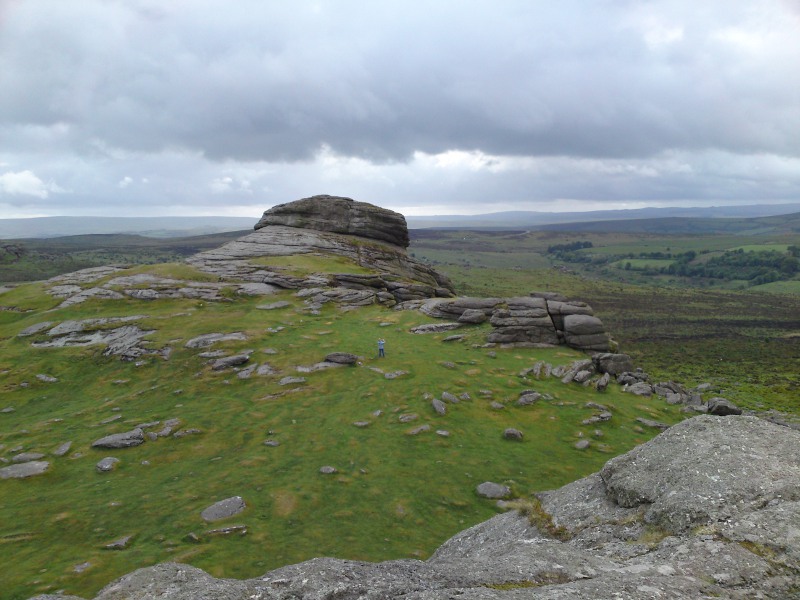
Last week we were walking in Devon and I took this picture from Haytor – I did not dare stand as the 80mph wind would have blown me over the edge. The tors are a relatively recent phenomena that were created during the ice age that occurred a mere 20,000 years ago and sent the early human settlers of this country scuttling back south to warmer climes. I was surprised to read on Wikipedia that ‘There is a theory that about 15000 BC prehistoric man, by killing the mammoths, removed a major grazing factor and so let the North American and Eurasian tundra get overgrown with trees, which, sticking up above the winter snow, made the land darker and made the spring warming much quicker, and so ended the last Ice Age.’ Surely this has to be the earliest example of man induced climate change on a major scale!

Coming back from holiday I found that my arch enemy The Mole had wreaked havoc in garden – the dry conditions leading him to undermine my prized recycled shed in his search for worms in the damper soil beneath it.

What this all means to me is that we can’t predict or control nature. We need to try and understand the natural world and to make the best of the resources available to us but nature will always throw up some surprises. Which makes it all the more important to build the resilient society that Transition aspires to.

Wednesday, 11 May 2011

On Gasland and Feeling

As I write just after sunrise this morning, I can hear birdsong of all kinds and a woodpecker drilling on a pole. A large wasp came in, carefully investigated the frame of the open window, flew slowly out again. The day is bright and the sky is mostly clear. The rain I wrote about on Monday returned with a few drops on the next night but that’s been it for now. The farmers have been watering the fields with those huge versions of sprinklers for several weeks.

Yesterday I got a message from 38 Degrees about the government’s proposals to remove the ‘red tape’ around environmental protection laws (read dismantle the laws protecting the environment) and reduce the UK’s carbon emissions targets. I read the piece by George Monbiot. I will write a letter to my local MP, as I did to protest the recent national forest sell-off plans.

And now I do want to mention what I did on my birthday, even though it was last week. I went to see Gasland with Charlotte at Cinema City. The event was organised by a young post-graduate from UEA and the auditorium was full of students, although from Transition Norwich I only recognised ourselves and Christine. We sat together for the film and the discussion afterwards with a panel of hydro-geologists and environmental experts.

Gasland documents the practice (and effects) of ‘hydraulic fracturing’ for ‘natural’ gas, or gas fracking, which in less than a decade has put thousands of wells all over the United States. Josh Fox decided to make the film after a company wrote asking him for fracking rights on his land in the Catskills. He got into his car and travelled the country to find out what was happening to the people who had sold rights on their land or lived near others who had.

It shows how gas and chemicals from the fracking process pollute the groundwater and poison the land. And how people (and animals) living in the area suffer or die as a result. There were shots of people setting light to the water coming out of their taps. One man said his water turned black overnight. Other people reported frequent severe headaches and worse - cancer and brain lesions.

Up until now in the UK, according to one of the panelists, gas fracking has happened out at sea but not inland. But it's due to start near Blackpool this summer. And what if those environmental laws get dismantled? Just as the US Clean Water Act was?

I think Gasland should be seen by everyone, certainly by anyone in a Transition initiative (see Rob Hopkins' review). Not just because it is interestingly shot, utterly engaging and completely topical. But because it has feeling. The filmmaker has real feeling for his home in the Catskills, the trees, the streams, the birds, the natural world, his fellow banjo players, the people he interviews. For what’s at stake. The kind of feeling we’re all going to need to have any real hope of restoring some kind of balance to our world, already fracked in so many ways.

This feeling was absent from the perfectly rational and well-presented panel discussion after the film. We heard about geological facts, profits and how in the UK our environmental regulations were tougher than in the US (although that was last week!). We were relieved that Norfolk (and I imagine Suffolk too?) was not earmarked for fracking.

I remarked on the curious flatness of the post-film discussion to Charlotte and Christine, who’d both felt it too. It reminded me of Ian McGilchrist’s book The Master and his Emissary*, which talks about how the left (smaller) hemisphere of our brains, the part that deals with facts, figures and stats, has put itself in charge of life, and usurped the right hemisphere’s rightful place, which is in contact with all life and the realm of feeling, and is really the ‘master’. And how this situation has become endemic to and expressed throughout the whole of Western culture with our obsession with numbers and quantification at the expense of the living planet and our own hearts.

One of the best things about being in Transition is the context it provides in which the bigger picture of diminishing fossil fuel reserves, carbon emissions, climate instability and the global economy can be brought to the table and given proper attention. With all our feelings on board. We can admit, as happened in our Low Carbon Cookbook meeting last month, that we don’t really know what the future will hold. Space and time for these discussions are invaluable in a left-hemisphere ruled world where 'getting it all done' and 'busy busy busy' are the norm. Where feeling is left out of the picture in favour of stats and ticking boxes.

And this is why I will go to a film like Gasland on my birthday. Because of the things it includes that are usually left out.

Pics: Josh Fox in the stream outside his house, among Wyoming wells, both from Gasland

*Click here for the PDF of the Introduction

Friday, 6 May 2011

Palm Oil

That's the mistake I want to talk about this week. I think palm oil has the potential to be one of the bigger environmental mistakes we make as a species. It's an oil derived from the fruit of the palm. So far, not much to separate it from rape or olive oil. But the problem is where its planted. The biggest plantations are in Indonesia and Malaysia, with others in Africa. It grows in tropical climates. Essentially it grows where there was rainforest. The equivalent of thirty square miles a day of rainforest are being felled to plant more palm oil plantations.

That rainforest is one of the most biodiverse habitats on earth. In Sumatra there are 465 species of birds and in Borneo 420. Sumatra is the only place in the world that the Sumatran tiger lives. Between 2004 and 2008, according to the US Great Ape Trust, the orangutan population fell by 10 per cent on Borneo and by 14 per cent on Sumatra. The decline of the orangutan in the face of deforestation motivated by palm oil has been described as genocide.

Ok, so we get the picture, palm oil is really bad. That's ok, because as we saw yesterday, humans are pretty clever, and as soon as we work out that something is really bad, we stop doing it.

No-one's going to accept palm oil. It's clearly a dreadful thing. Nobody's going to eat anything that says 'palm oil' on the label. Certainly nobody in their right mind is going to put it in their petrol tank and burn it. Right?

Wrong. Palm oil is being sold as biofuel. International agreements to increase the use of biofuel are directly contributing to the increased destruction of rainforests to grow palm-oil plantations. These international agreements seek to decrease the impact of climate change by reducing the emissions from burning fossil fuels. Unfortunately, the land that the plantations are being grown on is not only ex-rainforest, it's also ex-rainforest that grew on ex-peatbogs. The emissions from cutting down the rainforest and burning the peat are greater than from the fossil fuels they seek to replace.

And as to not eating anything that says palm oil on the label? There's no obligation to declare palm oil on ingredients lists. Any food that lists 'vegetable oil' as an ingredient may or may not contain palm oil.

Monday, 18 April 2011

Back to Basics

In the beginning there were the issues of climate change and peak oil and how these affected different parts of our lives, from the energy we use and the products and food we consume, to the waste we produce and the way we get around. Then the economic downturn was added to the list of issues and Transition Norwich got creative and developed many amazing projects. We have come so far and achieved so much, but to fully appreciate this we thought we should look back and remind ourselves of where we started.

So this week on the blog we will be revisiting the issues we are facing and having a sneaky peek at what solutions Transition Norwich and other initiatives have found.

Photos: bikes and wind turbines (Sam White), alcohol and preserves and Sri Lankan vegetables

Wednesday, 30 March 2011

My Struggle to Make Sense of the Financial Crisis in the Era of Peak Oil

Peak Oil, I get. I’ve been in Transition for three years and had my end of suburbia moment(s). I understand that fossil fuels are limited and non-renewable. That as the world’s oil fields diminish, demand exceeds production, and the remaining crude oil is harder and more expensive to extract, the enery return on energy invested (EROEI) drops to a fraction of what it was when oil was plentiful. No more cheap petrol. Oil prices soar. And along with them the price of everything else in our industrialised, oil-dependent global economy – including food.

The same with Climate Change, the anthropogenic variety. Creating a vast artificial industrial complex all over the planet which demands huge amounts of energy, destroys most of the rainforests and other complex eco-systems and burns billions of tons of fossil fuels every year with its attendant carbon emissions and expecting it not to affect the climate just makes no sense.

These two ‘drivers’ informed the beginnings of the Transition movement six years ago – a challenge to people and communities to respond to Peak Oil and Climate Change and start preparing for a (liveable, maybe even preferable) energy-leaner future without the whole world falling apart. When the financial crisis hit with the credit crunch in 2008 the economic downturn became the third driver.

Then last year Nicole Foss (Stoneleigh of The Automatic Earth) presented her talk Making Sense of the Financial Crisis in the Era of Peak Oil at the Transition Conference. It changed the whole course of the event. Suddenly Transition was seriously looking at economics and finance – money.

Money is where a vast amount of our attention and energy is invested (sic) and informs most of our decisions and choices, whether we have it or not. For the majority of us on a very basic level it’s the means by which we have a roof over our heads and put food on the table in the current economic system.

But it’s also where a lot of our aspirations, fears, fantasies and desires get caught up, “When I’m rich and famous, I’ll have a big house (and servants!!!…)” Yes, I wanted it too! This has been the case since money was invented but it’s been exacerbated by the creation of trillions of dollars of virtual wealth over the past thirty years. In addition, enough people have become more wealthy or comfortable in that time for others to feel they have the chance to follow.

But all this virtual wealth has been fuelled by cheap plentiful energy. This is where the connection with peak oil comes in. There will not be enough available energy for the modern Western resource-intensive lifestyle to continue. There won’t be enough real wealth to support it. The gap between rich and poor is already widening, bringing into sharp focus questions about social equality and the sharing of available resources.

So any conversation about the future has to include a discussion about money. Stoneleigh alluded to this on Friday night in Norwich. “It’s important to understand the way the global economy works,” she said several times. How markets work. How we are entering a time of deflation after a 30 year financial bubble. How housing (in the UK) has now become worth 8 times our incomes and yet the price of real things that matter like tools and bread are cheap and almost without value. How this will change as houses lose their value and the prices of real necessities like bread and milk go up. How when people can no longer afford the repayments on their mortgages, if one person sells their house in a neighbourhood cheaply, the prices of all the houses in that neighbourhood are affected. Meanwhile personal and global debt is enormous (the UK has the second highest debt-GDP ratio in the world after Japan).

This suggests the need for a good, hard look at what our values are. These are the conversations that need to take place. In the Stranger’s Circle meeting last year when we talked about "Stuff", each of us produced an item of value to us - all of them tools to do with either communication or making or mending things.

Social and communications skills were high on Stoneleigh’s list for what we’ll need in the times ahead, along with food growing and the ability to make things. We’ll also need to find inexpensive ways of entertaining ourselves.

I’ve been grappling with all these things since the talk, alone and in conversations with Charlotte and Nick. They’re hard to understand and hard to talk about, almost like breaking a taboo or a spell. It's like trying to catch a magician out in a sleight of hand. Or chasing shadows. Money is so entrenched in our perception of value.

But when relationships between people are given value, then you can start to share things. Some of those things cost little or no money.

Like joining in a Give and Take day, or listening to a storyteller in Bungay Library or going on a bee and flower mapping walk with Netta through Beccles and listening to the bees roar in the goat willow.

A follow-up discussion of Nicole Foss's talk will take place at Aladdin's Cafe on Magdalen Street, 12th April at 6.00pm. Everyone welcome.

Pics: Not Chasing Shadows with Netta and Charlotte in Beccles; Goat Willow with Bumblebee

Friday, 25 February 2011

Peak Oil! Peak Oil! - Oil! Oil! Oil!

Today I had planned to write about the Suffolk Agricultural Association’s Regional Conference on Climate Change and Food Security, which I attended last Friday at Trinity Park in Ipswich. But I’m finding it difficult.

There were probably 150 people at the conference, made up of farmers, lawyers, county councillors, politicians and transitioners. Although agriculture is not my subject, I am getting used to the flexibility that being in transition is requiring of me, so when I was invited to go and write about the conference I accepted immediately.

Professor Ian Crute of the Agriculture and Horticulture Development Board was clear and informative about climate change, although he ended his talk in what I thought was a very odd way. He showed us two pictures, one a detail of the Amazon rainforest before being cleared for agribusiness, and one after. He then said there was an argument for the second picture (a typical crop field which could be part of an industrial farm anywhere) being ‘better’ than the first. But didn’t tell us why.

The Agriculture Manager from Waitrose showed us how the company were going to increase their profits from £5 billion in the last year to £8 billion by 2016.

Then there was the unabashed and rampant display of pro-GM and biotech marketing by two speakers from the Conservative party.

But these are not the reasons I find it hard to write about the conference. I think it’s because the realities of Peak Oil were almost entirely absent from the proceedings. Representatives of several Transition groups in the region ( some of whom manage farms themselves) raised the subject.

The Waitrose man was unable to answer questions on oil price volatility, and how that would affect the supermarkets, it wasn’t his area. Other speakers just didn’t seem to hear the questions about Peak Resources. At least when (Lady) Caroline Cranbrook, who has worked closely with East Anglia Food Link, spoke out about phosphates already having peaked and asked “Is there a national larder in case of sudden food scarcity? ” she received the one direct reply I heard in the whole conference.

“No,” said chairmen John Gummer (former Secretary of State for the Environment), “is the simple answer to that question.”

Which means the just-in-time lorries serving the supermarkets are our only larder.

The conference was very much focused on the 'big picture' (the how will we feed the 9 billion people in the world by 2050? scenario), although one speaker, Lucy Wyatt, did tell us about her small mixed-farm, where she has set up an oilseed rape bio-fuel plant, providing her with electricity, and fuel for the farm machinery.

But there was no spokesperson for organic production and no representative of one of the community, small-scale projects that are happening all over Suffolk and East Anglia, like the Oak Tree Low Carbon Farm CSA, Joanne Brannan (Transition Ipswich) has set up. John Taylor, Suffolk's Climate Change officer, did ask about the small scale projects, but the question was not properly addressed.

And although I'm only a member of the mere hoi polloi, I'm inclined to say that a conference about climate change and food security that avoids the questions of Peak Fossil Fuels and small scale food projects is not really a conference about climate change and food security.

Well, I really didn't think I had anything to say about the conference, but there you are.

Just two more things for today. One is if you haven't read "The Long Emergency: Surviving the Converging Catastrophes of the Twenty-first Century" by James Howard Kunstler, and you want a solid, readable, intelligent book which brings climate change, peak resources (especially oil) and the follies of economic globalism together in a coherent manner, then this is the book for you. Don't let his occasional coarseness put you off, it's just his manner.

Secondly, The Waveney Greenpeace Winter Fair is taking place in Southwold tomorrow - 11am - 11.30pm. Donations in the day and £5 in the evening. It's usually fun with good food and stalls. Maybe see you there.

Pic: Sprouts and Clover at Oak Tree Low Carbon Farm by Richard Mudhar

Monday, 7 February 2011

Starting Somewhere

I’ve had some really interesting conversations over the last week or so, inspired, no doubt, in part by the ongoing “austerity measures” that are really starting to to be felt by the ordinary person in the street.  The conversations run along the line of “I really want to do something but I don’t know where to start”.

There’s a feeling that it’s all too much for people – they don’t know what to do and feel paralysed.  Classic shock syndrome.

I don’t pretend to know all the answers, far from it.  But, for those guys, and you know who you are, here is my personal top ten of where to start.

1. Pay attention – to paraphrase Donald Rumsfeld, it’s very difficult to know what you don’t know.  So you have to get out there and find out what’s really going on in the world.  Read the news (real news, not the slop that passes for news on much of the TV and the tabloids), read magazines, blogs and books.  Norwich library has hundreds of books on various subjects, and some great “dummy guide to” style books.  It’ll take a bit of effort, but once you learn about some of the things happening in the world – happening in your name - you will Get Angry.

2. Get Angry – research suggests that people will only make a change in their lives once they reach a certain point of anger and frustration.  That point is different for different people, but we all have it.  To actually want to do something, you’ll need to get angry. One of my favourite cartoons of last year reminded me that so much is interlinked – peak oil, climate change, economics, social justice, respect for people and planet.  So whichever subject floats your anger-boat, you’ll be in good company.  But anger can be very unfocussed, so it’s important to Arm Yourself.

3. Arm Yourself – with facts (not guns, obviously).  There are lots of people out there who will tell you that a) you’re wrong, or b) that you’re just a dreamer and it won’t make any difference.  Prove them wrong.  Learn some facts about climate change, about economics, whatever.  The more you learn, the more you’ll want to learn.  And also, make sure you learn the counter-arguments.  Learn the rhetoric of the other side of the argument; some arguments you’ll never win, but you may give the other person something to think about.  The important thing is to Get Involved in the debate.

4. Get involved – this should be an easy one in the sense that the country is buzzing with debate around the economy at the moment and the government’s various proposals of how to deal with it, from tax reform to selling off the forests, to restructuring the NHS.  People will want to know your opinion, so let them know.  Not just colleagues and friends, but also your MPs, councillors etc.  Make sure these last two know what you want from them, regardless of the party they represent.  Remember, they don’t represent a party, they represent you.  Make sure they remember that too.

5. Build Resilience – one of the challenges to getting started is feeling that you’re just one insignificant person facing a sea of indifference at best, strong resistance at worst.  But you’re not alone; look around you, there are hundreds of groups, thousands of people all wanting to make a difference; make things better for the many, not just for the few.  Transition Norwich is one such group, and there are many more, big and small.  Working with others will remind you that you’re not alone, and that together, people can work wonders.  If you don’t believe me, think of the suffragist movement, the trade union movement, the fall of the Berlin Wall; look at what’s happening in Cairo at the moment.  Think about the growth of Fairtrade or the Transition movement. Working together will build your personal resilience and inspire you. So, be inspired, and then take action.  If you’re not ready yet to jump right in, you could dip a toe in the water and Start with the Small Things.

6. Start with the Small Things – magazines and Sunday supplements are full of articles on the “ten things” that will save the planet, save the environment etc.  I’m fairly sceptical of these top tens, because they all tend to be pretty similar in subject and in scale.  Changing your lightbulbs to energy-saving ones and lagging the loft are all small things, and to my mind, lack ambition.  But hey, we’ve all got to start somewhere, and let’s start with the easy wins.  Have a look at your house and lifestyle and see what you can change. The plus side is that a lot of these Sunday supplement suggestions will also save you money, so you’ll get a warm fuzzy feeling from your bank statement as well as your conscience.  And, hopefully, as with learning to walk, once you’ve taken your first tottering steps, you’ll soon want to learn to run.

But before we embark on the big changes, it’s worth pausing to take a Look Behind the Curtain.

7. Look behind the Curtain – the world is a complex place, and what seems clear cause and effect isn’t always the case.  There are hundreds of examples, but one of my favourites is that of the Somali pirates.  Quick caveat – I’m not condoning piracy or the violence that goes with it.  Obviously…  However, there’s a view that the rise in piracy off the coast of east Africa was directly related to the overfishing and subsequent depletion of our own fish stocks.  Once we’d fished out the North Sea, then the North Atlantic, we in Europe sought new fishing grounds to keep the supermarket ice-counters full.  The industrial fleets moved into the Indian Ocean, and displaced the traditional fishing lifecycles of the people already living there.  So, skilled sailors with boats suddenly had no jobs, no income, and no way of supporting or feeding their families.  Next thing, Saga cruises are being held up by pirates. That’s a simplistic assessment of the situation, but the kind of scenario that you see when you look behind the curtain of the traditional media explanations.  There are many, many similar stories.

So if that kind of thing really hacks you off, maybe it’s time to start doing the Big Things.

8. Do the Big Things – you know the kinds of things I’m talking about – the things we discuss a lot on this blog.  Flying, shopping local, buying organic, making things, reusing things, changing your personal financial model, cutting down on consumption, challenging the economic growth model.  These are the things that can frighten people, but they’re actually the things that really mean something.  They can require personal sacrifice, or sometimes they just feel like they require personal sacrifice.  Once you make a change, you might wonder why you hadn’t done it before.

9. Live like you M
ean It – we had a laugh at work on Friday as I said I wouldn’t get a bacon bap for breakfast unless I knew where the bacon had come from.  I was kind of joking as I’d already had my breakfast, but there was a serious point too.  I do have a personal code that guides the decisions I make.  I don’t always make the right choices; other things get in the way and I have to compromise – that’s life.  But I try and I think we have to keep trying. I want to leave the world a little better than it was when I entered it; leave a legacy for my children and grandchildren that I can be proud of.  I won’t Give Up.

10. Enjoy Yourself and Don’t Give Up – my children constantly remind me that you can’t take yourself – and life –too seriously.  The challenges facing us are great, but working towards solutions can be a lot of fun – that’s one thing that Transition Norwich has taught me.  There’s a great bunch of people working towards a better, more equitable future, so join in.  Don’t give up, and have some fun on the way.

*****

So there it is – a very personal view.  What do people think?  What have I missed?  What would be in your top ten, or even top three?  Leave a comment and let us know.


Pic from www.businesszone.co.uk

Thursday, 9 December 2010

“Global warming eh? Why’s it so cold then? Hur hur…”

It had to happen.  Sooner or later some bright spark was going to ask the question:

“If there’s so-called global warming, why is it so cold?”

I saw it on Facebook first, which is perhaps inevitable given there’s 500 million people there (apparently even Sarah Palin is on there), and the very next day, skidding my way into the Coop on Dereham Road, I saw it on the front page of the Daily Express: “Global Warming: If Only”.

The subtext is clear – if global warming doesn’t match my experience of an unusually chilly November in England, it must not exist.  Even worse, it must be some kind of pinko conspiracy, dreamed up to fleece hard-pressed middle-Englanders of their hard earned money; the “squeezed middle” the media is so fond of.

Frankly people should know better.  Climate is not the same as weather.

Luckily the fabulous Marcus Brigstocke came to my rescue with a rant on that very subject, courtesy of BBC Radio 4 Friday Night Comedy “The Now Show”.  I fell about laughing.  So, if you happen to hear someone make a banal comment to you linking the early snow to global warming and you feel your blood boiling, Marcus will provide you with all the answers and rebuttals you need!  (You’ll have to be quick and listen to it before the weekend though.)

Laughter is a form of resistance and a form of resilience.
Listen to this and the laughter will sustain you through these literal and metaphorical dark days, I promise!

Pic from www.bbc.co.uk (Marcus Brigstocke in the middle with the offending piece from the Daily Express)

Saturday, 4 December 2010

Don't panic - let's escape!

A friend of mine's 10 year old son told me recently that he (the son) had recently written something at school about climate change and its solution. The solution, he said with some confidence, was that out there in the dark sky in a neighbouring constellation there sits a planet very similar to our earth, and to which most of the Earth's population is going to escape when the going gets too hot or tough on our resident planet.

The alarming thing came at the end - this was going to happen in 2012! He didn't say anything about what the existing residents of said planet might do or look like, but let's hope it isn't like this guy above.

Maybe more like this one? :

What children, and indeed young people, are really thinking about the future, can be very revealing. Whilst all sorts of fantasies are not uncommon, so too is the sense that our generation have messed up so badly there is not much chance of recovery - this goes as much in the current situation for pensions as it does for climate change.

So this week us adults have been blogging about our pet subject, and have come up with our own interesting images - including carrots and woolly hats, population graphs, Joint Core Strategies, Cancun, and a 'don't panic' slogan that might just pop up on someone's fancy mobile screen if they google for a lift across to Betelguese 5.

Maybe I am getting carried away here - whatever is happening in Cancun? As John said yesterday, it isn't exactly front page news. We do know that Japan appear to be blocking a renewal of the Kyoto treaty, which expires in 2012 ( oh dear, maybe that's where my friend's child got his idea from). And as ever, it is the developing countries who are pushing for binding agreements, as distinct from the rather loose accords that were agreed last year in Copenhagen. And the World Meteorological Organisation has just declared:

"The year 2010 is almost certain to rank in the top 3 warmest years since the beginning of instrumental climate records in 1850."

And..."Over the ten years from 2001 to 2010, global temperatures have averaged 0.46 C (0.82 F) above the 1961-1990 average" .

So here we go again... all the alarm bells, and none of the action it seems. Well, maybe not much of the internationally agreed action, but there is plenty of action being taken by ordinary people worldwide, including in Transition groups. Even in Cancun itself, local 'scavengers' - those who live off the huge rubbish dumps - have made themselves very visible and protested at the proposals to introduce an incineration process there, which would burn all the stuff that they both re-use and recycle, but also make a livelihood out of. This story, interestingly, only seems to have been reported in The Times of India. Hmmmm.... They point out that burning this 'rubbish', apart from depriving them of a livelihood, is also in one swoop increasing carbon emissions. I digress - although this story shows how interwoven the issues of poverty, carbon emissions, and waste are.

So we really don't need to escape - we really need to do more of the things we have already started in the transition movement, more of the things that have come so creatively from people locally and worldwide, projects that we have actually begun ( like the food projects), and projects that we have planned and will come.... as they always do when inspirational and creative and committed people come together.