Showing posts with label economics and livelihoods. Show all posts

Saturday, 16 February 2013

Making the best of a bad lot

My long suffering cherry!
It has been a strange start to the year. The weather has swung form very mild to very cold and the picture shows my beloved Morello Cherry suffering under a burden of ice when a neighbour’s gutter dripped in the freezing weather – it had better survive to provide more cherry pies.

In the Hethersett area we are seeing the final acts in some long running sagas that will shape communities for many years to come. Governments (both past and present) have decreed that more houses are needed for our ever growing population and the slow turning cogs have got to the point of examining the many planning applications. This puts local democracy to an extreme test where one set of elected representatives (District Councillors) have to implement to policies originated by others (Members of Parliament). Since very few people want their views over green fields to be replaced by a housing estate this creates a lot of conflict and has the potential to undo the efforts that some people are making to build local communities.

It is easy to get depressed by this and unfortunately some dedicated people have been hit hard by what they see as big government stamping on local wishes. Certainly for anyone involved in Transition it seems like a step in the wrong direction to cover more fields in concrete and create more traffic. However there is always opportunity in adversity and the much discussed cycle path is now firmly written into the plans – we now need to work for allotments, sports grounds and green spaces in order to provide facilities within the local communities. As Chair of the Parish Council I have done my best to be open with people and to keep them informed and the majority of people have reacted with admirable composure even if they don’t like the outcome. We may even get some new help on the PC.

Most initiatives in Transition are focussed on working with likeminded people – it’s a lot harder to work with the general public but there are grounds for optimism. I’d never openly describe my role on the PC as a Transition project but most people are aware of the issues that we face and most want to live in a supportive community. The difficult part is to persuade them to get involved. Small steps are being taken but in the right direction.

I’ll be doing my best to make sure that lots of trees get planted around the new devel- opments. One of the PC trees got Weeping Canker and I had to fell it – but the good news is that cat will have fires to lie in front of next winter and my run of free winter fuel extends to 34 years!

Wednesday, 6 February 2013

Chain Consuming or Systems Thinking

The biggest news story in recent weeks seems to have been the collapse of high street chains HMV, Jessops and Blockbuster. Apart from the news reports, there are various comments and opinion pieces, with various different attitudes. It’s a really big issue, and for so many reasons!

What I want to talk about here specifically is why the attitude of both big business and government in tackling this issue are wrong, and how we should be looking at our high street economies to help them thrive and be resilient through hard economic times.


So what’s the problem?

Some of the comments relating to this news story seem to point the finger at the businesses. “They simply haven’t moved forward; they are stuck in the past hoping what worked several years ago will carry on working, but we all know, it doesn’t”, John N says on Streetlife. I agree that there’s no point in a businesses that provides services that no one really wants, or can get much easier and cheaper elsewhere.

Other comments blame the government for high business rates or failing to provide the services which help businesses (like good public transport, for example).

The truth is though, that what is lacking is systems thinking. Each organisation is just looking at their little corner of the pie.

The businesses are looking at how much money they can extract from an area whilst keeping their costs as low as possible. Capital costs are only justified when their future value can have a firm price tag associated with it, even if that capital cost is only arbitrary and only really there to keep banks and accountants happy. It’s different in the oil industry, or in manufacturing, but in high street retail, value is created through experience and service. Why are we willing to buy a coffee for £2.50 when we could get something of equal quality for less than a pound at home? We are paying for the experience, service and environment of city centre shopping! I buy my books from high street shops, knowing full well that I could get the same book cheaper on the internet, because I want to be able to flick through it before I buy it, I want to be able to ask the employees whether there are other books by the same author that I might enjoy, and want to be able to take the book straight across to the nearest coffee shop and start reading it! All of this value is not recognised by national chains, and unless they start to recognise it, and invest their money in it, high street chains will die, and the companies will be to blame.

But businesses don’t only have themselves to blame. The entire system creates this rather sterile environment, and it must be a team effort to combat it. It’s lovely that individual shops strive against the odds and offer something unique, but to solve it more permanently, and for local communities to become resilient for the future, we need to work together. And we already have a system for working together in local communities. It’s called local government.

But the local government is riddled with red-tape, ego trips and hangovers from previous governments. It looks for ways to cut its spending, without any regard, seemingly, of the wider effects on the local economy, for which they are partially responsible. They take political lines based on what their national parties decided in Westminster, rather than what they, as elected representatives, think is best for local people. And they uphold the status quo for no more reason, really, than because it would take too much effort to no something new and ambitious. In the same way as businesses, the return from investing in the capital costs of better systems is not recognised.

So what if businesses and local government truly started to look at the big picture, the whole system? Rather than basing value on arbitrary figures in pounds and sterling, what if it was valued in the ability to provide for human need, in a sustainable and resilient way?

Systems Thinking

When I look at Norwich, I see a massive resource, with so much potential, but that, under its current, very conservative Labour group, is being mismanaged. Some of the many resources which Norwich city centre has are:
  • A historic market, which some see as being “sterile” since its latest transformation.
  • A wealth of city centre buildings, picturesque streets, heritage assets and spaces that people enjoy being in, as long as they are kept clean and well-maintained.
  • An expansive pedestrianised zone, with plenty of space for events and pop-up markets.
  • A potential workforce in its unemployed people (Over a quarter (26.48%) of residents in Mancroft Ward, which covers most of the City Centre area, are on state benefit, unemployed or lowest grade workers, according to 2001 census data – that’s a lot of potential work that could be mobilised!)
But there are reasons why they are failing, and they’re not that hard to solve, either, if the council only took on a systems thinking approach:

Most generally, all decision-makers should look at the effect of their decisions on the local economy as a whole, not just themselves. Where does the money they spend go? Who benefits and who loses out? This means that when the local authority or any decision-maker is choosing a supplier for their major services, they should be asking themselves how much of the money they give that company will be staying in the local area. Does the company employ local staff? Is the company locally owned? Will profits be reinvested in the local area, or taken straight to London or abroad? Does the company pay its employees fairly, pay its tax and contribute to the community? Does the company care about sustainability and is willing to invest in local energy efficiency measures (which will benefit the local tradesmen who supply them too), rather than just fork out more and more for gas or electricity (which will only benefit multi-national energy companies and their greedy investors)? How much money that is spent will return to us by way of it circulating in the local economy?

More specifically:

Currently Norwich Market has lots of empty stalls and generally suffers from stagnation of both traders and customers. If I were managing the market, I would hold short-term events to fill all the empty stalls for, say, a week at a time, with a theme. Such a theme might be “collectables”, at which one would invite collectables shops within Norwich and across Norfolk to trade their wares, as well as individuals who can’t commit to running a full-time shop. It would be advertised in city and regional media, and at the market itself, to ensure that plenty of customers who’re interested in collectables would be there, and whilst there, they would also use the food stalls and all the other shops in and around the market. Other themes might be furniture, local groceries, comic books and toys. Successful traders might then consider taking up a full-time stall, increasing the vibrancy of the market in the long term.

If I were local authority planners looking at the city centre, I would immediately try to encourage more of a community there. The city centre seems to be a place for people from outside of Norwich to come to shop and drink coffee. Where is the city centre community? Apart from a fair chunk of housing at Pottergate, much of which is council housing, the city centre doesn’t really have a community. I would want this to change, and would suggest that planning policy should encourage more residential flats above city centre shops. There’s loads of potential for it, and many of them are already empty. You just have to look around the city for signs above shops that say “3500sqm of office/retail space to let”. There are loads of them! Surely they’d be filled much quicker if they were residential. There would be many benefits apart from getting empty buildings into use – there would be more people in the city centre using the shops for their daily items, eating out and enjoying the nightlife without the worry of parking, petrol and drink driving. Crime would reduce because there would be more people keeping an eye on their streets at night.

When I was on job-seekers allowance last year, I got totally frustrated that the Job Centre and the local council were not making efforts to actually encourage the creation of jobs for me and the other unemployed people there. They essentially just tell you to keep looking at the adverts, brush up your CV, broaden your search criteria. As I’ve said before, all of this does nothing to change the number of jobs that are available, so all it really does is makes job searching more competitive, and more stressful for applicants and human resource managers alike. Under a systems thinking approach, the council would look at the job market as a resource, through which they can stimulate the local economy as well as get things done that need doing. They may be able to develop some policy that might actually create new jobs, or bring back jobs that have been sent overseas. The unemployed community probably have a wealth of knowledge and skills that the job centre, let alone potential employers, are even aware of, but just don’t have the resources to actually use and progress those skills. Here’s an idea: a business incubator, which does not pay staff, but offers them accommodation and cheap food on the condition that they spend working hours developing their new business. It would be no more expensive than distributing job-seekers allowance and other benefits, but successful ideas would pay back a proportion of their turnover to keep the scheme going.

Working together

The short phrase above has become a bit of a cliché, particularly in green (and Transition) circles. But I think the vision that I have in my brain when I think about working together is a little different to the quite fluffy idea that phrase might naturally conjure up. Last week I attended a lecture by Karen Armstrong, in which she talked about “Socratic dialogue”. This is the type of working together that we want. In Socratic dialogue, it’s not about winning, defeating and humiliating the opponent, but “it [is] a joint effort to obtain new understanding: you expressed yourself clearly as a gift to your debating partners, whose beautifully expressed arguments would, in turn, touch you at a profound level”, as Karen Armstrong puts it.

Monday, 14 January 2013

Funding Change

There are several reasons why I want to write about funding today.

One is my current circumstance. I find myself sans job and without a place to call my own. I have ambition to do social good in this world, but need some way to make it pay!

Another is that I've recently been reading some books which talk about the problems of funding and costs, and had some thoughts of my own off the back of that that I want to share.

Here's another: funding social change is something that it's easy to shy away from, to let someone else take up the slack, or not to look at realistically. achieve

So over the next few paragraphs, I'll ask why funding for social and environmental change can be a problem and how our culture has influenced how money moves about, both negatively and positively. Then I'll suggest one way through which we might be able to fund the changes that we need, and what a sustainable economy ought to look like.

"This is so obviously a good thing for society, so why will no one pay me to do it?!"

It's difficult being a young unemployed person these days, especially one who is determined that whatever they do must contribute positively to the world.  Those who speak up against our societal system are frequently told to "get a job" and those who are trying get accused of sponging off the state or not having the right skills for industry.  But no matter how hard jobseekers try, its impossible to fill more jobs than businesses create. And where there are skill shortages, isn't it the industry's responsibility, for the sake of the long-term viability of their industry, to train inexperienced workers?

"I want social change, but I can't pay for it!"

There seems to be a mismatch between what people require, and where the money is that might pay for it.  We desperately need to improve the efficiency of our housing stock.  We need tools and appliances that last a long time, to conserve limited natural resources.  We need value creation that improves human well-being, not the bank balances of the few.

But those who need these things just don't have the financial resources to invest in this way, or are under too much pressure from their investors to divert money to these areas of their business.  Local councils' budgets are being cut.  Businesses, meanwhile, are under intense pressure from all sides.  Shareholders want to maximise profit, whilst customers want prices ever lower and lower.  Anything that can be squeezed out of their costs, is.  Even socially responsible companies must compete just to stay in the game, and have to cut down their own profits if they choose to invest in the future or in better business practice, possibly to the point where their business ceases to be viable.

"Let's forget money and just share our skills and resources!"

The first argument which seems to pop up in Transition circles is to remove money from the equation.  To establish the "gift economy".

It all sounds very noble.  It all sounds very nice for society. It sounds like it will increase peace and goodwill to all.  I thought the whole concept sounded pretty attractive myself... until I read two books that give quite substantial evidence for a wealth [sic] of unintended consequences.

In You Are Not A Gadget (which I recently reviewed on my blog), Jaron Lanier criticises aspects of technology culture, particularly the Web 2.0 attitude, where everything should be free and available to all.  Eduardo Porter makes a similar criticism of "free" culture in his book The Price of Everything.  Both give very convincing arguments of how this attitude has diminished our society's cultural advancements and exalted the "Lords of the Clouds" (Lanier) that control the social networks and information aggregating websites. Producers of content (such as musicians and journalists) largely go unrewarded, even when the value of their content is indisputable (like when a YouTube video has several thousand or even million views). I won't describe these arguments in detail here, but if you're not convinced, I can recommend these books, and you're welcome to borrow them off me if you're around the Norwich area.

"Let's print our own money, then!"

So if those who would get the benefit of new economy activity don't have cash reserves to pay for it themselves, how do we create the mechanism for these value creators to be rewarded for that work? Another of Transition's popular policies comes into play here - local currencies.

Why don't we create the money we need ourselves to trade the services which local people need.  It's another of those ideas that seems very attractive at first.  When money is essentially just a social contract, why shouldn't we be allowed to make our own, and determine how it will be used, rather than commercial banks?

It's a good argument, and I'm all for local currencies.  It is important to be aware of some of their shortcomings though. It's often hard to convince businesses of their value, especially when a large proportion of a business's expenses are, by necessity, outside of the local community. As much effort must go into convincing people (mostly business owners) about why the use of a local currency is beneficial to them as the actual infrastructure used to implement it.

Now, this isn't an argument against local currencies, but I am convinced that we can do much of what local currencies aim to do without the need for an actual local currency, at least until we get to the point where we can afford the infrastructure of a local currency.

"So, what can we do now to fund the change we need?"

So another model, which I'm a big fan of, is crowd-funding. Under this funding mechanism, those who want a particular product or service can invest in it before it even exists. Return on their investment is then often in receiving the product or service they want, rather than in financial terms. It is, I suppose, a little like pre-ordering something before it's made.

There are various crowd-funding websites, and they all work in different ways. Some give primarily financial returns (like www.abundancegeneration.com, which is crowd-funding for renewable energy projects), whilst others focus mainly, or exclusively, on the social and product returns that they provide.

The Transition Free Press is using one such service to raise funds for the launch of their newspaper at buzzbnk.org. Please do follow this link, fund the project, and benefit from a year's subscription and more! Crowd-funding websites often do a lot to ensure that investments with them are risk-free, by only releasing funding once the project reaches its funding target, and requiring business plans or financial projections to ensure that projects are viable.

I think it's important to be imaginative about crowd-funding though.  This applies not just to creative artsy projects (like those on kickstarter.com), nor the very businessy "maximum returns" world of crowdcube, but even co-operative housing projects could be classed as crowd-funding. Any point where we can cut out the banks and those with a little cash to spare can invest it directly in business is good, as far as I'm concerned.

"So what does our future model actually look like?"

I envision a world where local sustainable resources, whether they are land, businesses or tools, are owned collectively by the people who use them.  This IS possible. It will take a lot of work, since it does require changing our attitude to money, savings, investment, ownership, sharing and our lifestyles.  It will also require us to claw back, collectively, all those things which we have slowly allowed the very rich to commandeer.

But as long as we look at each other as human beings, co-habiting this planet with the limited resources that it has to offer, rather than statistical consumers or welfare scroungers, we will get there!

P.S.  There's a lot more that I wanted to put in this article that I've had to leave out, so perhaps I'll get round to that in another post, so if bits of it don't fully tie together, that's why! Please leave a comment if you have questions or comments though!

Images: Hire me! (the author); Book cover of "You Are Not A Gadget"; Brixton Pounds; Mika from Japan reading TFP preview issue on a train in Suffolk Photograph of sign at Occupy Norwich.

Monday, 20 August 2012

REconomy comes to Norwich

Last month Fiona Ward of the Transition REconomy Project came to Norwich as part of a UK roadtrip. Chris Hull (Norwich FarmShare) and Simeon Jackson (Economics and Livelihoods group) showed her the city:

Norwich is a beautiful city, second only to London in importance until the industrial revolution. Within the city boundary live 137,000 inhabitants, but ‘greater Norwich’ – which includes the urban fringes – is more like 230,000.

I learn from Chris that it has a strong shoe making history along with textiles and weaving, and “the most esteemed flint knapped wall” in the whole of the country, if not the world. I am no green building nerd but even I was impressed with this.

Now employment is mainly in the service industries, especially public sector, insurance and finance. The city has the largest open-air market in England, established by the Normans around 1074.

The town centre is the usual mix of chains and some independents. A group of local businesses got together and formed an organisation, then created Norwich Lanes, a lovely collection of independent shops.

I wonder what other stories are out there about independents collaborating to fight back against the chains – not something I hear much about, but then again, I haven’t been looking for them.

I meet with Chris and Simeon in a local coffee shop – I am eating a LOT of cake on this trip – and hear more of the history of Transition Norwich and the main business it has created called Farmshare. This Community Supported Agriculture scheme (CSA) was in part inspired by the food section of Transition Norwich Resilience Plan, which explored whether Norwich could feed itself.

Members weigh their share at the food hub

8.5 acres are rented from a local farmer, and 2 growers produce vegetables and salad crops for around 100 members of the co-operative.

The members commit to pay for 1 year’s supply of fresh seasonal produce, which is brought weekly to the down town food hub (a space rented from Bicycle Links, another social enterprise), where the members weigh and bag their own share of the produce.

A ‘small’ share – enough for 1 person – costs around £4.50 a week, paid as a flat monthly fee. Some produce may be bought from other local suppliers to meet gaps. Members also give some hours of time per month, and can do work shares to reduce the cash cost e.g., designing the marketing materials.

The aim is for 150 members which will ensure the scheme breaks even, hopefully by October. It was started with around £30k of help from the Local Food Fund (now suspended) that helps pay wages and also bought a tractor and a van. The plot now is roughly the size of the old market gardens that ringed the city, and have an apprentice scheme in place. It’s not officially organic but grows without artificial fertilisers and pesticides.

And for your table this week…

Visiting the hub in the heart of the city, I can see how this provides more than just a food pick-up point. It’s a social time for people to chat, and to speak to the growers and have that direct connection to the people who are working the land to grow their food. Farmshare is starting to invite other small producers to come along, providing them with another direct outlet to consumers. Sharing the space with another social enterprise also raises their profile.

The meeting rooms there will be used for giving the classroom bits of the growing skills training courses that will be run. This enterprise had the help of the East Anglia Food Link (website being re-worked), a group I will follow up with on my return. It feels important that food strategies are held at appropriate scale including community, region and nation and I am interested to hear more about this regional level work.

Simeon is keen to re-start the Economics and Livelihoods Group, and to initiate some work in one or two of the more deprived parts of the city. He has run a visioning session in an area with lots of empty shops that is currently cut off from the rest of the city by a large derelict building. The approach has been included in a Communities Living Sustainably bid, and if successful this should help ensure the work continues.

T-Norwich found that the energy that was in the initial group has tailed off, with most of it going into projects like Farmshare and also the T-Norwich blog and Carbon Conversations training.

Visioning was done here in St.Augustines

This has left a bit of a vacuum in the centre, and now they are re-igniting things with a Phoenix group – getting people back together to refocus and see which direction to take next, planning some open events etc.
This is emerging as a theme from several of the places I have visited, an initial group that forms, meets for a while, and then puts energy into projects and new enterprises. Then there is an awareness that the centre has diluted, and timing feels right to put some attention back on it.

T-Norwich has no strategy at the moment for how to develop the local economy, but there is interest in learning what others are doing around this, and how such an approach might work to re-ignite things, and bring new people and new energy into the fold.

This model would need to include the means by which people could be resourced to co-ordinate and deliver this work, and which legal structures might be needed to enable this. This need is coming through loud and clear from all places I visit. Fiona Ward

Saturday, 18 August 2012

How do we make planning fun?

It’s been rather depressing in the garden recently with squashes withering in the cold and tomatoes dropping with blight but one surprise was this flower which rose on a 60cm stalk from my bog garden in front of the beans. I’ve never seen it before so I guess that it must be enjoying the wet! Does anyone know what it is? The last week has been hot and the plants are making a valiant attempt to catch up before autumn arrives.

I spent an afternoon this week in a very hot council chamber in order to speak on a local planning issue . One of the agenda items that I had to sit through was further phases of development at Queens Hills, Costessey. It was the usual depressing stuff, I’m afraid. One of the councillors asked why no allotments were included and the developer replied that it was a bit late to ask that but he would see what he could squeeze in. There was not a single mention of cycle paths and the main way of encouraging people not to use cars seems to be not to provide parking places. Highways admitted that travel planning was ‘in its infancy’ in Norfolk, I wonder if they have heard of climate change yet.

The committee had 20 other items on the agenda and were probably going to be there till well into the night – so in the end, a living environment for thousands of people, that will last a hundred years was decided in 30 minutes by 10 mainly elderly people. I don’t blame the committee who get very little recompense for giving up huge amounts of time – it is the lack of interest from all of us that is the problem – the time to raise issues is when the plans are being made. Which is what I’m trying to do in Little Melton, where we face massive developments on all sides – anyone care to lend a hand? Reading planning documents is not a lot of fun but it has to be done if we are to create something better than how Queens Hills is going to end up.

A squirrel taking a look at a development site

Wednesday, 15 August 2012

Why the Olympics were good but bailouts were bad

It’s easy to forget that when we spend our money, we aren’t just giving away our money, but the recipient is receiving it. It’s a passing of purchasing power from one person to another, not an expenditure, rather like the law of conservation of energy.

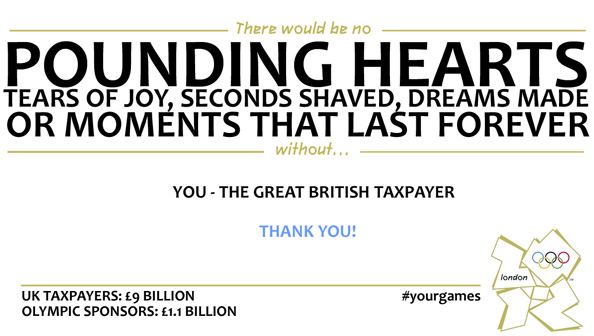
So when I saw the following edited billboard from the London 2012 Games posted at Make Wealth History, I started to question the other side of the equation.

 Your Games

Our initial reaction when you see that £9 billion has been spent by UK taxpayers to bring about the games is probably one of disgust. And rightly so – we never voted to have the Olympics; the Olympics supports London far more than the interests of the rest of the UK; and we are forced to pay for something whether or not we support it, or gain any benefit from it.  Altogether, that means that the decision to spend UK taxpayers’ money on the games is controversial.

But once you get past the selfish view of economics that we take as individuals, and instead look at the economics of the country and our society as a whole, this money was well spent. I’ll tell you why: Think for a moment about what costs the Olympics have had to face.  The costs that come to my mind are the design, engineering and building of Olympic venues and huge numbers of event staff to pay for their various services, from security to ball-boy. With very few exceptions, that money got delivered straight back into the UK economy as wages.

And will the government get back any of that? Of course! Their employees will pay income tax and the businesses that ride on the Olympic wave will pay their rates and taxes (in part thanks to our friends at 38 degrees).

So let’s compare that to bank bailouts.

What we could do with the bank bailouts

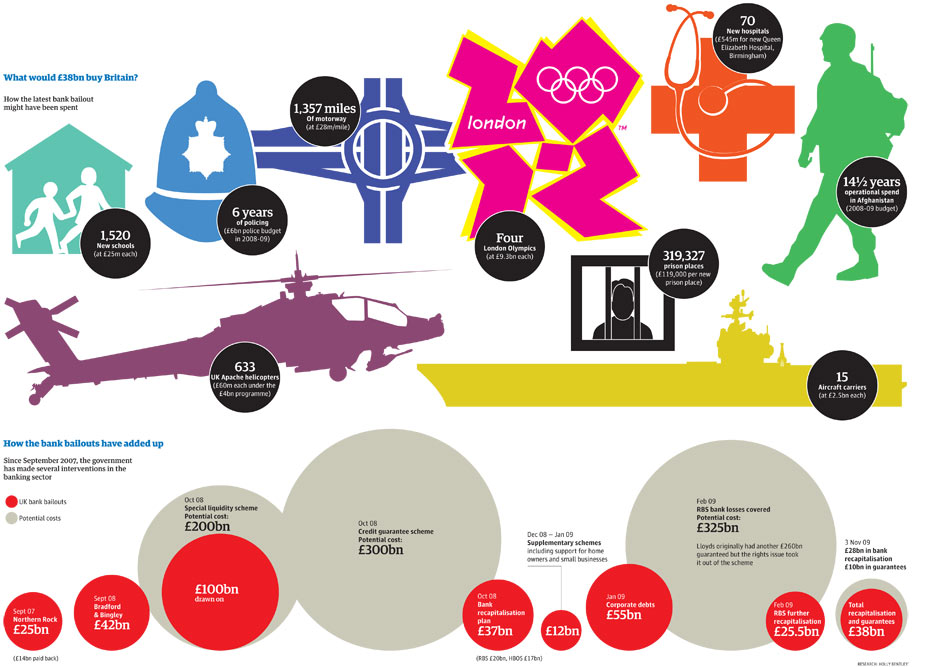
In this graphic from the Guardian, you can see equivalents to the £38 bn figure for bank recapitalisation in 2009, but this figure has since risen to £123 bn, according to this article, again from the Guardian, so rather than four we could have actually bought more than 13 Olympic games for the current bank bailout money!

But that’s not really the point, because the more significant thing is where this money goes. As we have all seen during recent years, the money that banks were given by the government did not go towards supporting our productive economy in loans to companies and entrepreneurs, and it did not go towards the wages of vulnerable low income families.  Banks selfishly continued to pay out huge sums in salaries, bonuses and make huge profits, ensuring that any benefit that came of the bailout remained firmly under the control of bankers, so that they could continue speculating on property and gambling with the world’s economy, whilst leaving the productive economy to fend for itself.

To be honest, I’m not at all surprised that bankers would take this kind of action.  If I were in their shoes, I may well have done the same (such is man’s fallibility), but what this does indicate, I feel, is that our economic system isn’t really designed to help society as a whole to develop and prosper.  It is designed as a game, where the winner takes all, and those who are unable to participate – through not knowing the rules, or not having the right friends, or not having enough cash in the bank already – must beg for the mercy of those who do.

Did we have a choice to bailout the banks?

Some people would argue that the government had practically no choice in bailing out the banks, because to have let them fail would have been catastrophic to our economy.  Those who take the opposite corner usually do so with the neat little phrase “bail out the people, not the banks”. The argument goes that the government should let banks fail, whilst guaranteeing the personal liabilities that the bank holds.  Who knows whether such action would have consumed as much money as bailouts, or have made pension funds fall flat on their faces and left millions of vulnerable pensioners without?

But what we can see is that the recipients of money from the Olympics were more diverse and more deserving than the banks, and created a more pleasing result for the millions of people who watched the Olympics, in London and around the world.

Disclaimer: I’m not an economist, and therefore may not be able to defend claims that I make in this article, so if you know more about this issue than I do, please correct me in the comments below!

Images: Billboard from Make Wealth History website; infographic from Guardian website.

Wednesday, 25 July 2012

What's the difference between spending and investment?

I've been looking for a new pair of shoes recently, to replace the over-loved and irreparable ones that have holes in the soles and torn inners.  But I'll come back to that in a moment, and take a detour into economics.

My shoes, with holes both top and bottom.
Each time our economy starts to take a downward turn, the government pipes up with "we must get the banks lending again" and as a result, the economists say "we must get Britain spending again", obviously to make sure there is a market for all these loans.

This, I'm not afraid to say, is absurd.  We are living beyond our own and the planet's means, but the maintained view is that we need to spend more, getting us further into debt and putting more pressure on our natural resources.

"So what's, your answer, smarty-pant, let our banks crash, unemployment run rife and reduce our quality of life to pre-industrial standards?"

No! My answer is to invest!

Investing is very similar to spending - almost identical, in fact - apart from the one distinction: that investment gives a stable or increasing return over time, where spending is instantaneously exhausted as the product or service is "consumed", leaving behind waste (which in itself takes more time and money to dispose of).

The distinction is still not clear, however, because we must answer the question as to whether the return on an investment has to be monetary, because if not, then surely lots of things we spend out money on are investments.  I would say that it doesn't:  A child's teddy, to take an example, may provide a return many times its price-tag in the pleasure and comfort it brings to that person throughout their life, making it a great investment, whilst a cheap plastic toy may provide merely minutes of entertainment before being discarded, firmly placing it in the category of consumer spending, and a drain on natural resources that could have gone into something which provided a significantly larger well-being benefit over a longer period of time.

Many people aren't very good at looking at their purchases as investments, and with good reason - it goes against human nature! Practically from birth our instinct is that a bird in the hand is worth two in the bush. Then at some point we learn the story about teaching the hungry man how to fish, rather than giving him a fish, and all becomes clear about the benefits of investment, rather than instant gratification. You would hope that from this point onwards, we would haven't learned and assessed both the short-term and long-term gains of our pursuits, but then advertising keeps on tempting us to satisfy our immediate desires, and we fall prey once again to unsustainable consumption.

So, whilst I've been looking for a new pair of shoes over the last few days, I've been asking myself whether they are a pair that I can wear day-in-day-out and still last me several years. I've also been looking at where they're made (Britain preferred), and what materials and processes contributed to their manufacture (to judge whether they are investment for the planet as well as myself, or merely a drain on natural resources). Alas so far I have been unsuccessful in finding a pair that fits the bill, and I'm sure that I'm going to have to compromise on something, even when I do find a pair!

But my point is this: if each of our purchases were seen as an investment, giving return of money, health or satisfaction in the greatest amount over the longest possible time, then what things would we stop buying, and what would we spend our money on instead?

Friday, 6 April 2012

Lubrication for the local economy

I've often heard money being referred to as the lubrication for exchange systems. But recently it has been becoming less able to fulfil that role. With the Corporation of London and private corporations being in control of the creation of it, they obviously lubricate for their own interests before distributing it to other people.

The problem

In recent months I have been learning a lot about money and our economic system. I have discussed many of the issues with those at Occupy Norwich as well as with family and friends. I have established what I think is the problem with money as it is.

It is not the fact that money is created as debt - all money is a debt, and wouldn't be money if it wasn't, because money represents what value is owed to the bearer, through the authority of the issuer (The Bank of England, in the case of pounds).

It is not the idea that interest is borne on debts - ok, interest can be excessive, and needs to be curbed and regulated, but where it represents the foregoing of the use of that value by the owner for a period of time, interest is a justifiable payment as the compensation for not having access to that value, just as you might rent your house to someone, or lend them something you own as long as you can have it back as soon as you need it.

The problem, I feel, is that the interests of money, and the accumulation of it by banks and wealthy individuals, through the pursuit of financial growth by the wealthy, mandated via corporate law (companies are legally bound to maximise profits above all else), is directing the use of resources, both human and physical, to the benefit of a rich elite of society, rather than for the well-being of society as a whole.

Money as credit

If I do something for someone else, in hope of reward, I'd be a bit miffed if they didn't see it the same way, and that they weren't going to give me anything back. In this way, if they gave me their promise of value as reward, I would be happy that the agreement was in place that I could claim value back when I required it. At this point, it doesn't really matter whether that "promise of value" is in the form of pounds sterling or an IOU, as long as I have faith that the issuer will honour their promise.

In this way, money is merely credit, and nothing more.

Value as well-being

Value on the other hand, is another kettle of fish. Since value is the well-being that I obtain from a particular action, item or experience, I'd be very happy to be rich in value, especially (and this is where equating money and value really breaks down) when I can share that value with others, as that also gives me the addition value of feeling part of something bigger than myself.

So what is money really for?

In a previous blog post, I established that money may have three purposes: as a medium of exchange, as a store of value, and as a measurement of value.

To me, it now seems obvious that using currency as a long-term store of value is bad, because it means that others are always endebted to you, enslaving them to your service, especially if you do not release that money without the condition of return to you with interest (a loan), and that stores of value for the long-term should be investments in things of real value - things which will not lose their value over time (and by value in this instance I mean their ability to provide well-being for people, not the amount of money that you could sell them for!).

Long-term value storage should therefore be in investments, such as property ownership (without mortgage) and in ownership of businesses that provide value to communities (see John's post).

But what about as a medium of exchange? It is the artificial scarcity of money (artificial because it is not aligned with a scarcity of value, as demonstrated by the fact that their are people out of work, who could be creating value if only there was money to employ them) that prevents it from being an effective lubrication for our economy, and thus we need to find alternatives that are more effective.

Previously this week, we have heard about gift economy, which is a great way of overcoming the difficulties of lubrication without having to actually exchange anything. A gift economy can be viewed as one where there is a free flow of value, and no debt. I.e. the creators or "owners" of value forego the debt of giving that value away on the basis that in future, others will do the same for them. It's a great idea, but it does rely on all those within the economy being fair, balanced people who won't take advantage of the system by claiming all the value for themselves and leaving others without, or worse, lending that "value" back to them at interest. It works well in families, but for communities where people don't know each other, we sometimes require something that is more robust - a currency.

Local currencies

From the word go, I think it must be recognised that money represents a promise to pay - a debt, and therefore an effective local currency should be safeguarded from two extremes of those promises:
  1. No individual should be in so much debt that they are effectively enslaved to the community, working long hours simply to service debt rather than improve their own well-being.
  2. No individual should have so much currency that they can manipulate, even control, the system for use to their will, rather than a collective will; their well-being, at the expense of others.
What kind of currency enhances our ability to create, share and exchange value, without individuals reaching these extremes?

This, I am still exploring, and I could write another whole post with my ideas of how this could be done (although it would be a bit rambly!), so I'll save that for another time!

Images: Oiling bike chain from this youTube video.

Thursday, 5 April 2012

A Time of Gifts


We are a market people. In a world where all things are a commodity - air, water, food, animals, the seeds we plant in the ground, the minerals under the ground, the genetic make up of our bodies - money is our god. Everything we do we do in the name of profit. We emulate the rich, we despise the poor. All things on earth are property. This bird, this child, this lake, this mountain has value only insofar it can bring us financial reward. Every day we bow down to Mammon.

We forget absolutely what all scriptures and native prophesies say about a people who are entranced and enslaved to a material world. I am not a bible person, or anyways spiritual, but I know when a house is built on sand and a storm is coming.

Some of us in 2012 are remembering and waking up to reality. The fact is since the banking crisis and the emergence of movements like UK Uncut, Occupy and Move Your Money, a lot of us are becoming atheist and getting much smarter about the spell-making behind money. How it is conjured out of thin air, how the financial high priests shape the physical world to their benefit, how mainstream media and governments serve their interests, and pillory anyone who dares challenge their absolute rule.

Engaging in alternative currencies is one of the ways to break up the global cult of money, as well as providing a transaction that brings benefit to businesses and communites on a local level. There are several organised by Transition initiatives: the Lewes Pound (as Chris has already mentioned), the Totnes, Stroud and Brixton - which pioneered the first e-currency - and most recently the Bristol Pound which will be launched in May (which Ciaran Mundy will be describing on Saturday). But there are other ways in which Transition assists in changing our dangerous allegiance to the money-making Machine and that is in bringing about a culture of free exchange.

Money enables you to control your world, and, as Charles Eisenstein says, in a hostile environment, where you are not connected to the planet or other people, money enables you to buy you some kind of protection. Money enables us to fly round the world and treat life as something we put in a shopping basket. But it doesn't bring companionship or connection. With the trees, with the people, with each other. For that you have to drop your belief in the power of money. And most of all you have to drop your fear.

Dropping belief

So this is a small personal story. In 2007 I went into a jewellery store in my local town with a necklace that once belonged to my mother. I was running out of money. That necklace, like other small gifts, was some kind of insurance against the bad times. It's African amber, my mother had announced when she bought it.

"I'm sorry to tell you this but this is plastic," said the girl in the Amber Shop in Southwold. "You could sell it as costume jewellery."

I laughed. Half in embarrassment and half in disbelief. Plastic! And then I asked myself, why did I go along with that African story, when I knew perfectly well that amber comes from Poland or Mexico, or is washed up on the East Anglian shore.

That's the day I felt hunger for the first time. I realised I would have to face the music and go on the dole. I was no better and no worse than anyone else. I would have to endure what millions of people without voices endure daily, in a process designed to humiliate and grind down those who are not slaves to the Money Machine. It will make me angry and make me fight for self-respect. It will show me a world I have never seen before and discover fellow-feeling in the strangest of places. Most of it will wake me up and realise I am not on my own. That standing up for myself is not just for myself. A year later I will join Transition.

Not having money breaks your isolation and opens you, and when you open up that's when the gifts come. It was shocking, I told the Norwich Heart and Soul group when I related this story, but it was also liberating. My mother spent her highly-bourgeois life saying she wanted to live in a community, that she wanted to be an artist and that things didn't mean anything. They weighed you down. She didn't make it. I was about to.

The gifts of Transition

So the first thing is not to be ashamed about not having money, or the wherewithal to make any. In Transition that's not hard as most of us are broke. We get by. Most of us are on low-incomes and tax benefits. We don't talk about it much, but we know it's there. I don't know whether it's because we have experienced what it is like to live on £50 a week with the world's hostility on our heads, but we do not look at each other in terms of property or income or status. We see the deeper values of people, the work we do for Transition, our skills and generosity and intelligence, we way we make each other laugh. the vibration we bring into a room. The fact is living a low carbon life is also living a low-income life and engaging in Transition culture makes having less easier, kinder, to bear, not just for ourselves, but for everyone on the planet.

This is not just about using Freegle or volun-teering at FoodCycle. You can do those things and still worship Mammon - out of meanness or as "charity", a way to salve your conscience. It's about a whole shift in cultural values. In Transition you're not putting all your attention into living in an exclusive fossil-fuelled property with a swanky car and putting Them down, you are making connections with your neighbour and the neighbourhood. You love street trees and hedgerows that bear fruit and nuts for everyone to pick. You love allotments and community kitchens and swapping second hand clothes and admire one another for living without heating, or cycling long distances to work. Or in the case of Mark Boyle, living without any money at all. This is a culture about We, because it depends on Us to work, a sense of being in the world together. Not Me against you.

In Transition we share stuff as a way of life. We lend each other tools and pass on our skills. In the Low Carbon Cookbook we forage, glean, skip dive, and tell each other about our freegan adventures. In Sustainable Bungay we put on Give and Take Days twice a year for the community to exchange goods without any money. We run Give and Grow days where we exchange seeds and plants, flowers and bushes and knowledge. All our events have an Abundance table with produce freely given from our gardens. I have only just finished the apples I gathered and stored last autumn from the table at the Library Community Garden.

Thanks to Transition I am bold and truly thankful: I can go to my neighbours to borrow a stepladder, a mower, big things I can no longer afford. People give me furniture and clothes, compost from the horses down the lane. Our local grocer lets us have food he cannot sell. Sometimes a pheasant that has been run over finds it way into our pot. It's a different attitude to life, that brings everything you touch to life. It's not glamorous, it's not powerful, but it has heart. A heart that is not for sale.

What do I give in return? When push comes to shove, everyone gives their gift. What they have in their hands at the end of the day. I write. I write in praise of everything I see. All the small and bold moves a people are making to downshift. All the beautiful and difficult things we experience. I write in praise of the people who are learning to love their neighbour and not worship Mammon. I write for the new paradigm. I am writing our story. I write for free.

Video for Sacred Economics; queue outside Brixton Credit Union on Move Your Money Day; Mark, Nick and Eloise on Give and Take Day; Mark Boyle, The Moneyless Man, outside his caravan; with Daphne and Lesley at the Produce Swap in the Library Community Garden

Wednesday, 4 April 2012

Local Shareholders

It is always dangerous to make generalizations, especially so on a blog but I’ll stick my neck out and say that most people who get involved in Transition pretty soon come to the conclusion that a lot of our environmental problems are a consequence of an economic system that does not meet the needs of the majority. Too many people are employed in unfulfilling occupations to earn money to pay for things that they don’t need and taxes to fund government services that in a better structured society would not be necessary. This week, the blog is considering how Local Currencies can change that.

Whilst I do my best to support local businesses (and have just started a village directory on the PC website to promote local services) I’d feel a bit hypocritical if I made a strong case for local currencies as I have 3 clients in Australia ( serviced via the Internet and not by flying there, I hasten to add!). I don’t think that I’d manage to run a software business in rural Norfolk if I relied totally on locally generated wealth. So I’m going to propose a different route to achieve the aims that Chis outlined on Monday.

Local shareholders. A word very often used in conjunction with shareholders is - ‘greedy’.  Shareholders are often pilloried in the press as faceless tycoons who force companies to pillage the environment in the search for profits at any cost. But it has not always been like that. Shareholders - and banks - used to invest local money  in local businesses and perform a useful function in enabling people to raise the funds to create the services that their local communities needed. Shareholders were often given incentives to use the business they invested in and of course shared in any profits, so would do their best to promote the business. Somehow the march of globalization has distorted this process and has led to speculation, asset stripping and a host of other abuses.

A variant on shareholding was the co-operative movement, which was much more prominent in my youth but has been trampled underfoot by the better promotion of competitors. I wonder how many people still collect a ‘divi’ from the CoOp or even know why CoOps are called CoOps!

Last year, some of us made an attempt to purchase a co-operatively owned woodland in order to produce firewood for our own use – but woods don’t come cheap! Maybe we need to widen the net a bit and get back to the roots of shareholding in order to raise the funds to create genuinely useful local businesses.

Monday, 2 April 2012

We have it in our power to build the world anew

The Lewes Pound, when it first launched in September 2008, inscripted this famous Thomas Paine quote on it's pound note. As Thomas Pain was born in Thetford, Norfolk, in Transition Norwich we are pleased to see our County heritage being used to promote the transition message and concept!

This week we are taking a closer look at local, or 'alternative' currency. Local currency has many guises - from the Totnes, or Brixton, or Lewes Pound, to LETS schemes, to time banks. They are all creating alternative ways of how we value our natural resources, and how we value ourselves and the way we transact with each other with our skills.

In conventional economics, as revised and built on by 'neo-liberal' economists and politicians, natural resources only obtain value once appropriated by human beings and made into goods or services. This model of course assumes unlimited supplies of resources, and also does not quantify the energy resources used to create goods - both fairly glaring fault-lines - or so you might think.
Local currencies, time banks, and skills sharing schemes, are all based on a different model - that of creating local resilience, and in the case of time banks and skills shares, placing equal value on the people sharing time or offering skills.

I actually joined the Norwich LETS scheme when it first formed in 1988. I found myself doing bike repairs, and then getting stuff done in my house ( I am hopeless at plumbing), and even receiving massages. There were so many skills on offer, and all within the City of Norwich.

Bartering, in a more general sense, is still very much a common way of transacting in countries of the South. When the Greek financial crisis first hit the news headlines and seemed to be taking hold, I asked a friend of mine ( who was Greek by birth and who still had friends and relatives in the country), what it was really like on the ground. His reply was interesting. He reminded me that in many rural areas of Greece, people do not use currency as we understand it - nowadays the Euro - and so for them much of the direct effect of the crisis was not being felt. There was and is a secondary effect, in that many people from urban areas are 'retreating' to the rural and this is affecting what was a thriving local economy.

In Lewes, when the Pound was launched - fully two-thirds of all it's retail transactions were through Tescos. Lewes is a town of about 16,000 people. The significance of this in terms of resilience should not be under-estimated: where a large national or trans-national company have that much of a market share in a place, it means that the money spent there in Lewes is leaking straight out of the local economy. The New Economics Foundation found that a pound spent in a truly local business circulated an average of 3.5 times in the local economy - a pound spent in somewhere like Tescos simply disappears from the local economy altogether.

With the general awareness now, in Europe and America, of how vulnerable our financial systems are, people sense that actually, money is out of control. Whilst this might give us wobbles, it is actually a sign of hope - that alternatives will press home, and that there will be some hope to create more resilience and place true value on our diminishing resources.

Useful links: http://hourmoney.org/ http://beyondmoney.net/

Top photo: my grand-daughter Olivia with her Mum Patricia

Wednesday, 14 March 2012

Mary Portas Review - High Street Collaboration

On Monday I blogged about how competition is bad for us. Today, I'd like to draw your attention to one report that promotes communication and collaboration as an antidote to such competition: The Portas Review: An independent review into the future of our high streets.


The review, written by retail expert Mary Portas, provides in-depth analysis of the current state-of-play in Britain's high streets, and concludes with 28 recommendations to progress regeneration.

Her first and quite possibly most critical recommendation, is to 'put in place a "Town Team": a visionary, strategic and strong operational management team for high streets'. I don't want to suggest by this that the other recommendations are irrelevant or unimportant, but it does seem to me that the biggest reason why small high street retailers fail to compete with large national chains is because of a lack of coordination in providing what customers want. Where a large corporation will coordinate between its various departments to ensure that the whole supply chain is efficient and effective in providing convenience for customers, a group of high street shops may actually hinder the effective provision of services to customers by having too many competitors in a small area, or having no "destination" services which will bring customers into the area.

Such coordination can only occur effectively when there is a team of collaborative stakeholders who are willing to invest in the future of their high street for the benefit of the community and for the profitability of local business.


In my survey of local economic concerns (which is still open for more input), there was considerable concern for the profitability of local business where they have to compete with large corporations (see figure above).  The idea of the Portas "Town Team" is that high streets could claim more power by collaborating with each other, challenging large corporations through innovation and better coordination between stakeholders, so that together, they can provide better services to customers, and ones which are more rooted within community than out-of-town superstores could ever be.

The local government minister, Grant Shapps, and Mary Portas have even launched an invitation to local communities to bid to become a "Portas Pilot", one of the first twelve "Town Teams", which attracts an £100,000 grant and the support of Mary Portas' retail consultancy team. Unfortunately the deadline is getting close (30th March), and it might be difficult to get a bid in on time if none has been started already, but if you know anyone with the resources to do so, it would be a ground-breaking boost to a local economy and a great project (which I would love to be involved in!).

It is clear that really successful local economies require collaboration, not competition, but also that the benefits aren't just economic, but also come in the form of social benefits in having a more cohesive community, and environmental benefits, because of reduced oil-hungry transportation.


Images: vision of a regenerated high street from the Portas review; responses to my Norwich local economics survey.

Tuesday, 13 March 2012

Public sector cuts: an amplifier for economic problems?

On Thursday, I got quite angry with the BBC Look East presenter who said that everybody agrees that cuts are necessary in the public sector (in this instance the police force), but that the only question was how they were going to go about that. Apart from there being a huge campaign against public sector cuts, which proves the presenter wrong, cuts to police services would actually reduce the amount of public money entering the local economy (through the salaries of police employees) and instead would be funnelled to... oh, yes, the banks, because they've got to pay back that deficit.

I'm not saying that cuts are not necessary altogether. I agree we need to reduce the deficit, but if you're looking at an entire economy, you won't solve the crisis by cutting public spending internally, unless there is somewhere to take up the slack in the private sector. With unemployment at a 17-year high, there is obviously not the capacity there to take up the slack. The crisis is just being made worse, whereas there are some measures that would improve the economy, help to cut government spending indirectly, and improve tax revenues without actually having to increase tax rates.

Essentially, this is done by plugging the leaks in our economy. If you think of an economy (e.g. the Norwich local economy) as a bucket of water (water representing money), and that there are leaks in the economy where money passes out of the local economy to financial centres or abroad, for example, it is clear that the water will diminish, unless either of those leaks are plugged, or more money is injected. With cuts to public sector spending, the input into our economy becomes less, whilst the leaks are unchanged, and the depression in the local economy deepens.

Plugging the leaks in government infrastructure spending

I am always rather upset when the government announces a huge major infrastructure project that is being awarded to a foreign company. I don't care how much more it costs by using a British contractor because, in the end, if that money returns into the British economy, it costs nothing to the British economy, because the total adds up to zero. But when contracts are awarded abroad, that is an instant loss to Britain's economy of the full amount being paid abroad. It seems that this issue, which is totally ignored by the government committees awarding these contracts, is central to keeping a stable economy.

Examples of contracts which have gone to foreign companies which could have quite easily gone to British firms are the contract for the Census last year, which went to American defence corporation Lockheed Martin, and high speed trains which were awarded to a Japanese company, rather than Bombardier, which has factories in the UK.

If these contracts had been awarded to companies who operate in the UK, the government would have benefited from reduced social welfare payments through lost jobs; increased income tax revenues from workers employed in the UK; an improved local economy in the areas where the companies are operating, helping to fund local projects, rather than requiring grants from government; and increased corporation tax revenues (provided that the companies don't avoid tax).

Plugging the leaks in local expenditure

The aspect of plugging the leaks that I think we can get most excited about in Transition are those that really include local communities. Anything where ownership is local and where money circulates amongst those within a community, rather than out to national or international markets, will benefit the economy and therefore the strain on government spending.

If the government tried to make local business more competitive to local markets, rather than subsidising international corporations and supporting the companies with the biggest spending power, there would be a lot more money being spread amongst the actual population, again leading to less money required for social welfare and more money in tax revenues from companies and individuals doing beneficial work.

In our own spending

It isn't just in public spending that this makes a difference, but in any spending that occurs in the local economy, so I urge you, next time you're forking out some money, to consider how much of that money stays in the local area, and how much goes out to national or international interests, never to return. This isn't just about choosing a locally-owned shop over a national chain, but where were the products they sell made? And what about your rent or bills? Does your landlord spend the money that they get from your rent in the local economy, or do they spend most of it on interest payments to national banks?

This article is inspired by, and uses references to the nef campaign Plugging the Leaks. If you want to become more active in promoting leak-plugging in Norwich, I'd love to hear from you! Contact me at simeon@simeonjackson.co.uk, or fill in my survey and mention this article in your comments.

Images: "Austerity Isn't Working" from UK Uncut campaign website; Plugging the Leaks bucket from the publication by nef.

Monday, 12 March 2012

Risk, or Why competition is bad for us

On Wednesday of last week I had my good friend James over for the last time before he moves away from Norwich. Having noticed it in the loft a few days before, I proposed we played Risk, the classic "World Strategy" board game, where you have to conquer the world by battling and out-witting your opponent. It was a tense game... well, it was for the first two or three rounds, but after a few lucky dice rolls from James, it became quite obvious that I would never be able to claw back enough territories to get back into the game.

And this got me asking myself "is Risk unrealistic in giving such an unfair advantage to the person who is already winning?" and when I thought about it, the answer is no. It happens all around us. Wherever there is competition - that is to say, a truly competitive environment - anyone who is already ahead has advantage over people who are lagging behind. A trailing runner always has to run not just as fast as but faster than their competition even just to tie with them.

So it is with races, so it is with Risk, and so it is with business. The latter is the one that most concerns me, because favouring business that is already ahead favours the large, long-established businesses of yesterday, rather than new, socially and environmentally responsible businesses of today. To be financially viable and provide a competitive return to its investors, a new business would have to be a lot more economically efficient than its competitors.

Labour Efficiency

Since the existing company already (probably) has the advantage of the economy of scale and materials, the new company will probably need to make itself efficient through labour efficiency - i.e. fewer or lower-paid workers for the same economic output. If they're a social enterprise, perhaps they might even use volunteer labour where the large business has to pay its staff, in order to be able to compete. My point is that by being new, and being required to be that much more efficient than its competitors to be able to compete in the marketplace, jobs will be lost, margins will be squeezed and the company will have to choose between its ethics or its bottom-line. If it is successful, then its competitors will have to become more competitive too, and job losses will take place there instead (or as well!).

You may be asking "what's wrong with that? Efficiency is good, isn't it?". Well, material efficiency is good (although there is a problem associated with material efficiency which I'll get onto in a minute). However, labour efficiency is not good, because it is essentially what puts people out of work. OK, it's good for the particular company that is racing ahead and making profits, and that company's investors, but on average over society as a whole, labour efficiency means putting people out of work, paying them benefits out of taxes, which in turn puts more pressure on small businesses to maximise their labour efficiency because the small businesses are inevitably less able to avoid taxes through the use of tax havens and other tax-dodging schemes.

Material Efficiency

As I mentioned above, material efficiency is a good thing. Doing the same thing with fewer physical resources is always good news for the environment: less energy wasted in the extraction of materials, less energy wasted in processing and less energy wasted in transportation. However, going back to the competition model, if a socially responsible company uses less material to make a product, the competitive industrialist sees this as an opportunity to take up the resources saved and put them to another profit-making venture. Thus, material efficiency only serves to free up physical resources for those who are competitive, rather than serve any societal or environmental good.

This dynamic mechanism both relies on and feeds consumerism to take up the slack caused by more efficient production, and is the reason why competitive businesses feel such need to advertise to ensure we keep on spending and consuming, to make up for any decreases in economic throughput caused by material efficiency.

When does this all stop?

Imagine if, like in Risk, the entire point of the game of political life was to conquer the world. A scary thought, I know, but I think the result would turn out much like is does in Risk. There would be one nation, that by directing all its resources to the conquering of other nations would end up taking over the world. Thankfully, this hasn't happened, with the recognition at the end of the cold war that nations do much better for both themselves and others if they cooperate with other nations rather than consider them their enemies.

I'm not saying that there is no place for competitive systems in society - there are times when a free market is the only way of reaching an equilibrium of resource distribution within a particular closed system, but at the same time, shouldn't society recognise the flaw in competitive systems as a means of distributing resources fairly, and instead look at ways in which benefit is felt by all, whether or not they have a competitive advantage?

Image: Risk, the boardgame, photo by the author

Wednesday, 29 February 2012

Community resilience requires a look at economics

Transition has always been, to me, about community economic resilience. Even the types of things that don't appear to have anything to do with economic resilience at first sight, do. Growing your own food, for example, is a great way of making yourself resilient to dramatic changes in global food supply or prices. Reducing your energy demand increases your resilience to fluctuating energy prices.

But looking at this beyond a personal perspective, and as a community, what can we do together to make ourselves more resilient?

Many Transitioners have thought about this question ever since the movement began, and lots of great community projects have come out of it, but many of the root causes are still there. Consumerism (or producerism, as I think it should be called), greed and globalisation still seem to be going strong with little sign of abating.

In light of Occupy Norwich decamping from Hay Hill last week, but with the continued prevalence of their concerns within society, I have written this survey to see what concerns we in Norwich have, and what effects Norwich is feeling as a result of our global economic problems.

The idea is not just to gather data on what people think, but what social enterprises, campaigns or government policy (both local and national) may grow out of these concerns. We have the power to make the world what we want it to be, if we come together as communities to make it happen.

I hope that you will find the survey interesting, and be interested to know about the various campaigns that already exist to tackle the issues highlighted. One that I'm particularly interested in is the Mary Portas review for high street regeneration, which I'll talk about in a later post, but I hope that I will be able to find ways to progress professionally!

Please feel free to fill in the survey which is at http://www.simeonjackson.co.uk/2012/02/23/local-economics-survey/.

Images: Transition high street; Occupy Norwich's rebranding, using Norwich's motto "do different".