Showing posts with label arts and culture. Show all posts

Tuesday, 23 April 2013

doing the spring shift

There it goes again. Booooooooom! 4am, April 20. Bang on time. The bittern is back in the marshes. Gotta be spring out there, right? And yes, finally it is: bursting out of its cherry-plum celandine and alexander seams. I've been tracking it since we went to the woods down at Dunwich in March. First the honeysuckle, then the foxglove, then the odd blue veronica winking along the curb. We checked out wild daffodils on the tumulus and goat willow at East Hill and they were finally in their splendour. I saw my first bumblebee and first butterfly (tortoiseshell) and sat barefoot on the doorstep, prepping veg, face in the sun.

You think it means nothing a shift of season, but after this long, dark and bitter winter Spring feels like a reprieve. We're warm for the first time in months and a feeling of lightness and happiness is flooding the house. At our first Sustainable Bungay wellbeing walk a crew of us walked around Bungay on the first really great sunny day of the year, mapping the streets and green spaces. We met at the community garden and everyone shared their favourite places, the edges of carparks and rivers, the commons, certain streets, trees and  houses.

We set off to visit the now community-owned, Falcon Meadow and  the wonky colourful Bridge Street, once the main thoroughfare and site of the Halloween pumpkin festival. We exchanged our experiences and memories, knowledge about birds, trees, history, delighted at the texture of place - brick, flint, faded wood - the river, alleyways, benches, footpaths, the pattern language of our town and finally ended up at Bungay Tea Rooms, everyone's favourite cafe, where we sat in the garden with tea and chips.

The sun shone gloriously. We felt good. Not just in ourselves, but with each other. Life was harder for all of us, but treasuring the day and this town we share made it seem all right. We mapped out the walks we are going to do this summer too, including swimming down the river Waveney and holding our annual picnic by the shore. And then Mark and I did a manita de gata (cat's paw) tidy of the community garden and delighted in all the green shoots of the herbs and plants that made it through the dark and cold.

Right now in the garden under the budding greengage tree, the coldwater champion of England and fearless Transitioner, Lucy Neal, has established her caravan. We have begun work on the book, Playing for Time and each week over the summer she is coming to stay for three days and we are hammering out the Work in the tiny crucible. Here I am sorting out the hexagonal sections that make up the centre of the book: contributions from the artists, writers and practitioners who gathered at Lumb Bank. Lucy recently wrote about our experiences on the Arts Council blog here:

http://blog.artscouncil.org.uk/blog/arts-council-england-blog/playing-time 

This week we are looking at each of those sections, starting with one that matters more than anything . .

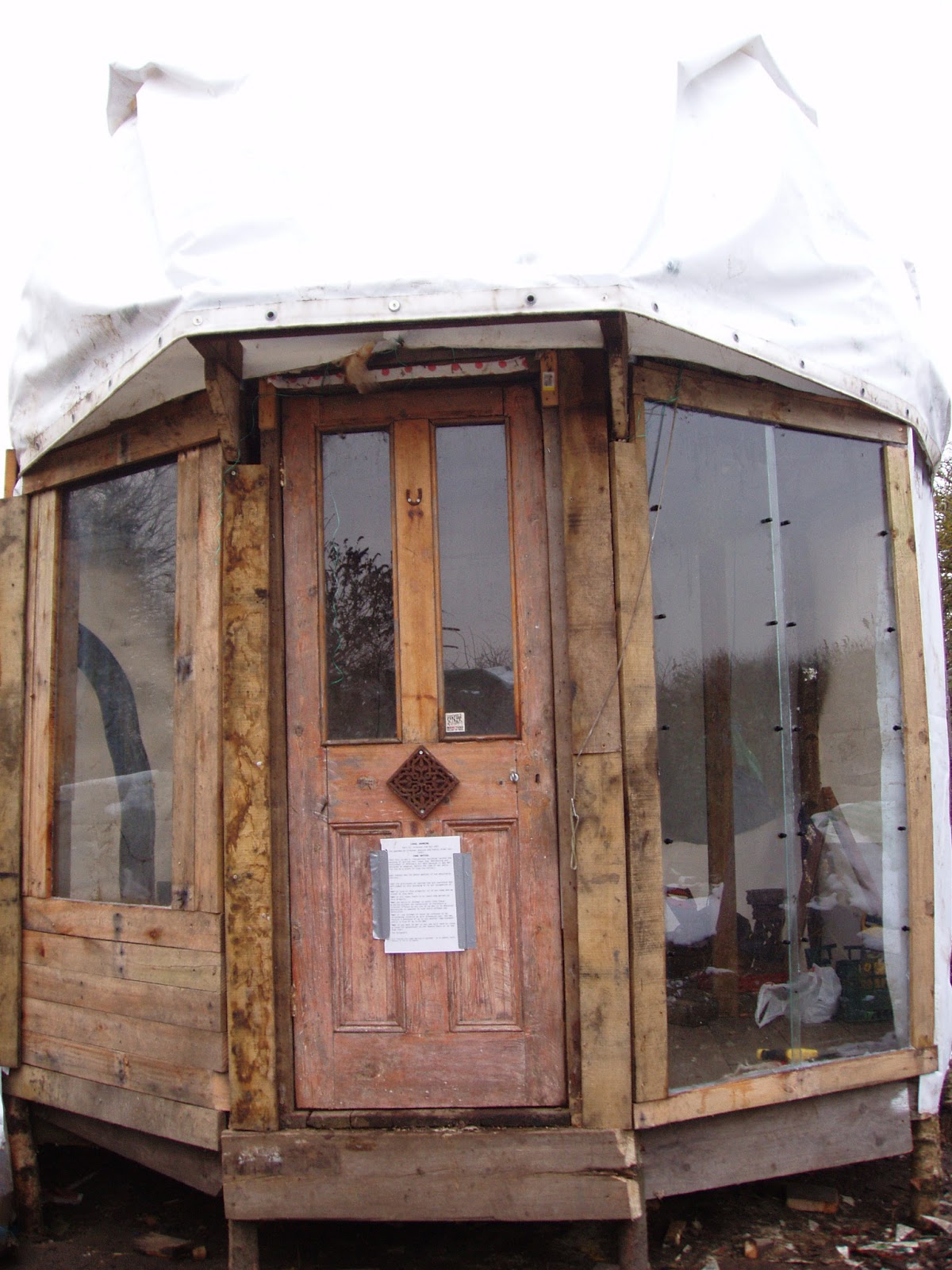
Images: honeysuckle and foxglove in Dunwich Wood, March; arts, culture and wellbeing walk en route to Falcon Meadow, April; in Lucy's caravan; message to Mark at the wild daffodil tumulus!

Monday, 15 April 2013

From the Mourning of the World to Happy Mondays

This year I'm co-curating one of the stages at the Uncivilisation Festival. All manner of poetry, prose and performance will take place on the Woodland Stage, as well as workshops in the woods (programme to appear soon!) When night falls and the fires are lit, the musicians will take over. Amongst them will be singer Marmaduke Dando, who this year has compiled an album of some of wild and uncivilised music associated with the Dark Mountain Project.

From the Mourning of the World features an alternate version of Caesar, recorded specially for the album by Chris Wood, as well as celebrated artists such as Jon Boden, Chris T-T and Bethia Beadman (whose track is a duet with REM’s Mike Mills). 

Like many creative grassroot projects, Dark Mountain funds its annual anthology by crowdsourcing - a kind of community-supported publishing. You order a book (or in this case an LP) by pre-ording a copy, and this in turn pays for the production. Following the trend and in the spirit of celebrating the beautiful and the physicial, From the Mourning of the World will be a 12” double-gatefold vinyl album, with a cover by the wonderful Rima Staines. Check out the crowdfunding page here:

I'm planning to give a workshop on Earth Dreaming at Unciv this year, and there will be more about this and other creative Transition projects during 2013, from Playing for Time to the new Arts, Culture and Wellbeing group. But right now I've got to proof the upcoming second issue of Transition Free Press and go make nettle pesto and beetroot risotto for our April Happy Mondays at the Community Kitchen. Stay tuned!

Tuesday, 19 March 2013

Wellbeing and the Community - a local perspective

Plants for Life Weeds Walk April 2012What makes up community well-being in a time of financial constraints and climate uncertainty? This was the question twenty five people turned up to explore at Sustainable Bungay's first Green Drinks of the new year at the Green Dragon in January. The evening also marked the start of our new Arts, Culture and Well-being sub-group.

Well-being has been the subject of several recent studies, such as the New Economics Forum's 'Five Ways to Well-being', as well as the focus for many Transition initiatives. We live in a culture based around a market economy, and money and material status (or the lack of it), have become the driving force of most people's lives.

But what real good has this done ourselves or the planet? Apart from living in a badly degraded environment, we are as a collective suffering from ill health, depression, loss of identity and lack of connection to nature and other people. And it doesn't seem to be getting any better.

For many people (including myself) this winter has felt particularly long, dark and cold, with uncharacteristic feelings of gloom and lowness. When I've spoken to people about it, many have said "Oh, it's not just me then." Then there are those colds and fevers which seem to take weeks to clear up. Something is clearly not okay.

What would it mean if our lives, instead of being determined by GDP, were based on our mutual well-being and happiness – not just our personal well-being, but within the communities and neighbourhoods we all share? What would it mean if instead of striving for our own comfort and security, we valued sharing our resources and knowledge? How would our attitudes to each other change, and what kind of changes in the environment would that bring?

Hot Beds & leafy Greens posterMuch of the work Sustainable Bungay has been doing over the last five years has this co-operative learning at its base - from creating the Community Garden at the Library to hosting Happy Monday meals at the Community Centre, to organising bicycle rides, sewing circles, Give and Take Days, Bungay Community Bees and the Pig Club. Several of us attended the recent East Anglian Living Together day about co-ops and intentional communities in East Bergholt, where we found we had over 30 practical skills between us - just in one workshop! As well as sharing these skills, we've learned that working together brings a certain kind of happiness you just can't pay for.

For example, you can go and forage for blackberries on the common on your own, but going out together, sharing a picnic and then taking some to the Abundance table or for a Happy Mondays pudding for others to enjoy, makes for a more open and shared experience. This simple activity has all those five ways in it: connection, action, learning, taking notice and giving. Most of all it involves the place we live in and includes the wild spaces we are surrounded by.

At our Green Drinks we have focused on the many ways we can reconnect, from learning about medicine plants to the restoration of the River Waveney. In January the ideas were flowing, as people paired up and asked each other what community well-being meant to them and what creative or practical skills they had they would like to pass on to others.

kORU FITNESS SESSION POSTERA common thread emerged: well-being meant belonging to a place and not feeling on your own. So plans for a wide range of communal activities were mapped out, from walking and exploring the local countryside, river swimming and canoeing, to sharing skills such as food growing, cooking and meditation. Creative workshops were designed, including storytelling, theatre work and body percussion. What also became clear was that well-being is a major factor underlying and motivating Sustainable Bungay's activities.

Giving ourselves more time and space to connect with people and the neighbourhood was something people thought was vital and in April we'll begin creating a well-being map of Bungay with a walk around town paying particular attention to what the various public spaces in town feel like to be in.

Sustainable Bungay is a busy group. We have always been primarily events-focused and that seems set to continue. But a closer look shows that these events  also often provide the space for people to come together for discussions that might not happen ordinarily.

For our seventh Give and Take Day last Saturday (16th March), Charlotte set up and facilitated a conversation on the Gift Economy – sharing what we have with others in times of austerity. Over twenty people joined in.  Nick spoke about some of the ideas in Charles Eisenstein's Sacred Economics and Jeppe and Vanessa talked about their involvement in setting up the Common Room in Norwich. This project makes unused or underused public spaces (in this case an old church) available as a 'living room for the community', where people can swap and share skills, knowledge and company with no money exchange involved.

Gift Economy discussion at Give and Take DayWhat was striking about this discussion on a cold, dark, Saturday midday in March in Bungay's (slightly dilapidated) Community Centre, surrounded by the Give and Take tables of household goods, clothes and books, and accompanied by a bowl of Josiah's homemade fava bean and winter root veg soup and Christine's freshly baked bread, was that when time was called after 50 minutes, no one was in any hurry to leave. People were still discussing everything from how to receive a gift and should that leave you feeling obliged to give something back in some way, to how to begin to value ourselves and other people, places, skills and the living planet in a way that is not market-driven or utilitarian.

Usually when we think of well-being, it's in terms of personal comfort, and often has medical associations. But what if well-being were really not just a personal matter? What if it also depends on our getting out of our personal enclosures and insistence on everything belonging to some private personal sphere? And into that 'living room for the community' where a conversation can happen about sharing what we have, and we can start to forge different relationships with each other, the places we live in and the planet that gives us life.

"I've never experienced such a discussion before," said one visitor. "I could have stayed much longer."

Images: Plants for Life 2012 weed walk, Bungay; Hot Beds and Leafy Greens poster, March 2013; Koru body percussion poster, March 2013; Gift Economy conversation at SB's 7th Give and Take Day, March 2013

First published on on the Social Reporting project 18th March 2013.

Monday, 28 January 2013

Snow report

Suffolk, Reydon. It came like a fox at night, stealthily, and left noisily in a rainstorm at full moon. Today I woke up and missed the soft quiet white blanket that has covered the land for the last two weeks. Life at sub-zero is a tough one in a low carbon household (5 degrees in our living room most days) and down a narrow ice-rink lane, especially when you have to travel all over the country for meetings and get a new newspaper out. But there is something very intense and creative about this weather that brings you closer to people and life. It's been full on during this time here at the depot, so there is just time for a few snapshots this week (normal service will be resumed shortly).

Hampshire, Petersfield Here I am sitting with the organising crew of this year's Dark Mountain festival, Uncivilisation 2013, We're huddled round a roaring wood fire in the Woodland Stage, which I am co-curating with the poet Susan Richardson in August. Fuelled by generous nips of island malt (Jura and Orkney) and travelling dishes (Galaway stew, Northern wild rabbit and East Anglia beans), we're cross referencing the speakers and writers, activists and workshop leaders, who will appear on the three stages amongst the beech woods. In spite of snow drifts and ice, we've converged from the four corners of Britain: from Wales, Scotland, Newcastle, Cumbria, Doncaster and London. It's seems crazy that we didn't stay home and talk on the internet. But you can't reccy a site, or work together virtually: it has to be real. Like the food and the fire.

Coming back to Suffolk, Mark picked me up at the station in a blizzard and we crawled home along the A12 in a white and whirling world. Scary, exciting, primal, unexpected . . . very uncivilised. Just how the stage should be, I thought.

Berkshire, Reading I'm travelling on the train with Lucy through the unknown birch woods and frozen ponds of Berkshire. We're on our way to Reading Museum, one of the Happy Museums you will be reading about in the upcoming Transition Free Press out this Friday.


We're off to meet Gilly Adams, one of the tutors for our 'write in' at the Arvon Foundation's creative writing centre at Lumb Bank in March. Lucy has organised for the central contributors to her book, Playing for Time to meet here and we are deciding on the the convergence's key elements. It's an adventurous task for all of us (I'm helping edit the book) as twelve artists will be sharing their community practices from all fields in the arts - from crafts to festivals to food growing projects. We're aiming to share our voices, stories and our methods and capture them on the page by the end of week.

Middlesex, Grow Heathrow Later that day in the kitchen at Grow Heathrow I'm drinking one of the best cups of tea I have had in a long time. It's a wild midsummer yarrow tea, collected by their foraging Fridays group. Rose (who also helped found Transition Tufnell Park) is showing us around the main buildings and workshops, gardens and individual houses. I visited the co-op before on a balmy September afternoon, and it's even more striking in winter how many ingenious ways the collective have found to build all the conveniences you need and power them entirely off-grid: a wood-fired shower, a straw bale, a hot tub, a kiln, compost toilets.

This is my favourite house with its geodesic dome built around a spinney of elder trees. Grow Heathrow are at present waiting for the verdict on their recent court case in London and we're all keeping our fingers crossed this extraordinary work of restoration and urban living won't end in their eviction.  

Suffolk, East Bergholt Back in Suffolk we're off to Bungay to edit this quarter's Sustainable Bungay newsletter ready to be distributed alongside the national paper with its suitable icy front cover. The roads are clear but it's still well below freezing and all the apple orchards and hedgerows in the Waveney Valley are covered in sparkling hoar frost. Very happy that Josiah is serving up some of his famous British bean and parsnip soup before we get down to the design board in his equally unheated house.

The next day, in spite of the threat of more snow, it's suddenly a beautiful morning and we are headed back down the A12 to meet up with 40 plus Transitioners and co-operative house dwellers from Cambridge, London and Ipswich. It's the Living Together gathering organised by the wonderful Gemma Sayers (Random Camel co-op) and Jon Halls (Lodge Farm). I'm giving a workshop on how to run new groups along creative lines called the Ideal Home Exhbition. I've never lived in a housing co-op, but I have worked cooperatively on many projects and have learned things the hard way. One of these is that selecting roles that you love and stick to are key: somehow that enables everyone else to share the best of themselves - their gifts. When we held a plenary and our four "editors" (Well-being, Practical Skills. Stuff and Resources, Social Pressure) fed back everything 25 of us had written on large sheets of paper, we found we had over 30 practical skills amongst us. That's how you know that when push comes to shove, we'll be just fine, even when it snows for days on end.

Just so long as We (and the enterprise) doesn't get stuck in Me.

View outside my window, Suffolk; woodland stage, Sustainability Centre: allotments outside Reading; Oscar's house and kale, Grow Heathrow; workshop on consensus-decision making (or how not to get stuck in Me) at Old Hall, East Bergholt; our lane.

Thursday, 17 January 2013

Slow train to Hebden Bridge

This month is all about time. I have been running up against a major deadline with the new edition of the Transition Free Press and haven't had a minute spare to write any posts yet in 2013, Ironic then that this week's report should be an introduction to Playing for Time - a collaborative handbook about Transition and the Arts, authored by Lucy Neal. Last year we set off to Hebden Bridge in Yorkshire to visit the house where the main part of the book will be created.

Heading North
The North is different my mother would say. People are more friendly and direct. She was from Yorkshire and would fiercely defend the wild moors and noble market towns of her youth. Heathen Southerners, as we were, we sided with our father (from the Sussex Downs), as they fought an ancient battle over the dinner table.  She was outnumbered.

Sometimes, however, roots go deeper than history.


And the North is different. You feel it coming out of Peterborough. some kind of barrier slipping away between people, some rugged shift in the texture of place, stone and brick. The influence of an industrial past. We only went for a day, but it struck me each time I changed trains or breathed in the air. I hardly travel outside East Anglia, so perhaps I have become more finely-tuned to the shifts and changes in landscape and atmosphere. Paying attention and celebrating diversity of places and people lies at the heart of this new work we are embarking on in 2013. It has been a project that Lucy has been focusing on for many years, a culmination of a lifetime collaborating with artists and performers (running the theatre festival, LIFT) and her pioneer work with Transition Town Tooting.

The book will document the practices of creators and makers and directors who are working with communities within the context of Transition. It encompasses many disciplines - from theatre to writing to crafts, and also those that may not traditionally be considered "art", such as community food-growing or street festivals and pop-up shops. In fact the book questions deeply what the use and function of art is in times of planetary shift and social change. Is creativity there to further entrench a hierarchical, business-as-usual culture, to uphold an Empire which sees Art in terms of commodity or entertainment? Or do artists serve a primary function, as agents of change and cohesion within the collective, moving us from one kind of world to the next? A reminder of all that is possible, and how we can activate the power of our imaginations and deep memory, not only to face the challenges ahead, but to create a future we actually want to live in?

Co-operation
We met at Leeds and took a little train down the Calder Valley. I am exhilarated by the sight of hills with their moorland tops and the rushing rivers (O so flat and slow in Suffolk!) and we alight in Todmorden to meet Estelle and Mary, two of the movers and shakers behind the Incredible Edible project. This food-growing "campaign" began here in Todmorden in 2005 at the same time as Transition, and shares many of its principles. Like Transition it has spread to countries all over the world, and there are Incredible Edible towns from Lambeth to Brazil.

The group began by "propaganda" aka guerrilla gardening, where pieces of unloved land around the town were planted up with fruit and vegetables for everyone to pick for free. The project has expanded to include school gardens, local food markets, chicken clubs, bee parades, community orchards and growing spaces in public places throughout the town, and even along this railway line.

"When Tim the ticket collector died we planted his favourite veg as a memorial," explained Estelle (he didn't want flowers). "You've heard of the Bluebell Line, well we have the Broccoli Line." Would we still be here on Saturday when there was a Festival of Lights, they asked, where three towns have a great parade of lanterns and huge puppets, and there is a bike ride all along the valley at night?

We wished we were, but already we are back on the road to Heptonstall, above Hebden Bridge, to find our tiny stone cottage, and meet Mark Simmonds of Co-operatives UK. Over a powerful pint of local cider, we discuss the extraordinary amount of community projects that are happening in the area, from workshops in Sheffield to the renovation of some of the "Tops" above the village, to manage the land for wood fuel and berry picking.


Co-operative societies have always flourished in the North, and so it feels right that we begin this co-operative project here among these wild hills and close valley communities. And right too, for writing - for this is the place where the poets Ted Hughes and Sylvia Plath once lived and, beyond the ridge, where the Brontes wrote their novels. If set and setting are the prerequisites for all good creative ventures, we are in the perfect place. The next morning we set off on the windiest day of the year to walk to the poets' former house at Lumb Bank. We head up the road, I anticipate a coach and four coming round the brow of the hill, to leave a young women in bonnet and cloak to face her emergent destiny. But she does not come.

We are living in a different time. To discover the enduring images of our time is the task ahead. 

Lumb Bank


This is the table where the main material will be forged. It's the dining room of Lumb Bank, home to a former mill owner, and briefly to Ted Hughes (who was from Heptonstall) and Sylvia Plath (now buried in the churchyard). The house now belongs to the Arvon Foundation, who run writing courses throughout the year. The foundation is an integral part of this project and something of a new venture for them as well, as most of their courses focus on individual creative writing of plays, poetry and prose. In early March 12 of us will sit around this table and, guided by two tutors, start exploring and putting together a collective vision for the future of the arts. For the past two months Lucy and I have been holding conversations with many of the people on the project (mostly via Skype). Some will come up here and we'll pull together ways of presenting their work.

The book is in three parts. The first part frames the book and will include essential "big picture" introductions, from Paul Allen of CAT on the history of energy, to Rob Hopkins on Transition. The second main section is a showcase of the different arts practices and people involved, and the third a methodology or roadmap of their practices, so that people in initiatives and communities everywhere can be inspired to do similar work. In the way, for example, that Anne-Marie Culhane of Grow Sheffield, inspired many of us to run Abundance projects, sharing unwanted fruit from our neighbourhood trees and gardens. Everyone taking part in Playing for Time is a story in their own right and it is my intention this year to write these stories, and give my own take of the process it will take to create a work-in-community, that is the traditional preserve of individuals.

Return
Meanwhile after discussion with the Foundation organisers and an exploration of the house with its barn and gardens and wonderful airy rooms overlooking the valley, we headed back to our separate destinations: Lucy travelling to meet one of her daughters in Sheffield, my four-train journey south and east of the country, with the timetable Mark made for all the arrivals and departures in my hand.

Right now at 10am I am about to talk with Lucy and our next practitioner and producer, Ruth Nutter, and then it's back to the paper. "I think twenty to eleven is a good time," said Lucy, as she sent me the top picture of the clock at Lumb Bank. "So long as it's not High Noon," I said. "Or as my friend and fierce doorkeeper, Karen Binns used to say: Two minutes to 12 people - time to wake up."

Clock at Lumb Bank; outside Hebden Bridge station; view from Lumb Bank; Charlotte on the road outside Heptonstall; working table; Lucy in Heptonstall high street.  Photos by Lucy Neal and CDC.

Tuesday, 27 November 2012

Playing for Time

Last month I embarked on a collaborative arts project called Playing for Time. It’s the vision of Lucy Neal of Transition Town Tooting and has been recently awarded an Arts Council grant. My role in the work is to help shape and distil a vast store of community arts practices into a book, and during the next year I will be writing regular posts on this blog to report on our experiences. 

The book will be written by a group of practitioners, several of whom are in Transition initiatives and so resonate with Norwich’s own past and present creative enterprises, including Abundance, Magdalen Street Celebration and of course This Low Carbon Life!

Here Lucy Neal, creator and producer of Playing for Time introduces the theme: 

Does art have a purpose? Can it change our sense of what is possible in the world? Artist and cultivator, Eva Bakkeslett thinks so. She works with yoghurt, yeast and fungi and is fascinated by micro-organisms. She tapes the sound of bread rising and tells stories of emigrating Finns who carried their ‘culture’ to a new country by dipping their handkerchiefs in yoghurt to re-activate on arrival.

Eva’s house is full of jars, some with cultures over a 100 years old. She loves everything to do with fermentation and the remarkable resilience of micro-organisms. She makes a soft ‘click-clocking’ noise in her mouth. ‘That’s the sound of bread rising’ she says. 

Eva is on to something: her art explores ‘the subtle and invisible wonders of life’ and re-energises people's engagement. An encounter with her work brings an awareness of the earth and environmental change to the fore.

This year I was a writer-artist in residence at the Battersea Arts Centre (BAC) and have been gathering up ideas about ‘transitional arts practices’ like Eva’s for a book called Playing For Time. It’s a handbook that will join the dots between the philosophies of art and the creative skills that are emerging in response to the planetary challenges we face.

The book considers the role the arts play in re-imagining a world in which life on earth and its ‘cultures’ are sustained. These range from traditional ‘arts’ projects to transition approaches to foodgrowing, visioning processes, eco builds, education, inner transition events, group facilitation or local development plans.

What stories are we living by? 
Much of ‘transitional arts practice’ could be said to come down to narrative: the ‘live storymaking’ of the experiences we are living through at this moment in our planetary history. Working with the playwright Sarah Woods from Transition Bro-ddyfi, Wales we found four different kinds of narrative emerged:

PERSONAL NARRATIVE:  How we experience who and how we are. Our inner life of spirit and emotions balanced with outward actions and how we connect to the world. 

COMMUNAL NARRATIVE: The shared narrative - co-created, collaborative and co-operative. The focus of Transition Towns and a natural one for the arts, building bridges, empathy and understanding, creating space where inspiration and change can be explored. 

GRAND NARRATIVE: A galvanising idea that in combination, globally our actions, plans, imaginings, projects and campaigns can create the shift to a more ecological age. Impossible to undertake alone, it’s the narrative of ‘Occupy’, ‘We are the 99%’, ‘The Great Turning’.

SUPER NARRATIVE:  A narrative of all time and all dimensions of life on earth. The shift from the Holocene to the Anthropocene Age, means our planet may no longer provide a comfortable place for us to live. It is a narrative of home and wonder and of fear and loss.

Playing for Time is seeking to hear about activities that engage with these narratives and  help everyone imagine a different future. From foodgrowing, to walking, rites of passage, plays, craft, public art, community celebration, engaged optimism, direct activism, sharing food, land use, play, psychogeography and map making, reports about any of these events or projects that have fostered shifts of perspective would be very welcome.

Maybe its something like Transition Heathrow’s “Kaleidoscope” artist residency in June that mixed activism and permaculture, or Tooting’s “Transition Shop with Encounters Arts” in May, a place of exchange, that helps reclaim our high streets.

In the future we could see a return to more rooted, cyclical patterns in our art and culture. Our descendants may be dipping their handkerchiefs in yoghurt to preserve precious resilient ‘cultures. What other tales of creative acts and art-making might there be? With your participation and input, Playing For Time hopes to draw these in! Thankyou!

Lucy Neal was the founder co-chair of Transition Town Tooting  and the co-founding Director of the London International Festival of Theatre (1981-2005).  Playing for Time is supported by Transition Network, the Battersea Arts Centre, Artsadmin, New Economcs Forum and CAT. Contact: lucy@lucyneal.co.uk. 

Article originally written for the preview edition of Transition Free Press

Sunday, 4 November 2012

Transition Video Games: Anno 2070

Ever since the Transition Conference, I've been meaning to write a post about it on the Transition Norwich Blog.  Well here's one, and perhaps there will be more later!

During open space on the Saturday afternoon of the Transition Network Conference, I was a bit of a butterfly and attended several sessions which caught my interest, without settling down for too long at each.  One such session, which I was probably at for no more than 5 minutes, was Transition Games. I wanted to let the people there know about Jane McGonigal, whose TEDTalk asserts that "Gaming can make a better world" (I highly recommend watching!), but I was also interested in what they said on the subject and whether there were any computer games that they thought relevant to Transition.

I'm not much of a gamer myself, but ever since high school, I've been great friends with a guy whose hobby is computer games.  He collects classic and rare computer games and consoles, raves about the latest technology and innovations, and, of course, plays them.  Through him, I get to see pretty much all the variety of video games that exist, and play games from time to time.  I've always been disappointed at quite how many of the computer games include violence.  Many of them are centred around war, or at least defeating your enemies in one way or another.  As a pacifist, I've constantly been on the look-out for games that turn this around, and make diplomacy the enduring quality of the best player.

So, when at the conference someone mentioned a game called Anno 2070, I was interested to hear how it was different, and what it could teach of Transition principles.  It was a game about resources, apparently, set in 2070, when sea levels have risen as a result of global warming, and several factions are competing to make the best use of the remaining resources. One of those factions is decidedly environmental in its focus, harbouring energy from wind, improving the quality of soil and replanting forests. I was intrigued, and decided that I would see this game for myself. So I bought it, and took a look.

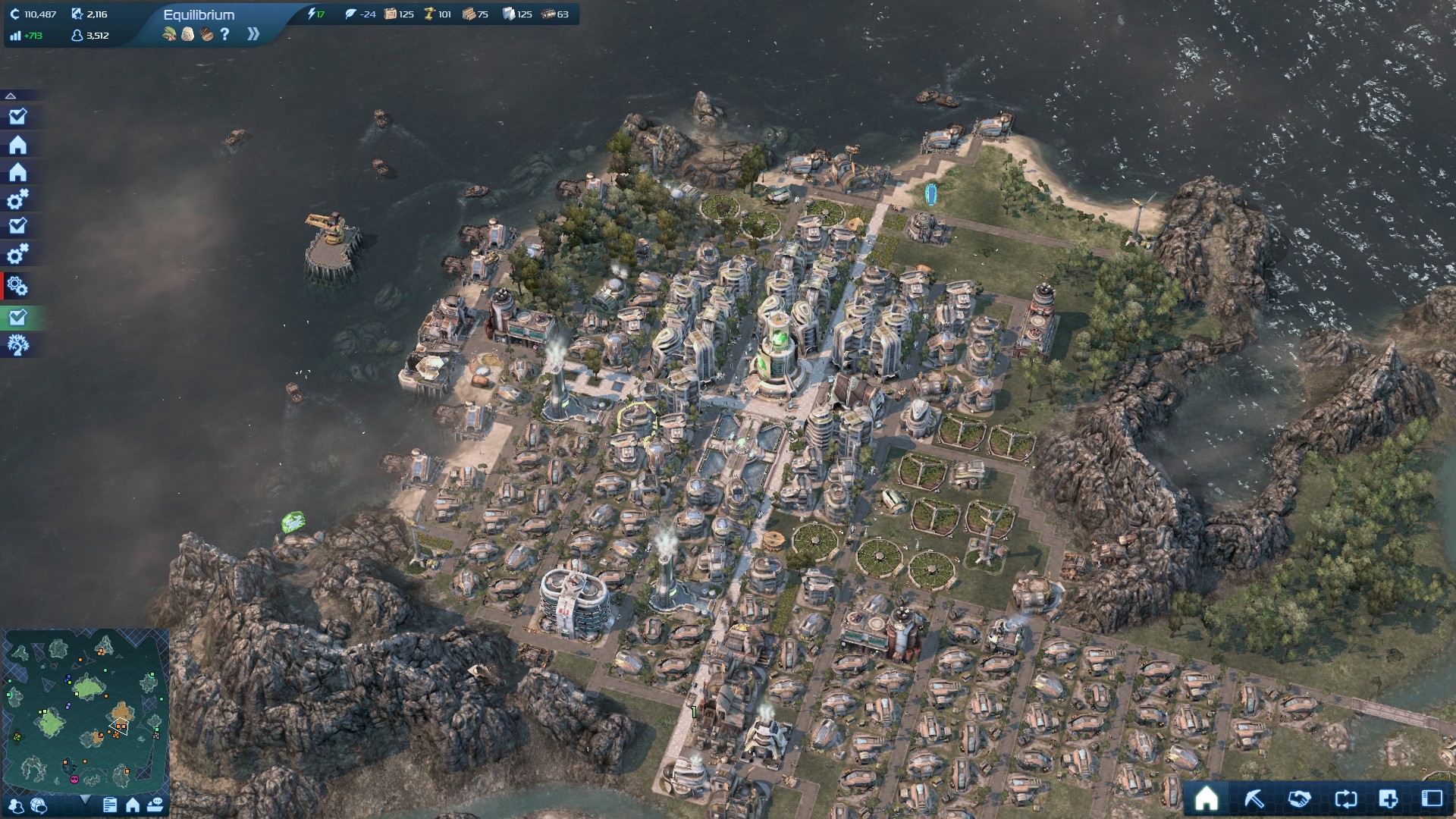
Anno 2070 Screenshot

The game is indeed about resources.  Each "mission" requires you to settle an island (its always an island because of the raised sea levels of the future), create a city, and then use the island's natural resources to complete an objective.  In one mission, the objective is to research the technology to save an existing city from the effects of poisoned fish, but they vary greatly.  The missions require you to mine resources, build factories, trade with other factions and (in a just a few cases) battle against factions with conflicting interests.

I was disappointed.  On several counts.

Firstly, there are two basic factions, one representing corporations that is only out for profit, and another representing environmental groups.  Apart from this not being a realistic model of a potential future political scenario, the differences are minimal, simplistic, and arbitrary.  The eco organisation still mines coal and ores, both consume huge tracts of virgin land in the building of their cities, and hydro-electric power (one of the best forms of renewable energy) is only available to the profit-motivated corporation.

Secondly, there is no real concern about the balance of resources, of the production and disposal of waste, or the effects that this has on the environment (except, again, in a rather arbitrary way).  The amount of resources on each island is plentiful, and therefore efficiency in the use of resources is not generally a concern, as long as you can process them fast enough and offset with "ecobalancing" technologies when required. It's not a game designed with education about eco-issues in mind at all, but it jumps on the bandwagon of being a game about climate change to get a few extra sales (from people like me... whoops).

Thirdly, there did end up being war in it, and although it's not the focus of the game in any way, nor is there any advantage to trying to avoid war.  In fact, it is sometimes part of the mission that you must attack some enemy facility to prevent them from causing damage to the environment.  Well, what about the damage to the environment caused by your military? That's what I want to know.

So, if you want to teach your kids about natural resources using a computer game, don't buy them Anno 2070.  Buy them Minecraft.

Minecraft Screenshot

Minecraft is an indie game (this means its produced by a small, independent software house, rather than the huge game publishing houses), where you wander around a virtual world made of one metre square blocks, moving them about and using the resources you find to build things.  Although there is an end objective (that of defeating the Ender Dragon), it's much more fun, in my opinion, to just create a virtual town with friends (it is a multiplayer game) and show off your creative talents (see the above town that my friends and I made!).

How does it teach about resources? Well, the name comes from the fact that you have to dig out materials and can then use them to craft things.  If you find iron, for example, you can smelt it, using coal or charcoal, and use it to make an axe. You can then use the axe to cut down a tree, which can then be crafted into timber to build your house, and so on.  The thing is that all these resources are limited. When you've spent ten minutes digging underground to find a seam of coal, you don't want to waste it by crafting something that you're not going to use.  And once you've mined all the resources from a particular area, they're gone for good, and you must go further and further afield to find the resources you require. Wood, on the other hand, is renewable, and as long as you remember to plant saplings to regrow trees that you chop down, you can have a continuous supply of timber, and therefore charcoal.  Resources have a real value to the player, because of their rarity, or the time and effort that it requires to get them.

OK, it's not perfect as a Transition game.  It wasn't designed as one, and it does still include enemies (monsters that appear at night), but at least you can choose your focus, and appreciate the challenges for what they are, rather than because they are imposed on you as "missions".

Still, an actual Transition game as an educational (and entertainment!) tool would be quite cool.  One that taught the challenges of resource allocation, the politics of change, the rewards of doing things differently.  Does anyone know of any existing games that fit the bill? If not, who's up for making one?!

Images: Open Space at the Transition Conference by Mike Grenville. Screenshots from Anno 2070 and Minecraft respectively.

Tuesday, 18 September 2012

Synchronised (or was that Synchronicitous) Sweeping at the Transition Conference 2012

The Transition Network UK Conference 2012 took place this weekend at the Battersea Arts Centre in London. Three Low Carbon Life bloggers were there and will be reflecting on the event during the next week. First here is a sweeping statement by Mark:

It is 9pm. I am typing this on fellow social reporter Jo Homan's (Transition Finsbury Park) laptop at her flat, where we have been staying for this Transition Conference weekend. Charlotte is preparing some pasta and Jo is about to return from forest gardening in Devon.

Ann (Transition Bro Dyfi) and Kerry (Transient Transitioners) have also been staying here, as well as Josiah (Sustainable Bungay) on Friday night, but they've gone home now and it is almost strangely quiet with just the two of us after such an intense, full-on, extraordinary weekend of meetings, conversations, laughter, cabaret, singing, dancing, collaborative compost toilet poems, Well-being walks in Tooting, the Transition Free Press launch, creating a Transition Town Anywhere and synchronicitously synchronised sweeping!

This is the first time I've been able to sit down and type anything, it comes just after the Conference has finished and I'll need a bit of time to decompress and let it all fall into place. So I'm really glad I put myself down to write a blogpost called Transition Network Conference - The Week After, coming next Saturday.

Jo's just walked through the door, so time to say hi and have a bite to eat, but I will just say that this was the first conference I'd been to since I entered Transition over four years ago. And it was amazing. More to follow. Mark Watson

Synchronised Sweeping, Dancing and Twirling in a Synchronicitous Way at the Transition Network Conference 2012 (by Charlotte Du Cann)

Monday, 27 August 2012

postcard from the woods - uncivilisation festival 2012

For we are all,
We are all,
We are all the children of,
We are all the sons of,
A brilliantly coloured flower,
A flaming flower.
And there is no one,
There is no one,
Who regrets what we are.

(Huichol Peyote Song from Pharmako Gnosis by Dale Pendell, 2005)

How can we become people who regret nothing and whom no one regrets? How can we find the new narrative about ourselves and the earth that Charles Eisenstein calls "the new story of self and the new story of the people"? Was it always there and we have forgotten it, or is it here now inside us, waiting to be cracked open like an acorn, to rise and take root?

I am at the Uncivilisation Festival in the Hampshire woods on the downs of England, giving a writing workshop based on my book, 52 Flowers That Shook My World. I am standing in at the last minute for a poet who couldn't make it, and as I walked through the dark wood last night, the warm wind shifting through the trees, I thought: what are the medicines the plants have taught me that I can now give?

One thing peyote showed us: we are not what we thought we were. We are more. We are not defined by class, or family or work, we are creatures of the sun and wind and the mythos of many lands, and no tranformation of the world, no transition, can truly take place until we become different kinds of people. And how do we do that surrounded as we are by the city world, its buildings, its harsh statistical language, its abstractions and globalised mindset?

You have to change the territory in which you move and speak, in which you come to different conclusions. You have to go into the woods and encounter the wild. The wild is not an escape from reality, it is a liberation into reality, out of the illusion of civilisation. For we are more than we think we are. We are kin with all creatures, all clouds, all rivers. We move and breathe and create part of the world's dreaming, the verbs and adjectives of its language.

This is one of the precedents for the Dark Mountain Project and for this festival, which over an intense August weekend gives 300 people a glimpse of what the future might feel like once we shed our conditioning, and start to tell our stories around the fire. Once we loosen the shackles of our identity and let the trees in.

There are several words for human being I said, in other cultures. The Okanagen word is land dreaming capacity. It is our function, if you like, to name the world, to make stories, weave fabrics, to dance and to sing. It is how the earth sees itself in our reflection. Another is winklil which is a Mayan word for vibrating root. The human being comes into the fabric of the earth with a certain sound or frequency, which resonates and harmonises with other beings. When rooted, it is our music that keeps the world in harmony.

You only have to think of the kinds of sounds cities make, or politicians or motorways to know the world's discordance. Out of time, out of place. It is our work as writers, I suggested, to name the physical and imaginative world beautifully, to root ourselves and get us all back in tune.

Breaking the acorn

The first writing exercise is to find the seed within and the right conditions in which to germinate.

I am holding my hands open and in my right, I hold practical seeds from my Transition garden: chickpeas, broad beans, sunflower seeds; in my left, two dreaming seeds, both from the desert in Arizona, a bearberry and a scarlet coral bean. The first is a traditional medicine for the kidneys, the second a tool for divination. Everything in our culture suppresses the germination of these seeds. Everything at Uncivilisation encourages it - practical worshops on scything, imaginative storyteling about Siberian shamans and the loss of the Caspian tiger. If you are a plant, I said, what kind of plant would that be? In which territory do you flourish?

At the Festival everyone is camping in the meadow. We meet around fires, listen to poetry and music in this woodland theatre, we debate in tipis and yurts, walk through tree and leaf galleries and performances under the starry skies. Last year when I stumbled upon Uncivilisation I felt I had come home. Lover of Transition as I am, there are parts it does not reach, where Dark Mountain speaks directly - language and creativity, mythos and earth. I realise that my roots lie deep within its territory, and that though I am happy working in the community kitchens and workaday comms and events of Transition, here I can be myself: here I can tell the medicine stories I learned and be heard in a certain attention.

Attention is what I am looking for this year - not the attention for the performer ego, but the set and setting in which to receive and transmit vital communications between ourselves as a network. Last year the festival had a very different feel, and I was a different person. It was just after the London riots and there were many talks about collapse and a lot of urgent political and intellectual debate. This year everything is acoustic and seemingly more mellow, more art and psychology than economic discussion. I am familiar now with the language of Dark Mountain (partly because I distribute the three books and help out with publicity). So I walk from event to event in search of the story. Not the journalism story which I wrote last year, or even the one I just wrote about Dark Mountain for the activist magazine STIR, but a story of a breaking kind. Like medicine, you don't know what you are looking for; you just know when you happen across it.

"What is the dreaming of Uncivilisation?" I asked everyone at the workshop. You can look at a dream - a night dream or an event or a relationship - on five levels. 1. the everyday level: what is happening over 48 hours 2. on the life level: in terms of your biography, what does your presence here signify in terms of your life? 3. As part of the human collective - what does this festival mean in terms of society? 4. on the mythical level - how does Uncivilisation affect the mythos of the world? 5. on the earth level: as the earth speaking to us. What are these woods telling us, the trees and the hills?

I am looking for the story. Standing with Kevin from our Dark Mountain Norwich group, stewarding the gate, I find a bank of eyebright flowers. This tiny eye-medicine flower is hard to find on the clay and sand soils of East Anglia, and we are on chalk here. Kevin tells me he found gravediggers hacking the chalk yesterday eight foot deep with pickaxes. And it's true: if you go down through the yurts and flowery enclosures you find yourself deep among the yews of the South Downland burial site.

It's easy to arrive at festivals and lose yourself in cameraderie and entertainment, and although this is no way a commercial event the desire to kick-back and have a good time is strong. Who doesn't like to drink cider and laugh and meet strangers who feel like kin? But this lightness does not crack the kernel.

I'm looking for something deeper, a more sober, urgent narrative that resonates with this land. Something more collective that allows death and loss to the party. I have been in Transition for four years now and know that we have to move together, out of individualism, beyond Me and my eternal sorrow and anger. I feel it sometimes: as we move around the fire in a Brythonic dance to the sound of bagpipe and violin, and the creatures of Mearcstapa move out of the darkness in the shapes of raven and wolf, stag and hare. I hear it in the discussion I have with Dougie (who curates the Big Tent stage) as we talk about the Deep Green Resistance, and with Robert who is reading Tennyson's Ulysses out loud in the wood. I stumble into it as I move from a wilderness initiation workshop and find myself amongst the mourners of the burial site and see a glimpse of the bright downland grass. And then I find it, right at the end of the festival, at a reading among the beech trees.

She was our sister, our mother, our lover.

Jim Hindle is reading from his book Nine Miles, a searing and beautifiully-wrought story about the road protesters in the 1990s. A celebration of the protests 20th anniversary is one of the themes of this year's festival and many of the people who have spoken of their experiences are sitting in this circle, the writer Jay Griffiths, the musician Andy Letcher, and the photographer, Adrian Arbib. All around us Tom Hirons, who has organised this talk, has hung slates in commemoration of all the camps that were held to defend the trees and the land from being destroyed in the name of growth and progress. Many of them near the Sustainablity Centre where we are now.

Hindle is quiet and intense as he reads his testimony of those tough and magical winters spent amongst the canopy of ancient oaks. He was a teenager then, and badly broken by the experience, yet the passion for the land is palpably there. It burns, and you can feel it. And I realised then that this was the spirit I was looking for. It was a mood, a warrior mood, that comes once the kernel has been cracked open inside. We are older now. We have lost, our lives have collapsed. Our hearts have been broken open, and now some of us realise they were meant to be, because a broken heart that can remember and reassemble itself burns more fiercely and more powerfully than any other - as every shaman story tells us. What these initiation tales do not tell us, as a future people, is that we do this work of return together. That's our own indigenous medicine story. Now I knew why I had ended my workshop with a passage from Tree Dialogues chapter. Once in these lands we decided everything under the trees. Everything to do with right government. It was not personal, but a matter for the collective.

"Would you do it again?" somebody asked the activist and writer.

"Yes," he said.

"Yes," we all said.


I was remembering the hilltop in Oxfordshire, I was remembering the oakwood of Shotover. I was remembering the people. People I had known who had stood by trees, and people I have never known who had stood by trees. We were all there, waiting, it seemed, for an aeon by the tree in Staverton Thicks.

We are holding out, the oaks said finally.

My heart jumped.

“I am with you,” I said. “I am always holding out.”

I am holding out that our hearts will return. I am holding out that the people of this green land will throw off our dark oppression. I am holding out that even though Mark and I are alone in this oak wood, we will all one day emerge from the underground and meet together. I am holding out that even though we are hidden and often alone, we know in our hearts, in our thousands, we are together. No matter what house we come from, what work we do, where we dwell in the kingdom, we are already united: the men that walk the mountains, the men who swim the wild rivers and seas, the men who sleep in the branches of the trees and burrow among the roots to stop the machines from killing the wildwood; the lion-hearted who speak out loud, who call to account, who bear witness, the oak-seers, the acorn-bearers; the ordinary men of England and merry maids of England, who bring their lightness and beauty and laughter, who stand by the men, who walk beside them, who see them and keep the fire. I am holding out for us all standing here together, as the oaks hold the sky in their branches and their roots hold the earth. We are holding out. We are holding the land sovereign. And with one heart we say:

This planet does not belong to you.

Photographs: woodland walk by Adrian Arbib from Solsbury Hill (forward by Paul Kingsnorth and George Monbiot); Robert reading poetry in the woods; woodland stage at Dark Mountain 3 writers' reading; slate road protest commemoration by Tom Hirons: Pete, Wendy and Paul with their 52 Flowers about to board the bus; Jim Hindle discusses Nine Miles; art installation (CDC); Farewell and Imagine Wolf by kind permission of Bridget McKenzie from This Learning Planet.

Quotations from 52 Flowers That Shook My World - A Radical Return to Earth (Two Ravens Press)

Thursday, 26 July 2012

still dumb as stones about whole universes inside

I wrote this post for the Transition Social Reporting project's book review week on the 12th July 2012. You can see the original here. (MW)

I don’t do holidays or holiday reading, although I might feel the need to this year, as our living room is gradually turning into a book and media distribution centre.

Over the next month or so all three Dark Mountain Project books (numbering over a thousand) will be delivered here where they will sit (be stacked) in boxes alongside Charlotte’s recently published 52 Flowers That Shook My World (Two Ravens Press, official launch date 1st August) and the Transition Free Press preview edition.

Hopefully all these publications will enjoy a happy, but temporary, stay here. Not just because I’m fond of our minimal living room, but I’d like to see them all distributed to more permanent homes and know that they are all being read for the great books they are. Meanwhile I’m happy for them to act as makeshift insulation in our low (and sometimes no)-heating house, even though for that they might have been more effective in the winter.

So for this summer’s transition reading I’m recommending two books and a poem. And I’d like to start with the poem. First a little context:

I’m sitting on a cushion on the ground in the Old City Park of Bisbee, Arizona. The year is either 2000 or 2001, I don’t remember exactly which but early in the millennium. It’s a hot desert evening in early summer and I’m here for a poetry reading. Bisbee was known for its poetry festivals during the 1980s and many writers and artists still lived in and visited this old mining town near the Mexican border. Tonight’s event was a mix of local and visiting poets and a large crowd of fellow cushion-sitters, turning the bare park with its concrete floor and stage into a resonant, magical place.

At the time I don’t think I appreciated just how invaluable such public spaces are. It’s the past few years in Transition with all our community centre cafes and Give and Take Days, playing field picnics, and library meetings and events which has brought it home to me. Especially at a time when many of these spaces are under threat of closure or privatisation. Sustainable Bungay was key last year in helping to raise awareness and keep the library going until at least 2013 and we helped host a World Book Night with local poets, singers and authors.

What I remember of that evening in Bisbee is Betsy Breault’s poem about time as a female being, and how this being experienced, waited, dressed and even farted! I remember how Betsy intoned ‘Ohhh, Ladyeee Ti-iime at the beginning of each verse, drawing you in to another fascinating aspect of her world. I remember a woman from San Francisco reading a poem about turning her innate laziness into an act of civil disobedience.

The poem that struck me most was one by a local poet and environmental toxics activist called Michael Gregory who had co-founded the original Bisbee Poetry Festival in 1979 . With a rhythm and tone with echoes perhaps of Allen Ginsberg, it was about how on earth we could even have survived up till now (now being the millennium then) with all the ravages of history, empire and

the mess and clutter of life as lived
edited only by turns of the head or shutting
of lids

The poem was long, and it really moved me but I didn’t remember its name, only that in the final verse it asked where Sylvia is and what comes next.

Through the years I would think about this poem on and off, and occasionally type in Michael Gregory and Sylvia (where was she?) and What’s Next into a search engine, but without any luck.

And then last week I found it and read it again. And again. It's called This Far and it still resonated all these years later, if not more so, with its

Nervous as never before about the failure
of vital organs: kidneys, heart, brain…

the inner workings at ward and precinct levels…

the gales of free market democracy…

but fairly fit otherwise, considering,
though more than a little tired at this stage
of all the lines, excuses and bullshit

- tired of having the public good sold out
to private greed…

tired of consent and consensus manufactured...

[of] headlines that say the majority think
the opposite of what the majority think...

tired of being enthralled to the ruling eye...


I wrote to Michael, who gave me permission to quote freely from This Far (the title of this post is taken from the final stanza). He told me that it will be appearing this year in his collection, Mr America Drives His Car, a very apt title to include in a transition blog post, even though Mr America is not alone in driving his car! So rather than just posting a link to the Occupy Poetry site where I rediscovered Michael's poem in its entirety, I can actually recommend it in a physical book. And here is Michael's bio.

The books are, as you've probably guessed, Dark Mountain Issue 2 (Issue 3 is due out next month -now why do I know that?) and 52 Flowers That Shook My World. And in case you think by now this is only a shameless plug for works close to my heart (and home), please know that I keep both books nearby at all times and read from them often.

In the case of 52 Flowers, after an intense few months helping to proofread and subedit the manuscript during last winter, I am now discovering the book in and of itself - an extraordinary firsthand account of a ten year exploration of the living territories of the earth and the plants, places and people connected with them.

Beginning in 1990 with a dream of an unknown Mexican plant called epazote, 52 Flowers takes us through England, Mexico and Arizona as the author moves away from a high-energy, high-octane western lifestyle towards a more earth-based life; an energy descent experienced firsthand. With all the joys and difficulties of the journey and always with the plants and trees informing, accompanying, shocking and shaking, this Radical Return to Earth is about going out, letting go, connecting with the earth, leaving one world behind and returning home to quite another.

Dark Mountain Issue 2 is a collection of essays, poetry stories and illustrations on the theme of the 'end of the world as we know it'. But rather than being apocalyptic or scaremongering and at the same time resisting didacticism or any kind of fix-it approach, the book expresses a diverse cultural response to the multiple collapse scenarios which are currently being played out in our civilisation: environmental, economic and social. A head-on look at the cultural myths and narratives we tell ourselves.

The writers and artists contributing to this book include small farmers in the US, environmental journalists and academics in recovery, and Dartmoor painters. One of my favourite pieces is writing professor John Rember's Consensus and Other Realities, not least because I relate to being up in the dark early hours of winter grappling with various scenarios not always pleasant.

In this post which is serious and funny at once, Rember revisits 'dead British psychiatrist' RD Laing, who said we create false selves 'to satisfy the demands of family and culture' and how these false selves alienate us not just from our real self but from nature as well. Rember then looks at the 'false self' of technological civilisation and the 'false story that backs it up' - the meta-narrative. Considering meta-narratives is a theme that runs throughout the book, whether the writers are talking about language itself or considering the true story of the 'Luddites'.

For a book that looks at uncertainty and loss on such a large scale and so directly, Dark Mountain Issue 2 does not leave me depressed. Rather the result is liberating, as if energy that's been bound up in maintaining illusions and pretence can be released and put to other uses.

Dark Mountain is different from Transition in many ways, but there's one effect on me that both movements have in common: I don't feel on my own in facing up to systemic collapse.

For me what unites these three works is precisely this ability to look square-on at what we're up against. And that's what keeps me fired up to continue my activities in Transition.

Images: Dark Mountain Issue 2, cover by Rima Staines; Save Bungay Library read-in February 2011; 52 Flowers That Shook My World cover