Sunday, 6 June 2010

The art of mending

On Friday we had the first meeting of the Hethersett Circle and we were talking about how we could promote skills exchange at a local level. This reminded me of a photo that my daughter recently sent me of herself using a 1930s lawnmower that was once owned by her grandfather. Tamsin has recently bought a small cottage and the old lawnmower was ideal for her tiny lawn but first it needed an overhaul. My retired neighbour likes to tinker with lawnmowers, so he offered to do the job but disaster struck when a bearing broke as he was dismantling the machine. The bearing was an Imperial size and I first thought that this was going to be the end of the lawnmower. However a quick google revealed that Simply Bearings had one in stock and a replacement arrived in next day’s post. A bit of improvisation provided the tools needed to press the new bearing onto the shaft.

So the power of the Internet combined with some old Imperial spanners and assorted bits of metal from my own and my neighbour’s sheds got an eighty year old machine back in working order. The wooden handles have been triple varnished and the machine painted and it now looks very much at home in the garden of an old cottage. There is no reason why it should not go on to serve another three generations.

I think that cheap foreign labour and increased health and safety regulation have combined to make it very difficult to mend our own appliances. Instead we throw away things that are still 90% functional and then have to work harder to buy new ones. Freegle has a steady stream of CD players and ink jet printers that have minor faults but cost more to repair than new ones. (RecyclePC will refurbish old PCs).

I look forward to sharing practical skills and tools with people in the village so that more people can mend their own things.

Saturday, 5 June 2010

bloggoff ( buy one blog - get one free)


yesterday i accidentally uploaded my blog to the news bit so today you have two blogs.

Its my birthday and to celebrate I am having loads of people over on Sunday to the textile centre on St benedicts street to knit. If you want to understand why then watch the video.
Today i will also be;
eating blackberry jam made from Mousehold heath blackberries ( thanks Karen for this)
walking into town to have lunch ( is the bicycle shop any good?)
listening to a blackbird in the garden that sings to the tune of camp town races
maybe dropping in at St Clements church that is open every Saturday lunchtime for history and chat
tonight we will go to my friends house and order a takeaway
stroking my dogs face hair into her 'go faster' style

falling asleep if I can because I will be too excited about knitting tomorrow...

today i felt as though living transitionally was starting to pay off. For the last year and a half I have been cultivating local friendships and shopping at independent traders.
I dont buy new clothes, only get them from clothes swapping and charity shops and i buy all my food from the co-op or Annas farm stores. Having said that I occasionally have a blip and end up in MacDonalds with a big mac. But like a friend of mine who is giving up smoking, just because you occasionally have a fag it doesnt mean you should give up giving up.
So today I walked to work and was pleased to bump into a local craftsperson walking her dog who makes necklaces from glass beads made in Suffolk. I asked if she would be in tomorrow as it was my birthday and I wanted one of her pieces. Friends say i am difficult to buy for because of being 'environmental type' but the truth is i would rather have someone just drop in for a drink and not bring a present atall.
The photograph is of me with Kerry Lane from the reskilling group at a clothes swap that was followed by a clothes altering session ( I actually just put some toggles on a cardi i got off ebay)
So the point of todays blog is not to give up just because you dont feel you have 'got there' yet.

Thursday, 3 June 2010

How do you decide whether to go to a meeting?

In my case the answer was 'you have to go if its YOUR meeting'
The other night i was at what was turning into a rather lively
private view and I had just persuaded pequlia bigtopp to knit me a square
when i realised i had to leave to go to the NR3 meeting and was wishing I hadnt started the group up again because the attendance had been poor.

But the meeting was amazing. We have decided to run a Magdalen Street International Arts fair in September. We were noticing how the street has such a great mix of independant Asian supermarkets, secondhand shops and craft shops. The idea seems to have got everyone excited and wanting to do something. Perhaps it helps to have a focus otherwise you feel you are just meeting for the sake of meeting. So anyone who wants to be involved please come to the meeting on 9th June at 27 St Augustines street. We plan to involve the local street traders, the northside artists and transitioners and anyone else from that part of town who wants to be involved.
so what can i say to help you decide whether to go to this meeting?

Wednesday, 2 June 2010

Bolivia, Waste and Being on the Train

At last week's Carbon Conversation (Transport and Travel) - we were working out our consumption of fossil fuels and the resulting emissions in terms of our car, bus, train and aeroplane use.

Christine asked us first to talk about either a favourite or a nightmare journey. I spoke about coming up by train this evening from Lowestoft to Norwich through the Broads with its big skies, swans and waterways. The train is filled with people returning from work, and there's a group or two of young people chattering away, on their way out for the night. The walk to St Benedicts Street, first to the Bicycle Shop, where Naomi surprised us and we conversed over coffee, then onto Christine's for the conversation 'class', and later walking back to the station with Charlotte, past the restaurants and nightclubs, for the last train home.

This is what I discovered on the way back home that night. An opened but barely touched chicken and bacon salad in its plastic container complete with black plastic fork. No I didn't finish it. Although such things have been known.

So what's this got to do with Bolivia? I took the following picture there in 1992. It's of a group of condors up in the Andes. You can make out one of them lifting up some carrion.

Bolivia keeps cropping up in conversations at the moment. This South American country has an indigenous President, Evo Morales, and is where the The People's Agreement of Cochabama has just been forged at the World People's Conference on Climate Change and the Rights of Mother Earth. Bolivia, along with other ‘poor’ countries, was kept out of the behind-closed-doors meetings of the ‘rich’ countries at the Copenhagen Climate Change conference last December. I learned all this when I was invited as a Transitioner to a meeting of the Socialist Workers Party a few weeks ago. The discussion was on climate change and what socialism might do to address it.

The indigenous people of the Andes come from a no-waste culture, underpinned by maintaining right relation with the living systems all beings depend on. The condor is the sacred bird of those high altitudes.

Well, you could say that Bolivia is a long way away and let them get on with it. The trouble is that the heavy use of fossil fuels by the 'rich' countries is melting Bolivia's glaciers and threatening the water supply of at least two cities. Take a look at this excellent article by Naomi Klein, author of Shock Doctrine, on A New Climate Movement in Bolivia.

We can read all sorts of (true) statistics about how 'we' waste a third of 'our' food in this country. But there's something about seeing it right there, on the Norwich to Lowestoft train at 11 o' clock at night on a Wednesday after Carbon Conversations, that brings it right home. Because everything comes home to us in the end.

Pics: The Train to Carbon Conversations; Wasted Food; Condors, Bolivia 1992; A Path through the Bolivian Andes - from the plane, 1992. Boarding the one coach train from La Paz to Arica (Chile). All photos by Mark and Charlotte

Tuesday, 1 June 2010

Bulletin - News From The Front Page

Here I am down at the local community centre grabbing a moment from editing the monthly TN bulletin. At the end of each month Charlotte commissions, collates and edits all the news, reports, stories, book reviews and pictures sent to us from Norwich Transitioners about everything that's been going on in TN and upcoming events. Each month about ten contributors file their copy from Transition Circles, TN2, Food and Farming, Reskilling, NR3, Heart and Soul, Communications, This Low Carbon Life, Carbon Conversations and the Resilience Plan. I then read it all through and check dates and spellings before we send it to Andy in the design department, who puts the pictures and text into shape ready to be sent out to everyone as the monthly bulletin on the TN Announcements group. Those of you in this group will get it later today.

Why am I telling you this? Well, partly because it's what's going on right now in my life in Transition, but also because I have a moment's break from full-on subediting to write it. Which is not the blog I planned to write today. But you can't do everything.

Tomorrow's post will be about waste, Bolivia and being on the train.

Back to the bulletin...


Pics: Me on the blog; TN bulletin banner by Andy

Monday, 31 May 2010

Reappearance of the Bees

This May it's been a busy month in Transition. Plant swaps, carbon conversations, Strangers' circles, blogs, bulletins. And yesterday afternoon, bees.

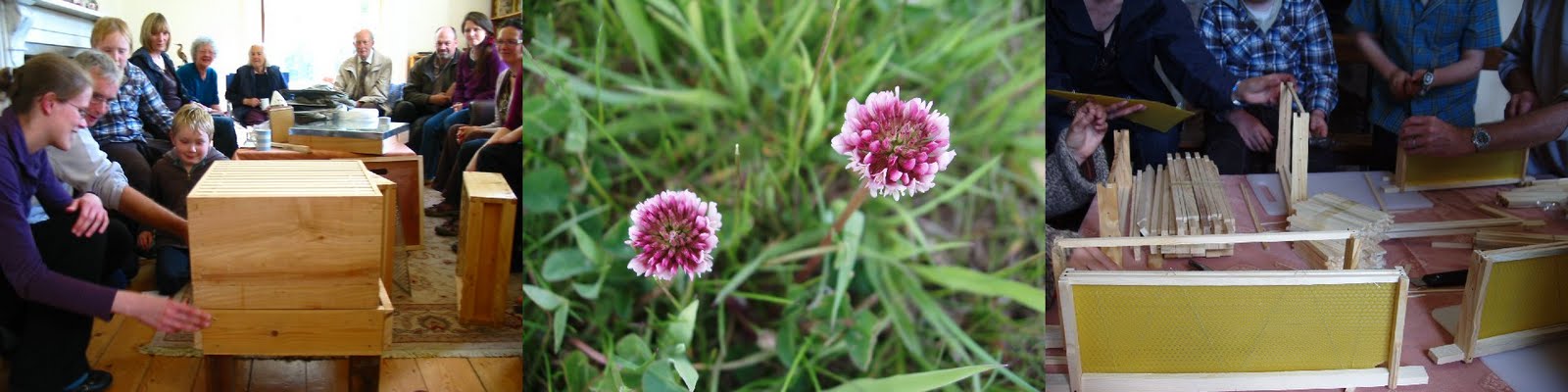
I've recently joined the Bungay Community Bees project (Britain's first bee CSA) and twenty five of us converged at Gemma's in Flixton to help build frames for the new beehives in time for the arrival of the first queen bees in June.

There really was a buzz as Elinor and Gemma reported on the progress so far. As well as getting our three hives (one of them donated), two more people are already being trained up as beekeepers and there are more and more offers of land where the bees can be kept...and of course, there's the bee blog. Meanwhile, Charlotte and Eloise are going to map out all the local wild and garden bee-loving plants and trees throughout the coming year.

Then we all got down to some serious woodwork. Luckily enough we had an experienced carpenter present - I haven't done any woodwork since school - a very long time ago - and I was not good at it!

People feel very strongly about bees. And particularly now with the loss of so many colonies here and abroad. Our neighbour Julia, who we bought the first hive from, lost hers in London. Waveney Valley beekeepers are reporting losses of about a third. And even the most experienced beekeepers say there seems to be no single, simple explanation. Keeping bees and providing organic, pesticide-free land with plants that bees love (like White Clover, pictured - pink when young and later turning white) has to be one way forward. See Sustainable Bungay's website for excellent bee links and information.

Yesterday I brought along Anise Hyssop and Mexican Hyssop for Gemma and Elinor. These are two of my favourite bee plants. I talk and fuss about them so much that Charlotte can't bear it any longer so don't tell her I'm writing about them on the blog! Anise Hyssop is also called Licorice Mint and the whole plant has an amazing smell of anis or licorice as its names suggest. The leaves make great tea. Mexican Hyssop has a more minty smell and is an ingredient in herbal medicine for the heart in Mexico. They are closely related and cross-pollinate so it's best to grow them far apart - especially as bees love them both madly and visit them with great gusto when they flower - which is over a long period in the summer. The seedheads are attractive, long-lasting and smell amazing. Enough! Enough of this encomium!

But the plant of the month must be Lemon Balm. Also in the Mint family, its Latin name Melissa means honey bee. Both the smell and the tea of Lemon Balm really revive flagging spirits and cheer the heart. And bees really do love it.

Pics: Bungay Community Bees people get to grips with hives, frames and foundations, and young white clover in a bee friendly field; Anise Hyssop or Licorice Mint on either side of Mexican Evening Primrose, July