Showing posts with label Low Carbon Cookbook. Show all posts

Monday, 4 February 2013

Low Carbon Cookbook - Update from the Resilient Larder

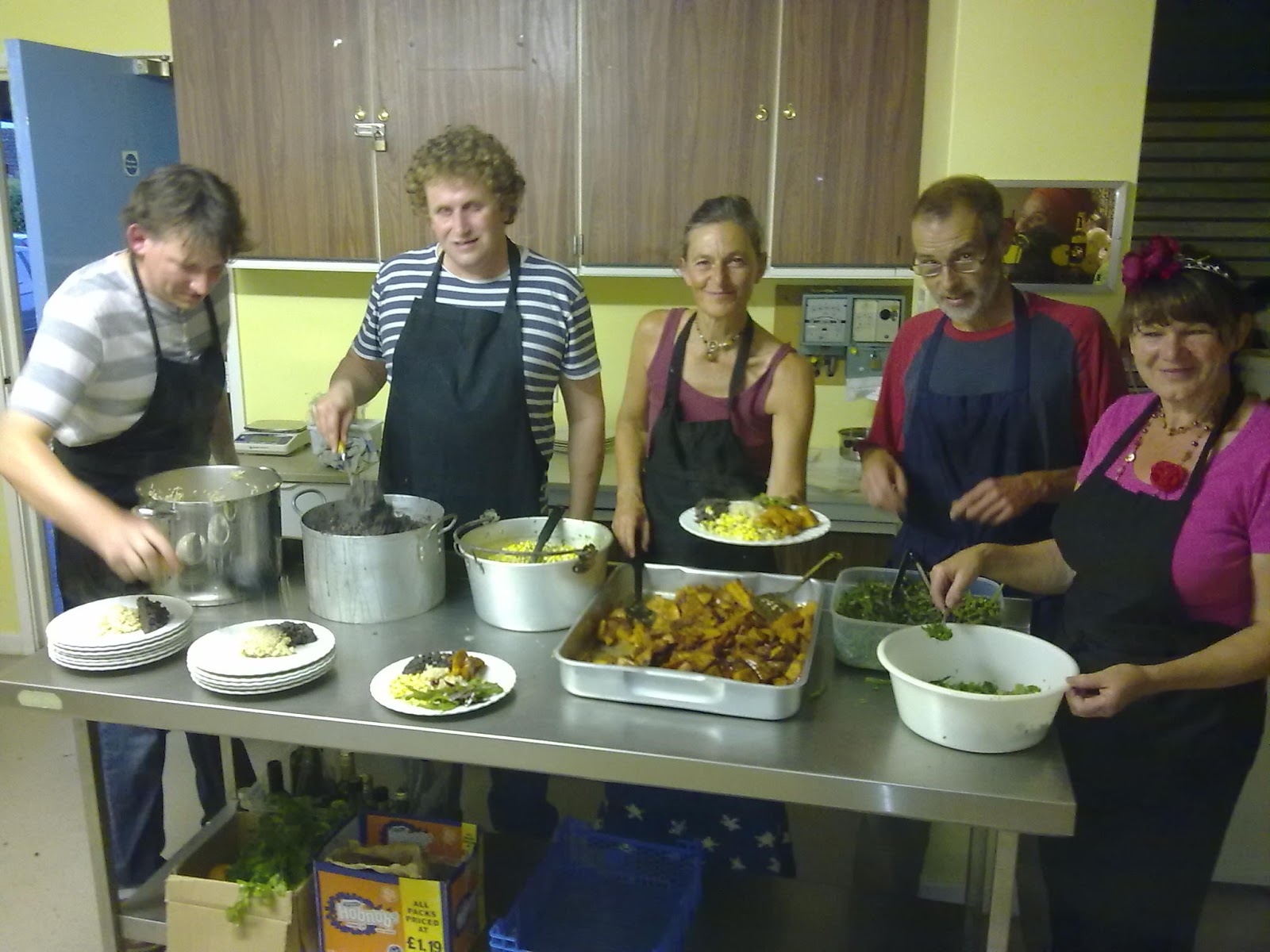
The Low Carbon Cookbook has been on the back burner for a while. First the Transition Free Press took us away from the stove (now out with great food pages edited by Tamzin Pinkerton). Then I was in bed with flu; then it was the festive season and everything in Transition came to a halt. So in the new year, I planned to report a cook-up with the Community Kitchen crew for our Happy Mondays Goes to Kerala January meal (with lovely squash curry and apple fritters).

But then it SNOWED.

Sometimes the greatest acts of invention come when you are faced with limited resources. As the year turned and the world was held in suspense, I went back to the kitchen and I realised I hadn't done much holiday prep. So, like all cooks when faced with a challenge, I went into the larder to see what I had forgotten, and might just turn into a dish.

on the shelf

Fist I found a bag of local wheat and spelt flour and discovered that flat breads from scratch - pittas and focaccias - are the easiest thing in the world to make. They went down a storm with Mark and Nick after hefty woodcutting, especially with sliced chillies from the conservatory and rosemary sprigs from the garden. Then I found a bag of dried chestnuts. Our foraged pile from local trees were toasted and eaten by the fire weeks ago, but Eloise, who comes from sweet chestnut country in France, said that people in her village boiled them up and made them into thyme-flavoured patties. So I mixed mine with parsnips and made a plate of sweet, rooty rissoles served alongside a sharp and tangy slaw (see below). Later, I bulked up a veg stew, and made a classic seasonal soup with sage, garlic and potatoes.

Another discovery was a packet of tiny chia seeds that Mark had originally sown to grow into massive blue-flowering plants. Chia is one the superfoods finding its way into uptown smoothies and granola. However it is a traditional famine food, and can be soaked in water overnight for a strong and sturdy blue porridge the next morning. I cooked mine up and it was a really tasty and warming breakfast with almond milk, pears and honey - somewhere between tapioca and amaranth.

finger on the pulse
But the new stars of the LC larder this winter are the East Anglian peas and beans produced by Hodmedod's. This month the new shapes of Kabuki peas and whole Victory fava beans have appeared on sale, to be followed in a couple of weeks by the wonderfully named, Black Badger peas, once a traditional street food:
Black badgers have been grown in Britain for at least 500 years – and older similar varieties of marl peas have been cultivated for centuries more. Variously known as maple peas, Carling peas, parched peas, black peas, black badgers and grey badgers, these peas are traditionally associated with the north of England where they are served ‘parched’ (cooked and then oven dried or soaked in vinegar) as a snack on bonfire night and as a Lenten dish eaten on Passion (Carling) Sunday.
Peas and beans have been the British staple food for centuries but since the advent of cheap factory meat and industrial processing, they have fallen from grace and from our supper tables. As we tucked into a great bean and parsnip soup, before editing the Bungay newsletter last week, Mark, Josiah and I talked about the folk stories around beans and peas (as well as the modern news stories in The Guardian and interview on Transition Culture). Josiah, who has taken the original Transition Norwich food project into a national arena, was saying how the fairy story was a parable for our times.

In the tale, the luckless Jack trades a cow for a handful of coloured beans. The milk cow is a symbol of prosperity, and beans one of poverty, so it seems a poor exchange. But this is an old initiation story in which the fool turns out to be wise. Jack takes a gamble and finds his treasure in the giant's kingdom, and the story has a happy ending.

"Maybe we should rename it 'Josiah and the Giant Beanstalk'," I said.

Maybe if will all let go of our addiction to meat and dairy products in favour of beans, we will all find our golden goose.

Beans are the wise staple of the downshift kitchen and its great to know you can buy local varieties when most come from Canada and China. I usually cook up a pot to have with rice or potatoes, and then turn in to soup the next day. You just need to add more stock and a handful of coriander or parsley leaves, finely chopped leek, any left-over veg, a big squeeze of lemon and hey presto! Lunch.

What all these rib-sticking peasant dishes call for however is a little lightness and zing. In summer this is typically a fresh tomato salsa, but in winter The Slaw comes into its own. The favourite side of our Low Carbon Cookbook bring-to-share meals, they are a dish where everyone's imagination can take root. Seasonal grated veg - beetroot, fennel, carrot, white and red cabbage, celery - is creatively and colourfully sprinkled with seeds, berries or currants (dried cranberries and pomegranates were new 2013 additions), livened with fresh citrus, umi plum seasoning, root ginger or perky shredded greens, sweetened with rose hip syrup or apples.

Here is one I put together at the recent Dark Mountain meet up at the Sustainability Centre kitchen in  Petersfield:

Celeriac with Seville Orange and Pears
1 head celeriac (organic if poss - those big football ones are woolly)
1 Conference or other hardish pear
1 large Seville orange, squeezed
Goji berries, sprinkling
Pumpkin seeds, sprinkling
Good dash of hemp oil (or other oil)
Celery leaves (optional)

Grate the celeriac and pear and mix together in a bowl. Add other ingredients. If you can't get hold of a Seville orange, a blood orange and lemon is a good substitute.

Potato seller from Memories of Mr Seel's Garden, Liverpool (lead food pic in Transition Free Press); Maple Farm flours; Hodmedod's Peas and Beans

Tuesday, 13 November 2012

Mr Moyse and the Green Tomatoes

Years ago when I first came to the lane, I joined a neighbourhood action group to protest the development of a tourist railway. It was going to cut through the network of lanes that run along the marsh in the back country of the parish. I offered what I could do as a newcomer. I wrote flyers and press releases and stood up in the village hall, speaking on behalf of the badgers and the blackthorn and the people who love to come down these "commons" on foot, or bicycle, or pony trap. After that (very successful) campaign, I felt I had finally put down roots. Everyone waved cheerily as I walked by their houses. And none more so than David Moyse (75) ex-engineer, steeple- and record keeper, who has lived on the corner of the lane all his life and his family for generations before him.

When I joined Transition the following year, I began to write again, after many years silence, and one of the very first stories I wrote was about the little roadside stall I found with neat bunches of leeks for sale and the man who grew them in his wedge-shaped garden.

It was the beginning of the Low Carbon Cookbook. 

 "Near me at the corner of the lane, Mr Moyse puts out his excellent tomatoes at the end of the season on a roadside stall in the manner of Suffolk cottagers, with a tin or jar for coins.They come in three sizes, but all of them are intense. Last year as we walked by we would say how much we were enjoying the tomatoes over the hedge. Just as October was coming to an end I found Mr Moyse walking towards me in a most determined manner:

"I’ve got to have a word with you," he said.

I had been talking about green tomatoes, how they are so delicious fried and make such good chutney. And now I found myself with several kilos of green fruit and a challenge on my hands. We had got talking when I went round to collect them and I had found out that Mr Moyse’s grandmother once lived in my house. She was the best cook in the lane he said.

So this is a small sustainable tale about honouring the elders and finding your roots wherever you are. Start talking over the hedge and you will make contact with another generation who knew how to live in synch with the land. Talking to the greengrocer in the market town I found he used to deliver milk by horse and cart as a boy (still works two horses), that the man who owns the local organic store originally comes from a dairy farm in Galicia where they still milk their 70 cows by hand. After the evening milking he says the family sit round together in the barn and talk until midnight. The key to human sustainability is communication; and not being afraid to open your mouth and make a fool of yourself. That way you find out that making chutney is dead easy (just don’t burn the pan).

Because I had of course never made chutney in my life. I liked the idea of making chutney which is not the same thing at all. I searched for a recipe from the library, picked a few windfalls from the apple tree and brought out the biggest pan I had. (Well actually it’s the only decent pan I have). Several hours of chopping, stirring and bubbling later the house was redolent with vinegar and mace and raisins and I had ten shiny dark-gold jars in the larder.The largest one I reserved. Six weeks maturing time later, I burst into the Moyses' bungalow and wished them a Happy New Year! I wasn’t ever quite sure whether they liked it, or were just being polite when they accepted the jar quietly with a smile.


This year on All Souls Day Mr Moise called out down the road after me. 
 
"Would you like some more of those tomatoes?" he said.
"You liked it the chutney then?" I asked.
"It were beautiful," he laughed. "Come round tomorrow."
 

So now we have a deal. Last year I found out about the history of the lane (his grandfather was head horseman of the neighbouring farm, his father the blacksmith), this year I learned about making wine from the fruits of the hedgerows and the local gardens, from rosehips, grapes, whitecurrants, blackberries, and now I’m having a rethink about all those windfalls I see lying around. Couldn’t we get an apple press and starting making our own juice?

It’s is not an official Transition initiative this lane I live in, but it is a transition lane in spirit, with all the right ingredients for resilience: market garden and barley fields, horses and rabbits, allotments and ancient coppice, wild cherry hedges and oak trees. There’s a good diversity of people too – dwellers of grand houses and humble cottages, newcomers and natives who have been here for generations. The lane brings everything and everyone together. Sometimes we meet and get talking about what the sloes and the mushrooms are doing this season. The plants are always a bridge. That’s when you get to feel you are living in the same place, in the same land, on the same planet. It’s the most extraordinary thing about transition. It makes you feel you belong in a time when you never thought it was possible."


So now, years later, Mr Moyse is definitely David. Now I know he doesn't like being called Mr., and is happy for Mark and I to swing by, talk over the gate, and ask for things if we need them. He has lent us his old lawnmower (which we eventually bought), and we have been enjoying his cucumbers and beans and delicious ripe tomatoes for several summers long.

 Now I always make my own jam and chutneys from local fruit - yellow cherry plums, damsons, apples, blackberries, and of course green tomatoes. This year I've used large unripe marmandes donated by Mr Pinder aka Malcolm, and several tiny Columbiana cherries we grew arounnd the tent in company with their fellow Solanacea cousins, Hopi Tobacco. I've had to move quickly because Mark is Very Partial to fried green tomatoes for breakfast. Those gorgeous slow-growing marmandes are a big treat too to have amongst a good pan of roast vegetables (right now sweet potatoes, last of the peppers, parsnip and pumpkin). I used a recipe from Elizabeth David's Spices, Salt and Aromatics in the English Kitchen, a very old Penguin I found in a junk store. I added a chilli and used mace and cloves (as there was no allspice in the cupboard), apple cider vinegar and less sugar and salt.

Green Tomato Chutney
2lb green tomatoes, skinned and chopped
2lb cooking apples, peeled and sliced
1/2 lb onions, sliced
1 1/2 lb brown sugar
1lb raisins or sultanas
2 tsp each of ground ginger, all spice and black pepper
2 cloves garliic
2 tbsp salt
1 1/2 pints of white wine or Orleans or white wine vinegar

Put all the ingredients in a pan, except the vinegar. Moisten them with some of it and cook gently for appromiximately an hour. Keep adding the vinegar as it bubbles down. When it reaches a jam like consistency it's ready. Allow to cool for a while then then pour into warmed jars. Keep for six weeks at least before using.

ED says it is "a long-keeping chutney"  . . .  just not in our house! 

Images: green tomato chutney (CDC) photographs from David Moyse's book The Village Where I Went to School, published by Southwold Press and available from Wells of Southwold or Boyden Stores, Reydon, £7; tent garden wtih Lesley from Sustainable Bungay, 2012 (Mark Watson).

Tuesday, 30 October 2012

Low Carbon Cookbook - Cold Comfort Food

It began last week. Not just the dip in the temperature, the closing in of night, the leaves turning gold and tawny in the lanes and the proliferation of mushrooms, but the unexpected appearance of those underground veg on the table. Although there were still cosmos and California poppy flowering in the gardens, winter had put his bony leafless hand on the pot and suddenly we were all thinking Roots.

At our Dark Mountain meet-up in Norwich last week, Jeppe (just back from Denmark) served up roasted veg - parsnip, swede, carrot - and Brussel sprouts. We all tucked in heartily to spicy and warming dishes of cous cous, quinoa and Puy lentils before discussing the hands-on practical side of the movement, here exemplified by Simon Fairlie's recent blog, Growing Up Dystechnic.

Our conversation was all about time. The time it takes to cook by hand, chop and watch the stove, to grind seeds and spices, using the ancient tool of the pestle and mortar (or in my kitchen a  volcanic Mexican molcajete). How those things link you in with other times and places and peoples in a way machine-mixed or  factory-made food can never do. How crafting the materials of life, including food, runs along another groove to gimme-now 24/7 consumerism. Time is what you need when you enter the slow cook, downshift winter. The days of quick tossed salads and leaves and the sweet and hot Indian summer dishes that were the focus of our Happy Monday's Mexican Fiesta are ceding to stews and soups and warm, wholesome stuff that requires a different attention. In the Chinese Five element system we're moving from the spleen "mother" foods (think pumpkin and sweet potato ) into the realm of the "father" (lung) where the tastes are pungent, strong and dark.

We will need to have recourse to this robust simple fare because out there the weather has been dire. The worst autumn on record, declared the Farmers Weekly, as growers everywhere are struggling to get their potatoes out of the ground, roots are rotting, leaves suffering from mildew and barley struggling to come through water-logged land. Across the UK and the world  food prices are rising. Animals are being mass-slaughtered as the price of feed, after a summer of drought in the US and elsewhere, has risen prohibitively.

Here a bag of organic potatoes that cost us £8 last year is now £24. Malcolm, who has been providing us with a box of veg for nine years has almost no apples, no parsnips, small onions and smaller potatoes, says it is unlikely we will get a box in the new year.

There is one bright green light ahead however:  the brassicas may yet be all right, he tells us.

Cabbage is one of our low-carbon winter mainstays. Somewhere around now I can't get enough of those greens: kale, Brussel sprout tops, wrinkly and straight cabbages, all for putting in the stew pot or for steaming and dressed with olive oil and lemon, or tamari and sesame seeds. Or best of all making endless creative varieties of coleslaw. Here is an economical, quick to prep, slow to cook recipe that warms up every meal. Enjoy!

SWEET, SOUR AND SPICY RED CABBAGE

1 small red cabbage, roughly chopped
I cooking apple, peeled, cored and chopped
1 red chili, whole
Handful of raisins
1 tsp of juniper berries, crushed
1 tsp of mixed spice
I sprig of fresh thyme  
I bay leaf
I tbsp redcurrant jelly (or similar)
1 tbsp of honey or agave syrup (brown sugar also OK if you use sugar)
Half cup of cider vinegar
Half cup water 
Salt and black pepper to taste

Method: put cabbage and apple into an earthenware pot. Add the rest of the ingredients and stir to make sure everything is evenly coated. Slow cook for one hour in the oven. You can also cook this on top of the stove. Just bear in mind this dish, like a lot of slow-cooked meals, gets better the next day. You can adjust the seasoning before serving too depending on how sweet or sour you like your cabbage. Take out that bay leaf and chili, unless you like surprises!


Pictures from our Happy Monday, Mexican Fiesta and Medicine Soup by Mark Watson. Bookings are now open for Sustainable Bungay's next community meal on 19 November on Winter Comfort Food.

Thursday, 25 October 2012

Winemaking - 'For Medicinal Purposes'

For Sustainable Bungay's 10th Plants for Life event last Sunday, Winemaking - For Medicinal Purposes, Nick Watts invited a dozen of us to his house for a practical demonstration of how to make fruit wine, in this case (sic) from raspberries.

Nick’s front room was filled with people (including Sophie and Nick from Transition Norwich's Low Carbon Cookbook group),  funnels, demi-john’s with deep red liquid and when you opened the door of any one of the cupboards you would discover a large container filled with a fermenting fluid. One demi-john contains enough for 6 bottles of wine at 750cl per bottle. Nick calculated he had about 80 bottles of wine fermenting at the moment.

First we took a look at some of the medicinal qualities of  raspberries. I’d been aware of the raspberry leaf  as a uterine tonic during pregnancy and childbirth and have used it along with yarrow to make a salve for piles. But for me raspberry fruits were always a delicious sign of high to late summer, picked fresh or bought from a roadside stall, and eaten long before they made it home to be turned into anything else culinary, let alone medicinal.

Raspberries, in fact, are incredibly rich in anti-oxidants and vitamin C. Eating them can help boost a poor appetite and they are useful in arthritis. See Hedgerow Medicine, by Julie Bruton-Seal and Matthew Seal,  for an excellent chapter on the many virtues and uses of  the raspberry, both leaf and fruit, with some great herbal recipes.

Penelope Ody in her book 100 great natural remedies has a simple recipe for raspberry vinegar: Soak 500g fresh raspberries in wine vinegar for 2 weeks, strain thick red liquid into a bottle and use in cough syrups, as a throat gargle or add to salad dressings.


Nick took us through the winemaking process in three stages, starting off a new wine and then using ones “I’d prepared a bit earlier.” He was keen to point out he was not an expert, having started about three years ago, but had really got into it and was happy to share what he knows with people.

This was the essence of not only this session but also a main impulse behind the whole Plants for Life project, and indeed Sustainable Bungay as a group and the wider Transition 'movement': If Nick could make so much and such decent wine (not to mention his delicious dandelion and burdock beer) from home and allotment-grown and foraged fruit by just doing it and immersing himself in it, then anyone with sufficient interest and initiative could. Watching Nick describe the process and go through it physically with a friendly group of people was absorbing and instructive, as well as good fun. It was a true skill-share.

What follows below is not necessarily the whole story, but what I learnt from Sunday's session:

STEP ONE
In a big bucket with 3lb raspberries (you can choose your own fruit, almost any will do), Nick poured on 5pts of water and added a teaspoonful of pectin enzyme to prevent ‘pectin haze’. He then mashed the raspberries with a wooden spoon and covered the liquid with a tea towel (very important esp. in summer to keep insects out).

This is left for two days.

STEP TWO 2 DAYS LATER
Add to the bucket between 1kg and 11/4 kg of sugar (preferably fair trade/organic, white) dissolved in 2 pts water off the boil. Add 1 tsp dried yeast with a little sugar all dissolved in some of the fruit liquid in the bucket.

It’s the yeast that turns the sugar into alcohol and the more sugar the sweeter the wine. Nick uses less (1kg) as he likes a drier wine.

This liquid is then stirred 2-3 times a day over the next four days, and the process is called ‘fermenting on the must’.

STEP THREE 4 DAYS LATER
This is the messy bit, where you strain all the liquid through a muslin sieve, before funnelling it into the demi-johns and putting an airlock on it. This is then left to ferment for between 3 and 18 months until there are no longer any bubbles to be seen in the airlock. During the fermenting process a stable temperature is important. Nick doesn’t worry too much about whether it’s warm or cool, just that there is as little fluctuation as possible.

STEP FOUR 3-18 MONTHS later
Decant into bottles and leave for 1-2 years depending on the fruit. Raspberries need less time than elderberries, for example.

After the demonstration, Nick invited everyone to taste some of the wines he's made. My favourite was the dry and fragrant Elderflower and Rosehip. I took half a bottle home and tried a glass with a dash of elderflower cordial - for medicinal purposes only, of course. And it was the perfect antidote to the recent gloomy days of continual rain and lessening light.


Photos: Raspberry wine fermenting in demi-johns; Nick instructing; Mashing the raspberries; Straining the liquid; Cheers on a rainy day (Mark Watson)

Thursday, 4 October 2012

Retroblog #4 - The Tent is Still Up and the Stove is Alight

In some ways it feels like lifetimes ago since I wrote my first post on This Low Carbon Life in October 2009. But the tent is up in.the garden as I write and I'm still blogging and going to Transition gatherings.

Although the pace has changed in the last year on the Transition Norwich blog with fewer people writing now, it still took me ages to choose just one post to republish. The blog is full of first-rate pieces.

One of my favourites is by Kerry Lane. After leaving Norwich for Scotland, then heading West a year later, Kerry has experienced firsthand what it's like to be a 'Transient Transitioner'. This led her at this year's Transition Conference, to start up a Transient Transitioners Support Group for like-footed and like-cycled folk. In February this year on This Low Carbon Life, Kerry was wondering how to go about Finding Mr Green.

Another favourite was by Erik Buitenhuis, Sports are so last century, a permaculture look at energy and waste, whose title made me laugh out loud.

The piece I'm choosing to republish is by Charlotte Du Cann from last winter. It's about food and connection and breaking out of a linear mindset to consider all things. It's about the Low Carbon Cookbook and Dark Mountain Norwich and how to keep the spark alive as we go about putting life back into life.

Photo: Tent Still Up, Sun Shining Through, September 2012 by Mark Watson

the spark that lights the stove
by Charlotte Du Cann
14 December 2011


i
"People don't want to be told about those things anymore," said Diana. We're at a Dark Mountain meeting on a dark December night in a small house in Pottergate. Nine of us, arts and science PhD students mostly, are sitting in a circle. We're working out a way we can create an event, based on Iain McGilchrist's work on the left and right hemispheres of the brain.

One of the characteristics of the left hemisphere is that it gets overloaded with too much information. It can only cope with one problem at a time, segregated into boxes with right and wrong, yes and no solutions. Phil, a marine biologist, who also helps run Norwich's weekly FoodCycle Cafe, has suggested we show what lies behind the industrialised food machine.

To face that kind of reality and make complex, consensus decisions you need to enter the right hemisphere and see everything it takes - plants, animals, people, land, systems, water - to bring our daily bread on to the table. You need imagination, feeling, connection and right relation. To understand all-things-at-once and undergo a complete change of heart is what sages once called illumination - the light bulb moment when everything becomes clear. It's the fire-brand that all creators steal to bring warmth and nourishment to the people.


ii
At The Nectar Cafe off the Unthank Road a small circle of people, Transitioners mostly, are sitting before a midwinter meal of spicy dahl, chickpea stew, millet, buckwheat, pumpkins, sprouts, parsnips, almond cheese, wild mushrooms and red bean hummus. We're closing up the year and discussing how to proceed with our Low Carbon Cookbook. I'm eating something I have never tasted in my life. It's dried curly kale that tastes of cheddar. Chewy, strange and very very more-ish*.

Jo's shelves are stacked with local herb teas and hedgerow cordials and jars and jars of lacto-fermented vegetables, chutney and salsas. A tall jar of sliced preserved carrots stands on the side, next to our brewing chai from redbush and home-made almond milk. Jo has been preparing all autumn for next year's hungry gap. Her cafe, like our Low Carbon Cookbook, is seasonal to the max. To live within these kind of constraints happily, as we have discovered, requires a whole different approach to cooking and living life. It's something that all cooks and creators find as they bridge the gap between the left and the right ways of seeing the world - the spark that lights the stove.

The spark is what you look for when you write a book, a creative way to mix that left-side heavy-duty information and the right-side possibilities of living lightly in synch with the planet. None of us wants to write an entertainment, or a text book. What makes you pick up a cookbook? we are asking each other around the table. To proceed towards a low-carbon future an imaginative relationship with the physical world is necessary, which certain key commitments have already been made. What wastes time is convincing people you think don't want to know. What we need is an encounter that illuminates the dilemma our industrialised culture is in. What we need is to be rekindled by something stronger, more alluring than any feel-bad information. Something you never thought of before, like curly kale tasting of cheese.

What you need is a practice. A spark that lights up your mind.

Field kitchen
In Japan a sixty year old farmer decided to write a book about farming and food. It is called The One Straw Revolution. For forty years, contrary to all modern Japanese agricultural practices after the war, the ex-scientist Masanobu Fukuoka tended his small fields of rice and wheat and orchards of tangerines without any pesticides or technology. He did not till or weed the soil or use machines and his fields yielded as much grain as the monoculture that surrounded his traditional hillside farm. When pests swept through the land his crops survived. He called his way of interacting with the land natural farming and maintained (until his death in 2008 aged ninety five) that a healthy body came out of a healthy environment. To keep sane and sound you needed to eat according to nature and the territory in which you live. Food that needed to be struggled for to obtain was the least beneficial. Nature or the body itself was the guide you needed to follow,“but this subtle guidance goes unheard by most people because of the clamour caused by desire and the discriminating mind.”

To restore the body requires a readaption to nature. To renovate exhausted soil or soil rendered sterile with pesticides and herbicides and artificial fertilizer requires perseverance. It takes time for the body, revved up by an exotic, highly processed, high-fat Western diet, to reorganise and recover its natural appetite. It takes time to learn how to absorb the kind of food Fukuoka (and several contemporary Western writers on food) are talking about: plenty of plants, not much meat, not much. It takes time to break habits and to let go of the complexity of diets and science in one’s mind and the emotional reactions caused by an unnatural way of life. To engage in a way of being where food is naturally limited by place and time.

Once engaged in this process however your body self-organises in a revolutionary way: you don’t suffer from depression, anger or restlessness, you are not filled with the desires and cravings of the modern snack-and-go culture, the hostility that comes as a consequence of eating unnaturally formed plants and caged animals. However this transformative re-naturalisation process is rarely discussed. Our present Western diet, with its glamour, its comforts and its treats, fully backed by a corporate food industry, is the elephant in the room. And no one wants to go there.

Except that we have to go there, because it’s killing us and everything else in the room. The industrial food machine has substituted lifestyle for life, a way of thinking that convinces us we have a choice and that the choices we take have no consequence. But this does not mean that consequences do not exist. To continue to uphold our lifestyle, to choose cheap and convenient food, means we choose to compromise not only the natural life of eco-systems and the livelihoods of farmers everywhere (including those in East Anglia) but also the very nature of our own bodies and minds. For the future to happen we don’t need choice in the kitchen, we need to make decisions.

This decision starts as we stand at the chopping board and by the stove. It doesn’t mean facing another direction so we don’t see the elephant, it means facing reality and undergoing a radical shift of values. Reality is what we are doing everyday with our hands, our ability to ask intelligent questions: What does it mean to eat and cook in connection with the living systems, ecologically, to take account of the consequences of our actions? What does it take to live and eat within our means?

Our book is about growing food and about eating food. As well as the bring-to-share recipes, resources and carbon calculations, we look at the decisions people are making not only to re-establish links with the living world but also with each other. The industrial food machine, powered by cheap fossil fuel, has enabled some of us to dine like Roman emperors. Eating for resilience means we will eat a lot more like peasants, more simply and more often together.

This book looks at what it takes to make these kinds of practical decisions, what happens in an energy descent kitchen, what kind of food you cook in downshift cuisine. How you go about putting life back into plants, into the pot, what Hopi farmers call navoti, the life in the seed, and Mexican cooks call chispa, the spark that fires up human beings.

The pilot light that fires us all from within.

*CRISPY CURLY KALE: Marinate small pieces of curly kale in olive oil, garlic, ginger and tamari overnight. Dry in dehydrator or low oven for a couple of hours. Store in an air tight container. The key with processing any raw food is not to cook it over 39 degrees, the point at which the enzymes are destroyed. The Nectar Cafe is at 16 Onley Street, Tue-Sat, 10am-5pm.

Photos: Gwyl y Golau or the Festival of Light in Machynlleth from Ann Owen's Social Reporting post on Arts and Creativity in Transition; Masanobu Fukuoka in the field; wheel of the local food year from One Straw Revolution; chia, food plant of the future by Mark Watson

Friday, 14 September 2012

Low Carbon Cookbook - Down Mexico Way 1

We're just about to head off to London to the Transition Conference and the launch party of the Transition Free Press (herbal refresher in hand), but all this week my heart has been in Mexico. Because next (Happy) Monday we're throwing a Mexican fiesta down at the Bungay Community Centre and I've been helping direct and organise the menu.

The main attraction of these community meals is their convivial and celebratory nature. It's not often you can cook for and sit down with 50 people for supper, and food with its provenance, memory and rich flavours brings us all together in a way that dry discussions about climate and cultural change can never do.

But still there is a deep Transition frame in which these monthly meals take place. All its drivers, including peak oil and the gift economy, are on the table, among the flowers and the leaves. Even though some of our dishes are global (Greek, Moroccan, Indian), nearly all the ingredients are local and seasonal. We are deliberately vegetarian to show how meals do not have to rely on resource-heavy meat or fish to be delicious and nutritious.

Everthing is cooked from scratch (in three hours flat) and so free from industrial processing. At the planning meeting earlier this month the recipes and ingredients were discussed in detail from the use of "dry" Italian rice (traditional paddy-grown wet rice creates extremely high methane emissions) to whether Nick's allotment maize would be ready in time for the Seared Corn with Coriander and Lime. I have spent a very happy fortnight sourcing local chillies (though most Suffolk growers who make their own sauces report very poor yields due to the wet and dark summer) and the house has been resounding with Mark singing old mariachi standards. Is he practising for something?

I'll be writing in more detail about the food and the gathering after the meal (happening just after Mexican independence Day). Needless to say beans, the staple of all Latin American meals, will be our cornerstone, followed by a classic-with-a-twist pudding made with late raspberries and blackberries.

Here is one of the side dishes to whet your appetitie. Sweet potatoes are sold ready-cooked from a barrel of honey in Mexican markets and this recipe by the wonderful Rick Bayless from his book, Mexican Kitchen, is full of all those sweet, warm and spicy tones of Indian summer.

Chilli-glazed sweet potatoes with cinnamon and orange
Serves 50 (with luck!)

20 garlic cloves
10 dried red chillies (Ring of Fire) or preferably 30 small anchos. stemmed and seeded
3 ½ tsp ground cinnamon
2 tsp freshly ground black pepper
1 tsp ground cloves (best freshly ground)
800ml water

For dish:
8 kg or 25 medium sweet potatoes
14 organic oranges, zested (7 juiced)
14 tbsp honey
Olive oil for the pan

Garnish (optional)
Crème fraiche or sour cream
Chopped coriander

Orange zest

Time: 30 mins to prep paste; 1 hour to cook

Method: Paste: Dry roast garlic cloves (15 mins), cool and peel. Toast chillies (in same pan), cover in hot water and leave for 30 mins, stirring occasionally. Drain and discard water.
Combine oregano, black pepper, cinnamon and cloves, along with chillies, garlic and water in a blender or pestle and mortar to make a puree. Strain through sieve into bowl.
Potatoes: scrub and cut into wedges (4 per medium potato, 6 large). Lightly oil baking dish and lay them in a single layer. Combine paste with orange zest, juice and honey in the bowl. Spoon evenly over pototoes.
Preheat oven to 180 deg. Cover potatoes with foil and bake for 45 mins or they are almost tender. Raise temp of oven, uncover, baste and bake until they are glazed (10 mins). Garnish and serve con much gusto!

Huichol maize mother and her five daughters from Lore and History of Maize; home-grown epazote, the key ingredient in black beans; candy-floss stall in Mexico City (by Mark Watson); sunflower.

Wednesday, 29 August 2012

Low Carbon Cookbook - Fruta mi amor?

Maybe it's because we're planning a Mexican fiesta meal next month for Happy Mondays that I keep remem- bering this refrain we used to hear long ago on Cartagena beach, where large ladies would sashay down the sand with piles of exotic fruit on their heads - fresh coconut, papaya and mango. Juicy, sweet, mouthwatering salads, cutting the salt of the sea and the fierce tropical heat. Those were the days when tamarind lollies, tumblers of passion fruit and naranjilla juice were an everyday thing and none of us thought twice about catching a plane.

Now in Transition exotic fruit is forbidden fruit: way too many pesticides and air miles, way too much exploitation of pineapple and banana workers. We live in frugal times with an eye on the planetary clock. Like many Transitioners I don't buy out of season or from supermarkets, and my tastebuds have been narrowed down to European organic citrus and English raspberries, quince and pears (and the occassional home-grown cape gooseberry or kiwi). I am stalwart in the winter, long months of wrinkly apples and early rhubarb, pulling out frozen plums or strawberries from the small artic in my fridge when guests come for supper. I say to myself: next year I shall bottle and prepare! But of course, like the currant-loving, sloe-pecking, cherry-picking birds, I gorge on the fruit when it is there, and then forget all about it.

These blackcurrants and gooseberries are from the Bungay Library Community garden and were a small handful of intense, multi-levelled sweetness, eagerly enjoyed by Mark, Josiah and myself last week. Normally as September advances my eyes are flicking up into street trees everywhere, the small roadside stalls are bursting with plums and we are gearing up to our Grow and Give produce swap. Last year I had enough apples stored in my larder to last until Spring. I was relishing the shared fruit in Cathy's orchard. The year before I was amassing wild fruit for jam. There was abundance everywhere you looked. Wasps and scarlet admirals feasted on the rotting windfalls in gardens.

2012 is a different year - no damsons, few cherry plums, fewer cherries, almost no scrumping apples. Fierce winds and frosts in Spring burned the blossom and many pollinators were grounded. What we have is a profusion of blackberries (the core of our Mexican pudding and winemaking workshop) and elderberries, which with sea buckthorn, will be the basis for our Fruit Tonic Plants for Life session next month.

"Sour this year though," remarked Margaret, as we discussed blackberries at our core group meeting last night. "Like the strawberries."

Without sun or light, the fruit does not sweeten and amor is harder to find. This year, with massive drought in America and the Artic sea-ice at an all-time low the shadow of climate change is falling over our lives.

You cannot be a cook or a gardener and ignore the effects these shifts in temperature and pressure are having on our local weather and thus the food crops on which we depend. Our mood is affected by these things. Once I might have written gleefully about our greatest feral fruit, the evocative way its rose-scented perfume curls around the house, bringing the happiness of all Septembers with it, how blackberry-gathering is one of the links to our ancestral foraging past, how I love to lean out of the window and see old couples and children with bowls of berries in their hands, or young men on bikes talking and eating from the hedges in the rich-gold evenings. Now my attention is otherwise engaged. It's OK to treasure what we have, to enjoy working and meeting together, but the frame in which we do these things - our community enterprises, events, projects - has to be palpable. It has to be real.

We began our Low Carbon Cookbook group two years ago to bring attention to the food we eat, to explore what it takes to downshift the kitchen and make our larders low-carbon and our bodies resilient. We've held conversations about food systems, energy and ethics, shared meals, skills, experiences, tracked our everyday growing and cooking patterns. This month as many harvests fail, or yield little, and prices rise, it feels as though we were just prepping in our one-planet community kitchen, and the real work is only now beginning . . .

The Low Carbon Cookbook archive can be accessed here. Plants for Life Fruit Tonic Workshop will be held at Bungay Library Community Garden on September 23. Wild plums - a short memoir on fruit and cooking - one of the original 52 Flowers That Shook My World is published here.


Fruit pix: Wild and garden plums, 2011; blackcurrant and gooseberries (Josiah Meldrum), Mark and Josiah, 2012; blackberry and elder berries, 2010; sea buckthorn berries, 2011.cherries, strawberries, peaches and nectarines, Strangers Circle, 2009 (CDC)

Thursday, 23 August 2012

Noughty but Nice and Keeping Refreshed at Happy Mondays

The Low Carbon Cookbook group hasn't had a meeting this month, and so here is a post I wrote for the Transition Social Reporting Project yesterday, 22nd August, about the latest Happy Mondays meal at the Sustainable Bungay community kitchen - a celebration of multiple birthdays with falafels, cupcakes and the herbs that refresh us. Mark Watson

Bungay community centre, Monday 20 August, late afternoon. I have spent the past hours gathering and infusing herbs for the herbal refresher I am making for Sustainable Bungay's Happy Monday meal. These events happen once a month with a different theme, using as much local food as possible and are organised and prepared by the Community Kitchen subgroup of Sustainable Bungay. Anyone can join in and help out or just come to enjoy the food and atmosphere. This month's meal is also a Happy Birthday celebration for the proportionately large number of us in SB who have arrived at an age with '0' in this year .

I'm hot, I've been unable to find any organic, unwaxed lemons in town and outside everyone seems to be moving at a snail's pace as the heat increases towards the end of the day. It must be nearly 30 degrees and I'm definitely feeling the effect of my particular 0 (which is no longer 30). The infusion of over twenty herbs (picked both from home and from the community garden at the library) smells amazing, but it's still piping hot, people will be here in forty minutes and WE DON'T HAVE ANY ICE!

Margaret (another 0) offers to go down the road for the ice after she's finished the flowers for the table. Charlotte cools the infusion by transferring it from jug to pot to saucepan to pancheon and puts in the summer fruits and flowers. I add a little sugar, fizzy water, a bottle of Nick(0)'s homemade raspberry wine and some blackcurrant cordial, testing as I go to get the right balance.

I've stationed myself in the main room where it's slightly cooler. Janet ties balloons on the windows and I carry on pouring and stirring and testing. Thane and Emma are among the first diners to arrive. "Great!" I said. "Tell me what you think of this. I don't want it to be too diluted."

"It's certainly strong enough," they said. "Adding more water would be fine. It's really refreshing!"

The mood of the kitchen is the usual one of intense concentration as everyone in the crew goes about producing the dishes: Josiah rolling the falafels he's made from British fava beans, Christine preparing a raspberry coulis for her cup cakes, Lewis testing the beetroot for the Moroccan salad. Cucumbers and tomatoes are sliced and onions are chopped for the accompanying dips and sauces. "Charlotte, can you do the yoghurt sauce?" says Nick almost at the last minute, whilst he washes up several large pans.

The drink is finally ready and living up to its name. People are arriving and everybody wants some.

"This is delicious," says Sally. "You must tell me what herbs you used."

"Well, there are over twenty five, with a strong base of lemon balm and lemon verbena, and... I'll come and tell you about it later," I said.

And there was plenty for everyone, with Dano (but not Dan0), taking the pancheon round the table so people could have seconds.

The meal was great, too – falafels, pitta bread, salads, sauces, oven-baked wedge potato chips, followed by cup cakes each with its own candle – and that raspberry coulis!

The candles were lit, the lights were dimmed and there was silence for a moment before we all sang Happy Birthday. Janet (yet another 0) and I laughed as we both realised we were singing happy birthday to ourselves and tried to add an 'us' in there somewhere, which didn't rhyme but never mind.

PS There were even more 0 birthdays in Sustainable Bungay this year than I mentioned here: Elinor, Eloise, Jon and Dee also celebrated the beginning of new decades. So cheers to you too, guys!

Pics: Birthday balloon by the window*; Peppermint (ricola) flowers*; oh those cup cakes, in the kitchen; Dano offers Margaret another glass of herbal refresher. By Josiah Meldrum and *Mark Watson