Showing posts with label groups. Show all posts

Tuesday, 7 August 2012

Mudville - Tin Village at the Sunrise Festival

Today's post is from the Sunrise Festival where I worked in the kitchens at the Tin Village, mostly helping run the pizza workshop. Next week I'll be writing up a recipe for that delicious, ubiquitous dish (here baked in hand-made earth ovens) for our Low Carbon Cookbook slot. Right now here is the background . . .
Standing in the camera oscura, a small wooden island in a sea of mud, Sunrise Festival 2012. I'm watching the crowd flow past slowly like a dream. Pennants are flying, pinnacles of tents pointing to the sky. The camera above the room gyrates in a circle around us. A group of small girls who are tracking it from the outside laugh and wave at us inside. We can see you watching us! It's extraordinary how this lens creates a different relationship with everything you see. You treasure it somehow, love the way you can pick out people and the shapes they make that would otherwise be a blur.
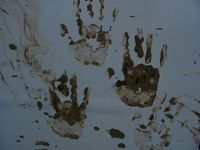
Time does that sometimes, acts like a lens. In the madness of the mud, in the struggle to get from place to place you don't notice the beauty of things. The handprints on the wall.
This is a postcard from the Sunrise Festival. Or perhaps it's a letter, a smoky, muddy love letter. It's from a temporary place called Tin Village that appears at festivals sometimes across England: at Sunrise Off-grid, at Tolpuddle, at Glastonbury. It goes up and then it comes down; people come together and then they depart. Something in the way the place is constructed stays however. That's the essence I'm trying to recapture. It was a watershed midsummer (and that's not just the rain). I had been continuously on line for weeks and then for five days I came off. I was offered a lift from Simon, Pete and Georgina from Norwich who wanted to hear about Dark Mountain. And so we talked non-stop about the world in transition, as we headed to the hill and pasture country of the West.

That's one thing festivals do: they break your crystallised patterns, break you open, open you to people you would be unlikely to meet otherwise, make you look at where you are going and where you are coming from. Teach you to receive gifts, as much as give them, take you out of your personal camera oscura and into the field. Perhaps the muddiest field you have ever encountered.
earth oven
Tin Village is an off-grid experiment in community living. It is built by a core crew who put up everything from scratch: the outbuildings, earth ovens, grey waste system, rocket stove kitchen, field shower, permaculture garden. During the festival an additional crew arrive and we work at least four hours a day running the pizza workshop and cafe, which provides the income for the enterprise. Most of us also give workshops (I gave two: one on Herbs for Resilience, based on my book, 52 Flowers That Shook My World - published today! - and another on grassroots communications with a poet from Occupy London called Venus, based on my experiences with this blog and the Transition Free Press). The sessions range from the intellectual and political to the practical and inspirational - from how to get involved with Frack-Off and Diggers 2012 to thatching and foot massage. This year the Village has been co-ordinated by Ian Westmoreland from Transition Heathrow, so there is a strong activist element. It's a lot less fluffy and spiritual than last year, and there is something exciting about this set of progressive and environmental groups coming together in one place, working alongside each other, swapping stories, making links. Last year I felt on the edge - everything was more distant, more polite. This year I am in the thick of things.

Where we meet is around the fires, the two pizza ovens and the four rockets stoves in the kitchen run by Harry from the Kitchen Collective. The tasks at hand first appear insurrmountable. At our pre-Festival meeting around the camp fire we put our hands up for camp duties and write our names on a rota. Then the rain began to fall. A rain that will last all weekend and turn the whole village into a quagmire, put out the fires, soak the carpets, drench ourselves, dampen the firewood, dampen everything - except our spirits.
Maybe it's because I have a warrior heart that I love the spirit of this camp. Not warrior in the sense of killing and fighting, but in the sense of a people coming together in resilience, not serving their own interests, but doing their own thing impeccably, which turns out to be everyone else's: acting collectively, sharing skills, knowledge, resources. The rain washed away the rota, so we let it go. Looking from the outside from the position of contol, running a temporary working community without a plan or leadership seems impossible, but when we got down to it everything self-organised.

I went to all kinds of music events during the weekend, danced, chanted at sunset, drank chai, listened to some great talks at the Green Dome - Mark Boyle, Maddy Harland, Theo Simon - spoke with low carbon cooks and Transitioners from all over the county, had a lovely meal with fellow reporter Ann and her family in their tipi, but I kept feeling pulled towards the home station of the Village.
Something there made sense in a way that a lot of the festival stuff, which is centered around entertainment did not. That floated away, the stuff we did for real stayed. The physical work - making dough, digging ditches, washing mountains of dishes, collecting plants in the rain, staggering across the field in my mud-encased boots, keeping the tiny tent dry for sleeping, talking to strangers who don't feel like strangers - remained in my memory. It felt like the kernels of coloured corn that Ann gave me for Mark. Seeds for the future.
rocket stove
I'm writing this midsummer postcard in hindsight. I pocketed those seeds and now the corn is growing in our garden six weeks later. It's now Lughnasa, the traditional time of the harvest and gathering. Tin Village came and went and yet the essence of it still flourishes. Some of the crew are coming to the Uncivilisation Festival this month, and there will be a Tin Village at Sunrise Off-Grid too (though a slightly smaller version). I wished I could have stayed and helped dismantle the camp but Simon and the East Anglia crew were heading back that Monday. I would have liked to have had that experience, got to know everyone more, as well as feeling I had played my part in the hard task of construction.

Sometimes you have to go off-line, off-grid, out of your comfort zones, to get a sense of what is possible. I know now when push comes to shove people can work together in hard conditions and flourish. And when they do something beautiful can happen that you would not expect if you judged everything from the way things appear, from the outside. The people who will make the future work are not the people you think: the control people, the shiny people, the spiritual people. They are the activist people, smart, funny, edgy, generous, friendly, warrior-hearted. The people who are not afraid of the mud. Who are not afraid of the earth or each other, and who can still make a fire, come what may.
Sometimes you wait a long time for the story to make sense. I had a seminal moment when the sun finally came out at the end of the weekend and everyone was going home. I found a chair to sit in and put my face happily in the warmth and the light (at last!) and heard a girl's voice singing: I wanna see the sun, I wanna see the sun (at least that's what I thought she was saying).
"This is it!" I cried. "I wonder what CD that's from?" and went into the tent to find a real girl singing the song, and a familiar figure taking photographs.
"Aren't you the person who shot Transition 2.0?" I asked her when the set was finished. "Didn't we meet in Liverpool?"
"Yes," she said, "And this is Rebecca Mayes. She found an impromptu slot here and I said we just had to have the Transition song!"
"Oh," I laughed."That's where I've heard it before!"

You think the sun is a star, operating outside of us in a scientific impersonal way, but it's not. It is in all things. It's a creative, mysterious, self-organised. connective intelligence that operates through everything on earth. Many strands and shapes interlocking and working for the whole. It works through our hearts and our fiery spirits and we can get a sense of its extraordinary organisation when we break out of the camera oscura of our minds and get into the field. When we trust the people we are working with, when we let go of control and enter the collective. We have been kept seperate for aeons at the behest of forces that have nothing to do with right relations on earth. It's time we got back together again. It's time we got back into relationship.
Sometimes we get that chance. Now is the time.


Images: mud prints on the camera oscura; constructing Tin Village (Heather); Tom and the pizza ovens; workshop blackboard; Transition rocket stove workshops; permaculture no dig garden outside the Green Dome; the stone circle

Saturday, 25 February 2012

The power of visioning

Today's blog is cross-posted from the Social Reporting Project, which this week has been reflecting on some of the Tools and Ingredients in The Transition Companion. Kerry Lane looks at Ingredient #7, Visioning, as one of the key Starting Out points for initiatives.

An Inspiring Low Impact house in Wales

Visions are the stories that we tell ourselves, the narratives we live by, they are so integral to our lives that it takes a collective effort to reimagine them.

I really can do no better than Rob's summary of the challenge associated with this ingredient:

Not being able to imagine a lower-carbon world is a huge impediment to designing and realising it.

I believe that the reason so many people become paralysed by the 'depressing' films Ann talked about on Wednesday is that they just cannot imagine an alternative to our current society, particularly one rooted in the reality of their local area. This is what Transition Initiatives enable, the collective imagining of a low-carbon future for their local area. And once you have a vision you have something to work with and towards.

It is no coincidence that advertisers have been using visions for years to sell their products, they are after all masters of human psychology. Whether it is harking back to an imagined golden age or playing on what we want from a better future - how many adverts can you think of that play on the idea of community, of being more connected? Visions and stories sell. Futerra, the sustainability communications gurus, recognise this in their top ten tips with #5 Only Stories Work.

Transition is one of the few environmental initiatives that has recognised this and has harnessed the power of visioning for positive social ends rather than for selling consumption. It gives us a joint future to work towards, one that we can start creating right now. You could argue that most Transition projects are the result of visioning of one sort or another. Armed with knowledge of the issues from the awareness raising and inspired by what others are doing, visioning lets our amazingly powerful imaginations get to work on sculpting local solutions.

Transition UWS
Vision is what is missing in my current Transition Initiative. The students and staff cannot imagine a low-carbon future that they want to be a part of. I suppose part of my job is to try and facilitate a community vision, but our funding constraints (which will be explored more in the Funding week led by Marella in March) make this quite difficult. Visioning is not really something you can force on people, you have to make a space and process where it is possible, but it is essentially a voluntary activity.

It is the inspiring visions cocreated in Transition Norwich that have kept me engaged in Transition through the group turbulence brilliantly described by Charlotte on Tuesday and through my relocation away from my initiative. In Transition Norwich I was involved in developing the resilience plan (energy descent action plan) that is effectively the next step up in visioning and we started by all contributing our individual visions, which were woven together into a rich tapestry of our communities vision.

It is my vision of being part of a Transition community, creating a low-carbon society, sculpting the job I want that keeps me hoping, keeps me creating, creates my future.

We are what we think. All that we are arises with our thoughts. With our thoughts, we make the world.
Buddha

Imagination is the beginning of creation. You imagine what you desire, you will what you imagine and at last you create what you will.
George Bernard Shaw

Kerry Lane

Original post on during week on the Ingredients and Tools from The Transition Compansion on The Social Reporting Project

Wednesday, 22 February 2012

rita, mark, josiah (and me) too - coming together in groups #1

In the last post of our Sustainable Relationships week (and a half!) we consider perhaps the most challenging relationship of all: with our fellow Transitioners. Here are some reflections posted yesterday on the Social Reporting Project in response to The Transition Companion's first Ingredient.

When Rob Hopkins launched the new Transition Companion on twitter, the question I asked in 140 characters was which of the 82 ingredients and tools did he consider the most important: "working in groups" was his reply.

Coming Together in Groups is the first ingredient in the book's storehouse; it is the essential thread that runs through the whole movement and distinguishes it in many ways. There are all manner of protest and campaign groups, political and philosophical movements and most of them are organised by small configurations of people. However in these groups the bigger picture is held to be the key unifying factor: us against them. In Transition the social fabric of the group (us) is considered priority. Because this is not an individual or a mass response to peak oil, climate change and economic recession, this is a community-led response, and learning to work in community is one of the hardest tasks we face. If we are serious about responding resiliently to the challenges of those drivers and powering down we have to learn to break out of our chronic individualism and work as a crew in dynamic and creative ways.

This is not to say Transitioners have it down. We so don't. Everyone in Transition can tell you how their respective groups or projects have formed and stormed and fallen by the wayside. How people clashed, initiatives dissolved, all manner of disaster tales. I am no exception, I have been in theme groups that fell apart, lost my temper, my cool, been foolish, been excluded from a core group, taken part in projects that did not happen in spite of everyone's talent and good intention. And I have also been in a core group for three years that has weathered the storm and prospered, and taken part in projects that have undergone radical shifts and succeeded in every way (and still do). I have sorrowed and rejoiced in equal parts, lost valuable colleagues and gained friends. And most of all, like everyone else disenfranchised and unrooted by modern society, I have found myself through these communal experiences, belonging to my neighbourhood and my native land in ways I could not have imagined.

So partly to explore this topic (in our week on Ingredients and Tools Part 1) and partly in response to Nafeez Mosaddeq Ahmed's statement (in yesterday's post) that Transition has "failed" in galvanising everyone to take part, I would like to share an insight I had when I was eleven years old.

Breaking form

Every Saturday at school we had a film afternoon at the lecture hall. It was the big highlight of the week: sitting in the dark watching the flickering screen, seeing places I didn't know and people whose lives I would never experience. One of these was The Inn of the Sixth Happiness. It was an old-fashioned Hollywood film, cheesy in many ways, and looking at it now I would probably wince at all its imperialist and religious overtones. But there was a scene in it that has stayed with me all my life. The film depicts a true story of a maid who becomes a missionary in China during the war with Japan. At the beginning of the film Gladys (played improbably by Ingrid Bergman) works to helps break this practice of footbinding that had been imposed on women (by women) for a thousand years. A group of women look at her in silence, and then two old women step forward. She shakes her head as the pain, unleashed from decades in captivity, will be immense. Let the younger ones do it, she tells them. But the elders know that if they have the courage to go first, the rest will follow.

There are many who say our current social and environmental problems are political, caused by capitalism and a dominant global hegemony, and this is true. But we can cannot really change these larger outer structures, unless we deal with the inner ones as well. Mostly our problems are perpetuated by a kind of cultural footbinding that has been in place for thousands of years. We are broken as children and as communities: our natural relationships with the world and each other are severed and we are enmeshed in unnatural ways of behaving and relating with one another. Hierarchical, hostile, subservient to the rulers of civilisation, we play out these constrictions daily, mostly unconsciously. And no matter what the rhetoric or rules of good governance we decide between ourselves, when we come together as groups these invisible forces control us and our endeavours unless we consciously dissolve them and unbind ourselves.

As individuals we can do this as a practice, with ourselves or within our relationships. In groups getting out of these binds is more of a challenge. Even naming them out loud is hard. We are advised in the Companion to seek outside help with the conflict that it inevitably arises, but most of us do not know the world of counselling, or want to engage in it. We feel these antagonisms between ourselves, as we come to meet: the feelings of repression or gloom. We find ourselves acting out roles that are not our own, scapegoating people or being scapegoated, taking the flack, taking too much responsibility, being excluded from communications, forming elite bands, being treated as a volunteer. Haughty, subservient, dismissive, flaky, silent, babbling, critical, self-important. Mostly we feel alone and under pressure. Me against Them.

Sometimes it feels as if the very fabric of the places we meet in - the pub, community centre or council chamber - impose their own restrictions upon our working together in harmony. As we struggle to bring in new ideas we find ourselves defaulting to the civic or feudal shapes the ancien regime has imposed on people through history. We find our fellow Transitioners disappearing into mental abstract realms or spiritual fantasy, preferring ideas to reality. Our contributions to the Bungay newsletter sound like dreary notices from the Parish magazine.

"Why are you writing like a member of the W.I?" I cry exasperated to Mark as we assemble everyone's copy.

"I don't know," he says. "It just comes out like that!"

If we are lucky we like each other. If we are determined we keep meeting each other come what may, keep inventing new and creative ways to do Transition. If we are "elder" enough we take off our binds, get over ourselves, cut the slack, be unremittingly generous. If we are wise we read the excellent essay, written in the 70's about the Women's movement, The Tyranny of Structurelessness and realise that our "cages" sometimes feel comfortable to us, the only thing we can count on, and that liberation from the known is scary, often painful and always challenging.

If we are smart, we do these things ourselves first, like Ghandians, and know the consequences of freedom, before we urge anyone to do the same (or criticise them for not doing it). We show everyone what the future looks like by living it conspicuously everyday. We don't lose heart. We know that one day our small local enterprises will join up, link together and make an extraordinary map across the world. Bearing this in mind, we get on with the business at hand.

Ten tips for coming (and keeping) together as groups

Taken from my experiences in the Bungay core group and the Transition Norwich bloggers

keep your doors open invite people to join meetings and the enterprise - network with other groups outside transition

keep insisting on a co-operative structure people have different roles but equality is key - value everyone, include everyone (that's you too!)

communicate, communicate, communicate keep those channels open, no secrets - remember if you are in control you are not in communication

do not react wait three days before you reply to THAT REALLY ANNOYING EMAIL

keep working together eating together, drinking together - even when you don't want to

share everything community culture starts here - vegetables, eggs, tools, knowledge, skills, books, cars

maintain a rhythm keep putting out that daily blog, that monthly green drinks/film night, quarterly newsletter on time

make a commitment to the project you love do that thing with all your heart

allow space and time for everything to unfold especially the tough parts - let go and hold on (that's a Zen one!)

awareness see this ingredient as the quicksilver of the social alchemy that is Transition - without this group the future you desire will not take place anytime soon, the old business-as-usual order will prevail

Like all pioneers of something new and radical we need to know we are breaking form. And that creating a new infrastructure - from local food systems to alternative media - is hard work, but that endurance furthers. Every time.

Wishing everyone the best in all your groups wherever you are. Come together, right now!

Coming Together as Groups is the first ingredient of The Transition Companion by Rob Hopkins (Green Books). All ingredients are available on-line as resources and also as playing cards.

Photos: Cathy, me, Eloise and Kate in Margaret's garden at Sustainable Bungay core group meeting; poster for Inn of the Sixth Happiness; cycling with Bungay core group; meeting fellow blogger, Kerry at the Bicycle Cafe, Norwich; last night at Happy Mondays at the Community Kitchen.