Showing posts with label wild plants/foraging. Show all posts

Thursday, 6 June 2013

FROM THE ARCHIVE: The Sea Kale Project

Five years ago I began a project which had at its base a walk along the Eastern Seaboard. It was called The Sea Kale Project.  

Originally it was going to be a springboard for a photographic exhibition and extend into Norfolk. In the end however the walk was the catalyst that drew me back into writing. First a small piece in a local magazine and then journalistic blogs, principally about the Transition movement, in the following three years. Sea Kale was also the subject of the final chapter in 52 Flowers That Shook My World. 
 
Tomorrow, in another different time of shift, I will go with Mark to Sizewell beach, as we do each year, to pay visit the extraordinary community of wild and robust cabbages that flourish strangely and beautifully beside the nuclear power station. Here is a piece I wrote in 2011 in celebration:
 
 Along the sandy dunes and shingle banks of the eastern seaboard there is a front line of wild plants, the ancestors of our allotments and fields - wild carrot, wild cabbage, sea beet, sea pea, sea kale, sea rocket, oraches, sorrel – and our medicine cabinets - wormwood and eyebright, sea buckthorn, sea holly, scurvy grass. Of all our ancient companions, the sea kale with its abundant flowers and rich detoxifying leaves is the largest and most impressive. Its tap root sinks deep into the shingle and holds fast in a rocky and uncertain time - the kind of plant that can weather a storm.

The plant marks a territory that runs along the shoreline from Norfolk to Kent. It’s a geographical, ecological territory, but also a place you can map in time, in the ways that make meaning of our presence on the planet since our forebears first ate those salty iron-rich leaves.

I came across the sea kale in Dungeness. I had gone there because of Derek Jarman. I had read his journals and noticed the flash of wild flowers in the text, as he struggled with the elements that howled through his shingle garden and to keep own tenuous thread to life. He had come in search of bluebells and found instead the bleak shore and the sea-kale that grew beside the nuclear power station. It was a singular territory that he made his own: wind-broken, austere, at the end of the line.

We had, like the artist, driven out of the city at bluebell time and found the crambe's crinkly purple leaves pushing through the stones. We had been travelling and were looking for a place to live. We walked past the black fisherman’s hut and its now-deserted garden, sat amongst the flowering dwarf blackthorn and crab apple. As we drove away, I looked back and the familiar mosaic of marsh and sky and sea sparked something in me. It was the memory of somewhere I used to know. A certain strand of my life that began when I was a child in Sandwich Bay and Felixstowe.

When we settled in Suffolk Mark and I began an open dialogue with the wild places along the coast, following a practice we had developed working with dreams and medicinal plants – visiting, holding a discourse within the territory, cohering our findings, keeping a creative log. It had become clear that for the future to happen we needed to be realigned with the natural systems and to recover our aboriginal ability to speak with the earth. How could we do this in our native land?

The dialogue began with a question: Who is this self in this territory? How can we communicate in an intelligent and vigorous way? What effect does the land, its moods, rhythms, creatures, weather, have on our imaginations, on our memories, on our realignment?

In 2008 we began a project that mapped the mosaic of eco-systems and their relationship with the human settlements along this shifting coastline. We named the project after the study seakale communities. Having this kind of dialogue means you don’t walk the track you choose. You encounter what is there. going out without a plan, meeting what crosses your path. Not just the beautiful, but also the difficult. We began just as the sea asters were setting seed n the marshes. On November 9 there was a massive storm surge. A powerful northeasterly wind ran against the high tide and the estuaries flooded their banks. We ran out of our houses and stood by the shore as the rivers merged with the sea and swamped the houses down at Blackshore harbour.

After the flood people everywhere began speaking about how to protect the land. Small bands collected together, stacked sandbags against the river wall, spoke out for the birds and the spirit of the place.

“Just a few cows”, we were told by the greysuited men from the Environment Agency in Reydon village hall. The agency were refusing to mend the broken banks of the Blyth as the government announced its retreat back to the metropolis.

"What about the fishermen?" I asked. "Fishing is not economic", he replied.
"What about the tourism?"
"They will go elsewhere".

The cows in the watermeadows didn’t count. The birds didn’t count. The land didn’t count. The people in the coastal seatowns didn’t count. Only the populations in the industrial towns would be secured. The oil prices began to rise. Suddenly I realised I was living in a different time. A time I did not know.

This was the time I found myself talking to Charles Clover, environment editor of the Daily Telegraph, our paths crossing after 25 years. He was telling me about the fish in the ocean he has spent his life defending, and a book he had written called The End of the Line. I told him what was happening down by the sea’s mouth. The agency was abandoning all the defences of the rivers and their harbours along the territory of the sea kale – the Blyth, the Ore, the Alde, the Deben. It was business as usual in the hotels in town, down at the pier, at the fish shop (The show must go on!) but some of us were beginning to ask why.

"They are going to take everything!" he said.

We walked the coast line from the statue of Neptune at Lowestoft, towards the Martello tower of Aldeburgh, from November to the following late summer. We stood on the beaches with 1700 others making a human SOS protest at Walberswick, watched an adder slither by through the sea peas as the police and activists outwitted each other at Sizewell power station, watched the sky burn as the reeds caught fire at Easton Bavents.

We swam in the ocean, with the seals, in the high waves, watched the sea become glass-green, pewter, azure, opal, bruised, mad with foam, tipped with fire. We swam in the wake of Roger Deakin, and walked in the footsteps of WG Sebald. Above us the sky raced with clouds, the wind blew sharp and salt, and warm, scented with heather, hail clattered on our heads. The sands shone silver, the cliffs flashed gold. The land pulsed with light, We pocketed treasures: sea coal, sea peat, a glass bead, a worn kitchen tile, an oyster shell, a deer skull from the tumulus at Dunwich at winter solstice. The sand martins departed their cliff dwellings, the barnacle geese arrived, the starlings rose like spectres over the marshes. Stags roared in the reeds. Seasons came and went. In the mornings standing at my window, I would see the sea like a shining band on the horizon, like a mirror. It’s a good day, I would say to Mark. Let’s go out.

Today is such a day. And I’m writing about this project, about the resilient sea kale, because you notice in a droughted spring, it’s the plants with strong tap roots that flourish. It’s the tap root that keeps us alive. To belong you need a story, and to have a story you need a territory. You need a strong tap root to keep you anchored in a hard time. Sometimes the territory you find yourself in is not the place where you think you belong. It is not the lovely bluebell wood, or the rose garden where you sit alone with your thoughts. It’s not a tropical ocean or an Aegean island cove. It’s a windy English beach with people and houses and oil tankers on the horizon, where you encounter a thousand difficult questions about power and nature and exploitation. And the story you need now is not the story you were born with; it’s a story you have to discover, that you are challenged to go walkabout and find.

Part of me when I began the project wanted to stay on that wild ecstatic shoreline with the flowers, with the birdsfoot trefoil and centaury and harebell, to put all my attention on birds and stones and light, to keep hold of the outsider position of the artist and dreamer, but that shoreline kept taking me to the people, to face those awkward questions: to the protesters at Sizewell, to the campaigners in the village halls. It took me back into journalism as I found myself writing an article on the project for a local community magazine, the first I had published in 2o years. It didn't take me to paradise, it took me straight into the heart of the struggle.

It took me back into society, into Transition, to the place where we all meet, the place at the end of the line, at the edge of the narrow land, England, at a point in time where we need to come to certain decisions about the future. Decisions and meeting places I'll be writing about this week with some of the people who have crossed my path.

Among the seakale on Sizewell Beach, 2011; Derek Jarman in Dungeness, 1992 (by Howard Sooley); Greenpeace protest at Sizewell A, 2003; SOS protest at Walberswick, 2008: Sea Lale Project notebook, 2009; Mark, seakale and Sizewell B, 2011.

Monday, 27 May 2013

Give and Grow, Walk and Be Well

Give&Grow and Well-Being Walk May 2013 06 Beans and Peas to Give and GrowSustainable Bungay's 4th annual Give and Grow event last Sunday (20th May) at the Bungay Community Library garden held a particular significance this year in the light of the recently passed EU "Plant Reproductive Material Law" aiming to regulate and restrict the sale, exchange or growth of all plants unless officially registered.

This would have impacted severely upon our freedom to (legally) "Give and Grow" in the manner of even our humble SB events, had the law not been mitigated in the final hour due to pressure from growers, gardeners and lovers of plants and freedom from all over Europe. See The Real Seed Catalogue's page for more information and why we need to keep an eye on this law (and take a look at their great vegetable seed list, too).

Our 2nd Well-Being walk took place after the Give and Grow with a group of six adults and three children setting off through town and the annual Bungay Garden Street Market, where we were joined by Sofia, recently moved to Norwich where she is studying midwifery. So here is a story in mostly pictures and some words of both the Give and Grow and the Well-being walk:

Give&Grow and Well-Being Walk May 2013 01 Lesley
Lesley Hartley, who is curating this year's Edible Bed in the centre of the library garden. Note the crimson flowered broad bean to Lesley's left. After a slow post-cold-winter start, the garden is beginning to respond to Lesley's hard work.

Give&Grow and Well-Being Walk May 2013 02 Lesley and Mark
Plant Medicine 2012 meets Edible Bed 2013. Mark and Lesley trying not to hide behind flowering brussels. What was that about Brussels, seeds and plants..? Keep giving and growing!

Give&Grow and Well-Being Walk May 2013 03 Brussels, Sign, Van
Brussels, A-Board and the big old red Post Office van, which Eloise has picked up all the large Give and Take day furniture and garden donations in over the last three years and used to deliver items to people after the events. As well as couriering display boards for Bee group events and other talks and workshops.

Give&Grow and Well-Being Walk May 2013 03A Nick, Mark & Lesley
 Nick shows Mark how to construct a make-shift seed envelope. This turned out to be a double (flowered?) version.

Give&Grow and Well-Being Walk May 2013 04 Richard planting Primroses
Richard demonstrates how to divide primrose roots and replant them. Primroses respond well to root division and the best time to start is just as the flowers are going over. Here Richard explains that even a small section of root like the one in his hands will resprout, though a misting table is best for roots this size.

Give&Grow and Well-Being Walk May 2013 08 Richard planting Primroses 2
 A new tray of primroses.

Give&Grow and Well-Being Walk May 2013 05 Double-flowered feverfew
Double-flowered feverfew growing out of the cracks and just about to come into flower. Feverfew leaves are a well-known herbal remedy for migraine. I'd never heard of anyone who'd actually used it till last year. A lady from Beccles came to a Plants for Life session and told us she swore by feverfew and used it any time she felt the beginnings of a migraine lurking. "Do you put it in bread," I asked. I'd read countless times that bread helped it to be easier on the stomach. "Oh no, I just eat a couple of leaves raw. Always works!"

Give&Grow and Well-Being Walk May 2013 07 Tony Reading TFP
You can't go to a Give and Grow event anywhere these days without coming across someone reading the Transition Free Press! Tony in  deep concentration.

Give&Grow and Well-Being Walk May 2013 09 Charlotte and Tony
And isn't that the TFP's editor sitting there with Tony? What a coincidence!

Give&Grow and Well-Being Walk May 2013 10 Paul and Rob and TFP in Pocket
Goodness me! Is that ANOTHER copy of Transition Free Press sticking out of Paul's pocket?

Give&Grow and Well Being Walk May 2013 11 Straw Bale Culture by Lesley
Straw bale culture. Cucumber. nasturtiums and giant pumpkin planted by Lesley for EastFeast at the Street Garden Market.

We've now left the library and the Give and Grow and started our well-being walk. No one was in any rush to leave the courtyard garden though, it was so relaxing.

We mapped out the route between us deciding to go via the market to the bridge at the bottom of Earsham Street and then down Castle Lane which skirts round the castle ruins. A favourite walk for several people, some found the castle ruins romantic, some liked visiting the wildflowers and others found it an  enjoyable route for walking the children to school.

Give&Grow and Well Being Walk May 2013 12 EastFeast at the Market
A brief stop at the East Feast stall (love that hat, Dano!), to play a board game with the children, and then on to  Orchard End Herbs: "I know you," I said to a young woman there. "You came to my Trade School class on rosemary and circulation at the Common Room in Norwich a few months back. Would you like to join us on our well-being walk?" "That'd be great," said Sofia. "And I'd like to bring some friends to Happy Mondays tomorrow. How do I book?" "You need to talk to Josiah," I said. "And he's coming on the walk, too."

Give&Grow and Well Being Walk May 2013 13 Looking Over the Bridge
Leaving the market (and the Punch and Judy show) and heading down to Earsham Street bridge and the River Waveney. This is one of Sally's favourite places to visit.

Give&Grow and Well Being Walk May 2013 14 Bridge Over the River
Waterweeds in the Waveney.

Give&Grow and Well Being Walk May 2013 15 Occupying the Street
Reuben leads us purposefully to Castle Lane.

Give&Grow and Well Being Walk May 2013 16 Down to the River
Take Me To The River, but don't drop me in the water... at least not until August when we combine our annual picnic with a swim.

Give&Grow and Well Being Walk May 2013 18 Edge of Flowers
Back lanes full of wildflowers and garden escapes, from cow parsley and Babington's poppy to shining cranesbill and grape hyacinth. One of Bungay's delights.

Give&Grow and Well-Being Walk May 2013 17 Sitting on the Bench
Sitting (and climbing) on the bench, before heading back to Sally's for a cup of tea. The whole walk was very relaxed and took about an hour and a quarter. To find out when our next Wellbeing walk is, check out the Sustainable Bungay Calendar - all welcome!

Images (all by Mark Watson): Beans, peas and seeds; Lesley and the Edible Bed; Mark and Lesley behind the flowering broccoli - medicine plant bed 2012 meets edible plant bed 2013; brussels, board and red van; making seed envelopes; Richard demonstrates primrose division 1 & 2; double-flowered feverfew growing through the concrete; Tony gets the lowdown with Transition Free Press; And again with TFP's editor Charlotte; Give and Grow and sit down for a chat; straw bale culture; garden street market with Dano; Earsham Street Bridge; waterweeds; follow the leader;  down by the Waveney; plants along the wayside; on the bench

First published 27th May 2013 on Sustainable Bungay's website

Saturday, 17 November 2012

Trees in Transition

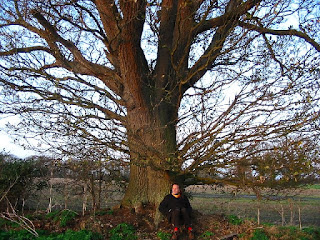
There is an oak I go to visit. Sometimes I just go there and sit under its huge spreading crown, and look over the fields and we keep each other company. Sometimes I visit when I feel fractious or discombobulated, or when a certain restlessness happens. I always greet the tree. Then I sit down and wait. At some point even on still days a breeze will rustle through the branches and echo in the nearby poplars. Within ten or fifteen minutes, I feel grounded and calm. Sometimes a conundrum or question I have is resolved. This is the effect of the tree.

I think a radical overhaul in our relationship with and approach to 'nature' is long overdue. All culture and civilisation is built on and over the earth's living systems and not the other way around. The earth is primary and we are secondary, as Thomas Berry put it.

In our present civilisation trees, like everything and everyone else, are primarily considered in terms of resources, how useful or profitable they might be. Or as property to be managed, cut down or controlled. Or we might see them in ecological terms, how they store carbon and provide oxygen. Our relationship with them is often abstract.

But what about approaching trees in their own right, seeing them as a part of the biosphere along with ourselves and other forms of life? Connecting and communicating with them?

Trees are always at home, wherever they are. Even though often we are not. Wherever I've spent time trees have shaped and informed my experience, whether growing up amongst beechwoods in Buckinghamshire, spending a season in an old miner's cottage under a huge cottonwood in the high desert of Arizona or the decade I've now lived in Suffolk. Much of this is due to the quality of being-at-homeness that trees possess.

In the face of all our human restlessness and running around, trees seem to be saying, hold on, slow down, wait (at least) a minute, stay awhile, take root, connect with where you are, with the planet, with life. Come home.

And Transition challenges us to get local, to start coming home.

(ii) Trees in Transition

I'd never really considered consciously until this week just how much trees inform transition. All the abundance projects, mapping neighbourhood fruit trees and planting walnuts, foraging and gleaning apples, plums, berries. Learning how to plant and prune.

In the thousand plus posts since 2009 on the Transition Norwich blog, This Low Carbon Life, the most popular label is Reconnection with Nature. We have hosted tree weeks with posts on The Gift of a Tree, Fruitful Trees and A Swinger of Birches and we've run a week on Deep Nature. In Sustainable Bungay's Introduction to Permaculture course in January 2010, which kickstarted the building of the Library Community Garden, I met Paul Jackson, a tree surgeon and nature lover, who helped save some threatened poplar trees in the village where I live. Paul also fashioned oak planks into seating for the central plant bed and planted fruit trees in the garden.

At a recent Green Drinks, Rob Parfitt, from the village of St. James, spoke about the orchard planted over the past few years by a group of villagers. Along with the varieties of apples and pears there are also quince, medlar and cobnut trees.

In the following conversation a feeling arose that what was now being done for pleasure by people in their spare time might well be a vital part of the resilience of the village in coming times. It was a kind of skilling up, learning to work together on the land and with the trees.

My own relationship with trees has expanded since becoming involved with transition. Previously I ordered wood for the stove from a nearby woodsman, stacked it in the woodpile and when it ran out, gave him another call. Later I would forage for wood around the neighbourhood lanes. Earlier this year I felled a dead elm at the bottom of the garden. There were three trunks, each between twenty five and thirty feet high. The first two I sawed myself with a bowsaw by hand (and if anyone copies the way I did it I accept absolutely no responsibility for any of the consequences). As I sawed through the wood my body entered a kind of merging with the action and the tree. It was total attention of the kind Kerry mentioned in her post on Wednesday. I had never felled a tree before but the two trunks came down in exactly the right place. I was sweating and exhilirated.

When it came to the third and biggest trunk the next day, it wasn't happening. I approached the tree three times and each time I became suddenly exhausted and could hardly lift the saw. I looked at the trunk. It was not that much thicker than the others. But my body was telling me something. I rang Nick from Sustainable Bungay and asked if he'd give me a hand. We finished the job together a couple of weeks later with a two handed saw.

So we had firewood from the  bottom of the garden which was great. And there was beauty too in felling the tree by hand, a tree we had lived with, walked past and seen from the window for years until elm disease took it, where the birds had perched and sung and rested. We could honour its presence and passing. And it was joyful too, working with Nick.

(iii) Taking Notice

This post would not be complete without mentioning the current plight of another of the hallmark trees of Britain and Northern Europe, the Ash, in the form of dieback disease. Government failure in the last two administrations to ban imports of live ash seedlings into the UK despite warnings that our ash populations could be seriously threatened, led to an article by George Monbiot in the Guardian calling the relevant environment secretaries to account. My hope now is that no rash eradication programmes are set in place before the trees have a chance to build resistance to the disease over time.

Ash disease, like those of elm and horse chestnut, calls all of us to account. We need to start looking at trees and the earth's other living beings in a different light and stop treating them and the land as simply property, resource or something that makes a nice view or blocks it. Or that we can cut down, uproot or trash as we see fit, without regard or negotiation.

These are the beings that provide us with timber for our dwellings and furniture, heat for our fires, shelter, shade, food and medicine. They are home to any number of birds, mammals, insects. Some of them give us grounding and answers in a restless, stressful time. They give so much to us and life. It's time to take notice of them. Mark Watson


Photos: Under the Oak, Winter Solstice 2011*; In the desert shade of the Cottonwood, Arizona 1996*; St James Village Orchard map by Rob Parfitt*; Felling the Elm with Nick, 2012*; Teaching Medicine Plants under the Silver Birch with Transition Belsize, May 2012** by *Mark Watson and Charlotte Du Cann, **Sarah Nicholl

Thursday, 25 October 2012

Winemaking - 'For Medicinal Purposes'

For Sustainable Bungay's 10th Plants for Life event last Sunday, Winemaking - For Medicinal Purposes, Nick Watts invited a dozen of us to his house for a practical demonstration of how to make fruit wine, in this case (sic) from raspberries.

Nick’s front room was filled with people (including Sophie and Nick from Transition Norwich's Low Carbon Cookbook group),  funnels, demi-john’s with deep red liquid and when you opened the door of any one of the cupboards you would discover a large container filled with a fermenting fluid. One demi-john contains enough for 6 bottles of wine at 750cl per bottle. Nick calculated he had about 80 bottles of wine fermenting at the moment.

First we took a look at some of the medicinal qualities of  raspberries. I’d been aware of the raspberry leaf  as a uterine tonic during pregnancy and childbirth and have used it along with yarrow to make a salve for piles. But for me raspberry fruits were always a delicious sign of high to late summer, picked fresh or bought from a roadside stall, and eaten long before they made it home to be turned into anything else culinary, let alone medicinal.

Raspberries, in fact, are incredibly rich in anti-oxidants and vitamin C. Eating them can help boost a poor appetite and they are useful in arthritis. See Hedgerow Medicine, by Julie Bruton-Seal and Matthew Seal,  for an excellent chapter on the many virtues and uses of  the raspberry, both leaf and fruit, with some great herbal recipes.

Penelope Ody in her book 100 great natural remedies has a simple recipe for raspberry vinegar: Soak 500g fresh raspberries in wine vinegar for 2 weeks, strain thick red liquid into a bottle and use in cough syrups, as a throat gargle or add to salad dressings.


Nick took us through the winemaking process in three stages, starting off a new wine and then using ones “I’d prepared a bit earlier.” He was keen to point out he was not an expert, having started about three years ago, but had really got into it and was happy to share what he knows with people.

This was the essence of not only this session but also a main impulse behind the whole Plants for Life project, and indeed Sustainable Bungay as a group and the wider Transition 'movement': If Nick could make so much and such decent wine (not to mention his delicious dandelion and burdock beer) from home and allotment-grown and foraged fruit by just doing it and immersing himself in it, then anyone with sufficient interest and initiative could. Watching Nick describe the process and go through it physically with a friendly group of people was absorbing and instructive, as well as good fun. It was a true skill-share.

What follows below is not necessarily the whole story, but what I learnt from Sunday's session:

STEP ONE
In a big bucket with 3lb raspberries (you can choose your own fruit, almost any will do), Nick poured on 5pts of water and added a teaspoonful of pectin enzyme to prevent ‘pectin haze’. He then mashed the raspberries with a wooden spoon and covered the liquid with a tea towel (very important esp. in summer to keep insects out).

This is left for two days.

STEP TWO 2 DAYS LATER
Add to the bucket between 1kg and 11/4 kg of sugar (preferably fair trade/organic, white) dissolved in 2 pts water off the boil. Add 1 tsp dried yeast with a little sugar all dissolved in some of the fruit liquid in the bucket.

It’s the yeast that turns the sugar into alcohol and the more sugar the sweeter the wine. Nick uses less (1kg) as he likes a drier wine.

This liquid is then stirred 2-3 times a day over the next four days, and the process is called ‘fermenting on the must’.

STEP THREE 4 DAYS LATER
This is the messy bit, where you strain all the liquid through a muslin sieve, before funnelling it into the demi-johns and putting an airlock on it. This is then left to ferment for between 3 and 18 months until there are no longer any bubbles to be seen in the airlock. During the fermenting process a stable temperature is important. Nick doesn’t worry too much about whether it’s warm or cool, just that there is as little fluctuation as possible.

STEP FOUR 3-18 MONTHS later
Decant into bottles and leave for 1-2 years depending on the fruit. Raspberries need less time than elderberries, for example.

After the demonstration, Nick invited everyone to taste some of the wines he's made. My favourite was the dry and fragrant Elderflower and Rosehip. I took half a bottle home and tried a glass with a dash of elderflower cordial - for medicinal purposes only, of course. And it was the perfect antidote to the recent gloomy days of continual rain and lessening light.


Photos: Raspberry wine fermenting in demi-johns; Nick instructing; Mashing the raspberries; Straining the liquid; Cheers on a rainy day (Mark Watson)

Friday, 5 October 2012

Retro blog #5: I never promised you a rose garden

As well as our topic and themes weeks on This Low Carbon Life we also wrote in three-day (originally five-day) shifts. It gave us a chance to focus on our "home" subjects and to see the breadth of each others' experiences and to respond (the great advantages of contributing to a community blog, as opposed to a solo one, is  knowing you are not on your own). These days allowed us to stretch our wings as writers and photographers and appreciate our different styles and takes on life.

Where we met was in our celebration of plants, people and places. So whether this was Jon talking about bees, planting an oak or finding a city fox, John reporting on his vegetable garden in Little Melton, or rescuing toads on Norfolk roads, Elena on the wild life at Norwich FarmShare or Helen celebrating the artist quarter of Magdalen Street, place making forms the heart of this blog. You could say it created a connection between us, as well as grounding us within our Transition stories. Climate change and "community" can be abstract things unless fully engaged with. A feeling, kinetic and imaginative connection to our neighbourhood and its inhabitants (not just human) help us all make ourselves at home in a rocky and restless time.

One of our most eloquent PPP reporters has been Mark, who manages to weave a love of the wild and medicine plants with an unswerving generosity towards fellow Transitoners. Funny, warm, self-depracating, as well as a great record of community events and meetings, his blogs regularly track the comings and goings of plants, particularly this year where he has curated a Transition medicine bed at Bungay Library Community Garden. I really enjoyed the winter (look still no heating!) Meanwhile let's talk about the weather, the springtime foraging epic Conquering Alexanders and the mix of midsummer meetings in  Life is roses... sometimes.

We are told that life should be a paradise, when we see all about us a wrecked and polluted kingdom. We depend utterly on the plants for our food and air and shelter, yet we are taught to treat them as mere commodities. Somehow we have to restore our relationship with the planet, with each other and get back on track.

Sometimes we find help in the most surprising places . . . .

Magdalen Celebration crew, 2011 from Shift Together - Working Title (helenofnorwich); Mark under neighbourhood cherry from Wallking with Weeds (Charlotte Du Cann)

Some Notes on Tracks and Edges by Mark Watson
31 March 2012
At the edge where we encounter another human being, we discover for ourselves what it is to have to break down a little... Cat Lupton

I am standing on the platform at Lowestoft Station. It is early evening. April 2010. And May. And June. In under an hour I will have traversed the Broads on the two-coach train, past the swans and waterways, past the big sugar factory, past the wide green and gold vistas and the boatyards. And will have arrived in Norwich where I am on my way to a carbon conversations course.

I have loved these journeys, made possible as they have been by a bus service connecting Lowestoft to where I live further down the coast. This will not last. The bus route which has run for 26 years will be reduced then scrapped altogether in the Autumn. No more connecting night buses. The carbon conversations will finish.

I am unsure about the carbon conversations, a 6-session course over twelve weeks aimed at helping people reduce personal and household carbon use and emissions using a non-confrontational approach. I often feel like I’m at school disrupting more well-behaved pupils in a quiet and serious class, and prefer the more creative, deeper, experimental nature of our Stranger’s Circle meetings where we bring our household energy bills to show each other, take a good look at the industrial food system, have difficult conversations about transport use. Where we're making it up as we go along. Where there's more of an edge.

Down the line (sic) I see the value in both approaches, and it was through both the Strangers’ Circle year and carbon conversations that the Low Carbon Cookbook group was born, which meets monthly to explore low carbon ways of buying, growing and preparing food (and write a book about it – always the hardest part!)

But back to the easternmost station in England. I have no such ambivalence about the journeys themselves (carbon-footprint-calculated though they were). Having downshifted in a major way over the past decade from someone who travelled all over the place in bus, car, train and plane, I rarely travel beyond East Anglia now. And I’ve learned to become less spoilt, less desirous of more ‘glamourous’ destinations, more present to where I am.

That platform for instance. If you walked past where the small train stops, where no one goes, in June and July of 2010, you would find, there at the edge, the most extraordinary outbursting of native wildflowers and medicine plants, all Growing Up Through the Cracks: midsummer Mugwort, St. John’s Wort, Plantain and Yarrow, Buddleia and Wild Carrot. All shining in the early evening light. The plant the Chinese use for moxa in acupuncture, the ‘sunshine herb’ dispeller of demons and nightmares, the menders of myriad wounds, the butterfly bush and the ancestor of one of our favourite vegetables.

It is so easy to hate: those who flail the countryside hedgerows and pour poison on the poppies by the junction of the main road. The stupidity of councils and people obsessed by tidiness. The compulsion to keep anything that smacks of ‘wild’ or ‘untamed’ out or under strict control.

Those rude, healthy, resilient plants. How dare they push through those cracks in the polite concrete and tarmac. In the end they were not left alone, beautiful and shining on that part of the platform where hardly anyone went, but removed in the manner of all ‘weeds’ in the name of civic orderliness. They still make their appearance further over on the tracks and by the fences though it’s not quite the same.

And anyone who loves the 'wastegrounds' and the natural world will know how difficult it is to live with the feelings that these things bring up. In my pre-Transition years I was frequently overwhelmed by them. Now after all the meetings and events, carbon conversations and circles, food and plant swaps, wild plant and foraging walks and experiments in downshifting, I still feel the same about the destruction of wildflowers and their habitats, but I'm tougher. I'm taking people out to show them where the 'weeds' grow, what their properties are, how they feed bees, how they heal us and how beautiful they are in their own right, and curating a plant medicine bed with related events.

Not that Transition has been either an easy ride or a magic pill. Learning to temper one's individualism to relate to others, even include them at all and not lose yourself, can be a struggle. There's the frequent temptation to cut off when that carbon conversation is just too, too... annoying. Boring. Left brain. Whatever. Or to simply go along with things that don't feel right because challenging them would make you feel like you WERE THE ONLY ONE IN THE WORLD WHO FELT LIKE THAT and EVERYONE would look at you like the OUTSIDER YOU REALLY ARE and you would be EXILED.

But engaging in that struggle, difficult, edgy though it is, can bring a meaning and sense to life which no amount of comfort or opulence will ever bring.

And the quote at the top of this piece? It's from an extraordinary post, Meeting Your Edge, by Cat Lupton, writing this week on The Place Between Stories about grappling with individuality and community after an introduction to permaculture course.

It was reading Cat's post that gave me pause to consider these things.

Pics: Mugwort Lowestoft railway station 2010; on the train to Norwich, Lowestoft, 2010; Midsummer wildflowers, Lowestoft, 2010; Plants for Life talk at Bungay Library community garden, 2012

Friday, 31 August 2012

Ribwort Plantain is Your Friend - Get Your Balls Rolling!

It's the last day of summer, a blue moon and I'm off in an hour or so for the last of the plant medicine 'surgeries' I've been holding at Bungay library community garden every Friday for the past few months. Between 1 and 3pm anyone can come and talk about plants as medicine, share knowledge and tips and visit the plant medicine bed.

These Friday sessions have formed part of Sustainable Bungay's Plants for Life project, which I've been curating this year.

As well as the central bed of the library garden showcasing a variety of medicine plants, the project also includes a monthly talk, walk or workshop on some aspect of plants as medicine. Authors, medical herbalists and biodynamic growers have given readings, shown us how to make great green teas, tinctures and oils and passed on invaluable tips for growing herbs. I have taken several groups on walks around Bungay exploring the medicinal value of the plants we call weeds.

Over the past month I've received so many requests from people asking which plants will help with insect bites and stings that I'd like to share some tips about a fabulous plant - it's common, handsome and grows everywhere. You probably step on it all the time.

When it grows unimpeded by human feet and its flowers shimmer in the light and breeze, you wonder why you never noticed it before. And it is truly a medicine chest.

And although summer is coming to a close, bites and stings will still be a possibility for some time yet, especially for those working on the land or in the garden, so...

Ribwort Plantain is your friend.

Bites and stings of bees, wasps, ants, nettles, mosquitoes, horseflies and fleas are alleviated by rolling a ribwort plantain (Plantago lanceolata) leaf in your hand into a juicy ball, and applying it to the bite/sting.

The leaves of this friendly, common, handsome plant have been giving me a hand all summer and I've been recommending it to everyone.

It really works, often immediately, and is utterly safe. And usually not too far away.

I was stung on the neck by a wasp in a local shop and after making a very unmasculine shriek, I went home, rolled a plantain leaf and applied it to my neck. The pain disappeared immediately and there was no swelling.

So get those balls rolling! And love those plantains!

Note: This piece is adapted from a post I wrote earlier this week, itself an extract from a forthcoming, more extensive post about the plantains. UPDATE October 2013: More of my posts about and including plantain and its marvels can be found here.

Pics: ribwort plantain flowering; ribwort leaves; ribwort flower close-up; rolled ribwort plantain ball (all by Mark Watson)

Sunday, 19 August 2012

ARCHIVE: Plants, Bees and Fascism in the Garden - High Summer Photoblog #1


Every day this week on This Low Carbon Life, one of the crew will be telling a story in photos (and maybe some words!) on the theme of High Summer. As the weather turned wet and windy last week, John joked that we might need a plan B for our theme week. Or was that plan Bee? Everything reminds me of Bees at the moment - as if with Bungay Beehive day next Sunday (where I'm leading a Bee and Flower Walk and also giving a talk about honey as medicine), I need reminding...

Meanwhile back to the photos, and a few words about my letting go of fascism in the garden. I have grown a white-seeded form of sunflower for years now, faithfully collecting the seeds at the end of each season to plant the next Spring. You can see if you click on the picture below that the flower has vibrant gold sepals with a beautiful green-gold centre.

I'd nurture the young plants (probably quite obsessively) and Charlotte would always make sure she was somewhere else when it came to planting them out as I would become inexplicably bad-tempered.

Anyway, this year as usual I planted the seeds, the plants grew and I was alone when it came to planting them out. But what were these flowers that emerged ten days ago - with bronze flames!?! Then I remembered the dark sunflower we had in the garden last year given to us by Rose at the Transition Norwich Plant Swap...

A moment of bewilderment and shock! Then over the next few days a strange sort of relief as I relaxed. I don't have to control everything! The new sunflowers are undeniably beautiful. And it means that the bees have been busy in the garden too. I think I can live with them.

Anyway, it seems I'm not alone when it comes to 'fascism' in the garden. I was telling Becky from Greengrow about my sunflower awakening on Saturday at All Under One Roof, where she had a stall next to Sustainable Bungay's.

"I know, it happens to me in the garden, too. And not particularly anywhere else," she said. "Have you read any Zygmunt Bauman, the Polish sociologist? He talks about the fascist elements of our modern consumerist 'gardening society'."

But enough of fascism. Here are a few more pictures of my low carbon high summer. Here's Charlotte on Saturday holding up the local paper with an article on Bungay Community Bees, featuring our main beekeeper, Elinor, and Elinor herself.


Here I am with Amanda, manager of Bungay library, looking at the Anise Hyssops I brought for the bee bed in the library courtyard garden this year. I talk about them so much that John tells me they are known locally as 'Mark's plant' in Little Melton these days! Amanda says they are very popular with both bees and people.

And last but not least, here is a St. John's Wort being visited by a honeybee in the garden. One of the great native wildflower medicine plants, I had never seen honeybees on it before. But this one clambered over every single flower gathering up the pollen. And yesterday the plant was full of bumblebees.

A few hours later: I just received a request from fellow Transitioner Nick asking if I'd lead the planting of the medicinal plant bed next year in Bungay Library Community Garden. I said yes of course and I'm already excited - by then maybe the fascism will have gone completely! Mark Watson

Pics: Banner of new sunflower, result of non-fascist gardening techniques
; last year's white-seeded sunflower head; new sunflower this year; Charlotte and Elinor at Sustainable Bungay stand at Satuday's All Under One Roof; Talking Anise Hyssop with Amanda at the library; St. John's Wort and honeybee