Showing posts with label lifestyle. Show all posts

Wednesday, 9 January 2013

Most Of It We Don't See

Image2921
What connects us and makes us resilient in the face of collapse, are the things you cannot ordinarily measure or see. Charlotte Du Cann
A year ago I felled a dead elm and sawed much of the first two trunks into logs by hand. These logs burned okay, but everyone said splitting the wood was better. Yesterday I split wood for the first time.
So here I am in heroic mode, spltting the wood. I did a pretty good job, was surprised it came so easily and felt very satisfied at the end.
But no one is a hero in isolation, not even a humble woodsplitting one. In fact, I think the whole hero thing reflects the hyper-individualism of our culture.
And there is always what you don’t see in the picture. And not just the photographer. In this picture you also don’t see Nick who lent me the maul you don’t see (very well) either. Nick helped me cut down the last of the dead elm trunks last year and sawed it into logs. Charlotte sawed another dead elm by hand on her own whilst I was out a couple of weeks ago, so even I didn’t see that.
Also remaining unseen are the people and the materials that made the maul, and all the actions and connections that led to our being here and to Nick coming over on Wednesday on his way to drop his daughter off at her boyfriend’s nearby.
All those transition meetings in Bungay and Norwich and skill shares and learning about global markets and industrialisation and wanting to be less dependent on them and get to know people and places closer to home. Wanting to chop firewood with my own hands, to work with the grain, the material.
And all the conversations over the years I was listening to without even knowing I was listening to them, about how to let the woodsplitting axe fall by its own weight and how to stand properly and not twist your back.
In fact a thousand words wouldn’t be enough for all the connections making up what lies behind and beneath this simple photo.
Golden Chilli Tree 2Or indeed this one. I don’t celebrate Christmas. This year, however, we found a broken bough of pine in the local wood and brought it home for the living room. On Christmas night something got into me and I cut into strips the gold paper Dano had given me at Sustainable Bungay’s Solstice/Christmas party and tied chillis to the bottom of them reusing ties from plants that had died down. The chillis were a gift from Malcolm and Eileen where we get our weekly veg box, a mix of the formidable Ring of Fire and the fragrant serrano.
We’re taking down the bough and chilli decorations tomorrow and so I wanted to share it here.
Though this piece is mostly about some of the things we don’t see.
Photographer unseen, Splitting wood for the first time 4 Jan 2013, by Charlotte Du Cann; Chilli, gold paper, use garden tie decoration on salvaged pine bough from nearby wood (MW)
This post originally appeared on the blog Mark in Flowers on 5th January 2013

Tuesday, 21 February 2012

Intellectual Adventurousness


When it comes to relationships, I'm not someone who likes to be in a cosy blanket of "love". I don't want it to make no difference to my friends whether I try to be a good person, or whether I just sit back and enjoy a passive, environmentally destructive lifestyle. No, I like to be challenged by my relationships, allowing my (and their) beliefs to constantly evolve. My best relationships, I feel, are with people with whom I have an ongoing debate on all manner of topics, including "contentious" ones, such as religion and politics. I always try to understand people's views, but if mine differ, and I can justify that difference, I prefer a relationship where I can speak out, and start a dialectic conversation.

So when it comes to Transition, there's a lot to talk about, because there is such a variety of differing views and beliefs. My friend Matt and I often find ourselves fighting for opposing corners when it comes to use of local shops or the effects of computer games on society, but this helps me to understand the complexity of such issues, and I'm grateful for it. I also have a very dynamic relationship with my parents, where my mum has in the past stood up for the conventional view of economics, whilst my dad agrees with me that there are too many people getting paid huge sums of money for just moving other people's money around, and that it's not right. My attitude to friendships is that if you are not affecting each other on both emotional and practical levels by being friends, what is the point of the relationship?

I don't currently have a girlfriend, but when I do, I'd like her to be "Intellectually Adventurous". I'm not too bothered about shared interests, and even her current political or social beliefs are not really an issue to me, but an attitude of adventurous debate, I feel, is important. When it comes to debate, no viewpoint is too radical to be considered, if it can be justified in some way. This, to me, is the best kind of relationship. It may seem strange and unconventional, but some of my happiest moments have been when two differing opinions, when discussed and thought through, converge to a single, enlightened truth.

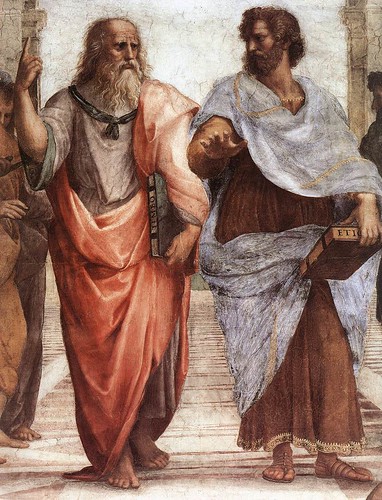
Image: Plato and Aristotle from The School of Athens or Scuola di Atene by Raphael Sanzio.

Saturday, 18 February 2012

Finding Mr Green

In case you don't know me I will just start with explaining that transition pretty much summarises who I am. It shares most of my values and beliefs, it defines how I try to live my life, I even work for a Transition Initiative albeit an unusual one, it is also what I want to do with my future. For more info on the depths of my Transitioness check out my How Transition Changed my Life post.

So with that clear, my answer to one of the question Helen asked us 'How much do you let the Transition lifestyle interfere with your relationships?' is that it's kind of hard not too when that's essentially who I am. It does, however, create additional hurdles in what is not the easiest quest in the first place.

The first fairly obvious side effect is that the number of people who can comprehend and accept (even if they don't follow) what I believe in and how I live is relatively small, making the chance of finding them much smaller. For example I went on a date with a lovely guy who turned out to be a carnivore capitalist (his definition not mine!) which was going to make things a bit tricky.

And how do you find these people? Those who agree with the transition ethos are so diverse that it's not like knowing you like heavy metal and so going to lots of heavy metal concerts. Transitioners don't follow stereotypes or labels (apart from that they are all lovely!)

This is not made easier by the fact that our society doesn't really offer many easy opportunities for talking to people and getting to know them. We seem to be expected to make all decisions on face value. Hopefully transition's community building is changing this, so maybe in 20 years time...

And if you do meet lovely people on the same path as you then another hurdle rears its head. Transatlantic relationships aren't really viable if you have vowed never to fly again. So a further limit - keep it local!

It's not all barriers and problems though (just like its not all hair shirts and lentils!). So much of Transition is about building positive, nourishing relationships that this can only be good in the long term. And we are constantly encouraging community and connections. So maybe it takes a wee bit longer to get started (no quick convenience culture here), but it's built to last and it's a lot more fun if your partner likes climbing trees and gets as excited about home grown jerusalem artichokes as you do!

Photos: maybe we need a transition uniform so that we are easier to identify - I'm voting for this stylish look, muddy matches online dating: lovely transitioners or feudalist recreational hunters?

Saturday, 11 February 2012

Seeing Things Differently #1

The #1 in the title of this post is there because being in Transition has made me see differently in so many ways. This post is about one of them.

I could tell you transition has made me more tolerant and that would be true. But it wouldn't convey the sense of what this actually means. Just being tolerant is okay, probably better than being intolerant in general, but it's a bit passive. "I accept people for who they are" seems like a nice-person type of thing to say, but the world is full of nice-person-type cliches. Cliches don't change the world.

There may be a better word than tolerance for what I'm about to describe, but it'll do for now.

If you look straight-on at what Transition is responding to as movement, it's nothing less than the collapse of our present industrial civilisation, built on peaking oil and other finite and diminishing fossil fuels, coupled with increasing climate insecurity, severely strained planetary life systems, and economic and social chaos.

In short, the collapse of the world as we've known it.

Building community resilience requires us to take the reality of these events seriously. This is more likely after an end-of-suburbia-moment when you've seen the 'terror of the situation'. The split-second when you realise you're living in life at the end of empire and that the world is not what your parents, friends, teachers, business-as-usual governments, global corporations or the BBC are saying it is - nor what you have been agreeing it is:
A civilisation relies upon a set of unconscious agreements as to what constitutes meaning and can be allowed into discourse. When faced with information that falls outside these parameters, cultures and individuals alike forget or neglect, or actively suppress, the ill-fitting data. Yet the repressed elements return to haunt us eventually...*
Maybe instead of tolerance, I really mean patience, or allowing enough time and space to see myself and others in a different light. So we can come to different agreements together, as valuable co-participants in life with work to get on with at a critical time.

We can't do this if we're going around seeing each other just as same old, same old nice person/nasty person, winners/losers who happen to agree or disagree with ME or be an ally or enemy to MY particular worldview or lifestyle. Particularly when that lifestyle has reached its best-before date.

Seeing ourselves and others differently is a task that takes persistent effort. All of us have been raised in and conditioned by the same system with its competitiveness, jealous rivalries and power struggles in a culture that says some people are better than others because of class, looks, education or financial status.

That's why tolerance or patience, or allowing time and space so the more co-operative aspects of ourselves and each other can emerge and our skills be recognised and valued is a practice really, an active rather than a passive thing.

And where better to practice it than with those fellows in transition who already acknowledge the situation?

Then we can really be the change we wish to see in the world.

For it is important that awake people be awake...
the darkness around us is deep.**


Later: As synchronicity would have it, the themes here find echoes in a great piece about Occupy Norwich on the One World Column today by Vanessa Buth.

* from 2012 by Daniel Pinchbeck, p.41 (2007, Piatkus Books)
** from A Ritual to Read to Each Other in Stories That Could Be True: New and Collected Poems by William Stafford,
p.52 (1977, New York: Harper and Row)

Pics: Woodbridge station arches looking through the window; Honesty, Darkness and Sunlight (both MW, January 2012)

Thursday, 9 February 2012

Skill Sharing as a Way of Life in Norwich and Bungay

I didn't really notice it at first. There I was in the early days (2008-9) at Sustainable Bungay meetings saying 'Oh a local food conference, how brilliant, I'll help out with that, I can do front-of-house, dish out some soup, help wash dishes, learn something about food systems'.

Or spending the day learning to graft and plant fruit trees and use a sledgehammer for the first time (to secure the stakes) at growers' co-operative Greengrow down the road.

Or speaking about Deep Ecology with Transition Norwich, though I hadn't spoken in public for years.
And that was just in the first six months of being in Transition. I was responding at a deep level to what Ann Owen described last Monday as
being open to learning anything from anybody, anywhere. No need for teachers or schools, just the willingness to share what you know and can do, with others, who will likewise share their skills with you.
Coming away from that grafting and planting session on Valentine's Day 2009, I was in love with digging and sledgehammering and delighted to have learned the names of three varieties of apple I'd never heard of: Ashmeads, Kernel and Suntan.


And so when, over two and a half years later, Gemma (co-chairman of Sustainable Bungay) rang up to say someone she knew had moved and left a young orchard behind which the new owners were planning to JUST DIG UP and THROW AWAY!!! (excuse CAPS of frustration here - that kind of thing really gets on my nerves!) would anyone like some apple trees, I (along with almost everyone in SB) said YES PLEASE!

And even though it was August and hot and dry and traditionally a dreadful time to uproot and replant the trees, I took a Katy and a James Grieve, dug two large holes, made sure there was no strong grass there and planted them. But not before speaking to three fruit tree growers I've got to know since being in Transition. They varied in their optimism as to the trees' survival prospects but they were all unanimous on one issue: WATER, WATER, WATER. Soak those trees! At least once a day, twice even.

And even though I'm not religious, I watered them religiously. I spoke to them, 'that's right fellows, you can do it!' Right now they have healthy looking buds all over them. So we have lovely replacements for the trees we've lost over the years.

Engaging in the reskilling/skillsharing aspect of transition has revolutionised my whole attitude towards life. As I say, I didn't really notice it at first. It's been cumulative and all-pervasive. Paying attention to my own skills and those of fellows-in-transition, which are dismissed or ignored in the mainstream discourse: the ability to hold a meeting where everyone's included; communicating the experience of downshifting; learning to cook, eat and shop for food differently as part of the Low Carbon Cookbook crew; making space so solutions can emerge in the face of energy and financial constraints, using a chainsaw, making a rocket stove at the Transition Camp!

Here are some more skill share examples from Sustainable Bungay and Transition Norwich: In the picture on the left Josiah shows me how to navigate the new Sustainable Bungay (Wordpress) website in May 2010, (along with his daughter Iris) in the kitchen. This picture was included in the Transition Companion for the ingredient: Transition Towers - having an office or not.

I learned to bake sourdough bread from Jane in Transition Norwich, who always arrived at meetings with a delicious freshly-baked loaf. She visited us one November day in 2009 to pass on her skill and the gift of a leaven she'd originally been given by Andrew Whitley at a breadbaking course.

And what of some of the skills I'm sharing? Having worked in what I call the Transition Engine Room in the Norwich and Bungay initiatives over these years, guiding Gemma to set up her own twitter account over the phone last month was peanuts (or maybe cobnuts!). Never mind that I didn't even know what Twitter was until a year ago - and I was quite snooty about it at first!

And in December I spent one Sunday afternoon in Elinor's kitchen teaching fellow Bungay Community Bees to make a Yarrow salve with our very own beeswax.

Of course it's not just about me. Eloise has led a series of sewing groups in Bungay library on winter Sundays, where anyone could turn up (sic) from complete beginners to experienced sewers and make curtains, learn how to hem or use a sewing machine. Rose is organising a Skill Share, Knowledge and Resources Directory (also the subject of our next Green Drinks).

Kerry and Helenofnorwich have been reskilling in Transition Norwich in all the colours of the rainbow since the beginning. Talking of rainbows, click here and then again on the video in the post (I'm unable to embed it directly)... And there are all kinds of practical tips and hints in the posts on This Low Carbon Life on everything from insulating priest holes to accepting feedback and the basics of permaculture to communicating and forging alliances with other groups.

As Kerry said in I love Reskilling last week, every time you learn something new (or teach something you know), you get more confident, you feel life is much more in your own hands. And it's enjoyable to share knowledge with other people.

It's as if skill sharing works its way into the fabric of who we are. And becomes a way of life.

Photos: Preparing the Ground at Greengrow Feb 2009; Growing Local Conference poster, Sustainable Bungay November 2008 (Josiah Meldrum); Website skill sharing Transition in the Kitchen Office, May 2010 (Charlotte Du Cann); Sourdough breadbaking November 2009 (MW); Twitter pic, January 2012; The Colours of the Rainbow knitting with pride, 2010 (helenofnorwich)
This post (amended slightly) was originally published as part of the Social Reporters' Skill Sharing topic week on the Transition Network site.

Friday, 3 February 2012

A world with hope

Transition made me the person I am. It has guided the path I walk, the people I know and the way I think. It gave me hope. I cannot imagine a life where I was not involved with Transition.

I first discovered Transition during my third year of university, when I heard about the 'Great Unleashing' of Transition Norwich and thought it sounded exciting and something I would be interested in. I had been bought up with a love of nature and being outside and I was studying all of the ways we were destroying our world at university. I was getting tired of just studying what was going wrong and I really wanted to start doing something about it. I had got involved with a lot of the environmental groups at the university, but I had never really felt comfortable with Protest and Direct Action. I recognise their value, but the anger and negative angle never resonated with me. I was drawn to the positive projects, such as setting up a veg box scheme on campus, but I hadn't really found my niche. It all felt too small, not quite right, too isolated.

I had also been living in Norwich for 2 years and I still hardly knew people outside of the university. And then Transition started and WHAM!

It all started with lots of meetings, lots of discussions. I learnt a lot and met lots of diverse, but all lovely people from across Norwich and East Anglia. It was a gradual process, but we started to build a community, I felt I was part of something, I had found lots of other lovely people who were also trying to do something to make the world better.

I had already learnt about Climate Change and Peak Oil in my degree, but for Climate Change the solutions all seemed very big and imposing and the advice we were given on Peak Oil was stockpile food and buy a gun......so Transition's positive vision for the future and can do optimism were the balm I needed. They gave me hope that another world was possible, that enough people cared. And I came to realise that solving all of these problems could actually lead us to a better world as well.

So I jumped in with two feet and pretty soon I was attending 3 or 4 Transition meetings or events a week and my life was revolving round Transition. When conflict reared its head I was shaken and disheartened, but Transition had given me an enduring belief in what is possible. So I developed an ongoing interest in non-violent communication and healthy group dynamics ('Groups' are something we are missing in our current society and we need to relearn how they work.) And we got through and were stronger for it and we moved into the action phase and there were lots of wonderful events and activities and projects that emerged.

I have learnt so much from other inspiring ordinary people and through my experiences about how we can live a happy low carbon life. So when it came to finding a job I wanted something that could help create this world, hence the fact that I have been working for a Transition Project since May. My contract finishes in March but one of the criteria for my next job/location is that it needs a Transition community...

I do not know where I would be now if it wasn't for Transition, but I am sure that the last 4 years wouldn't have been anywhere near as exciting, eventful and happy. And I wouldn't have such hope for the future.

Photos: One of the first Transition Norwich Open Spaces, the Transition Norwich contingent in the Lord Mayors procession with Celeste the dragon, A rag bag that I made in a reskilling workshop and the flier of Transition University of West Scotland who I work for at the moment.

Saturday, 12 November 2011

Entering Transition Circle Hethersett

This is our first contribution to This Low Carbon Life and happily it feels particularly relevant to be writing about our experiences with Transition at this point in time. Steve and I attended the ‘Great Unleashing’ three years ago and were very excited by the event but the actual reality of engaging with Transition has only recently begun to emerge and develop in our consciousness and behaviour. It feels as though we have very much been on a slow burn with this movement; aware of its significance and importance but hesitant to do more than show a concerned interest in it.

The Hethersett Transition group
, although it has sometimes lacked cohesion and momentum, has been a supportive nudge in helping us to actually start engaging with Transition. Seeing how others are committed to the movement has led us to reflect on our own lifestyle and expectations and to do more than just contemplate making changes towards a more sustainable lifestyle. However, we are still very much beginners in this field and it feels as though there are many daily obstacles to overcome before we could begin to call ourselves Transitioners. We, like, I imagine, many of the ‘concerned interested,’ are wary of some of the real, hard choices to be made. It feels like there’s a jarring between how we have been living and how we’d like to and ought to, live. We’re at a bit of an uncomfortable stage and it’s easy to feel inadequate when the ‘old’ unconscious way of living comes up against an increased awareness of the issues.

I don’t want this blog to be a whinge about how difficult it is to engage with sustainability nor a guilty confession about our ‘bad’ consumption habits. Rather I’d like it to be an opportunity to explore honestly the difficulties of engaging with such changes when other structural aspects of our lives seem to require a different pace or way of being that seems to be at odds with living sustainably. I also want it to be about how a community group like the Transition Circle can support and encourage people to make the changes needed.

In February 2009, with the first wave of the property crash resounding in our ears, Steve and I moved from our small terraced house in north Norwich to rent a large, old farmhouse cottage in Hethersett. We fell in love with the place at first viewing and immediately envisioned chickens, vegetables and freedom loving children all flourishing in the very large garden that surrounds the property on two sides. However, the reality of living in a draughty old house with costly oil fired heating has at times been more like a nightmare and the garden has seemed like an enormous burden rather than the gift it could be.

Steve works four long days a week as a counsellor and CBT therapist and I am currently on maternity leave with our second child, although I normally work three days a week also as a counsellor. We have three children between us and weekends are very child focussed. We both have professional commitments that require us to ‘work’ in addition to our paid hours (supervision, CPD, book editing etc) and Steve is currently doing a PhD. We are active members of a church in Norwich and so the list goes on! Our greatest poverty is time and increasingly our depleting reserves of personal energy and tightening finances are posing even more obstacles (excuses?) in the way of introducing new ways of living. Nevertheless, we do want to live slower, lighter lives while also providing a good quality of life for ourselves and our children.

I don’t know why it should seem that the prospect of living more sustainably might impact on the quality of our life, but it does. If it were a seamless transition then everyone would have engaged in the process already and looking at the queues for parking in Norwich on weekends, I know this is not the case. The shift to living more sustainably does not so much feel like a purely practical one but a cultural one too and it is really quite daunting. And this is where I think the local groups can really come to the fore: by connecting people at all stages of their journey and by engaging those who would like to be involved but don’t know how or feel too intimidated to ask.

It seems crucial to me that established group members have to be non-judgemental and welcoming. It’s a bit like welcoming people to a church without making any assumptions about where they are in their spiritual journey. We are lucky in the Hethersett group to have some very experienced members who can share their knowledge and skills in this way and who put a lot of effort into making things happen.

Last week, they came and had a look at our unloved garden to offer some ideas and advice for growing veg. It is really encouraging to find people who are willing to offer their time in this way and the result is that we really do want to find ways of engaging with the process. Like any process of change, it might just take a bit of time and we might not take all the advice offered.

So how far have we come in reducing our carbon footprint? Well, Steve cycles to work every day and I have become much more conscious of how we waste energy at home. When the baby is old enough to go on the back of the bike, I will also cycle to work. Although with two children in tow, I reserve the right to use the car when the weather is terrible. The old house is no longer quite so cold; our landlord installed a new boiler and radiators when we pointed out that we were using oil at double the rate of our neighbours and we have put thermal blinds on the windows where possible.

Three of our main challenges as a family are to reduce waste, especially plastic packaging; to be more organised with our shopping so we can reduce our dependence on supermarkets and subsequently the car; and finally, to find more ecological ways of managing the huge amount of laundry we produce every week.

We’ll being doing a bulk food order with the Hethersett group once again soon and I promised some time ago to look into bulk ordering for detergents. With so much laundry to do it’s now definitely in my interest to get this done. Food and drink packaging is a real annoyance for me as our kitchen recycling and rubbish seem to take on gargantuan proportions every week. This is going to be my personal project as I do most of the shopping and if anyone I know is reading this; I’d really like a Soda Stream for Christmas so we can eliminate plastic bottles for ever. As for the veg growing, I’m pretty sure we’re not the Tom and Barbara we envisioned when we first moved house. Rather, we might have to revise our own vision of what it means to live more sustainably and opt for a more modern, energy efficient house that’s easy to clean and maintain. If this means eventually giving up the garden and leafy outlook in return for a sense of manageability in our lives then this seems sensible to me. In the current absence of another housing option however, Steve is going to try some of the advice from our fellow Transitioners and tackle the beast once again. Ruth Roberts

Thursday, 3 November 2011

So I'm a Transitioner, am I?

Thanks to Mark, who's allowed me one of his blog spots this week. I realised that since joining the bloggers in April, I have only really been posting during theme weeks, and consequently have been limited in what I could write about, so in this post, I hope to convey a bit more of a personal take on what transition means for me - a bit of heart & soul, if you like!


I'm 26, and a recent masters graduate. Like many recent graduates, I haven't got a full-time job, and the prospects of getting one, at least within my field of study (Architectural Engineering) remain dim, as even rapidly expanding companies seem to demand at least five years of relevant work experience. I'd be slightly more bothered about this fact, however, if a 9-5 graduate position in a consultant engineering firm was really going to fulfil my desires and ambitions for life. Whilst it would be great to have a regular income and the opportunity to develop my skills, I can't bring myself to pine about my lack of formal employment, not whilst the reward for such effort would be the opportunity to join the consumer society, ravishing the Earth with each new gadget, branded item of clothing or trip abroad that I liked the look of.

Being underemployed has given me the great opportunity, which I have embraced wholeheartedly, to think about the effect that I have on the environment, on society, and on our economy. When you have to consider what each pound that comes into your care is going to be spent on, lest you fall short at the end of the month, you get to appreciate its effect.


From August 2010, when I bought my car, to August 2011, when I sold it, I kept a record of all the journeys I had made, how much it was costing me, and what the journeys were for. This exercise alone taught me a lot, and gave me a new perspective on transportation, and on accommodation. Since I was living 16 miles out of Norwich, in a village with no public transport links whatsoever, the car was a necessity, but after thinking about it, was living 16 miles from Norwich a necessity? The answer - no. So now I live in Norwich, sans car, and paying approximately the same amount each month for the privilege, not to dirty oil companies, but to a dear friend and landlady, whose value, to me, is far greater than any international corporate conglomerate could ever be.

This move alone, though, does little to satisfy my thirst for peace of mind in terms of my impact on the world. I don't just want to have a not-negative effect on the world (and no doubt I'm still nowhere near that, at least ecologically), I want to have a truly positive one! I want to see more than our society just coping with the challenges imposed by the economic system and ecological limits of this world: I want to see a transformation! I want to be part of that transformation, and I want our society to thrive! This cannot be done just by ditching the car and using a bike. It's a much wider scope - a scope which Transition is the only movement/organisation that has the courage to look at in its entirety, and why I am proud to associate myself with it.

It was so inspiring, for me, to attend the discussion meeting after Nicole Foss's talk on the financial crisis, where the challenges of our modern world were being faced from so many different angles. Our civil liberties being undermined in the name of international security, producerism being the driving force behind consumerism, government cuts skirting round the only sector which deems them necessary. And at the core of it all, being our own media with our own vision (rather than that given to us by "The Media") as the only solution which can carry us through the challenges ahead.


So, when I cut up my Natwest credit card, and transfer any remaining funds which I still hold with them away, I'm not just taking action because it's what I want to do — in fact, by doing so, I lose out on £1000 worth of interest-free overdraft amongst other graduate "benefits" — I'm also making a statement to anyone who cares to listen - that investment in tar sands, arms trade and other destructive projects is wrong; that massive bailouts should not be coupled with increasing executive pay; that I want any savings I hold to be available as loans to small local businesses, rather than only to national or international chains with no interest beyond this quarter's profits; that I stand in solidarity with the millions of people who agree that the 99% of the people of this world pay the price for the extravagance of the 1%, and are protesting all over the world (including in Norwich) to bring about the changes required to correct this.

But in the end, I'm not the type of person who will just stand here shouting about what I want until someone else comes along and sorts it out for me. I'm a doer, and may every action I take transition to a world that is better - ecologically, socially and economically.

Images: my graduation; cycling in Norwich; Natwest credit card - cancelled.

Monday, 31 October 2011

The goose is getting fat...

Approaching the end of October, you can't miss the fact that the shops are already gearing up for Christmas - the Chapelfield lights are "officially" turned on this week, Thursday I think, to coincide with late night shopping. And between now and 25th December, we, of course, have two other important festivals - Halloween and Bonfire Night. The shop windows are already jostling each other to fill up the space with plastic pumpkins and fake fangs, or fireworks and boxes of toffee, or the usual seasonal fare of snowflakes and presents. It's all crept up on us, I think, the association of these traditional festivals with unending amounts of plastic stuff and the unrelenting push to buy things.

We were up at Bewilderwood with the girls yesterday, and they had some wonderful real pumpkin lanterns, and jam-jars with tea-lights in, dotted around the trees. We made lanterns out of willow and tissue paper - very tricky if you've never done anything like that before. We went home before the sunset parade - it was cold and we were all hungry - but I imagine it must have been magical amongst the trees. OK, Bewilderwood isn't the cheapest day out, but they'd clearly thought hard about what they wanted to do for Halloween.

Tully wrote a wonderful piece about Bonfire Night a while back, and it's well worth reading in the run up to next weekend's public firework displays. I do love fireworks - I know they're probably not environmentally sound - and I love a good bonfire. Being something of a hippie at heart, watching fireworks always reminds me how lucky we are to be able to watch what are essentially controlled explosions safely, unlike so many people throughout the world and throughout history, for whom a skyburst display like that would be something to fear and hide from during all the wars that have been fought since gunpowder was invented.

Now, Christmas - can I offer one suggestion for all those thinking about Christmas shopping? Ask people what they want. Don't wander into a store and buy whatever's on special offer. Your recipient probably won't really, really want a Simpsons' mug and coaster set, or a packaged mortar and pestle set with authentic chinese spices. If they did, they'd probably already have them. If they do harbour a secret unrequited wish to drink coffee out of Homer's head, then here is your opportunity to find out and get them that dearest wish. But ask first.

And can I also suggest that, in return, if someone asks you what you want, tell them straight. Don't pretend you don't want anything and then be offended if they either get you exactly that or you find yourself grinding chinese spices by new year. Of course, if you genuinely don't want anything, say so. And make sure they know you mean it.

You might just get your best present ever.

Monday, 5 September 2011

It's not about the building

This week's blogging will feature transitioners showcasing things we have done to our homes to help us be lower carbon users.

As I write this, my trusty woodburner has been dormant for several months, and seeing it in the photo here, makes be look forward to the cooler and colder times ahead!

Lance Armstrong, the cyclist from Texas, famously wrote a book entitled 'It's Not About the Bike'. As I reflect on what I have done in my own home, and looked at the energy bills steadily tumbling, I realise that this has been achieved as much through my own behaviour change as through doing small technical bits and pieces to my house. Or more precisely, it is through the relationship between the technical bits, and me as a person.

So....when I installed a standard water butt (30 quid) to feed my loo with rain water,( featured in a previous blog) I began to become much more aware of water usage generally, and found myself doing things which I had not thought of before - often simple things like capturing the run-off when running my hot water tap, rather than let it down the drain. The overall result is that I pay £5 a month for my water.

I live in a typical Norwich mid-terrace Edwardian house, sometimes regarded as a nightmare for 'greening up'.
However, given most of us are not in a financial position to build our own, we're faced with looking at what we have, and what we can do....and the solutions are sometimes surprising.

That rather large window you can see there in the bay - sadly modified in the great 60s rush for demolishing all things past - does now in fact have a retro-fitted sealed double glaze in it. So rather than replacing the window - which is what many a double-glazing company try to sell you - I replaced the glass in the existing frame. For the technically minded it is a 'stepped double glaze' unit, with argon filling and K-float on the inner glaze. Because it is south-facing, in the low winter sun, I find that the room now warms to a nice 18 or 19 degrees from solar gain, when the outside temperature is only 1 or 2 degrees, with no internal heating on. That is helped by the underfloor insulation I have installed under the floorboards.

So... for the rest of this week, we will be hearing from Mark on the subject of sheep's wool insulation and Council grants, Simeon on how he managed (with his parents) in no less than a listed building, John on the vagaries of dealing with a 1970s bungalow, and James, as guest blogger on the CPRE Green Buildings open days as a whole. James Frost of CPRE has been the inspiration in setting up the Open Days which showcase individual buildings of a huge variety throughout Norfolk. It has been so successful, that other regions are looking to replicate the model - James will be writing about this on Friday. (See : http://www.cprenorfolk.org.uk/greenbuildings/tours). On Saturday Charlotte will be reflecting on the world of Transition interiors and looking at Stefi Barna's (Magdalen Street Celebration) retrofitted house in NR3 and a strawbale designed and built by Carol Hunter and John Preston from Downham Market and Villages in Transition.

As a blog reader, please get the questions and comments flowing, as there will be some nice juicy, gritty, practical stuff coming up this week!

Sunday, 28 August 2011

Hedgerow Resources

Despite the remit of this week I definitely wouldn't be leaving my copies of my chosen books on a bench anywhere, I couldn't bear to part with them. I would, however, definitely consider buying more copies and leaving them on benches to spread the word. And that in itself is a high recommendation of them as I don't tend to buy books now-a-days. I find that Libraries amply supply books that I want to read. The only purchases I permit myself are reference books that I will not necessarily read all in one go, but will keep refering back to for years to come.

So now that I have thoroughly piqued your interest I shall introduce my chosen books. The first is actually by Norfolk authors Julie Bruton-Seal and Matthew Seal, Hedgerow Medicine: harvest and make your own herbal remedies. It is a fantastic introduction to the ecology, history, folklore, medicinal properties, harvesting techniques and potential uses of 50 herbs which can be commonly found in UK hedgerows. It is clearly laid out with beautiful photographs and is very easy and enjoyable to read, although it is impossible to take in the information on more than a couple of herbs in one sitting! As well as providing interesting anecdotes (such as the fact that WW2 pilots ate blueberry jam sandwiches before a flight to improve their nightvision)there are also many easy to follow recipes for concocting your own remedies with clear explanations of their medicinal properties.

My other book is River Cottage Handbook: Hedgerow by John Wright. Now I happily sat down and read this book in one sitting, not because I was able to absorb all of the information in it at once, but because John Wright is such an engaging and amusing author. I would like to treat you to an excerpt:
"I am frequently told that going on a walk with me can be rather disconcerting. Except for the occasions where I offer my companion the odd leaf to chew upon, I appear to be strangely distracted and barely listening to what is being said to me. Well, I am - usually - listening; it is just that I am doing something else as well - looking.

Once one learns the foraging way of life, it is difficult to stop. If my walking is absent-minded, my driving is lethal. Foraging at 50mph, with eyes darting right and left and the occasional abrupt punctuations of the forager's emergency stop, has made me a danger to all road users."

And I know from experience that foraging on a bicycle is not much safer! In common with hedgerow medicine, this book gives you a detailed introduction to each plant, its distribution, appearance, harvesting technique and ways of eating it. It also, usefully, details some of the very poisonous plants that you need to make sure you avoid!

Between these two books I am slowly, season by season rediscovering my environment and transitioning my approach to food and health. And how exciting it is to concoct your own Rosehip and Rowan berry syrup to boost your immune system. For me it is the ability to take these books in bite-sized chunks that appeals to me, so when I happen to spot something whilst on a walk or I find time to go on a foraging foray I can dip into these treasure troves of information and glean a bit more knowledge of the world I'm living in and how I can be a part of it.

I would like to share these books with other people as they are easy and engaging introductions to foraging and herbal medicine. The revelation that you can eat things that grow all around us and which you can collect for only the cost of your time, challenges the supermarket concept of food, linking the consumer directly back to the source. Similarly herbal medicine calls into question some aspects of our current health system, especially the 'purity' of many medications, which only consist of one or two different chemicals and are consequently quite harsh on the body. In comparison plants are incredibly complex, containing many different compounds that work in harmony to affect change in the body, this results in much gentler medicine.

A greater understanding and personal control over our food production and healthcare will be very useful skills in the Transition. As will an increased connection to our environment. So come on, give it a go, eat weeds!

I did have lots of lovely photos for this blog, but blogger is having none of it so I will have to add them later!

Saturday, 27 August 2011

Survival - a Planetary Healers Manual

Can reading a book change someone’s life? Who knows what course my life may have taken had I not bought a very strange book back in 1976. I had a pretty conventional time at University – by the standards of the 1970s – and enjoyed myself at the taxpayer’s expense in rural Devon. That was followed by an equally conventional life of work in London in the early days of IT – yes computers really were the size of buses then. So I have no idea what made me spend quite a lot of money on ‘Survival into the 21st Century, Planetary Healers Manual ‘ by Viktoras Kulvinskas – maybe it was the pretty cover!

I read the book on the tube (no Ipods in those days) and people peered over my shoulder at the exotic (and some erotic) illustrations. The contents were a complete revelation to me – in the dark ages before the internet people were much less likely to be exposed to ideas and thoughts from outside their immediate circle of friends.

My partner at the time took one look at the book and exclaimed with dread “you’re going to become a vegetarian!!” – well she was not quite correct but I certainly ate a lot less meat and to her credit she took on board a lot of the messages from the book once she got over the initial shock.

‘Viktoras’ – as we called the book for short – led me to join Friends of the Earth, take up Yoga and WOOFing and ultimately to move to the country to grow my own food and now to Transition. I don’t claim that this book will have that effect on everyone – it was very much a product of its time – but if it inspires some people the way it did me, then so much the better. Unfortunately I leant my copy to someone in 1978 and I’m still waiting for it to be returned – so I’ll have to refer people to the library if they want to read it.

So what did Viktoras write in this magic book? From what I remember it was a compendium of ideas for healthy eating, sustainable living and just about every weird idea that was new and crazy in the 70s. One fact that I have tucked away for use in a time of word turmoil is that one can derive much more nutrition by sprouting grain than by baking it as flour. So you will know things are really bad when I dig up the remaining lawn to grow seeds for sprouting!

pics from www.survivalinthe21stcentury.com/

Friday, 26 August 2011

The Spirit Level... and never said a word

I have a book in my possession with a ‘wandering word’ BookCrossing sticker in it. I didn't find it on a bench though, it was given to me last winter by Erik at a Low Carbon Cookbook meeting. And although I’ve read it, and would recommend it highly, I probably won’t be leaving it on a bench any time soon. But only because I have no plans to visit Germany soon – if that changes I’ll take it with me…

The book in question is Heinrich Böll’s …und sagte kein einziges Wort (…and never said a word). It is set in Germany around the end of the 1940s and tells the story of a married couple as they struggle to meet their most basic needs and stay together in a world trying to rebuild itself from the ruins and trauma of war. This is a Germany in transition, a Germany in the predawn time of the Wirtschaftswunder (economic miracle) of the 1950s.

The story is narrated in turns by the man and the woman and Böll’s language is sparse and clear as he relays an almost visceral sense of postwar reality. There are the bombed out churches, grey government buildings and the rented room the couple and their two children live in, separated from their neighbours only by a flimsy screen. There is also the face of the woman, prematurely lined from hardship and worry, looking into shop windows at clothes she can’t afford and the gaunt figure of the man as he enters a Kneipe to spend the last of his change on schnapps and the pinball machine.

…und sagte kein einziges Wort is a kind of novel-cum-social report. It is frequently harrowing with an ending at once ambiguous and with a glimmer of light. Not precisely holiday reading. Then again we're not really in holiday times.

If …und sagte kein einziges Wort takes place in a Germany in transition after the second world war, then The Spirit Level by Richard Wilkinson and Kate Pickett is firmly set in the first decade of the 21st century.

I am not a fan of books filled with statistical graphs. Having to prove everything exists by researching numbers then crunching them into averages has become endemic in our culture, even pathological. As far as social inequality goes, (which is what The Spirit Level is about) a good look around at our society (the recent riots, government spending cuts aimed at the least well off, a walk around any city, talking to people) will tell us most of what we need to know.

But The Spirit Level is a book well worth reading, for all its graphs and statistics. Its main aim is to show the social effect of income inequality (i.e. the gap between rich and poor) in different countries in terms of those countries' well-being.

The book looks at factors such as life expectancy, physical health, obesity, depression, education, teenage births, violence and punishment and provides evidence to show that in countries where the income gap is large (such as the UK), everybody is adversely affected. In other words it shows in tables and graphs what most of us in our hearts are aware of. That social inequality, with its attendant atmosphere of hostility and mistrust, is bad for all of us, with perhaps the exception of the very rich. And it is the level of income/social inequality within a country and not how wealthy a country is in and of itself which is the determining factor.

Other key points in the book include a necessary shift of “attention from material standards and economic growth to…improving the psychological and social well-being of whole societies". There is also the need to get beyond seeing the problems we face as individual psychological issues with individual therapies and remedies, to seeing them systemically, and ourselves as active parts of the social and political fabric.

And perhaps our greatest challenge lies in the last point above. Each one of us has been educated and conditioned to think and act individualistically (though not necessarily as individuals). So to shift to thinking in a more social way, as a member of society, is to go against that conditioning and is therefore a task. A task requiring both individual and collective effort in the face of a future where a 'Wirtshaftswunder' of the kind Germany saw in the 50s remains highly unlikely.

Photos: Heinrich Böll book cover; photo from BBC documentary 'Poor Kids'; The Spirit Level cover from the Equality Trust

Thursday, 4 August 2011

Sun, sea, sand and ..........

Sustainability of course, what else would you be thinking?

But if you were thinking about something else then how would you have an environmentally friendly romantic relationship? More and more of my friends are meeting people through Internet dating. You can find your absolute perfect match. No need to be three dates in before you find out they don’t recycle or read the wrong newspaper. But it seems that when you find your perfect match they invariably live in another part of the country.

So how would you find a partner in your own postcode area? We were discussing this in the Magdalen street Celebration meeting ( yes we had drifted off the point slightly).

So I have come up with a few places I think you could try. Please feel free to add send us more ideas:

The bicycle shop ( full of green types and great locally produced food)
Transition meetings and events have lots of lovely people and you could probably go to several meetings a week until you found someone that took your fancy.
Norfolk Quakers (I slipped this one in as they are very environmentally friendly individually and as an organization)

I recently took some flowers on a date that I picked from a graveyard (they were not from a grave, that would be wrong) and I took some cider from the Norfolk Square Brewery shop in Magdalen Street. Of course if you were going out with a non-environmentally type they would just think you were either weird or a bit of a cheapskate. These things are only partly true.

Sunday, 24 July 2011

Stupermarket Break Out!

In the third of our occasional Sunday cross-posts Rachel Lalchan, editor of the Ecomonkey blog and one of the organisers of the Magdalen Streeet Celebration, reports on her recent withdrawal from buying stuff at supermarkets.

It's been over 13 months since we shopped in a large, intense, brightly lit, empire of grocery consumerism and I'm happy to report that life sans supermarket is not only viable but quite wonderful! With no intention of going back, I hope you will consider quitting too!

The thing about supermarkets is that there's really nothing super about them. Ripping off farmers and producers both here and abroad, selling cheap products at huge cost to suppliers, tricking us into buying far more than we need, producing tonnes of unrecyclable waste, filling our landfills, upping CO2 emissions, encouraging detrimental consumer habits, grabbing land from local ownership, promoting unhealthy over-processed crud disguised as 'food', destroying local communities and values as well as our own farming industry, I mean really, what's super about any of that?!

To ensure that farming can continue in the UK as part of our sustainable present and future and that we can feed ourselves instead of relying on other countries for our nutrition, we need to stop supporting supermarket shopping. It has proved to be an unhealthy, unsustainable and unethical method of putting food on our tables.

So, what can we do? Firstly, we would do well to ignore the outrageous lies that supermarkets and their affiliated corporations put out about alternative shopping and feeding methods being more expensive, too time consuming or just not practical for such busy people like us (funny how we're so often told how terribly busy we are by people who want us to buy their unnecessary convenience items).

There are many options to supermarket slavery and whilst they make take a little time and effort to put into action, as change of habits always do, they are possible. And affordable. Improved health, real community interaction and support, increased awareness of what we consume at little or no extra financial cost. All these benefits are possible. And you truly are worth it!

Secondly, research your options - box schemes, farmers markets, local shops, direct from farms, generous friends with gardens, landshare and allotment produce swaps, growing your own or preferably, a combination of all these. Some box schemes, for example, are cheaper than others, some offer standard seasonal fare whilst others provide more of a choice including fruit and other food and non-food items. Take time to find the option that best suits your lifestyle, pocket and family needs.

If home grown produce sounds a tad scary, start small with a tomato plant, 'cut and come again' lettuce and some herbs on a windowsill. There is heaps of growing advice online, in libraries as well as within community projects. Keep persevering even if crops don't work out the way you expect. Once the basics have been mastered and you've been enchanted by the magic of growing food you will feel able to turn that unused lawn into a veg patch, a tiny courtyard into a vertical feast machine, find a local allotment or join a landshare project.

Thirdly, and perhaps most importantly, enjoy the lifestyle changes and don't give up. Once you get used to ordering fruit and veg online, make popping to the farm or market at the weekend a sociable habit, spend invaluable time on the allotment or garden, experience the joy of picking your own raspberries, lettuce leaves etc you'll wonder why you spent so long traipsing zombie-like through aisle after aisle of processed stuff you didn't need, pushing trollies full of items just because they were 'on special', coming home with reams of plastic bags, unrecyclable packaging, and that familiar feeling of emptiness that constant consumerism brings.

There are alternatives to the stupermarket madness and we need to take advantage of them now, before our ability to feed ourselves, both as a nation and as individuals, disappears. Once you walk out of the supermarket for the last time, I can promise you won't look back and your life will feel much better for it.

Rachel Lalchan

..as shoppers reach for that quintessential summer treat, they should perhaps ponder the fact that it is the farmer, not the supermarket, who is paying for the generous discount.

The farmer may well be making no profit at all, with no choice in the pricing and little or no idea, when he picked and shipped the raspberries, how much he would get for them. Or that the packaging would be paid for by the farm, but done by a company chosen by the supermarket – at up to twice the cost of it being packaged independently.

Farmers do not talk about these things. Many of them, during a month-long investigation, told
The Observer that in the midst of the downturn they dare not risk annoying the big processors and shops. There is a "climate of fear" – the National Farmers Union's phrase – in the monopolistic world of modern food retail: small producers are too frightened to speak out about the abuses that are impoverishing them because they risk "reprisals", which may mean losing the only customers there are. Very few felt able to speak to us on the record...

Alex Renton, Guardian, 2 July 2011


Read full article here
Radish Lettuce Bed; Riverford veg box; first harvest (copyright: Racheblue@bAd) Riverford Veg Box (Riverford Farm)

Original article published on Ecomonkey

Monday, 4 July 2011

Come Together Right Now

This month all over England tents are appearing in their thousands across green fields and meadows. If you were a stranger you could be fooled into thinking we had become a nation of refugees, or had broken out into civil war. But then you realise the people are doing something rather more entertaining. We're doing the summer festival thing; escaping from the city and our ordinary routines, picnicking, camping, dressing up, dancing and singing, making merry while the sun shines.

Although Festival-going was once a hip and radical way to gather and listen to music or explore alternative living on the planet, it has now developed into a mainstream pastime. There are festivals and summer camps happening everywhere in the UK: funky, commercial, political, experimental, traditional, Transitional.

And so, during the days leading up to the Transition Conference 2011 in Liverpool, This Low Carbon Life blog crew will be looking at all gatherings great and small this week and asking: are these outdoor pleasuredomes just an excuse for hedonism and a mass distraction from reality? Odd weekends where we can cut the slack, let off collective steam and convince ourselves we are groovy movers-and-shakers really underneath, before returning to our conformist high-tech, high-carbon city lives? Or do they serve a real and essential purpose, providing a meeting place that is not possible within the restrictions of our “normal” social groupings and work places? A glimpse of how life could be if we dropped our collective desire for possessions and mechanical power? Something nearer the earth.

Nearby at the Henham Estate as the security fences for this year’s Latitude Festival are put up by workers bussed in from London it’s easy to be cynical, but last month I went to a convergence that in many ways defines the philosophical and practical art of future living . . .

Tin Village, Sunrise Festival, Bruton, Somerset
The village is constructed the week before: a square of tin-roofed timber-framed buildings set round a no-dig garden and a wood-fired pizza oven. The hand-chopped fuel heats a copper tank that feeds hot water into the field-kitchen. The waste water feeds into the grey-water system constructed from local reeds and iris flowers. Breakfast and lunch is cooked by Jumana on rocket stoves, perpetual chai brewed by George on a camp fire. Even the Transition Network newsletter being edited by Mike today as I arrive is sent on the wire using solar and wind-power. The Village is a travelling model of off-grid living, organised and run by people from all over England (some Transitioners, some who are already living communally on the land), and the purpose behind everything here is a teaching and a skill-share, how to live sustainably, with an eye to powerdown.

You could sit in the workshop spaces of the Village and learn everything you needed to know about downshift: practical stuff about earth ovens, inner stuff to do with change. Mike begins at 7am teaching yoga and ends at midnight showing films about peak oil and living without money, I’m giving a workshop on Social Reporting and Storytelling with Ed (web coordinator for the Network) and working my keep in the field-kitchen, making dough, chopping veg and talking with festival goers who queue up to make their own organic pizzas. It’s hands on, full on, for three days.

Here I am with Cat from Transition Brentford discussing wild edible plants, listening to Philipa on how to make a disinfectant from horsetail and orange peel. Here I am rushing off with a plate of chickpeas for Pete from Tinker’s Bubble who has just found two swarms of bees underneath a car. Here I am talking with Kath (one of the Village’s organisers and also a beekeeper) about the best ways to transport them. Here I am talking with Jumana who made the chickpeas and who used to cook for the Hari Krishna folk in India and Cardboard City in London. And now back again kneading dough: push, pull, fold, feel, let go.

Afterwards I walk around the tents in the two fields, checking out the scene like everyone else. Drink, eat, move, listen, watch. Do things I wouldn’t normally: dance to The Orb, sit naked in a sauna, drink mead, watch the sun go down between the green hills with a hundred other people. The shapes and colours from another England appear like magic: tents like giant hats, blackboards with curly coloured handwriting, girls in wild exuberant costumes, pennants fluttering in the breeze. Wizards talk about the end of the world, circus performers tumble through hoops, a black poet tells a tale about losing his leg, children in dragonfly wings climb a dragon made from ash and willow branches. Crowds roar at bands at several stages. You can cycle to recharge your mobile phone, work for two hours in the Buddhafield cafĂ© and get a free curry, make sour-dough bread or a wood bowl in a forest garden, you can lie in a rainbow faraway garden and rave on till dawn. Boom, boom, wah-wah, the party in fairyland never ends. Or so it seems.

What matters is that we remember we are all workers and that we care about each other, says Theo Simon from Seize the Day in the Green Dome. That’s the sentence that sticks among the millions of words and lyrics floating in the breeze. Hard to remember when there is a pressure to enjoy everything, catch it while it lasts (quick, quick, because in a few days the show will disappear). That’s why it’s important to write stuff down I’m telling the Social Reporting crew on a dry-run for this weekend’s Transition Conference. We have to feedback our experiences and put them into form, so they take root within the fabric, or it could vanish like a midsummer night’s dream. What matters is that we start telling a different story.

What is the story? That’s the key question. The story is what you keep and want to pass on. The story you can tell to a circle of people, or write down because you care. The rest is transience. What remained from Sunrise was the fire, the feeling of being part of a crew that converged and did stuff together. Head, heart and hands knowledge that you can’t get from books. The first two days were hot and beautiful and then on the last day the storm came. The wind howled and shook the tents. I sat with Mike in the children's activities area among a pile of rain-soaked mats and drank coffee gratefully from a tin mug, as the Village crew began to chop wood and light the stoves. Rocket stove, camp fire, earth oven. That’s when you remember what really matters: shelter, warmth, food, company, and most of all warmth.

No fire, no people.

Sunrise camp; George and the Magical Art of Chai Making; Tin Village blackboards; workshop on Design for Sustainable Living with Kieran Vandan Bosch; making pizza; no-dig garden; Jumana making breakfast