Showing posts with label ecology/permaculture. Show all posts

Thursday, 2 August 2012

Buddleia in Full Bloom but Very Few Butterflies

Every July and into August the enormous buddleia in the middle of our garden throws out a huge array of blooms and on sunny days over the past ten years we've counted up to two hundred butterflies of different sorts making their nectar visit: Red Admirals, Peacocks, Painted Ladies, Large Whites, Commas, Tortoiseshells and others.

Just not this year. The bush has been in bloom for several days now with its characteristic scent, but there's not a butterfly to be seen. This week I've spotted a few meadow browns and a gatekeeper in other parts of the garden, but the buddleia has remained lonely save a couple of large whites, two red admirals and several large bumblebees.

In an article on Monday this week in The Independent, Dr. Warren of the organisation Butterfly Conservation says this could be the worst summer ever for garden butterflies following two already 'atrocious' years.

So I completed the big butterfly count Butterfly Conservation are asking people to join in with. This involves 15 minutes observation in one place, which can be the garden, a wood or a wasteground and then sending them the results. You can do it once or any number of times until the end of August.

Other people I've spoken with about this year's butterflies are saying the same thing. They've seen very few. One farmer's wife however reported seeing a number of different kinds around her house. So sometime over the coming week I'll make a 15 minute visit and see what happens.

This is an updated version of Buddleia in Full Bloom but No Butterflies, published Monday 30th July on Mark in Flowers blog

Pics: California Poppies, Wild Carrot, Sunflowers and Buddleia - just no butterflies; Looking out for butterflies 30 July 2012

Saturday, 9 June 2012

On Community Gardens and Sweet Cicely - a Conversation with Jeremy Bartlett

Last week I paid a visit to Jeremy Bartlett, who over the past few years has co- ordinated the planting up of Grapes Hill Community Garden in Norwich. Jeremy is part of the Norfolk Master Gardeners group, who help local people and communities set up food growing projects. He also designed the Grapes Hill garden website.

I first met Jeremy online through his monthly update for the garden on the Transition Norwich News website which I help edit. Then on an early November morning last year when Rob Hopkins was in Norwich we took him to visit Grapes Hill, and in the briefest of exchanges I discovered Jeremy loved sages.

"You would love chia (Salvia hispanica)," I told him. "It's an annual sage. The seeds are an edible resilience food in Mexico. Mine are just coming into bloom with incredible blue flowers. Would you like some for next year?"

We arranged to swap seeds and cuttings in the spring. And for Transition Norwich's Low Carbon Cookbook group to have a small display of ancient and modern superfoods at the Grapes Hill garden. These would be the aforesaid chia, along with goji berry and amaranth.

The goji berry plants were given to me by Jo at Edible Landscapes London in January and rooted very successfully and the chia was grown by Jeremy from seeds I sent him. I'd hoped to add Amaranth but I've had poor results this year from the seeds. So I took a few other plants and went for tea on Monday afternoon.

We spent two hours in a full-on conversation about everything from the tall fernlike sweet cicely plants in his Norwich garden to the activity of furanocoumarins in plants like hogweeds and parsnips, its effects on human skin and how these effects vary at different times of the year.

I also asked him about how he became involved with the garden at Grapes Hill and in what way.

"I came in at the planting stage after the steering group had received funding for the garden in 2010. Many residents of Grapes Hill don't have gardens. They knew they wanted one but didn't know what they wanted in it. A lot of people were keen on the idea of an edible garden. This was great, but I felt it shouldn't be just edible. There needed to be some wildlife and human interest in there as well. Edimentals as Stephen Barstow calls them - where the garden is edible and ornamental.

"So I chose the plants and liaised with the suppliers and have led most of the fortnightly task meetings for the last two years. I'm looking to delegate more to the community now as the garden is pretty well established. And I've recently taken on a similar role at the Belvedere Centre's garden in Belvoir Street, which is requiring a lot of time and attention."

I asked Jeremy what types of plants he chose for the garden.

"I wanted to include all different types of plants. So there are native British wildflowers and also buddleia. And sages, of course. Many of the plants I chose deliberately for their long pollinating period to attract all different kinds of insects. And also to highlight how many different uses they have, how many different things they do."

The aim of the garden then is multifold. To be friendly to wildlife, attractive to people and visually enjoyable to be in, as well as provide a social space and have a strong edible element.

The garden is also partly educational, Jeremy told me, to show people what food plants look like. There are varieties of Norfolk apple trees, and also some more ordinary types such as Bramley, Cox and Discovery. And this year some of the residents have started to rent out their own small plots there to grow food plants.

I had to go on to another meeting. We swapped some tomatoes, peppers and tobaccos and Jeremy said that the Sweet Cicely in his garden had developed large taproots over ten or twelve years, so not to worry about my ones, which were only two years old and much smaller. In time they would also be splendid.

Before I left I asked Jeremy if he had any tips for people new to growing plants.

"A good gardener observes and pays attention, sees how the plants are doing, how much water they need. It's about love and attention really."

For the latest update on Grapes Hill community garden see here

Pics: Sweet Cicely (Myrrhis odorata) in Jeremy's garden, May 2012; "What was that about furanocoumarins?" talking with Jeremy, May 2012

Friday, 30 March 2012

Some Notes on Tracks and Edges

At the edge where we encounter another human being, we discover for ourselves what it is to have to break down a little... Cat Lupton
I am standing on the platform at Lowestoft Station. It is early evening. April 2010. And May. And June. In under an hour I will have traversed the Broads on the two-coach train, past the swans and waterways, past the big sugar factory, past the wide green and gold vistas and the boatyards. And will have arrived in Norwich where I am on my way to a carbon conversations course.

I have loved these journeys, made possible as they have been by a bus service connecting Lowestoft to where I live further down the coast. This will not last. The bus route which has run for 26 years will be reduced then scrapped altogether in the Autumn. No more connecting night buses. The carbon conversations will finish.

I am unsure about the carbon conversations, a 6-session course over twelve weeks aimed at helping people reduce personal and household carbon use and emissions using a non-confrontational approach. I often feel like I’m at school disrupting more well-behaved pupils in a quiet and serious class, and prefer the more creative, deeper, experimental nature of our Stranger’s Circle meetings where we bring our household energy bills to show each other, take a good look at the industrial food system, have difficult conversations about transport use. Where we're making it up as we go along. Where there's more of an edge.

Down the line (sic) I see the value in both approaches, and it was through both the Strangers’ Circle year and carbon conversations that the Low Carbon Cookbook group was born, which meets monthly to explore low carbon ways of buying, growing and preparing food (and write a book about it – always the hardest part!)

But back to the easternmost station in England. I have no such ambivalence about the journeys themselves (carbon-footprint-calculated though they were). Having downshifted in a major way over the past decade from someone who travelled all over the place in bus, car, train and plane, I rarely travel beyond East Anglia now. And I’ve learned to become less spoilt, less desirous of more ‘glamourous’ destinations, more present to where I am.

That platform for instance. If you walked past where the small train stops, where no one goes, in June and July of 2010, you would find, there at the edge, the most extraordinary outbursting of native wildflowers and medicine plants, all Growing Up Through the Cracks: midsummer Mugwort, St. John’s Wort, Plantain and Yarrow, Buddleia and Wild Carrot. All shining in the early evening light. The plant the Chinese use for moxa in acupuncture, the ‘sunshine herb’ dispeller of demons and nightmares, the menders of myriad wounds, the butterfly bush and the ancestor of one of our favourite vegetables.

It is so easy to hate: those who flail the countryside hedgerows and pour poison on the poppies by the junction of the main road. The stupidity of councils and people obsessed by tidiness. The compulsion to keep anything that smacks of ‘wild’ or ‘untamed’ out or under strict control.

Those rude, healthy, resilient plants. How dare they push through those cracks in the polite concrete and tarmac. In the end they were not left alone, beautiful and shining on that part of the platform where hardly anyone went, but removed in the manner of all ‘weeds’ in the name of civic orderliness. They still make their appearance further over on the tracks and by the fences though it’s not quite the same.

And anyone who loves the 'wastegrounds' and the natural world will know how difficult it is to live with the feelings that these things bring up. In my pre-Transition years I was frequently overwhelmed by them. Now after all the meetings and events, carbon conversations and circles, food and plant swaps, wild plant and foraging walks and experiments in downshifting, I still feel the same about the destruction of wildflowers and their habitats, but I'm tougher. I'm taking people out to show them where the 'weeds' grow, what their properties are, how they feed bees, how they heal us and how beautiful they are in their own right, and curating a plant medicine bed with related events.

Not that Transition has been either an easy ride or a magic pill. Learning to temper one's individualism to relate to others, even include them at all and not lose yourself, can be a struggle. There's the frequent temptation to cut off when that carbon conversation is just too, too... annoying. Boring. Left brain. Whatever. Or to simply go along with things that don't feel right because challenging them would make you feel like you WERE THE ONLY ONE IN THE WORLD WHO FELT LIKE THAT and EVERYONE would look at you like the OUTSIDER YOU REALLY ARE and you would be EXILED.

But engaging in that struggle, difficult, edgy though it is, can bring a meaning and sense to life which no amount of comfort or opulence will ever bring.

And the quote at the top of this piece? It's from an extraordinary post, Meeting Your Edge, by Cat Lupton, writing this week on The Place Between Stories about grappling with individuality and community after an introduction to permaculture course.

It was reading Cat's post that gave me pause to consider these things.

Pics: Mugwort Lowestoft railway station 2010; on the train to Norwich, Lowestoft, 2010; Midsummer wildflowers, Lowestoft, 2010; Plants for Life talk at Bungay Library community garden, 2012

Tuesday, 24 January 2012

Places are made of people (and bricks)

I blogged yesterday about the book, A Pattern Language. One thing it teaches us is that places aren't just bricks and mortar and concrete, they are a culmination of thousands of years of human activity, and constantly adapt to the patterns of life which occur there.  They are shaped by humans to operate for the benefit of humans (or, more usually, a subset thereof).

But this is by no means the end of the story! As Jonathan Smales of Beyond Green said in a lecture I attended at the Festival of Architecture in Norwich and Norfolk (FANN) last year, "We shape our cities; thereafter they shape us." The phrase is based on Winston Churchill's quote which talks of buildings, rather than cities, but it all boils down to the same thing... the designers of our environment have a lot to answer for because of the influence that their perhaps seemingly trivial decisions can have on how we live our lives.


How can we live low-carbon, ethical and fulfilling lives when much of our environment is designed for car-drivers, supermarket shoppers, individualistic materialists and resource wasters? Sure, there are some great places too (which I shall mention in more detail in tomorrow's post), but there's a double waste associated with bad environments: firstly the wasteful environment itself, but also the destruction of the potential for a sustainable environment. Fields, once turned into car parks, cannot be turned back into fields without another huge packet of waste.

Beyond Green Developments are, in some ways, in a great position to try this out, and indeed they are determined to, as developers responsible for an entirely new place to be built in the north-east Norwich "growth triangle", but that doesn't mean that we should just leave all these complex place-making decisions up to them alone. As potential residents, shop-owners, community members, we also should be able to guide these design decisions.  Luckily, Beyond Green, unlike other developers, is keen to ensure that the new community members do get a say in the form their community takes.

Such new communities would have the ability to design an "identifiable neighbourhood" (pattern 14), with a "web of shopping" (pattern 19) where "individually owned shops" (87) form an activity node (30), served by "bike paths and racks" (56), encouraging the use of those local shops over bland, out-of-town supermarkets.


But why shouldn't we also try to influence decisions made about places that already exist?  What small changes could we make to our environment that would help us to live in a more sustainable way, without having to rely on huge redevelopment? Take, for example, the pattern "Fruit Trees" (170), which suggests that small orchards should be planted "on common land along paths and streets, in parks, in neighbourhoods" for the experience they add of "growth, harvest, local sources of fresh food; walking down a a city street, pulling an apply out of a tree, and biting into it." We could quite easily plant up places like the above open space on Trafford Road with a few fruit trees.  It would serve multiple purposes, as it could also create a vibrant "public outdoor room" (pattern 69) by planting up the area near the road, effectively forming a wall (pattern 173) to shield the space from the road.

When people talk to you about how they want to live more sustainably, but lack the ability to follow through, why not ask yourself how much of that is because their environment is shaping their lives more than they themselves are? Perhaps it's time for a change of environment, like moving to Norwich from the middle of nowhere so that you don't have to drive everywhere, for example!  

Images: Chapelfield Mall Car Park entrance and park on Trafford Road, both by Simeon Jackson both released under Creative Commons.

Sunday, 11 December 2011

Sharing the Load - A Permaculture Workday

Last Saturday, December 3rd, I joined a group of East Anglian perma-culturists and transitioners for a work day at Eloise and Kris's place on the Suffolk -Norfolk border.

"The idea of work days is simple and great!" said Eloise, who has been studying permaculture for the past year. "Invite your friends round to help with some big jobs or projects you want to get done in exchange for lots of nice food, company and good fun! And help on their plot another day!"

Shared work days are part of permaculture's ethos and practice, including in Transition Norwich's own permaculture group.

It was sunny, mild and dry and over twenty people had come to help out with building a new compost area, preparing raised beds, rotavating, mulching, chopping bundles of kindling in the coppiced wood area for an earth oven and making chicken tractors.

Chicken tractors are small tunnels bound together with long sticks and covered in wire netting under which you grow plants for chicken feed. The chickens can't get in whilst the plants are growing but when they're ready you make a door so they can enter. The long sticks were made straight from from the coppiced wood out of ash, oak and horse chestnut.

I went to the kitchen and made a pumpkin and carrot soup with Brenna. Her first baby was due the following week and I was really struck by how relaxed both she and her partner Callum were about it all.

There was fresh bread, delicious bean stew and coleslaw for lunch along with all sorts of cakes and biscuits. Everything was homemade and a lot of the veg homegrown. At lunchtime everyone crowded in the kitchen and the stew was devoured, but it was so filling there was no room for the pumpkin soup - no problem, it would be just right for dinner.

I was also on a deadline for This Low Carbon Life, so whilst I did cook, rotavate, help with a raised bed and take down some old runner bean stalks, my attention was rather divided. Several times I tucked myself away in Eloise's office until I'd knocked a very different post into shape from the one you see in the top picture.

Meanwhile Charlotte was seriously reskilling in the field: learning from Brenna how to make a solstice wreath (now on our front door) out of the boughs of yew, ivy, cypress, bay and holly as they sat around the fire in the yurt; from Callum, who is a carpenter, how to make a raised bed from four pieces of wood without nails (with luck we'll make our first raised bed here next year); from David - a maker and blacksmith who spent many years working in Africa on low-tech solutions - how to sharpen secateurs and shears, and to use her Opinel knife to whittle sticks into pegs; from David and Lee how to make a compost bin out of wooden pallets.

"What I really liked was being shown directly by the makers how to do these things," she said "You're finding out how to it physically, with your hands, with your eyes, listening and watching. You can ask them questions, they can guide you. This is very different from reading about how to do things in a book or on the internet."

I did learn how to use the rotavator Kris picked up for £50. And that after you rotavate you put the compost on, then the topsoil. "You can borrow it next year for your raised bed," said Kris "It can cost you £50 a time just to rent one."

I'm off to do a bit of teaching myself today with Bungay Community Bees: how to make a Yarrow herbal salve. We'll be using this year's beeswax from the group's hives (and sampling our first honey!) Gotta get going....

Pics: Hammering the psts for the pallet compost bin; Preparing raised beds; Pumpkins for soup; Lunchtime stew; Kindling; Solstice wreath

Friday, 4 November 2011

More News From The Engine Room - Transition Network Social Reporters

I first published the post below, News from the Engine Room, on the Transition Network Social Reporting blog.

This nationwide blog, created by Ed Mitchell and Charlotte Du Cann during the summer and launched in September is based on our own This Low Carbon Life. Like the Norwich blog, there is a daily post - today will be the 49th - and like ours too it's full of great writing, variety, poignancy and humour. It's the place to read firsthand experiences of transitioners from all over the UK.

From Omagh (Northern Ireland) to Heathrow, Artist's Valley (Wales) to Glasgow and the Black Isle, Lewes to Bungay and Norwich, Totnes to Lancaster to Dursley near Bristol to Finsbury Park, we're talking from behind the transition scenes about what it's like to be in the thick of it, full-on, night and day. We're talking about:


So here's mine from the Communicating Transition theme week:

NEWS FROM THE ENGINE ROOM (Mark)
When I signed up to contribute to the Communicating Transition theme this week, I thought writing it would be a cinch. I should know by now after years of 5am starts (with prep beforehand) and hours wondering whether I'll be able to string more than one intelligible sentence next to another, that cinch doesn't come into it.

But hey Transition is just about getting together with others within the context of global peaking fossil fuels, climate change and economic downturn/ instability/crisis/chaos and systems meltdown and building community resilience, isn’t it? About responding to these things as individuals and as social and planetary beings. About working together on parallel infrastructures whilst the present dominant global industrial one breaks up. About finding alternative ways of inhabiting the planet to the business-as-usual one. And having some fun (hopefully) at the same time. What's so hard to communicate about that? We all GET IT, don't we?

The problem comes when you start trying to define communications or transition as one thing (or when I do). They are such multi-dimensional affairs. They are ten thousand things.

Today I'm going focus on practical communications and talk about the blogs and websites we've developed in Transition Norwich and Sustainable Bungay as part of creating the alternative media Joe was writing about on Monday.

Communications are the flyers Marella wrote about yesterday, the visits Charlotte spoke about the day before, the phone conversation I had with a farmer’s wife recently who told me top-down agricultural bureaucracy ignores the actual lived experience of people, like herself, who have lived on the land all their lives and know it intimately.

Providing an outlet to give voice to our experiences of being in (and going through!) transition as it happened was what originally inspired This Low Carbon Life. This was a Transition first.

Charlotte, together with Andy, a graphic designer and Jon, also an ex-journalist, pooled their editorial experience and created this community blog (on Blogger) in October 2009. Since then about twenty bloggers, of all different backgrounds and ages, have written between us more than 650 posts on everything from the low carbon growing, cooking and sharing of food to downshifting in style to reducing fossil fuel usage to half the national average. Many posts take a good, considered look at the bigger picture: reconnection with nature, politics, the industrial food system and inner resilience, whilst others explore the kinds of people we are becoming/need to become as we navigate the times. We also take our own photographs.

As well as the regular writers we feature crossposts from fellow transitioners in other initiatives and guest slots on transition-related themes. We meet every three months, sort out the rota and decide the topic and theme weeks for the coming quarter. We keep in touch with each other via a googlegroup in case someone wants to swap days or forgets to post. Charlotte and I both look at the blog daily to check photo and text alignment and I proof the copy. But we don't edit the content, it's a no censorship blog. Everyone’s voice remains free to be what it is. It’s a bit like a feral choir.

The structure of This Low Carbon Life is also what Ed and Charlotte have used to develop this very social reporting project we're all now engaged in.

As I write this I feel like a Transition Communications maintenance engineer: I spend a lot of time caretaking! As well as This Low Carbon Life, I co-produce the monthly Transition Norwich News bulletin and the quarterly Sustainable Bungay newsletter. I use the word co-produce because none of us do any of these things on our own (even though it sometimes feels like that at 5 in the morning, or when someone who's NOT DOING THE WORK dismissively remarks "you missed a comma there" or "you need to get your marketing sorted. I've never heard of...")

Transition Norwich News is also a community Blogger-based website. A crew of 15 people from the various groups and projects in the initiative upload their copy each month and we organise it and make sure the calendar is up-to-date. The bulletin is edited and sent out to all TN subscribers (yes, I know Network, we call it that too) with links to the news items and latest This Low Carbon Life posts.

Sustainable Bungay's newsletter is likewise a collaborative publication with people from the theme groups sending in copy to Charlotte (editor), Kris (designer) and myself (sub) which we then collate, typeset and publish both online and in a printed version. The latter we distribute to Bungay library and local shops and services. This works well for people who do not have internet access and adds a physical dimension to SB’s presence in the town.

In early 2010 Josiah set up Sustainable Bungay's website using Wordpress and showed us how to publish posts about SB’s activities - both announcements and write-ups of our events. It's a shared thing. We each have a password and we write when there’s news to report, whether it’s about Give and Take Day, Happy Mondays, Bungay Community Bees, Film Nights, the Library Courtyard Garden or the Give and Grow and Abundance events. The great thing about it is you can see the thumbnails for the recent posts on the home page so all the projects and events are displayed.

For intergroup communication we have a googlegroup and speak to each other on the phone when the emails just get too much. Never underestimate the power of giving good phone!

I realise there is so much more to say about how we communicate transition: by word of mouth, by tweeting, by meeting, by Green Drinks, at community events (our own and others)... Here's a picture of Lesley and Kris arranging the new SB display boards at the All Under One Roof event this July.

Down in the engine room it's sometimes hard to see where all this is going. Is anybody out there reading me? Is the message getting through? I can't tell. But I think it's key in transition that we're as consistent as the mainstream. That we keep the rhythm going. That we keep writing, reporting and photographing. Every quarter, every month, every day.

Pics: Preparing the Transition Norwich monthly bulletin down at the community centre; Transition Norwich Bloggers on the Bench August 2011; Transition Norwich 2nd birthday poster October 2010 by Andy Croft; Notebook from The Sea Kale Project by Charlotte Du Cann; Josiah holds his daughter Iris AND shows me how to upload posts on SB's website; Lesley and Kris arrange the new SB display boards, July 2011

Wednesday, 31 August 2011

Opening Up The Nectar

Today we give a warm welcome on board to Jo Balfe as she joins the TN blog crew. Jo is active in Transition Norwich in the Permaculture and Low Carbon Cookbook groups and is part of Norwich FarmShare. In her first post she talks about the opening of her new (mainly) raw food cafe in Norwich this coming Saturday and the passion, experience and (very transitional) principles it is based on. I'll leave the rest to her...(MW)

The Nectar cafe opens its bright red door on Saturday 3rd September. I have spent the last three months building, plumbing, painting, collecting, experimenting, feeling a whole range of emotions and coming to the last few days before opening going, "this is going to be really amazing!"

We have a beautiful space just off Unthank road in Norwich, small but cosy and intimate I like to think! There is no cooking equipment, only a small hand-built kitchen area where we will be making up fresh salads, sandwiches, soups, juices, smoothies and a huge range of teas.

Most of the produce we are using will be coming from the Norwich farmshare, so will have food miles of about 6! The rest we will source from other local organic suppliers and my own and others allotments. The herbs for teas are all coming from the Organic Herb Trading Company, which grows a lot of its own herbs on their farm and sources the rest ethically from organic growers.

We also have our own herb bed outside and lots in pots inside. Charlotte from Suffolk is supplying us with her hedgerow and garden cordials and preserves, we have local honey, bread baked two minutes walk away at the dozen bakery and lots of handmade gluten free-raw goodies.

It is a friendly and fun space, where you can come and relax, learn about local, seasonal food, join in a workshop, have a herbal tea made specifically for you and enjoy cakes and treats which you can be assured have been handmade with ethical ingredients and with optimum health in mind.

I personally have spent the past five years learning and living a high-raw food lifestyle, after discovering it whilst travelling in Australia. I met some “raw-foodists’’ who I ended up living and working with, running a farmers’ market stall selling cakes, chocolates, smoothies, breads, crackers, dips, even pizza, all made from totally un-cooked, organic vegan and dairy free ingredients. Most of the produce we used was grown locally, including lots of tropical fruit, year-round vegetables and coconuts.

After living in this community for a year, I came back to Norwich and carried on eating mainly raw foods, but realised that I didn’t feel good about eating this way when I was buying a lot of imported fruit and veg. I then started integrating a high-raw diet with my instincts of keeping the focus on local seasonal ingredients, listening to my body and combining warming cooked meals with nutrient dense living-foods such as sprouted seeds and pulses, wild greens, and juicing and preserving seasonal gluts.

This felt much more sustainable to me being able to still eat in a way which felt like it was keeping the life-force as high as possible, but without compromising with non-local produce. For me, a locally grown meal lovingly cooked and shared with friends is far better for us than a meal which is totally raw but full of tropical foods which are probably weeks old before reaching our plates. Its all about choosing what’s right for us and adapting to our environments and situations.

I have broken free of putting a ‘label’ on the way I eat nowadays, I just love what I eat and love using local, seasonal food as much as I can! Right now, I am eating my way through so many home grown tomatoes and making so much gaspacho and tomato and herb salads that I will be happy to wait another year once the season is over to eat another tomato!

Eating in season connects us to nature, time and the abundance which is all around us. I only need to walk out of my home a few minutes to find trees brimming with wild fruits, medicinal herbs, berries and nuts. People have asked me about organising some foraging walks from the café and it is something I would love to do!

From Saturday 3rd September, we will be open from Tuesday-Saturday 10-5, for fresh juices, smoothies using either our home made nut and oat milks, or organic cows milk. Our toasted or open sandwich menu will include homemade pesto and tomato, organic cheese or homemade raw vegan ‘cheese’ with chutney, or hummus and grated root vegetables. A tasty salad bowl or a dipping plate of our sprouted seed crackers and three dips.

Our sweets are our speciality, with most of the cakes being raw and all vegan and gluten free. For a special treat, we make our own raw chocolates; not so locally grown but using organic fair trade cacao and local honey. Come in for a warming mug of almond milk chai or hot chocolate, fresh herbal tea or a coffee from our brew bar. Our organic coffee is gently pressed through hand-extractors.

I am running monthly workshops on raw food, which are based on the seasonal produce and traditions of that particular month. I am opening up the space for other groups to use for meetings, creative clubs or workshops.

The other thing which differs the Nectar from other cafes, is our mobile smoothie maker, the bicycle blender! On sunny days outside the café or at local events, you can pedal for your own smoothie, blending up fruity goodness by your own leg power! We will have the bike outside the café this Saturday on opening day, so pop along and try your feet at making your own smoothie or sampling some of our special cakes or lunches.

If you can't make it to the café, we will be at the Waveney Greenpeace Fair at Henham Park on Sunday with the bicycle, so do come and see us there! Jo Balfe

The Nectar, 16 Onley Street (off Unthank Road) Open Tues-Sat.

Saturday, 9 April 2011

Spring Scheming

One of my new resolutions for 2011 was to get more involved in some of the other Transition activities happening in Norwich.  Having greatly enjoyed a morning back in January planting hedges at the Norwich Farmshare site, I was really looking forward to last month's Spring Scheming at Inner Space.

After a recap of all the great things Transition Norwich has done so far, we started to think ahead and imagine a different kind of Norwich, a more resilient city, a greener, low-carbon city, a city rooted in community.  And we started to think about some of the things we could do to get us to that place.

I was really struck by the wealth of good ideas in the room, and also by the experience and enthusiasm of the people present.  Everyone had ideas, everyone wanted to work together to make them a reality and make a difference.  We talked about local shops, community energy, waste and transport cooperatives.  We talked about schools, cafe-conversations, sharing skills and tools.  We talked about food and about farms.

All good, strong, practical ideas.  We could have spent many engaging hours working through them, but we agreed to take a few ideas and work through them now here and now.

We split into groups, and the group on my table talked about community woodland and bees.  I'll come back to the community woodland idea in a future blog-post, but for now I'll talk about bees.

I've been fascinated by the progress of the Sustainable Bungay's Community Bees scheme, and really wanted to get something going in Norwich along those same lines.  Having spoken to Elena, I knew that the Norwich Farmshare were keen on including bees in the scheme, so it seemed like the perfect match.  We talked about beekeeping in our group, and everyone seemed very keen.  I agreed to take the lead on getting something up and running...

Confession time:  At that point, I knew virtually nothing about bees, other than what I'd say is common knowledge.  I couldn't even say with any certainty how bees actually made honey - I knew they made it out of nectar and kept it in wax combs, but that's not about how honey is made.  So, crash course time.  Norwich library has a number of books on beekeeping, including the excellent "Practical Manual of Beekeeping" shown above.  Fantastic, amazing book - I'm even more excited now that I'm reading through it.  I'm learning lots and have been in touch with the Bungay Bees team to see what we can learn from their exerience.  In our Spring Scheming discussion, we were clear that we wanted a community beekeeping scheme.

And to make it really work, it needs to be a community effort.  If you'd like to be part of setting up a Norwich Community Bees scheme, please do get in touch - leave a comment to this post, contact me via the Transition Norwich google groups, our Facebook page, via this blog's Who We Are page, or via Kerry on the Transition Norwich News piece.

Spring Scheming really was a catalyst for change, and I'm looking forward to seeing the fruits of the discussions over coming months and years.  Let's get buzzing!

Thursday, 7 April 2011

News from Norwich FarmShare

Spring has finally arrived in all its glory and we're getting the first plants in the ground at Postwick. It's taking us a bit longer than we expected as our poor tractor is temporarily not as well as we'd like and has taken to its bed. That means sowing every single seed by hand- and when you're looking to feed a hundred families for a year that's a whole lot of planting. But, as I discovered last Saturday, it's also a lot of fun. Between us we got through more than 3000 broad beans and 3000 onions.

Planting them was nice and straight-forward, but I never quite mastered the peculiar penguin-waddle necessary to tuck them in afterwards.

Half way through our work, we stopped for a fabulous picnic, complete with hand-made crackers, wild garlic pesto and delicious bread rolls. Comfortably stuffed and only really wanting to snooze in the sunshine, We rattled through our AGM at a good pace before returning to our onions. Here they are, stretching off into the distance:

We were keen to see how our hedge was getting on, but when we got there I was distracted by the lovely little common lizard that scurried off into the field margin. I tried to get a photo to show you, but he was much too quick. He was missing a big chunk of his tail, so he's obviously been in a scrape. It's great to see lizards in the field- they wouldn't be there unless there were plenty of insects to eat, so it's an indication that there are good levels of biodiversity on the site for us to start from. We have pledged to increase the wildlife on the farm, and to help us monitor it a local organsation has offered to come and survey the wildlife each year. We'll be sure to publish the results, so you'll be able to see how we're doing.

I know that barn owls use the river valley, so I'd hoped we could put up a nest box for them. But I checked with the RSPB and they said that barn owl boxes should never be put up within a kilometre of a major road- as so many owls are killed by cars. There isn't anywhere on our field that is far enough from the A47 for us to put up a box.

We're still planning to put up bird boxes for smaller birds, bat boxes and bee boxes. We're looking for spots around the field that won't be in the way of the tractor so we can plant wildflowers without them being squashed. We're wondering if there's room for a pond, and reading up on ways to help skylarks breed successfully.

And in the middle of all this we're growing enough veg to feed our members. We want to show how farming can work for wildlife, produce delicious veg, be economically viable and be something we can build a community around.

If you want to be part of our community, please make sure you've let us know: there are only 100 shares to go round and we don't want you to miss out!

Friday, 25 March 2011

A Spring Tale

One sunny spring morning a posse of permaculture oriented Norwichians assembled at Norwich station for an exciting excursion to the foreign country of Essex. After a pleasant train journey we set off on our first mission to walk to the Apricot Centre. On the way we found some rather enticing banks of salad...


...tasty purslane and garlic mustard, the first foraging of the spring that on this beautiful day we took full advantage of...

At the Apricot Centre we had a very interesting tour around the permaculture designed fruit farm and we got to appreciate all of the emerging signs of spring.


Flowering redcurrant


Newly emerging leaves...


...shining like jewels in the spring sun


Furry caterpillar catkins


Gorgeous blossom...


...in beautiful juxtaposition with winter


and a successfully fruiting outdoor nectarine!

At the second project we visited - the peoples community garden in Ipswich - we had another lovely tour and then had a little nap...


...and did some concentrated digging to give a little bit back!


All in all a rather marvellous spring day!

Photos: All by me of the visit day

Tuesday, 26 October 2010

6. Eliminate the concept of

The picture is of my two recycling bins. Both of them were last emptied when I moved into my present house on 28 June 2008. The left one contains things that South Norfolk presently recycles. What you don't see is the ~30 glass bottles I have taken to the bottle bank over that time, because they don't get collected here. And you also don't see much paper, which I use to start my woodburner (the ash goes to fertilise my plants and the charcoal also goes into the soil as a long-lived carbon store and it's also said to act as a slow release nutrient absorber). The right one contains my hopefulls. I think ~90% of this could be recycled now, and I'd be quite happy to separate them into different types of plastic if I could then go and deliver them to my local recycling centre. I'm hoping that this will become possible before it becomes too difficult to stuff more into this bin.


One of the people who has been thinking about how to do this, and in particular how to design our manufacturing so that it becomes the technosphere, the way that the collective of ecosystems make up the biosphere, is William McDonough.
He and his company formulated the Hannover principles in 1991 (see the title of this blog post). He's a designer and though he does not claim an affiliation with permaculture, when he talks of Thomas Jefferson and the American constitution saying "life, liberty, and the pursuit of happiness", I had the same discovery moment as he mentions at 25:51 when I realised that's the same as permaculture ethics: Earthcare, fair shares and people care. The American constitution. There's hope yet.

Here's a small taster of what he has to say: "... and you can't say that it's not part of your plan that these things are going to happen, because it's part of your de facto plan. It's the thing that is happening because you have no plan". I'd like to invite everybody for some Alchemy 3 soup (don't worry, I didn't actually get any pumpkins out of the Alchemy 1 and 2 box, so the connection is more a matter of intention than of actual nutrient cycling, and closing the cycle is not compulsory either) at 7, watching William McDonough's talk (to the Bioneer conference in 2000) at 8 (people who can't make it for dinner welcome), followed by discussion. If you're interested, fill in the doodle.

Saturday, 9 October 2010

Whole solutions

Dear Elena,

Last year you asked me what is the difference between an ecological footprint and a carbon footprint. I said I would need to think about how to explain this and would get back to you. At the time this struck me as a rather strange answer, because on the surface it's very easy to explain the difference: a carbon footprint converts all greenhouse gas emissions to a carbon equivalent and an ecological footprint converts all consumption to the land area that would be needed to support it and absorb its waste. Then last week David Gershon, in his wonderful book Social Change 2.0, told me why I thought this answer is incomplete: I think ecological footprints are a much more useful tool than a carbon footprint because they give whole solutions. If we stopped emitting greenhouse gases and changed nothing else our world would still go to pot, but when we achieve a one planet ecological footprint we'll have a whole solution. I say when not if, because the choice is between that or human extinction. As I tried to explain in April, if we keep exceeding the carrying capacity of the Earth, mortality will go up. I would call this the first law of ecology: exceeding carrying capacity equals increased mortality. In addition, David Gershon says you need a whole solution to engage people wholeheartedly. More on this tomorrow.

Saturday, 31 July 2010

Hard Labour

When the first rains fell
we did what was necessary
we climbed down from our lofty thoughts
and began to work the fields

(from ‘Poor Memory’ by Alberto Blanco, trans. Mark Shafer)

Some weeks ago I met a woman on a bicycle just outside the village of Uggeshall, a few miles from where I live. She was born and raised there, has a garden orchard and sells her apples and jams outside her gate. She told me she remembered the moment when practical jobs and skills started to be looked down on in favour of adminstrative and office work, which was about the time she left school. We were roughly the same age. I am 48.

I was born in London, and grew up in High Wycombe on a council estate. My dad was a car mechanic and my mum cleaned offices and worked in shops. My dad also repaired wind instruments as a sideline, and built our kitchen cabinets himself from old railway sleepers. My maternal uncles, who like my mum had emigrated from Ireland in the 50s, spent their lives laying bricks on building estates in London.

I passed my ‘twelve plus’ exams and went to grammar school. The last thing I wanted to do was work with my hands. I didn’t know how to do it and I didn’t want to know. I couldn’t wait to grow up and move back to London, which I did, where I worked in television and then studied for a degree in languages.

Yesterday, eight of us from Sustainable Bungay turned up to shovel five tons of earth and compost into the new raised beds and borders at the Library Courtyard Garden. I met Paul ('Coley') the bricklayer for the first time. You can see his fine work in the photos.

In all we were there for about four hours. It was hard, physical work, made lighter by the fact we were doing it together, for something that the library courtyard group, led by Nick, has been planning and working on for over a year now. All the negotiations with the librarians, organising a permaculture weekend, a community consultation, the design meetings, sourcing the bricks, soil, manure, plants and trees and transporting them, finding a willing bricklayer. All this and more with the inevitable delays, frustrations and disappointments - WOULD THIS PROJECT EVER HAPPEN?

“Transition is a white, middle-class movement,” is a criticism I hear all the time. But like the famous “We’re all middle class now,” it appears to be saying something when really it acts as a conversation stopper or sends us running off to see how ‘we’ can change how we’re perceived.

The fact is whatever class we are from, when we float around with our ‘lofty thoughts’ and opinions and don’t get down to the actual work, others unseen, mostly somewhere else but sometimes in the same house or group, will be picking up the tab. Doing the hard graft, the cleaning, the mining, the building, the paperwork, the phone calls, the communicating, the organising, the donkey work.

For Transition to work we all have to pull our weight.


Pics: Sustainable Bungay Shifting and Tamping Down Soil at the Library Courtyard Garden; Wheeling Barrows and Raking

Tuesday, 13 July 2010

How to start a war

I finally lost my patience.

"That's it!" I said.  "Something's gotta be done."

Since before the Seed Swap, I'd been nurturing this year's plants in the warmth of the conservatory.  They were doing so well that I figured it was time to start hardening them out for the summer.

That first night, the slugs came out in force and ate the lot.  They devastated the aubergine, munched through the squash, even climbed up the tomato stalks, chewing as they went.  Things were not looking good.  If they went on this way, I wouldn't have anything left growing.  There was only one thing to do.

One quick trip to Thorns hardware store in town later, I returned with a bottle of patented slug killer and liberally sprinkled it around the base of the plants.  The next morning I visited the scene of the crime and found lots of dead slugs.  I poked one with a stick, just to be sure.  G came out to see what I was up to.

"Daddy, what are you doing?" she said.

I explained about the chewed plants and the slugs.  "And look," I said, "the ants are eating up the dead slugs."

"Daddy, are you now going to kill all the ants?" G asked.

That stopped me in my tracks.  It had been so easy to just go and buy slug-killer that I hadn't even thought about it.  But with the slugs gone, the ants could just move in.  If I killed off all the ants, something else would take its place.  It would be a never-ending arms-race trying to protect a few plants.  And a small-scale arms-race with chemical weapons!  Isn't this what I'm trying to get away from?

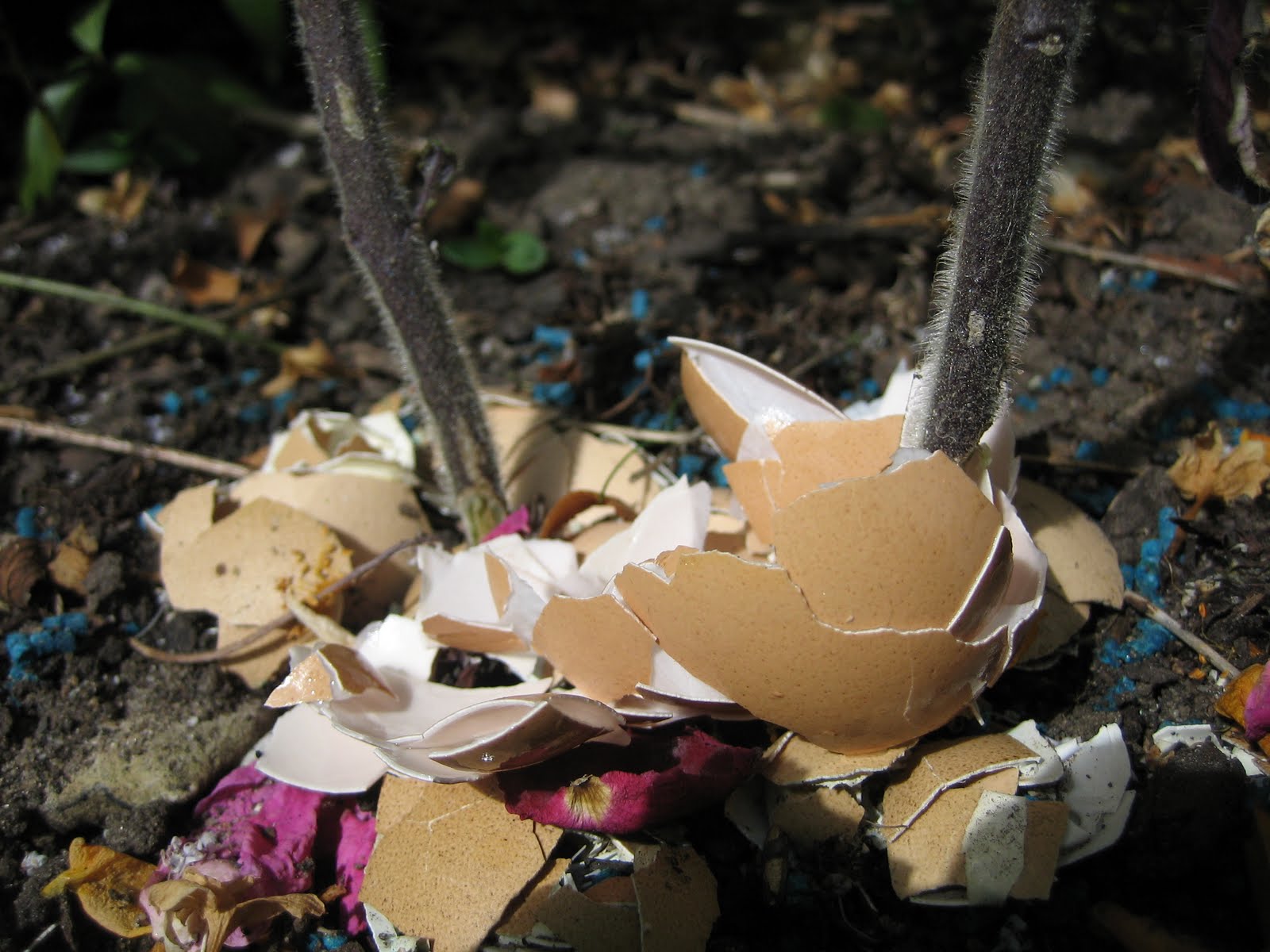
A quick check-in with the "Introduction to Permaculture" handbook and now I'm experimenting with broken egg-shells (free-range and local), coffee-grounds (less so) and moving the marigolds next to the veggies (apparently the slugs will eat them in preference to the crops).  If that doesn't work, I'll try out the beer trap, though it seems wrong to use Adnams for that just to stay local!  My favourite suggestion was to employ chickens, but I'll have to wait a while before I can get them.

The pics below are of my lovely roses a week or so ago, and the little caterpillars that are now happily stripping the leaves.  But I'm not going to spray them with chemicals.  I'm hoping they'll make a nice meal for the birds...