Showing posts with label Celebrations. Show all posts

Thursday, 18 October 2012

A Transition Camp Journey

I am a reluctant traveller these days, rarely venturing beyond Bungay or Norwich, let alone East Anglia. And it’s strange. Having lived in the Americas in the 80s and 90s and experienced incredible landscapes, people and ways of life, now, after ten travel (and money)-lean years, I’ve learnt to totally appreciate the odd train trip, whether it's going to London for the Transition Conference in September or travelling up to Norwich in the carbon conversation days through the Norfolk broads as the sun goes down.

Last weekend I went by foot, bus and train to the 5th Transition Camp in the Sussex Downs at the Wo-Wo campsite. And I loved it. From the moment I walked in when Mike greeted me and Alice handed me the key to the Little Owl yurt where I’d be sleeping, I felt welcomed and relaxed. It was a weekend where you could kick back, lead or participate in workshops and talks, sing around the fire at night and have transition conversations that the normal rush of life just doesn’t leave time for.

"These seeds," said Rebecca from Transition Crouch End, who opened the camp in a circle around the fire on Friday afternoon, “represent what we would like to plant here this weekend, so take one as they go round and consider for a few moments what you’d like to give and receive from the Camp. We’ll put them all in a saucepan and on Sunday, they’ll be cooked up and we’ll share in the stew.”

“They are called Victor beans,” she said, holding up a postcard that was now very familiar to me. I withheld my desire to whoop out loud. But I got my opportunity to speak when we went round the circle saying what we’d like to experience.

“Well, I’ve already experienced something amazing,” I said. “Those are native East Anglian beans, grown very near where I live and Josiah, who runs the Great British Beans business that promotes them is a friend and fellow transtioner in Sustainable Bungay. They make great hummus and falafels too by the way and feature regularly in our monthly Happy Monday meals. Talk about making connections. If the rest of the weekend is as enjoyable as that then I’ll be a very happy camper!”

It was. From working up some great harmonies round the fire on Friday as we sang into the night, to being lent a soup bowl by Claire and dry wellies by Nigel (mine were leaking and that first night was very wet); from learning the Basque word sapori (which means 'taste') from Urtzi, who also taught us how to start campfires, to learning the basic steps of the Charleston with Jo in a very dark tent as we sang along to the Muppets theme song. When I just couldn’t keep step, Christy took me gently by the elbow and guided me through. The Camp was like that; friendly, fun and people giving each other a hand when they needed it.

Most people at the camp lived in East Sussex, and were involved in local transition initiatives or wanting to start them up. But there were also transitioners from London, Buckingham, even Aberdeen. Peter, who was visiting from near Aylesbury gave such a great rendition of Singing In The Rain that we all asked for an encore the next night, even though it was dry by then and the stars were out.

Everybody was asked to do a stint in the kitchen, chopping veg or keeping the water fresh in the washing up bowls. Every morning there was hot porridge, fresh fruit and bread, yoghurt and raw milk from the biodynamic Plaw Hatch Farm nearby. Lunch and dinner were equally abundant (and very tasty) and made from scratch by the good-humoured kitchen volunteers.


Martin from Brighton led an introductory session the first night where we said our name out loud each time we spoke. Although the repetition felt awkward at first, I soon got used to it and remembered people’s names for the whole weekend. Not that I would forget Martin’s name. We shared the Little Owl yurt, talking and laughing late into the night and taking it in turns to keep the fire alight. Even though we’d only met briefly once before I felt like I was staying overnight with a friend from school again. It was great fun and really liberating. I reckon we could run a pretty good ‘inner adolescent’ workshop for jaded over thirty-fives! I even managed to turn three X-Ray Spex songs into lullabies and impose them on Martin before he went to sleep! (He did actually fall asleep in the middle of Oh Bondage Up Yours!).

If you ever need anyone to break the ice for a meeting so people can get to know each other, Martin’s your man. On Saturday morning he did another introductory session where each person told two truths and one lie about themselves. Where else would you find out that Lynne sang in a punk group called the Decaying Bogeys in the 70s (or was that the lie?), that Rebecca crossed the Sahara Desert, that I will be 52 next year, that Mike lived in a hippie commune on Ibiza or that Martin was a famous child star? True or False? Answers on a postcard.

On Saturday I held a Plants for Life workshop and spoke about my work in Sustainable Bungay this year organising the Plant Medicine bed and monthly events. St. John’s Wort was the plant of the workshop, and I passed round Rose’s bright red oil for people to smell and rub on and guess what it was. Then I read out the St. John’s Wort chapter from Charlotte’s book 52 Flowers That Shook My World, which was published this year. I passed around the hawthorn leather I made for people to share at the camp and we took a look at ragwort, a plant that brings up strong reactions on any wild plant walk. See here for a balanced, sober look at this plant. The hour and a half sped by and I finished by showing people how to roll plantain balls for bites, stings and incipient cold sores.

Don arrived on Saturday afternoon with the sauna - a bright pink converted caravan with a wood burning stove. Over the next 24 hours, the brave and hardy would cool down by jumping into the nearby river. Some just sprayed water on themselves from a container outside the caravan. I, of course, jumped into the river at every opportunity! Truth or lie?

There was a fascinating workshop making Sterling engines run by Louise from Buckingham in Transition with her partner.
“Buckingham. That sounds familiar. Did you start up the herb garden there?” I asked her. ”I saw a post about it some months ago and I’ve been meaning to get in touch.”
“Yes, that’s me,” she said.

It also turned out that the rocket stove Charlotte made at last year’s camp and that now sits in our conservatory, was the product of one of Louise’s workshops. There are a hundred and one instances of connections like these, but it’ll make this post far too dense to give all the details.

The weekend was filled with workshops on rhythm and resilience, permaculture and fairy tales for children. A foraging walk on Sunday led by Tanya Lodge, focused on the medicine chest in a stretch of hedge no more than thirty feet long at the edge of the campsite field. Dock, nettles, elder, rosehips and cleavers were all discussed along with how to make tinctures and dry herbs. And the redoubtable plantain made a robust appearance at the end. Did you know that plantain helps draw out toxins and heal wounds. Chewed and kept in  the mouth it can also helps with teeth abscesses. The plantain book grows by the moment!

At a talk on fracking and extreme energy, Olly introduced the latest data on Peak Oil, spoke about the work of Frack Off and showed us a short Australian film about a rural community who have united to keep coal seam gas (CSG) out of their area.

Suddenly it was 3 o’ clock on Sunday afternoon. Mark Boyle, The Moneyless Man, gave a sober and unapologetic talk about our relationship with money and how it affects our relationship with the world. Speaking about money exchange as a way of saying "I want no more to do with you", and examining the hidden pain and exploitation behind the consumer products we take for granted in our society, Mark exhorted all of us present to open and FEEL the damage that maintaining a consumer lifestyle is wreaking on our fellows both human and not, and the planet that gives us life. And to keep open and keep feeling...

Photos: Mike doing the morning shout-out of all the day's activities*; Great British Beans in the community pot; Woodland and Kitchen yurt with Saturday's talks and workshops*; Reading aloud from 52Flowers That Shook My world in the kitchen yurt**; the pink sauna caravan; Mark Boyle burns money By Mark Watson, *Mike Grenville and **Matt O'dell

This post first appeared on the Transition Network Social Reporting project on Saturday 13th October 2012

Monday, 1 October 2012

Tale of a Thousand and One Blogs

Today I'm writing our 1001st blog. We started This Low Carbon Life with a party and three years later the invitation is still open, as we celebrate our third birthday on 17 October at the Bicycle Cafe and the Keir Hardie Hall. Since then we have documented every aspect of resilience from allotments to zero waste. We have written short and long, nonchalantly, passionately, politically, in gritty black and white and in full-colour.We have looked at the big picture and the small print - from the impacts of global climate change to mending a kettle in our downshift kitchens.

This year in our topic weeks we looked at sustainable relationships, Transition documentaries,energy, buildings, blogs, trees, music, economics and livelihoods and development. We reported back from Norwich FarmShare, the Community Bees project, Low Carbon Cookbook and many encounters with the natural world - still our top subject (see Reconnection with Nature tag). Chris Hull's A Love Affair with Place became one of the Talkback comments on the new Transition Free Press; while Kerry, Charlotte and Mark have become full-on national bloggers on the Social Reporting Project (both publications inspired by work on this blog).

Since 2009 there have been 15 regular bloggers, who have contributed to this site, as well as many guest bloggers from Norwich's progressive quarters and neighbouring Transition initiatives. So hats off to all of us! It has been an extraordinary and productive commmunity enterprise and has inspired many people, including, of course, ourselves. Communication is a big part of resilience and opportunities to "show and tell", especially in a shared creative context, are increasingly valuable in our controlled,  locked-down culture.

Who knows where we will go next? As people have migrated to other projects - FarmShare, Magdalen Street Celebration -  left the initiative or the city, we have had to change our rhythm. We held our last Transition Themes Week #14 in May and in June we switched from running topic weeks and three-day shifts to a once-a-week rota. We now publish about three times a week, including occasional reposts from our awesome archive. Most of our work is original, and some of it cross-posted. Whatever shape or form this blog takes in the future, thank you dear readers for travelling with us.

So, as we head up for our birthday this week (October 4), we'll be publishing some of our favourite posts of 2012. Here to kick off is a reminder from our film week about what really matters when push comes to shove . . .

Baraka by Jon Curran
20 March 2012
 
Sometimes it’s easy to get wrapped up in our own lives, become obsessed with what my friend calls “first world problems”. The issues of the world outside our own bubble become abstract, almost academic. It takes something powerful to ground us again, to open our eyes to the wider world that we don’t always have direct access to.

I first saw Baraka in 1994 and I’ve watched it many, many times since. I call it a film without words; the name means “blessing”, and it’s a celebration of all that’s beautiful in the world, and an anguished cry against all that we do to destroy that beauty. It also, crucially, puts us, humans, in the context of the natural world around us, and reminds us that our cruelty to each other is not always in the action, but sometimes in the inaction too.

This is my favourite part – a montage set to great music by Dead Can Dance.


Bloggers meeting, upstairs at the Bicycle Cafe, St Benedict's Street at 6.30pm. Dancing from 8pm at Keir Hardie hall. For more info contact Charlotte Du Cann theseakaleproject@hotmail.co.uk
 
Images: Social Reporters at the Transition Conference at Battersea, late summer flowers from a roadside stall

Thursday, 27 September 2012

Integrating our cities' functions

I've always been a fan of things with multiple functions.  I take great pleasure in the fact that the tree which I've been building a treehouse in with and for my niece and nephew is not just a place of recreation for them, but is also contributing to the air we breathe, supporting various forms of wildlife, and providing a visual and physical barrier at the edge of a field.


But this is a trivial example in comparison to many others.  Cities, one could argue, are the ultimate in providing multiple functions in one space. Within one city block, there will be housing, entertainment venues, cafés, shops, public buildings, transportation hubs.

Within each of those, many human needs may be served at once. The best cafés, in my opinion, are ones which provide good food, a calm environment and wifi access so that I can work on my own, as well as a nice space to meet with friends or colleagues. Even better if the café has a community noticeboard, outdoor seating, enriching art on the walls and a few plants around.

It troubles me that some areas of cities have lost touch with what makes them great - this multiplicity of functions - and have been compartmentalising themselves.  In Norwich, the city centre is a place to shop, but with relatively so little residential property, it becomes dead at night, and seems cold and unfriendly. The suburban housing estates, meanwhile, lay empty in the middle of the day whilst everyone is at work in the city centre, but become active once again in the evenings when residents get back from work.

Flats in the city centre of Freiburg, Germany
OK, some would argue that that's just how cities work. But you only have to cross the channel to see that that isn't entirely true. Cities such as Amsterdam, Netherlands or Frieburg, Germany (above) enrich their city centres with multiple functions, with housing right in the centre, greenery on the rooftops, and plenty of multiple function public spaces and shops, serving shoppers during the day, and residents in the evenings.

Food From The Sky on the roof of Budgens, Crouch End, London
Transition, I feel, is all about this integration of functions in local communities, serving local needs locally.  Why ship food from across the world, when it could be grown on our rooftops? Why get contractors in from London when we could be giving Norwich people jobs, keeping money in the local economy?  Why separate work and living zones when integrating them together will reduce need for transportation and make places more vibrant places to live?

Whilst we operate as individuals, or as single organisations serving their own needs, it is easy to lose sight of how what we're doing might be affecting the things that are going on within our communities and cities.  That's why this Friday's meeting, "What's Happening in Transition Norwich", was organised. It's a chance for us to learn about what is going on in Norwich, and how collaboration can lead to the enriching of community, each action serving multiple human needs at once.

Images: all by Simeon Jackson

Thursday, 23 August 2012

Noughty but Nice and Keeping Refreshed at Happy Mondays

The Low Carbon Cookbook group hasn't had a meeting this month, and so here is a post I wrote for the Transition Social Reporting Project yesterday, 22nd August, about the latest Happy Mondays meal at the Sustainable Bungay community kitchen - a celebration of multiple birthdays with falafels, cupcakes and the herbs that refresh us. Mark Watson

Bungay community centre, Monday 20 August, late afternoon. I have spent the past hours gathering and infusing herbs for the herbal refresher I am making for Sustainable Bungay's Happy Monday meal. These events happen once a month with a different theme, using as much local food as possible and are organised and prepared by the Community Kitchen subgroup of Sustainable Bungay. Anyone can join in and help out or just come to enjoy the food and atmosphere. This month's meal is also a Happy Birthday celebration for the proportionately large number of us in SB who have arrived at an age with '0' in this year .

I'm hot, I've been unable to find any organic, unwaxed lemons in town and outside everyone seems to be moving at a snail's pace as the heat increases towards the end of the day. It must be nearly 30 degrees and I'm definitely feeling the effect of my particular 0 (which is no longer 30). The infusion of over twenty herbs (picked both from home and from the community garden at the library) smells amazing, but it's still piping hot, people will be here in forty minutes and WE DON'T HAVE ANY ICE!

Margaret (another 0) offers to go down the road for the ice after she's finished the flowers for the table. Charlotte cools the infusion by transferring it from jug to pot to saucepan to pancheon and puts in the summer fruits and flowers. I add a little sugar, fizzy water, a bottle of Nick(0)'s homemade raspberry wine and some blackcurrant cordial, testing as I go to get the right balance.

I've stationed myself in the main room where it's slightly cooler. Janet ties balloons on the windows and I carry on pouring and stirring and testing. Thane and Emma are among the first diners to arrive. "Great!" I said. "Tell me what you think of this. I don't want it to be too diluted."

"It's certainly strong enough," they said. "Adding more water would be fine. It's really refreshing!"

The mood of the kitchen is the usual one of intense concentration as everyone in the crew goes about producing the dishes: Josiah rolling the falafels he's made from British fava beans, Christine preparing a raspberry coulis for her cup cakes, Lewis testing the beetroot for the Moroccan salad. Cucumbers and tomatoes are sliced and onions are chopped for the accompanying dips and sauces. "Charlotte, can you do the yoghurt sauce?" says Nick almost at the last minute, whilst he washes up several large pans.

The drink is finally ready and living up to its name. People are arriving and everybody wants some.

"This is delicious," says Sally. "You must tell me what herbs you used."

"Well, there are over twenty five, with a strong base of lemon balm and lemon verbena, and... I'll come and tell you about it later," I said.

And there was plenty for everyone, with Dano (but not Dan0), taking the pancheon round the table so people could have seconds.

The meal was great, too – falafels, pitta bread, salads, sauces, oven-baked wedge potato chips, followed by cup cakes each with its own candle – and that raspberry coulis!
The candles were lit, the lights were dimmed and there was silence for a moment before we all sang Happy Birthday. Janet (yet another 0) and I laughed as we both realised we were singing happy birthday to ourselves and tried to add an 'us' in there somewhere, which didn't rhyme but never mind.

PS There were even more 0 birthdays in Sustainable Bungay this year than I mentioned here: Elinor, Eloise, Jon and Dee also celebrated the beginning of new decades. So cheers to you too, guys!

Pics: Birthday balloon by the window*; Peppermint (ricola) flowers*; oh those cup cakes, in the kitchen; Dano offers Margaret another glass of herbal refresher. By Josiah Meldrum and *Mark Watson

Saturday, 11 August 2012

Small Bouncy Lights in Dark Times

Last Saturday evening at Elinor's birthday party in Bungay, I found my 50 year old self unable to resist a bounce on the trampoline in her garden. I waited until I thought there were no children around and climbed unobtrusively into the safety net. But obviously not unobtrusively enough. Suddenly I was surrounded by every child at the party, laughing, screaming, tugging at my legs and each demanding that it was their turn to bounce in the middle and show off their acrobatic skills.

5 year old Tristram handed me a Star Wars sword and said, 'You be the captain, and... I'll be captain too, afterwards. Mark's the captain,' he shouted to everyone. 'Okay, let's take it in turns to go in the middle,' I boomed in a captainy sort of way. Everyone else wanted to be captain and go in the middle all at the same time and a couple of rather alarming tousles broke out involving toy screwdrivers from Dr. Who and several children wanting to climb onto me and do acrobatics at the same time. Any sign of captainness was disappearing very quickly.

But we did get a couple of synchronised harmonious moments in the general chaos, one of which was caught in this postcard. Later on, when the children were otherwise occupied or had fallen asleep or gone home, I trampolined with several of the adults, which was just as much fun, though somewhat more measured.

Why am I talking about trampolining on the Transition Social Reporting project? Have I been caught up in the silly season? Actually, no. For much of the time recently I have been aware of a certain gloomy feeling I can't quite pinpoint and which doesn't feel like a personal depression. Maybe it has to do with the dearth of fruit on the damson, sloe and cherry trees or the potato blight so many growers are talking about due to the strange, out-of-synch weather this year.

Maybe it's to do with how few butterflies there are around* and what that could mean. Our buddleia (centre photo) came out in bloom towards the end of July and I've counted only six or seven butterflies at any given time. And this on a huge bush which has consistently lived up to its butterfly name even in lean years.

Maybe it's the times we're in. The beginning of August is a time of abundance, harvest and gathering. And this year there just seems to be less.

So what do I do to tend the fire and the light when the times feel dark? I visit the sea in the early morning as much as possible. I sit on the beach with Charlotte and a flask of coffee and we make a space where anything that needs to can surface for our attention. Sometimes we have an animated discussion, look at the things which will get shunted aside once the activities of the day start imposing their demands. Sometimes we'll sit in silence, getting a feeling for the place we're in. The sea, the sun, the sky, the land. And for the times.

I try and stay as open as possible, sometimes more successfully than others, to the people I meet and the places I find myself. On Friday afternoons I spend a few hours curating the Plant Medicine Bed in Bungay Library community garden, paying attention to the plants, and doing some planting, pruning, seed collecting and sweeping. Sometimes people arrive for a conversation, bring a snack or to help out. Someone will say how lovely the garden looks, someone else that they have been rolling up ribwort plantain leaves whenever they or the kids get bitten or stung by insects, and that it really works. This is a tip I have been passing on to practically everyone I meet this year, and it's great when people come back to you about it. It really does work by the way.

And I look forward to Sustainable Bungay's 'Noughtie but Nice' Happy Mondays adult's tea party later on this month, so named because so many of us have birthdays this year with 0 at the end of them: all the decades between 30 and 70, with several of us turning 50!

So I guess what I'm trying to say in this postcard is something about the power of the small things. Those small lights in dark times that cost little and mean everything: bouncing up and down on a trampoline with the children of fellows in transition when you've just entered your fifty-first year; how the smell of lemon balm lifts your spirits as you rub its leaves on the way to the compost heap; the joy when friends receive the homegrown sweet peas you've brought to their party and when you realise they've given thought to the kind of food you eat, even though they eat differently; the hosts of red poppies among the barley in the next field; seeing the first two peacock butterflies of the year on the buddleia yesterday lunchtime.

And going down to the sea to make space for a deeper conversation.

*Postscript: Yesterday we counted 13 peacock butterflies on the buddleia - the first we've seen this year.

Images: Trampoline bounce at Elinor's (Bungay Community Bees) birthday party; Buddleia in Full Bloom but Very Few Butterflies; Sunrise at Lughnasa, Aug 2012

This post first appeared on the Transition Social Reporting project 7th August 2012

Friday, 22 June 2012

Because the worlds are round... and wavy

For the Summer Solstice and 24 Hours of Possibility I stayed offline and concentrated on connecting with the living systems of the earth, beginning with a visit to the beach at four in the morning to see the sunrise half an hour later.


It sounds like the simplest thing in the world to just remain offline for twenty four hours. The truth is I can't remember the last time I had an internet-free day. Much of Transition communications is a web-based business. Just the previous day I'd been emailing and tweeting everyone in Sustainable Bungay about Green Drinks that evening and updating a post on the website about it. I went to the Green Dragon with a host of flowers in jars to speak about plant families for the second Plants for Life event in three days.


It was a misty dawn just off the sunrise coast here in Suffolk and I settled for sensing the moment of the sun coming up over the sea rather than seeing it. It can be just as exciting, that moment when you FEEL it and become aware of other senses than the visual at play.

But the coast was clear, the tide was out and the sea was calm! And here's what it looked like a few minutes after the sun rose.


The photograph gives only the merest impression of the stillness and the quiet fullness of everything. No one else was around. The tide was out. The wind was occasional and light. I stilled my thoughts and tuned in with my feet on the ground. Everything felt big and wide and yes, if I had to put it in words, filled with possibility. My body felt relaxed and alert all at once. The sun seemed like a being, something like a person.


Back home

I set about making a midsummer birthday herbal drink for Charlotte to take on her journey to the Transition Tin Village at the Sunrise festival later that day. It was some time before seven, the sun well risen and the whole garden alive and shining with its mix of wild and cultivated plants and bushes. Plant and flower time can be a very different experience from clock time and when I glanced again at the kitchen clock it was way past nine o' clock!


By then I had gathered 47 different plants for the midsummer herbal cocktail, and they were infusing in the teapot. You could smell them throughout the house: a whole array of mints, English and Japanese mugwort, elder, heartsease and marigold flowers, two types of fennel, lovage (one small leaf!), anise hyssop, giant mexican hyssop, lemon balm, salad burnet, southernwood, lemon verbena, two sages, chia, epazote (very small leaf!), lavender, vervain, alecost, plantain, white deadnettle... and twenty-odd more. I added some fresh organic lemon juice and some fruit syrup (we'd run out of honey, which tastes better, but the syrup was okay) et voila!

When I asked Charlotte to guess what plants were in the drink, she named at least twenty five that I hadn't put in along with the ones that were there!

Now it was time for the tortilla, or Spanish omelette, all local eggs, potatoes and onions, Norfolk tomatoes and homegrown parsley, basil and Greek oregano. The birthday, solstice and cross-country journey food and drink were prepared.

So when Simon arrived from Norwich with two friends just after midday to pick Charlotte up for their shared car journey to Somerset, I thought, now I'll do my reconnecting with the living systems.

Then realised I'd been doing it all morning.

One thing that struck me during these 24 screen-free, pixel-free hours of possibility: How wavy the living world is. And how round.


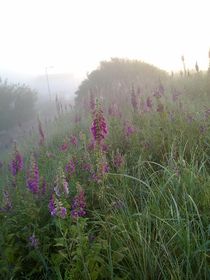
Photos: Summer Solstice Foxgloves at sunrise, Southwold; Talking plant families at Green Drinks, Bungay June 2012; Summer Solstice Sunrise, Southwold June 2012; Garden Shining, June 2012; midsummer birthday 47 herbs for infusion; mostly local Spanish tortilla (all by MW)

Wednesday, 13 June 2012

A birthday bash, anyone?

It's my birthday today. Dev- elopment of some kind ( I hope), although what I write about today is hardly a subject for celebration. Perhaps, though, if those with the decision-making power paused for reflection, one of those famous decisions the media call a 'U-turn' could happen?

The Norwich Northern Distributor Road (NDR) has been a hot topic for over a decade now, and, after a lot of horse-trading and amendments, it is now listed by the Department of Transport on the official list of major new roads to be built. It may well be 5 years off yet, and has yet to get planning permission, but already a casual look around the areas to the north and north-east of the City will show a surprising number of houses for sale near to the proposed route.

Probably the most shocking aspects to the proposal is the cost. If you add all the pots of money together - government, County Council, and the GNDP ( Greater Norwich Development Partnership) you get about £112 million, and you can probably safely add another 40% or so to that in reality, which is the average 'overspend' on major road schemes over the last 20 years. The County Council right now are carefully putting money aside from it's revenue budget ( estimated at around £2.5M) into what can only be described as a slush fund to build up extra reserves for the road. All this at a time when frontline services are being systematically reduced to 'save money'.

In September 2005, early on in my role as a County Councillor, this topic was so hot and so big, a special dedicated Full Council meeting was arranged over and above the regular meetings, to hear all Councillors views on the subject, and crucially, to take a vote. Of the 69 Councillors present that day, only 2 voted against the proposal - myself and my colleague, Andrew Boswell. What was also remarkable was the lack of expression or understanding of the bigger picture. Faced with a large business lobby - for many of whom the word 'infrastructure' means 'roads' - and an assumed continued growth in road traffic, this development appeared to all those present an unquestionable step to make. For the full minutes to this meeting, and a brief summary of the speech I made, look here:

http://www.norfolk.gov.uk/Council_and_democracy/Committees/Committees_Archive/index.htm

So will the road ever be built? Privately, there are key planners and newer politicians around now who are saying that there are doubts. Let's hope so. There is still a long way to go, but maybe there will be true celebration - much as there has been in the past over the relinquishing of plans for new roads - when we see the area to the north-east of Norwich remain unblighted by this unnecessary road.

Saturday, 17 March 2012

It's my birthday and I'll buy if I want to

So it's my flat mates birthday and I haven't bought her anything. I have decided not to buy anything in lent, so cannot go shopping. I did not buy anything before lent in readiness. To be honest my shopping was a bit random before lent. I went into Oxfam to buy a wardrobe, I saw one for £19.99 and then saw that for just another £6.01 I could buy a ....er..... sledge.

Which turned out to be rubbish for hanging clothes but quite good for chitting potatoes.

So I make her a card out of an old ladybird book with a funny caption.

Then I wrap up a book which I found being thrown out at work called 650 Favourite Recipes by the Womens Institue. My girlfriend is coming round for the evening before my flatmate's birthday so I declare this 'Kate's pre-birthday event'


We spend the evening reading out the recipes which seem to consist of long forgotten 1970's ingredients such as 'canned chopped pork'. We decide to have another evening where we make a whole meal from the book and the winner is the one who doesn't throw up.

We then watch a Sarah Millican DVD borrowed from a friend. We laugh a lot and Jo is glad she did not watch it with her children.

We then tell each other funny stories and all secretly decide we could be stand up comedians.

Friday, 2 December 2011

Transition Is The People

I first published this piece on Monday 28th November as part of the week's People and Connections theme for the Social Reporting project on the Transition Network website.

"Your beetroot is on the Low Carbon Cookbook table," said John, who had brought the giant vegetable from his home four miles away. I went to have a look. Bee had arranged a smashing display of locally grown vegetables, cooking utensils and a fresh salad. But that beetroot took the biscuit (sic).

"I've brought those seeds," said Cathy, and handed me a small white envelope. I’d forgotten about the cigar plants I found so exciting in her garden a few months back.

"Here's that Echinacea plant," said Lesley, handing me a small pot with wilting leaves. We both laughed. "It'll be fine for the medicine plant bed next year," she said.

This all happened within ten minutes of my arriving at the Transition Norwich 3rd birthday celebrations on 15th November. I felt like it was my birthday with all those gifts. Throughout the evening I talked and laughed with over thirty people I knew from both Transition Norwich and Sustainable Bungay, and several others I hadn’t met before, including Rob Hopkins who’d come up from Totnes to speak about Transition and The Transition Companion.

I’m not saying this to let you all know what a socialite I am, though I love a good party (probably more than a protest march!). It’s just that I wouldn’t be having any of these conversations if Transition had not entered my life in the summer of 2008 in the form of Sustainable Bungay. Before then I was living in increasingly unsplendid isolation down a country lane in Suffolk, immersed in plants and places but with little human contact. And it wasn't like the world (or my own prospects) were getting any better. Maybe I needed to join in with others. A community-led response to Peak Oil and Climate Change? It wasn't environmental activism or a religious group or anything like anything else. After a major attack of resistance to DOING ANYTHING I decided to give it a go.


And three and a half years further down the peak oil path, I can say that for me Transition is the People. Whether it's being part of the Transition Norwich bloggers group, This Low Carbon Life, since it began in 2009, co-producing the Norwich and Bungay newsletters and bulletins, communicating with people by email or phone, or meeting up at Sustainable Bungay's yearly summer and Christmas parties, it's us, the people that make it happen. No people, no transition.

The movement is like a great social network bringing people together to build resilience in the face of global and local energy depletion, climate change and economic meltdown. These are the common threads and they affect all of us. Transition connects a huge diversity of people and we would probably never otherwise have met in the dominant, conventional money-driven, class-obsessed, hierarchical and compartmentalised culture. It encourages us to develop a different, more equable system of values. It opens things out.

It also challenges all those in-built structures inside oneself. Replacing the lifelong held idea of limitless energy with the fact of finite resources can lead to tension between people who accept the latter and those who don't. And that's just one shift. Sometimes you fall out with people. Sometimes, as Ann said Saturday, you hold events where only "three people and a horse's head attended". Some meetings go smoothly and are joyful and some really don't. It gets on my nerves when people talk about transition as if it has to be perfectly formed and presented (mostly by you, with no effort on their part), when it really is a work-in-progress. And a lot of it is about holding on in there and learning to be and work with people in harmony and co-operation and with no hierarchy.

Yesterday morning the phone rang. It was Lesley from Sustainable Bungay. Would we like to go for a walk by the sea? She arrived bearing two huge and delicious pears from the tree in her garden and after the walk we sat round the fire at dusk with hot tea and talked about everything from autism to growing food to the difficulty of finding decent work and navigating the benefits system, which we're all on.

Lesley told us about her Open University degree in Environmental Studies (Hons), and how she had been gardening and growing plants since she was a child. And about how bringing up an autistic son made you tolerant and open-minded about the differences between people.

We told her about our neighbours who gave us a laptop and access to their studio to do our Transition communications work last year. And how those same neighbours, Philip and Irene, now share their second car with us after our old one took its final trip to the scrapyard. (And I'm talking from within the context of an isolated and underpopulated rural area where whole bus routes have been scrapped over the past year). It's a happy arrangement, we share the running costs and take care of the plants and birds when they are away. Philip and Irene are not in transition themselves, but they were motivated by our involvement to give us a hand.

Lesley said she’d be happy to grow more plants for the Medicine Plant Bed at Bungay Library next year, as well as an amazing tri-coloured amaranth called Chinese spinach. I'm really looking forward to the project.

I was really struck by the human warmth in Sarah's introductory post about her friendship with the late David Fleming, its feeling for relationship. I asked Lesley yesterday did she feel her life had changed since she got involved with Sustainable Bungay.

"It's great that there are other people who feel like I do about the planet and want to do something about it together. You don't feel so on your own."

I know just what she means.

John Heaser is a Transition Norwich blogger, caretaker of the local toad population and advocate of cycle paths and has been growing organic food at home since the 70s

Cathy Proudlove is Sustainable Bungay’s treasurer and leads SB’s Abundance project, giving freely from her garden and orchard all kinds of produce from chard to Norfolk Biffin apples (to cigar plant seeds!)

Lesley Hartley is a gardener and food grower with a degree in Sustainable Technology who is actively involved in several Sustainable Bungay projects including Happy Mondays.

Pics: Bee and Charlotte with Giant Beetroot at the Low Carbon Cookbook table, Transition Norwich 3rd Birthday celebrations; Transition Norwich Bloggers meeting at The Greenhouse, clockwise from left: Simeon, Jon, Charlotte, Chris, John, Helen and me; Lesley, me, Charlotte, Rita at Happy Mondays, Bungay, November 2011

Thursday, 17 November 2011

being the 99% not the 99p

Last night I was at the launch of Rob Hopkins new book about transitioning. It was the most amazing transition evening since the unleashing 3 years ago. I left with renewed enthusiasm to go out and make changes. There were three rooms at the united reformed church in Norwich. In the main church hall there were speeches and a film shown made by Tom Harper. I did some stand up comedy about being a transitioner and then Rob talked about how things had changed since the unleashing and some of the initiatives that were going on around the country.

The lovely James Frost played a song he had written for the film which I was looking forward to hearing but then got sent off with a bucket to collect money from people who had come in late and missed the chance to donate. Afterwards there were stalls representing different projects going on in transition such as the Magdalen street celebration and farm share. There was a most amazing cabbage on display which looked like an imaginary cabbage in a dream you might have.

With regard to the Occupy Norwich picture that you see there was an agreement that here was a very visible revolution going on that people could get involved in. One that was saying that we can't can't carry on in the same way as we have already.

The main thing I learnt though is that when someones says in an email 'can anyone introduce a film and be a bit funny' then before you send one back saying 'pick me, pick me!' you might want to imagine yourself holding a piece of paper with jokes on in front of 250 people first.

Friday, 11 November 2011

Magdalen Street Celebration


If you haven't heard of the Magdalen Street Celebration then WHERE HAVE YOU BEEN?!!

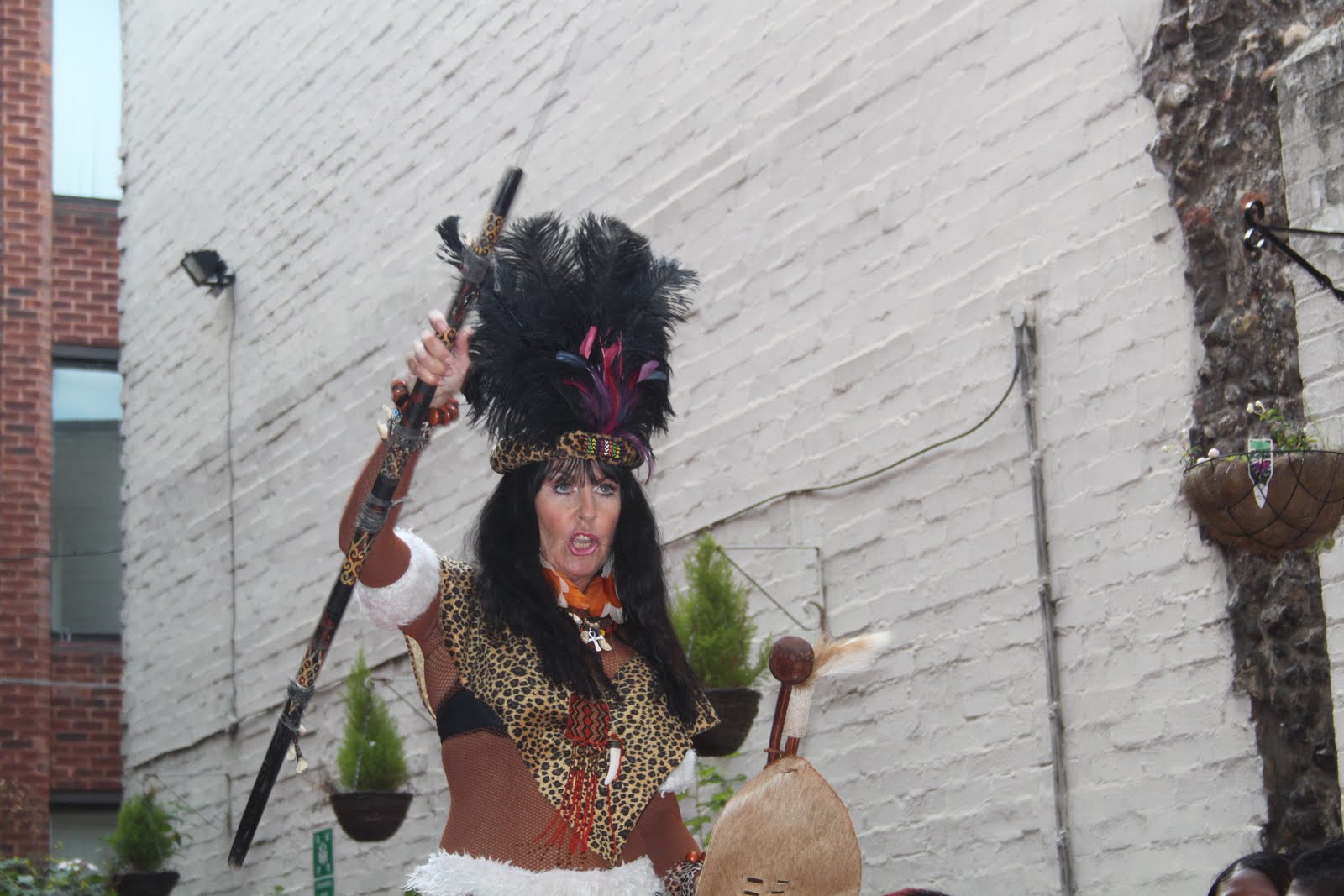
But seriously the second street festival went amazingly well and I think these images convey the spirit more than I can in words.

What I will say is that the event is building a sense of community with more and more people being involved. This year Roys had their forecourt available for stalls so this spread the activities up the street. One of the cafes had a cooker outside and offered hot food alfresco.

A group of shops got together and had a fashion show of vintage and London influences. Entertainment wise there were new groups as well as the old favourites: Taiko Drummers and Golden Star Morris dancers.

The Anglia Square empty shops were offered again and played host to a wonderful selection of workshops including eco-crafts, puppet making from the Norwich Puppet Theatre and Story telling to name a few.
If you want to be involved next year then we are looking for volunteers. If you have any skill to offer then please do get in touch via the blog page or facebook page. Even if you are happy to go round with posters or are good at taking photographs then it all helps. The more the merrier! Our meetings are rather fun and take place in a Magdalen Street cafe everyone is encouraged to use their interests to contribute to the day whether it be an interest in history or knowing local people or organizations.

Friday, 14 October 2011

NR3 is the place to be

Anyone who has been to the Magdalen Street celebration would know that NR3 is a most exciting and vibrant place to live. Of course it always has been and all the celebration did was to give people permission to show that side of themselves.

Amongst the many artists, performers, craftspeople there were local groups, a vintage fashion show, churches open for the day, traders with special offers and local historians giving talks. When I walked down the street two days later I could still feel the buzz and walked along with a new view of the street, a more connected view. Like I had lived there since I was a child and everyone knew me.

A few months ago I wrote a blog called sun, sea, sand and sustainability which was about finding someone with the same values as you locally. A chap then got in touch with me to tell me about a website he is developing aimed at helping people find ethical connections in Norwich called Heddcraft.

If all else fails you could do worse than find yourself a Morris dancer.

Monday, 3 October 2011

A Year of Living Differently

This Low Carbon Life is two years old this week. Our blog year began with apples and angels last frosty October and ended with a sunrise over the sea on the hottest autumn day on record. In between eight of us have monitored the shifting mood of the world every day (except some Sundays) and shown how these shifts affect our ordinary lives in Transition, both from the inside and outside. The blog started out as a record and an experiment, a way of showing what a low-carbon culture looks and feels like, and for some of us during these two years this project has become a way of life.

The blog has undergone some changes since it began. Its shape has remained the same: regular bloggers writing for three days each interspersed with topic weeks with 5 or more contributors that explore subjects such as Waste, Climate Change, Health, Deep Nature, Buildings and Happiness and celebrate the changing seasons. But in December we introduced the Transition Themes Weeks with their regular reports on TN's theme groups (which we will look back at on Saturday) and there have also been shifts within our crew.

In May Kerry went to work outside Glasgow and Elena became more involved in Norwich FarmShare and both have become occasional rather than regular bloggers. At the same time we welcomed Simeon who's started up the Economics and Livelihoods group and Jo from the Permaculture Group and Low Carbon Cookbook. We've invited guest bloggers to contribute too during our theme weeks: Mark Crutchley (OneWorldColumn) on the the state of the oceans, Adrienne Campbell (100monkeys) Whose Land is it Anyway?, Rachel Lalchan (EcoMonkey) on giving up supermarkets, Andrew Boswell (Norfolk County Council) on the region's controversial waste incinerator and road scheme, amongst others.

Meanwhile we've covered events from Norwich Pride to the Uncivilisation festival, from the Transition Conference to the Norfolk Anti-Cuts demonstration. We've reviewed films and books, had a rethink about turnips and towerblocks, talked about the birds and the bees (oh, and sex) and all things under the sun (which has also starred in our many photographs). We've been cross-posted and quoted and perhaps most successfully been the editorial blueprint for the new Social Reporting pilot on the Transition Network.

This week on our retroblog we're selecting some of the individual posts that have struck us during the year. Tough call. How to choose from Helen's witty urban reports, Elena's feisty (and frequently delicious) pieces, Mark's warm and perceptive social reporting, John's practical, earth-connected prose, Chris's kinetic and lateral thinking . . . How to chose just three from over three hundred?

There's another question too looking back. How is this year different from the last? On reflection it's been soberer, deeper, tougher. Politics and economics have entered all of our lives and the posts have reflected this shift. There has been less on the domestic joys of baking bread and growing stuff and more serious thinking on social enterprise, livelihoods and activism. Most of us, following the shape of the initiative, have grounded ourselves within practical projects as the Transition movement has become more socially aware, less inward looking, more connected to other progressive groups. More conscious in many ways that we hold something precious in our hands we need to hold dear as the culture so many of us took for granted is falling apart at the seams.

Within this frame I'd select the kind of posts that were written after Nicole Foss came to speak to TN in April: My Struggle to make Sense of the Financial Crisis in an Era of Peak Oil by Mark and Defining Freedom by Kerry. Both have a sense of discovery and openness that are key to writing in the field. We are brought up in a civilisation that loves to have everything down and be in control, to be above it all, smart after the event, safe from all the messy and difficult challenges of reality. To write on the edge of Transition means you have to experience change from a position of not-knowing. Why I love this blog is because it gives space and time for that creative process. Because it shows how this downshift that none of us have done before can be done with grace, fortitude, beauty, intelligence, courage, style and above all, with great humanity.

What I love too is that here you don't have to market Transition or spin yourself or your life. You can say how it is in ways that you can't elsewhere, at home or work or amongst your friends who are all hoping things will turn out otherwise. You can write stuff you don't find in the mainstream media or written in books, because none of us who blog are hip or connected enough to register on that business-as-usual radar, we don't fit the box or the mindset, we live in the wrong city, we're from the wrong class, we're unfashionably in Transition, too old, too poor, too green, too radical, not radical enough . . . whatever. You can wake up with something to say and today you're going to say it anyway, straight from the heart. Even though you are under the kind of pressure that Jon captured so clearly and honestly in his A Shocking State of Affairs (my third choice). It's a different narrative. Written by the people who are experiencing it first hand. On a deadline.

Here's to us and all our fellow bloggers, citizen journalists of a disappearing and emergent world, and to all our dear readers. Thank you for being with us.

Still from Ken Russell's Amelia and the Angel:
with Helen at the Magdalen Street Celebration; with Jon and Simeon outside the Greenouse after our summer meeting; A Darkling Thrush; October sunrise.


A shocking state of affairs

Jon Curran
30th November 2010

DSC00604
I feel like I’m coming out of hibernation. The last few months have been crazy and I feel like I’ve had no time to think. Every single day was as hard as the one before. I felt disconnected.

One of the things that fell by the wayside while I tried to get things back under control was my involvement in this blog. I didn't have the time or energy to post, and wasn’t able to contribute to John’s excellent Make Do and Mend theme week, even though I had a piece all mapped out in my mind.

These recent months have taught me that I’m not as resilient as I thought I was. Pushed for time, and pulled in all directions, I’ve driven the car more, eaten more junk, taken less notice of things around me and the impact that my actions have had on the environment; I bought more stuff to compensate for how frazzled I felt in the rest of my life.

It’s not so much that things have calmed down, but I have perhaps got used to it. Luckily things in my immediate life haven’t changed that much while I’ve been out of the loop. "Luckily", because things could have – I was reading George Monbiot’s recent post “Britain’s Shock Doctrine” and yes, this is what happens when you take your eye off the ball. If you haven’t read Naomi Klein’s book “The Shock Doctrine” I cannot recommend it highly enough. Read it, read Monbiot’s post and then look back at events of recent weeks and months. It’s a sobering thought.

Which is why I’m very much looking forward to tomorrow night’s meeting of the Transition blogging community. It’s a chance for us all to catch up on what’s been happening in our lives, talk about ideas for the blog in its second year, and, for me, most importantly, to reconnect with just how important this work is; perhaps, now, more important than ever.