Monday, 10 May 2010

Throwing pots- the easy way

My mum said to me one day: "you know you can buy those things to make pots out of newspaper? Surely if you can make them with one of those things, you can make them without."

Well yes, probably you can.

I forgot about it for a few days, then got a book out of the library and there it was: how to make pots out of newspaper.

Here's how:


I think they'll be much more stable once they're full of compost and plants.
For the shape to form them round, you need any straight sided object with one open end. A glass does it but feels a bit hazardous for squashing. I've used an ancient pot that used to hold mixed herbs.

Enjoy!

Saturday, 8 May 2010

My Entry Into Transition and A Medicine Jelly

(i)
Two years ago I went with Charlotte to see the documentary What A Way To Go – Life At The End of Empire, which Sustainable Bungay were showing at the local Fisher Theatre - one of a series of films for bringing attention to peak oil and climate change. I almost left in the first half hour, feeling trapped in my seat whilst a monotonous American voice droned on about the end of the world of the American dream, accompanied by images of the mining, burning, deforesting, bombing and drilling of the earth. Something compelled me to stay, however.

The central image is of a train that’s headed for disaster, whilst the genteel passengers in smart clothes chat away and have food served to them, unaware of anything beyond the train. The solo voice of the writer-director gives way to interviews with other writers, artists, psychologists, friends and relations who all see or sense our predicament. At the end of the film, Tim Bennett walks out into the land, down to the shores of Lake Michigan in the rain, where he joins a group of people. His messages for the times ahead: build lifeboats, get to know the land in your area, the medicinal plants; find your people.

Afterwards the lights went on and Kate led a discussion, which the whole audience joined in with. No one left. Some people found the film depressing. But more than a few of us, myself included, felt liberated by it in some way. As if suddenly we weren’t on our own.

We are the people we have been waiting for.

This was my entry into Transition.

(ii)

Recently I've been making what I call medicine jellies, using a basic vegetarian jelly mix and adding all sorts of herbs and fruit. Here there is peppermint, lemon balm, ground ivy, mugwort, slices of lemon and blackcurrants stored from last year. Only the lemon and the jelly mix are not from the garden.

I made the first one for Charlotte to help shift the remnants of a cold which had affected her sinuses. They taste (and smell) really good, not at all medicinal. And they're really fun to do. Just drop the chopped fresh herbs and lemon into the liquid jelly right at the beginning and stir once or twice before it sets (I use the handle of a wooden spoon). I put the (cooked and defrosted) blackcurrants in slightly later than the rest of the ingredients.

The jelly in the picture I took along to the Strangers’ Circle on Wednesday. It was a great digestive after our celebration feast. I took it as a good sign that it disappeared without trace almost before I’d put it on the table.

Talking of jellies, the picture at the top is of a jelly bag with the remains of a bunch of cleavers, which I chopped up fine and squeezed first into a bowl, then into this jar before adding some runny honey. This is called cleavers succus. A friend showed me this marvellous green medicine she'd made after the Bungay Plant Swap. When I tasted it I got so excited I had to go and make some myself. The recipe can be found in the excellent book Hedgerow Medicine. Cleavers, or clivers, or goosegrass, is a lymphatic cleanser and general tonic. It’s scrambling everywhere now in the lanes and garden. It's best used before it flowers, so now is a good time to gather and squeeze - or brew – especially as you can’t use it as a dried herb. Cleavers is related to coffee, which might explain the electric zing I get when I drink the tea or take a teaspoon of the succus.

And with that I bring my latest three day week of Transition Tales to a close. Wishing you all the best of the Maytime green.

Friday, 7 May 2010

Give and Grow

Today I’m (re)visiting Sustainable Bungay’s Give and Grow seedling and plant swap which we held in Bungay library courtyard last Sunday. The place was transformed inside and out with a constant lively buzz as people gathered, swapped plants and talked about everything from beekeeping to heritage bean varieties - in spite of the rain and the cold.

We'd all been patiently (very patiently this year) growing our seeds for allotment and garden in homemade newspaper pots, toilet rolls and even ordinary pots. The tables were laden with vibrant healthy lettuces, currants of all colours, tree saplings, cosmos, mints, aloe vera, grasses, lemon balm, foxgloves, snowdrop bulbs, wild flower seeds, seed potatoes, cucumbers, the list goes on. And you had to be pretty quick as plants swapped hands even before they got on the tables. Especially the sturdy tomatoes which several people said they'd been having difficulty growing so far.

By the way, don't be misled by these photos into thinking only a few people came. I kept getting into plant conversations with people and forgetting to get the camera out! Here I am with Daphne, Josiah and Nick discussing the merits of 'Totem' dwarf bush tomatoes.

Burgeoning fennel with Josiah's hand and Charlotte's boots

Inside the library Gemma had set up a table of the homebaked cakes and biscuits from the cafe she runs in a local garden centre. (She also gave me an amazing chocolate cake for my birthday).

When the top of the huge tea flask got stuck and seemed set to stay that way, I turned half jokingly to David, who is a craftsman and maker and said, ‘have you got some tools round your belt to fix this?’ Actually he had, and immediately produced an impressive looking penknife he never goes out without. We laughed and I turned away to talk to someone else. Two minutes later he handed the fixed flask back to me. Then he showed me how he had done it and I can now fix seemingly irreparable tops of hot water flasks. Reskilling on the spur of the moment! And everyone could have a hot drink.

People are always talking about community in Transition and suddenly I realised: here it was! parents reading books to their children, conversations about what we might do for the honeybee and Elinor (who runs Bungay Community Bees with Gemma) said she loved the look of the datura I'd brought along, but maybe she'd wait till she was about fifty and the kids were grown before she had one at home.

As we left, Kristian, library manager and fellow plant lover, gave me a bottle of his delicious home-pressed apple juice - another birthday gift!

What also came home with us: rocket, lettuce, chives, pot marigold, lemon balm, lovely black grass and a rowan sapling

PS Don't forget Transition Norwich's own
Plant Swap on Saturday 15th May at the Playhouse.

Thursday, 6 May 2010

The Kind of Party I Vote For

Last night the Strangers' Circle met up at Elena's and Alan's in Keswick for our May meeting. We were celebrating two birthdays (Elena's and mine) and a wedding anniversary (William's and Naomi's), and we were also divvying up our first food order as a co-op, which Tully had collected earlier in the day.

The food was awesome. Elena's Indian-style tomato and lentil soup with tamarind and cassia bark silenced us all, and we're not a quiet company! There was freshly baked bread, just-picked asparagus, Naomi and William's pasta bake, Tully and Angie's spinach roulade, fluffy baked potatoes and Alan's homemade cider (pure nectar). All delicious. There was more to come, but first to work.

With quick and nimble fingers, Charlotte, Elena, Tully and Naomi set about weighing rice, chick peas and lentils and packing them in old margarine tubs and used plastic bags. Dusk was falling and I darted about with the camera, trying to keep things focused and not use the flash, with varying degrees of success. I tripped up and splashed licorice tea over Elena's cushions and some of Naomi's order, which they were both extremely nonchalant about. William did the washing up, Alan checked the football results for Naomi on the internet, Tully checked the figures on the order, Charlotte and Elena poured and packed. And it was all done in about half an hour.

Back in the kitchen Charlotte raised a toast with the champagne Naomi had brought and we sang a version of Happy Birthday, which we altered on spec to include wedding anniversaries. And we ate the stunning chocolate birthday/anniversary cake Charlotte had baked all with organic ingredients, creme Chantilly and last year's blackcurrants, and decorated with local strawberries and the edible wild and garden flowers of the spring. On the top we put tiny beeswax candles with holders Angie had made on the spot out of tin foil. It was lovely. We decided to host a Transition Circles Midsummer picnic on 21st June at Mangreen in celebration of our low-carbon year in TN2. There'll be a carbon cutting quiz and Naomi will be Quizmaster! Everyone is welcome.

We also decided to look at Resilience in our next six meetings (beginning with a discussion about this key transition concept) and Tully spoke about the feasta report in respect to current non-resilient systems. Then Charlotte briefly mapped out a joint project for our low-carbon cookbook... because we couldn't stay off the topic of food for too long!


Pics: The Strangers' Circle celebrate birthdays, anniversaries and co-operative food buying; A Transition Wholefood Circle of organic rice, chick peas, lentils, peas, gluten free pasta, ring of fire chillies and a bay leaf, by Charlotte

Wednesday, 5 May 2010

Leaders wanted... preferably alive

A few bulletins ago I wrote a short review of this book about leadership, and have since discovered people read it - the review and the book - and others have been curious to know more. So I guess this is a more extended review, mixed with my own musings about leadership and what it is.

'How was your day?' is a question that is often asked, but which matters more now than we think. For those of us privileged to be in the field of change and challenging business-as-usual in whatever guise, it seems that the line between work and play has all but disappeared. In the last 20 years, even conventional business wisdom has 'clicked' that employees who enjoy their jobs do the best work, make the greatest impact, and are changing the most.

I've been inspired by Godin's book as one of those which seems to affirm things I dimly knew but had stored away somewhere, and at the same time exudes confidence to all of us involved in the world of change and challenge - to lead even.

Aha! I've popped that word LEAD. I've often wondered why the 'L word' provokes such reaction - as it seems to - particularly in the world of activism, campaigning, NGOs, and volunteering. Godin says, " leadership isn't difficult, but you've been trained for years to avoid it". Sometimes scepticism about the need for leadership comes from the experience of management, and management is most often about keeping the status quo, not challenging it.

More commonly, however, I think leadership gets confused with ego. Many 'leaders' in the public domain do big egos, which furthermore seem to thrive in the limelight. We can instantly sniff this sort of thing when it appears. Authentic leadership, however, involves the opposite. Think humility and service, and think Ghandi, Martin Luther King, Eckhart Tolle.... we all have our ideal leaders.

Maybe another problem is that when we think 'leader', we think 'big', and we think 'leaders have loads of followers'. Not necessarily so. One of the traps which many NGOs and campaign groups fall into is to think 'bigger is better', and that involving more and more people will mean things get better. Also, not necessarily true. Godin's response to this comes in a great little piece called 'Most People Don't Matter So Much'. It goes like this:

Most people work hard to fit in so other's don't notice
Most people want the world to stay as it is, but calmer
Most people are afraid
Most people didn't use Google until last year
Most people aren't curious

You're not most people
Not only aren't leaders most people, but the members of the most tribes aren't most people either

Most people are really good at ignoring new trends or big ideas
You can worry about most people all day, but...they're not worried about you - they can't hear you, no matter how hard you yell.

Almost all the growth that's available to you exists when you aren't like most people and when you appeal to folks who aren't most people.

Hmmmm.... so I'll sign off there on that note..... and ponder at the end of the day, how it was.

Monday, 3 May 2010

The hungry gap is over!

I just wanted to share this picture of the first radishes of the year. Actually they are not the first because I ate some last week but was so eager to taste them that I forgot to take a picture first.

I've been eating rhubarb from the garden for 3 weeks now - and shared some with people at the TN meeting last Monday - but it is a big moment when the first 'proper' food of the new season appears. Something that we can easily miss in this age of global food production.

Saturday, 1 May 2010

A Radical Rainbow

I want to do with you what Spring does with cherry trees
(Pablo Neruda - Every Day You Play from 20 Love Poems and a Song of Despair)

Happy May Day everyone! I'm just back from the woods shimmering with new bluebells and there I found the pond which was covered in one of England's shyest and rarest flowers -the water violet. It was raining quietly and then the sun burst through the hazel and hornbeam trees All the birds were singing - blackbird, wren, thrush, robin. The bittern was booming in the marshes. Cows lowing in the village. Today the world is green, green, green and there are flowers everywhere.

White blossom:the lanes frothy with blackthorn and all the roads fringed with scurvy grass

The most revolutionary thing in a black and white world is to go for the rainbow - to bring in as many colours as you can into your house, as much beauty as you can into the hardness of the streets, as much harmony within the discord, as much laughter in a dark time.

On another May day I wrote a piece about radical flowers and I thought I would post it today. Because it's easy in Transition to think of the earth as all climate change and environmental disaster. Sometimes you need to get up at dawn and listen, take a look all around you. What's really happening in the neighbourhood . . .

Deep purple: pasque flower; True blue: emerging bluebells; sky blue: forget me not

Here's that extract . . .

"Venus, the earth’s mysterious sister, appears in the morning and evening, shining brilliantly in the sky during the month of May. You cannot look at her directly, as her surface is veiled by cloud. The veil hides a planet of volcanoes. No man or machine can land on her fiery body without being blown apart. In the painting Venus appears out of the sea, naked, balanced on the half-shell. You gaze into her pale vacant face and fall at her feet in adoration. But this is a manufactured Venus. The real Venus is active and fiery, not static and pale. When she comes naked into the world she brings revolution and May day parades, she does not bring consent. When you work with the wild flowers that emanate her presence in the month of May you know that artificial glamour has no power of itself. It is an object that can be worshsipped and possessed. Real beauty cannot be possessed. It can only be beheld. And only those whose hearts can match its fiery revolutionary nature can really know the love for which Venus is also famed.

I want to do with you what spring does with the cherry trees

Going green: green goddess; arum on the marsh track; unfurling horse chestnut bud

Beauty emanates the high frequency you feel in all living things. It arrives suddenly, unexpected; in the high intensity of a butterfly wing as it brushes past, in the startling presence of the quince outside the window, the perfume of a jasmine flower at dusk. It is almost oppressive that moment, unbearable as if this colour, this scent were pushing all the unkind things within your being out into the light. The frequency Venus brings has dramatic transformative powers. Sometimes you turn away from that kind of beauty. But if you hold that moment you undergo a kind of alchemy, as you shift from the base mindset of the world into the high frequency of the heart. This alchemy begins by pressurising the lowest elements down into their base material, forcing the beast out of the matter. Once Venus has forced everything ugly out of its hiding place, it can go about its radical make-over.
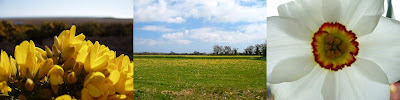
Sun yellow: gorse by the sea; dandelions in the field
Fire orange: centre of the poet's narcissus

This is why all empires are threatened by real beauty. The empire does not want to change, it wants to hold on to its power. It is terrified to experience its own ugliness, its lack of heart, its human vulnerablity. It will do anything to prevent discovery. It blocks beauty’s dangerous alchemy by mutating the natural forms of earth, by copying, grafting, manipulating its components, bringing them under the control and ownership of its corporations and then attracting the people’s attention to the tamed and tortured and hybridised. It does this by highlighting and praising the monsterish elements of life, by making the mind and emotional body dependent on end-of-the world dramas, by entertaining us with circuses and freakshows, by fostering envy and possessiveness of a “lifestyle” epitomised by grand and showy garden flowers, by young girls adorned in monster costumes. Meanwhile it does everything in its power to destroy the real thing. This is why wild flowers are mown down and poisoned, why native peoples who celebrate the beauty of the earth, such as the Maya, are so oppressed. Why the developed world appears ever more ugly and flaunts its power in ever increasing images of artifice. It is working hard to kill every shred of beauty from appearing.

While the planet, regardless, keeps pushing up more and more radical beauty each spring."

Keep weaving that rainbow!

Radical Red: geranium flower by the conservatory glass door; mossy stonecrop, the tiniest flower in England on heathland

(from 44/Lady’s Smock – 52 Flowers That Shook My World - A Radical Return to Earth)